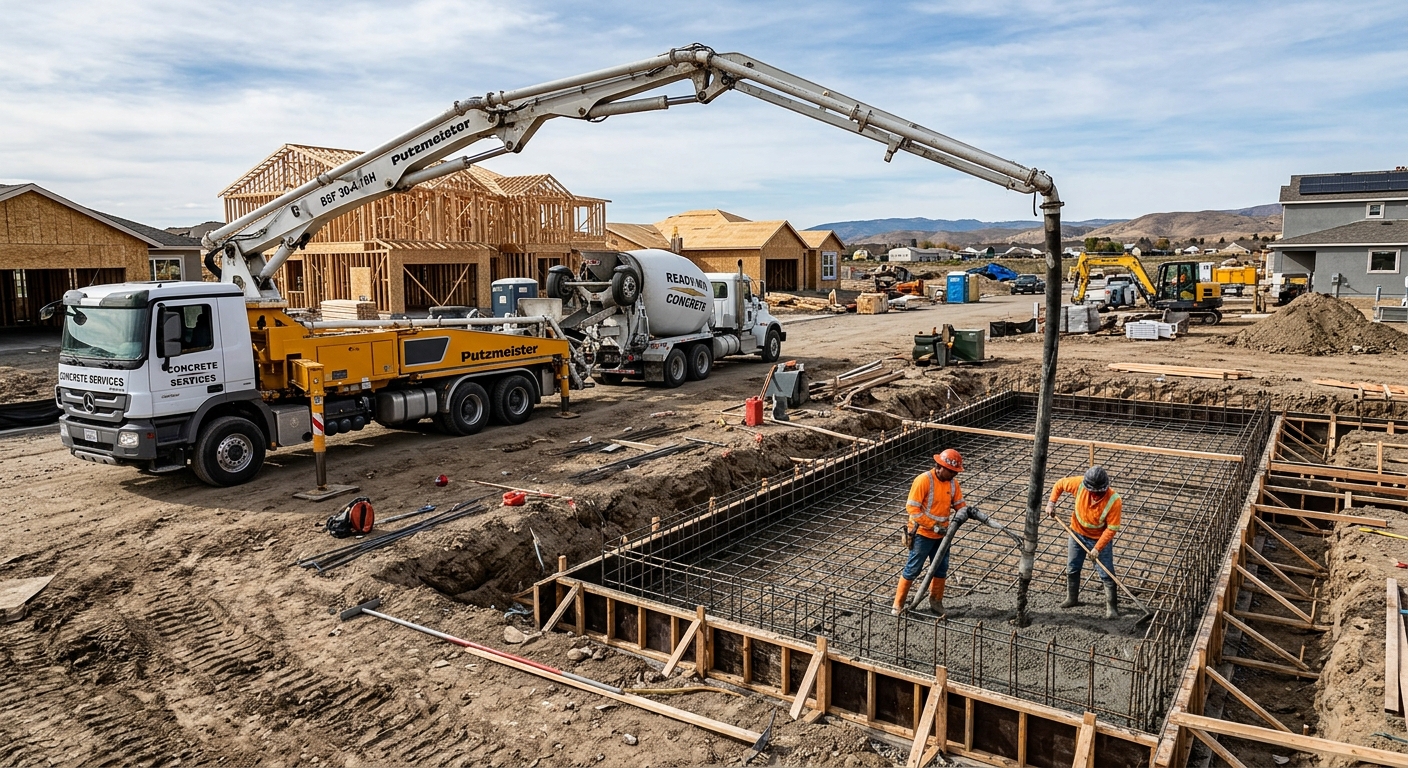
Concrete work options and costs in Hamptons
In Hamptons, Alberta, concrete is one of the most used exterior materials for driveways, patios and walkways—especially in a town of 7,360 residents (Statistics Canada, 2021 Census), where most homeowners are improving or expanding long-term family properties. Flatwork demand tends to concentrate around established residential areas where people add parking pads, backyard living spaces and accessible paths without rebuilding the whole lot. From a housing perspective, many local projects start as a “simple” pad or driveway replacement and quickly become a full base and drainage upgrade once we excavate for frost-safe subgrade.
Calgary’s cold continental climate drives pricing the same way every time: footings and exterior slabs must be engineered around deeper frost exposure and frequent freeze–thaw cycles. That means granular base prep, air-entrained concrete mixes, and control joints are not optional—they’re costed into proper jobs. In late fall or early spring, the pour season is shorter and cold-weather curing precautions (insulating blankets, heated enclosures where required) can add labour and equipment time, which impacts contractor availability and schedule certainty. For Hamptons, trade demand is especially steady in the broader NE Calgary growth corridor feel—where contractors are busy with residential infill and backyard upgrades, and crews often need to be booked ahead.
Below are practical Hamptons cost ranges you can use to compare like-for-like scopes, then we’ll dig into what changes those numbers by 30–50% across the region.
| Application |
Typical Size |
Key Spec |
Finish Option |
Price Range |
| Concrete driveway (standard broom finish) |
24 ft x 10 ft (240 sq ft) |
Air-entrained mix, compacted granular base |
Broomed, control joints |
$12,000–$18,000 |
| Exposed aggregate driveway |
24 ft x 10 ft (240 sq ft) |
Base prep + proper curing to expose aggregate evenly |
Exposed aggregate with sealer |
$13,500–$21,000 |
| Stamped concrete driveway or patio |
24 ft x 12 ft (288 sq ft) |
Air-entrained mix, release agent, weather control |
Stamp pattern + colouring |
$15,000–$26,000 |
| Plain concrete patio or walkway |
12 ft x 16 ft (192 sq ft) |
Reinforcement as needed, air-entrained mix |
Broomed or trowel-finish with joints |
$5,000–$9,000 |
| Garage floor (interior slab) |
22 ft x 20 ft (440 sq ft) |
Vapour barrier/insulation where required, reinforcement |
Light broom or trowel-finish (depending on use) |
$4,500–$9,500 |
| Foundation footings (structural, below frost) |
Typical single-detached footing plan |
Engineered excavation + concrete below design frost depth |
Structural concrete only (no decorative finish) |
$28,000–$45,000 |
Prices are estimates only and vary by project scope, site access and material selection.
What affects the price of concrete work in Hamptons
In Hamptons and across the Calgary economic region, two quotes for the “same” driveway can still land 30–50% apart because contractors aren’t pricing the same risk. Concrete pricing isn’t just about pouring; it’s about engineered excavation depth, base thickness, reinforcement decisions, mix design, curing logistics and how the crew protects the slab through cold snaps. When a job is in the shoulder season, we’re also paying for time—heat sources, insulated blankets, and extra checks so the concrete reaches the right strength before freeze conditions hit.
Most of the big swings come back to Alberta frost and freeze–thaw behaviour. Footings and structural elements must extend below the design frost depth (about 0.5–1.2 m in coastal BC, but up to 2.4 m in Alberta) to reduce frost heave and seasonal movement. For exterior slabs, air-entrained concrete is required to withstand freeze–thaw cycles without scaling and spalling. In cold weather, that becomes a curing problem: exterior concrete placed too late in the year or without proper blankets can fail surface durability even if the pour “looks fine” at day one.
Two examples I see often in Hamptons:
- A driveway replacement where the first contractor assumes “like-for-like” removal—while another quotes a deeper, frost-safe granular base. That difference alone can move a standard broom driveway from roughly the mid of the $12,000–$18,000 band toward the higher end when excavation and base rebuild are unavoidable.
- A patio or walkway that includes a proper air-entrained mix and sealing plan versus one that skips sealing. If de-icing salts reach the surface early, you’ll usually pay later—repairs can cost close to redoing the $5,000–$9,000 scope.
Finally, consider household realities: older properties often have compacted fill, drainage issues or buried footings that raise excavation time. Even a small grade correction can add labour, haul and disposal costs—so the “foundation of the foundation” is where the real budget starts.
| Price Factor |
Why It Matters |
Cost Impact |
| Frost line depth — determines footing depth and form height |
Below frost prevents movement that cracks slabs and damages foundations |
Higher excavation volume can add major concrete and labour costs |
| Site preparation — excavation, grading, compacted granular base |
Proper grade and base thickness reduce voids and settlement |
More hauling/disposal and longer timelines raise price |
| Reinforcement — rebar or wire mesh requirement |
Controls cracking under shrinkage, loads and temperature cycling |
Adds material and labour, but prevents premature failures |
| Mix design — air-entrainment and compressive strength spec |
Air content + strength target improves durability in freeze–thaw |
Higher-spec mix typically costs more per yard, but is critical |
| Finish type — broom vs. stamped vs. exposed aggregate |
Decorative work adds steps, crews and placement accuracy needs |
Stamping/aggregate can push driveways toward the top of the band |
| Pour size and concrete truck access to site |
Access limits pumping/placement efficiency and time on site |
Long hose/pump or waiting times can increase labour |
| Cold-weather curing precautions — heating and blankets |
Protects early strength gain and reduces scaling risk |
Equipment and time can add a noticeable premium in shoulder season |
| Control joint pattern and sealing cost |
Joints manage shrinkage; sealing improves resistance to salt |
Skipping them may lower upfront price but raises repair risk |
Permits & regulations in Alberta
In Alberta, structural concrete work typically needs a building permit—especially when we’re building something that carries loads or forms part of the foundation system. That includes footings, foundation walls, grade beams and any concrete related to structural support. Many projects also require engineered drawings that the municipality reviews as part of the permit process. For concrete flatwork (driveways, patios, walkways), a permit usually is not required unless the work affects lot grading, impervious surface coverage limits, drainage requirements, or the municipal right-of-way.
For Hamptons homeowners, the best approach is to confirm requirements before you sign a contract. Start with these steps:
- Ask the contractor if the scope includes any structural elements (footings/foundation walls) that require a permit.
- Request the contractor’s liability insurance certificate and verify the policy covers the type of work being performed.
- Confirm they carry WSIB/WCB coverage (coverage status and certificate number should be current).
- For job sites requiring permits, ask whether they include the permit pull and inspection scheduling in the quoted scope.
- Check references on similar-scale projects in the Calgary region, ideally with foundation or exterior slab work in winter conditions.
To verify: look for an Alberta contractor registration/licensing record online (where applicable), then review the certificate of insurance and any WCB/WSIB clearance documentation. If a contractor can’t produce current documents quickly, that’s a red flag—especially for structural work.
Getting concrete right in Hamptons's freeze-thaw climate
Concrete failure in Hamptons usually traces back to one of five issues: weak or improperly prepared base, poor air content, missing reinforcement where needed, control joints placed incorrectly, or inadequate curing protection. In a Calgary-area climate engineered around deeper frost exposure and frequent freeze–thaw cycles, the specs have to be more disciplined than in milder provinces. The goal isn’t only to finish the surface—it’s to ensure the slab survives winter wetting, de-icing salt contact and spring melt.
To spec the job correctly, focus on five points:
- Base preparation: We build a compacted granular sub-base to the required depth for local soil and frost conditions. This reduces voids and prevents settlement.
- Mix design: For exterior flatwork, ensure air-entrainment is targeted—commonly 5–7% air content—with a minimum 32 MPa compressive strength for durability.
- Control joints: Spacing should be planned so shrinkage cracking happens in the joint lines, not randomly through the field.
- Curing: Minimum 7-day curing under appropriate conditions is the baseline. In cold weather, heating or insulated blankets may be needed to avoid early freeze damage.
- Sealing: Apply a penetrating sealer after proper curing (typically around 28 days post-pour) to repel de-icing salts and water migration.
A clear example: a homeowner who chooses “plain broom” concrete might compare the $5,000–$9,000 patio band to a decorative option. If the cheaper quote omits sealing and uses a lower-spec mix, you may spend again on patching or re-surfacing. In contrast, paying for correct air-entrainment and sealing is often the difference between a patio that stays serviceable for years and one that starts scaling early.
| Spec |
Why It Matters in Hamptons |
What to Ask For |
Impact if Skipped |
| Compacted granular base (depth?) |
Reduces settlement and supports frost-resistant performance |
Specify base thickness, compaction testing approach, and drainage/grade plan |
Uneven movement, cracking and edge failure |
| Air-entrained concrete mix (target air %?) |
Helps resist freeze–thaw scaling and spalling in Alberta winters |
Ask for target air content (commonly 5–7% for exterior flatwork) and mix source |
Surface scaling, freeze-related deterioration, shortened lifespan |
| Compressive strength (MPa rating) |
Ensures strength gain for durability under winter loads |
Confirm minimum 32 MPa (or higher where engineered) and placement/curing plan |
Weak concrete, higher crack risk, premature wear |
| Control joints (spacing per ACI guidelines) |
Manages shrinkage cracking during temperature swings |
Joint spacing and layout plan (include saw-cut timing) |
Random cracking, water intrusion and faster deterioration |
| Minimum 7-day curing period |
Cold nights can slow strength gain and damage early concrete |
Ask how curing is protected; include blankets/heating when forecasts require it |
Scaling, dusting/weak surface, long-term durability issues |
| Penetrating sealer (when applied after cure) |
Repels salt and water migration that drives freeze–thaw harm |
Confirm sealer type and timing (typically after cure, around 28 days) |
Faster surface breakdown and more frequent maintenance/repairs |
How to choose a concrete work contractor in Hamptons
Choosing the right concrete contractor in Hamptons starts with proof you can verify. In Alberta, confirm the company is properly licensed for the work they’re doing, and ask for their current liability insurance certificate before the first site visit. Then verify WSIB/WCB coverage: request the certificate details and ensure the coverage is active for the project dates. If a contractor can’t provide documents quickly, it’s a poor sign for both safety and job accountability.
Next, get 2–3 itemised written quotes, not just a lump sum. You want a breakdown that shows labour, concrete supply, excavation/grading, granular base, reinforcement, forms, finishing, concrete finishing materials (if decorative), sealing, and concrete disposal. Clarify what’s excluded: permit pull, utility locates, saw-cutting, haul/disposal, and any required heat/blankets for cold-weather curing. A well-scoped quote should also list concrete thickness, joint plan, and curing/seasonal protection steps.
Warranty matters too. Ask for a workmanship warranty length and whether product/manufacturer warranties apply to sealers or decorative systems. If repairs are needed later, find out if the warranty is transferable with home sale or title changes.
Payment schedule should be conservative: never more than 10–15% upfront, with a holdback until completion and cleanup. Get the start date and completion estimate in writing, and ask what happens if forecasts push curing risk into colder nights.
- Ask for Alberta insurance and WSIB/WCB clearance documents before signing.
- Request references on similar driveway/patio sizes in the Calgary area.
- Confirm thicknesses, base prep depth, and whether compaction testing is planned.
- Get a joint layout plan (spacing and saw-cut schedule).
- Verify mix design: air-entrainment and minimum strength spec.
- Ask about curing protection for cold nights (blankets/heating plan).
- Confirm sealing type and whether it’s included (for exterior flatwork).
- Require an itemised quote: labour + materials + disposal + access/pumping.
- Check if permit pull and inspections are included when structural work is involved.
- Set a realistic timeline tied to weather and curing windows, not just “we’ll fit you in.”
- Use a written scope that states exclusions (soil removal, utility locates, grading corrections).
- Keep payment milestones tied to inspection checkpoints, not “progress” alone.
Concrete red flags I see in Hamptons: promises of “no need for air-entrainment” or vague mix specs; no written curing plan for cold weather; missing documentation for insurance/WSIB/WCB; quotes that treat disposal and base rebuild as “included” without measuring excavation; and no clear warranty terms beyond a short blanket statement.
Frequently asked questions — concrete work in Hamptons
Can concrete be poured in cold weather in Hamptons?
Yes, concrete can be placed in cold weather in Hamptons and the Calgary area, but it has to be done with a controlled curing plan. The biggest risk is early freeze before the concrete gains enough early strength—this can lead to surface scaling or reduced durability even if the slab “sets.” In practice, contractors may use winter-grade mix, insulated blankets, temporary heating, and more frequent temperature checks to protect curing. For exterior pours like driveways and patios, the timeline matters because the freeze–thaw cycles are intense here; rushing late-season work often costs more later. When budgeting, ask how winter precautions affect pricing—many jobs still fall within the $12,000–$18,000 or $5,000–$9,000 ranges, but cold-weather methods can push toward the upper end if additional labour and equipment are required.
How do I maintain concrete in Hamptons's freeze-thaw climate?
Maintenance in Alberta is mainly about protecting the surface from water and salt intrusion that drives freeze–thaw damage. Start with proper timing: make sure the slab has cured fully before heavy use, and plan for a penetrating sealer after the cure window—typically around 28 days post-pour—so de-icing salts can’t penetrate as easily. Use de-icers carefully: rock salt is common, but avoid over-salting and try calcium-magnesium blends when possible for less aggressive surface attack. In spring, keep water from pooling by maintaining grading and clearing weeping points. Watch for early signs like flaking, pop-outs, or hairline joint growth—those are often repairable before they expand. If your concrete was broom-finished for a driveway or walkway, keep in mind that proper air-entrainment and joints determine how well it holds up through winter; sealing and joint maintenance preserve that design.
What causes concrete to spall in Hamptons winters?
Spalling in Hamptons winters is usually a durability failure triggered by moisture getting into the concrete and then freezing, expanding and breaking the surface. The most common cause is inadequate air-entrainment or poor mix control, which means the freeze–thaw cycle has no internal “buffer” and the surface begins to scale and pop. Base preparation also matters: if the granular base isn’t compacted properly or drainage is wrong, the slab can flex, widening micro-cracks and giving water a path in. Cold-weather curing mistakes are another big factor—placing concrete too late without blankets/heating can weaken the surface so it can’t resist repeated wetting and freezing. De-icing salt accelerates the deterioration because it increases water migration and chemical exposure. If you’re comparing quotes for a patio or walkway around the $5,000–$9,000 band, make sure the lower price isn’t coming from skipped air-entrainment, rushed curing, or no sealing plan.
What is rebar and when is it required in Alberta?
Rebar is reinforcing steel bars embedded in concrete to control cracking and improve load-bearing performance. Whether it’s required depends on the slab thickness, soil conditions, whether the slab is interior or exterior, and how the design handles loads. For exterior flatwork like driveways, garages, and some walkways in Alberta, reinforcement may be required where engineered drawings specify it—or where the risk of cracking is higher because of wider spans, heavier vehicle loads, or less stable subgrade. In practice, contractors decide based on design requirements, slab thickness, and the overall frost-safe base setup. For foundation footings and structural elements below frost depth, reinforcement is commonly engineered and tied into the design. If you’re budgeting for a foundation, the $28,000–$45,000 band typically reflects engineered excavation, structural concrete, and reinforcement decisions that can’t be simplified.
How long does a concrete project take in Hamptons?
Project duration in Hamptons depends on the scope and—most importantly—curing and weather conditions. A small patio or walkway can often be completed faster on site, but you still need time for excavation/base prep, forms (if required), placement, finishing, and curing protection. Decorative work like stamped concrete or exposed aggregate adds time for careful placement, pattern work and colour or exposure steps. For driveways, factor in truck scheduling, base prep, reinforcement placement, and saw-cutting control joints within the right timing window. Even if the “pour day” is short, you should plan for weather delays. Most homeowners can see completion on a worksite in days, but readiness for full loading can be longer. If cold weather placement is necessary, insulating blankets/heating may add days and logistics. When comparing quotes, ask for a written timeline and how long the contractor plans to protect curing—this is where Calgary-area schedules often differ.
What is a concrete overlay and is it suited to Hamptons?
A concrete overlay is a new concrete layer placed over an existing slab to improve appearance and add surface thickness without full removal. Overlays can be a fit in Hamptons when the underlying concrete is still structurally sound (no major settlement, deep spalling, or widespread failure) and the surface preparation is done correctly—usually including grinding, cleaning, bonding steps and assessment of adhesion potential. Overlays are less suitable when the base has moved or the original slab is already failing due to freeze–thaw damage, because the new layer can’t correct structural issues. In this climate, moisture and salt are persistent, so durability depends on good bonding and the same durability principles (air content, proper curing and sealing). If you’re comparing options, remember that overlays can be cheaper than full replacement in some cases, but if your driveway is at risk of spalling, full re-pour within the $12,000–$18,000 range may be the longer-term option. A contractor should evaluate the slab and tell you whether overlay is truly appropriate.