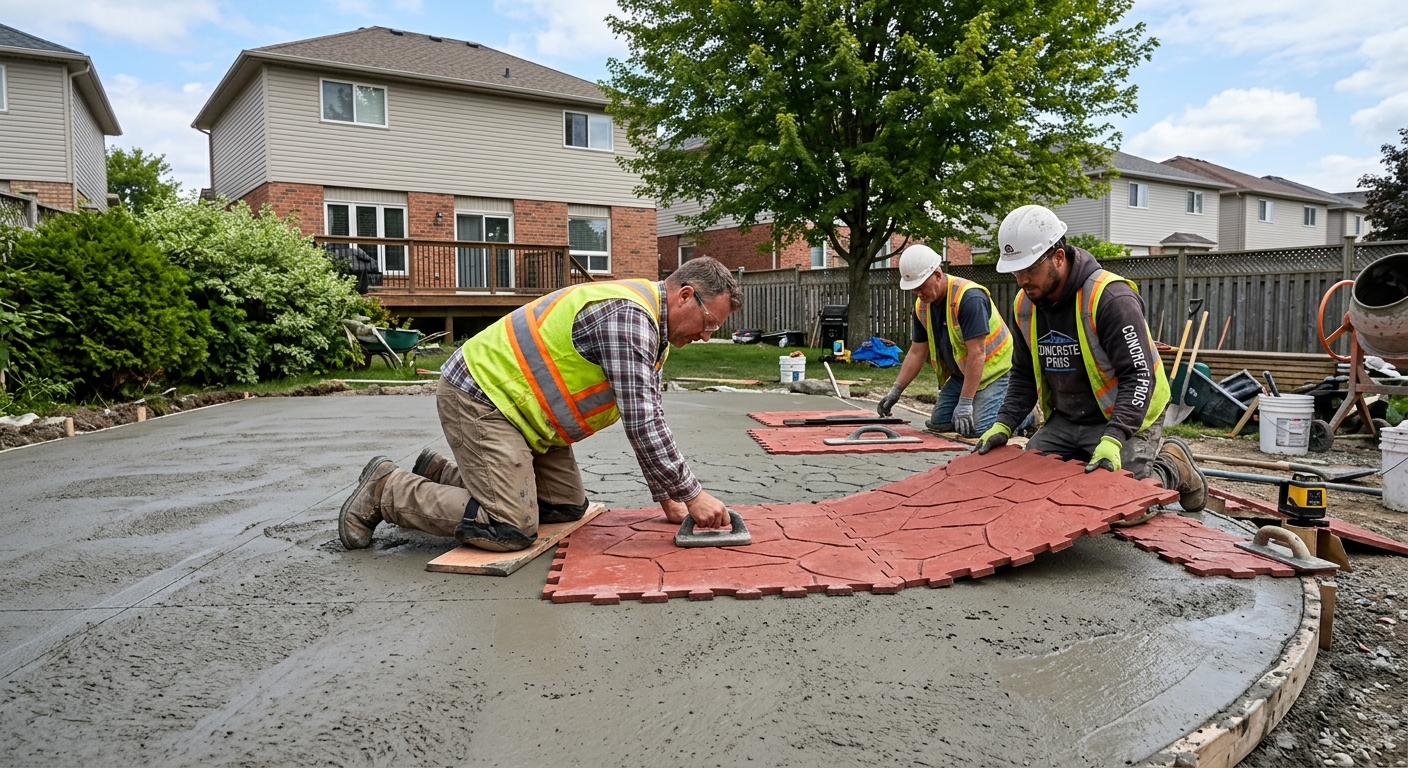
Concrete work options and costs in La Crête
La Crête, Alberta is a small community where concrete flatwork gets tested every winter—especially through rapid freeze–thaw cycles. With a population of 2,911 (Statistics Canada, 2021 Census), there’s enough local demand to keep crews busy, but you still want to book early for exterior pours. Most concrete driveway, patio, and walkway work is tied to the area’s housing stock and ongoing property improvements, and in turn that affects lead times and pricing on truck availability.
In the Calgary economic region, concrete costs are engineered around a deeper frost design than in milder parts of Canada. Practically, that means excavation and foundation volumes can be higher, and exterior slabs must be built with air-entrained mixes, proper base prep, and disciplined curing. Calgary-area supply and labour are also sensitive to seasonal schedules: the practical pour window is shorter in late fall and spring, so contractors may carry additional overhead for cold-weather placement (insulation blankets, temporary heat, and scheduling around curing temperatures). In La Crête, this trade tends to be especially in demand around residential pockets where people are expanding driveways and updating sidewalks leading to garages.
The result is that two homes with “similar” concrete can still come in far apart depending on frost-bearing requirements, granular base depth, reinforcement, and finish upgrades. Below is a practical comparison to help you understand typical scope and what commonly drives the numbers, before you move to itemized quotes.
| Application |
Typical Size |
Key Spec |
Finish Option |
Price Range |
| Concrete driveway (standard broom finish) |
24 ft x 10 ft (240 sq. ft.) |
Air-entrained exterior mix, compacted granular base |
Broom finish + control joints |
$12,000–$18,000 |
| Exposed aggregate driveway |
24 ft x 10 ft (240 sq. ft.) |
Air-entrained mix, dressed aggregate top layer |
Exposed aggregate (stamped look not included) |
$15,000–$21,000 |
| Stamped concrete driveway or patio |
20 ft x 12 ft (240 sq. ft.) |
Air-entrained exterior mix, release agent + stamping |
Stamped pattern + integral or topical colour |
$15,000–$26,000 |
| Plain concrete patio or walkway |
10 ft x 12 ft (120 sq. ft.) |
Air-entrained mix, proper slope and base |
Steel trowel or broom texture + joints |
$5,000–$9,000 |
| Garage floor (interior slab) |
20 ft x 20 ft (400 sq. ft.) |
Interior mix, vapour/thermal considerations if applicable |
Steel trowel (light broom option for grip) |
$7,000–$14,000 |
| Foundation footings (structural, below frost) |
Typical house footprint (engineered) |
Excavation to frost-bearing depth, rebar/footing steel per engineer |
Structural concrete + proper inspection hold points |
$28,000–$45,000 |
Prices are estimates only and vary by project scope, site access and material selection.
What affects the price of concrete work in La Crête
In La Crête and the wider Calgary area, it’s common to see quotes for the “same” concrete project vary by 30–50%. The biggest reasons are the hidden items: frost depth-related excavation, how much granular base is installed (and how well it’s compacted), whether reinforcement is required for the site conditions, and the contractor’s cold-weather curing approach during scheduling pinch points.
Here, concrete is engineered around freeze–thaw. Footings and foundation elements must bear below the design frost depth to reduce frost heave risk; in Alberta this is often up to about 2.4 m depending on the site and engineered requirements. Exterior slabs and driveways also need air-entrained concrete mixes to survive repeated cycles, plus control joints that limit random cracking. Because the pour season is shorter and shoulder-season temperatures can drop fast, crews may need winter-grade practices—insulated blankets, controlled curing, and sometimes temporary heating—to hit strength and durability targets. Lastly, de-icing salts accelerate spalling if the mix, air content, and sealing aren’t right, so sealing becomes an important part of the long-term cost picture.
In La Crête specifically, a driveway on clay-heavy soils or a sloped approach often costs more due to deeper stripping and extra base. By contrast, a simple patio replacement on firm, well-drained subgrade with easy truck access can fall closer to the $5,000–$9,000 band. If you add stamping, you’ll usually pay closer to the $15,000–$26,000 band, but that cost is often justified when you’re also upgrading drainage and jointing so the finish lasts through winters, not just through installation day.
| Price Factor |
Why It Matters |
Cost Impact |
| Frost line depth |
Determines footing depth and form height |
Higher excavation and concrete volume; can swing structural costs materially |
| Site preparation |
Excavation, grading, compacted granular base |
More stripping and base material increases labour, truck trips, and disposal |
| Reinforcement |
Rebar or wire mesh requirement |
Adds steel, chairs/dowels, and labour for correct placement |
| Mix design |
Air-entrainment and compressive strength spec |
Air-entrained, higher-spec mix can cost more but improves durability in freeze–thaw |
| Finish type |
Broom vs. stamped vs. exposed aggregate |
Stamping/exposed aggregate increases labour time and material handling |
| Pour size and concrete truck access to site |
Impacts scheduling and how concrete is placed |
Long carries or limited access may require additional equipment or smaller pours |
| Cold-weather curing precautions |
Heating and blankets |
Winter-grade procedures add labour hours and energy/material costs |
| Control joint pattern and sealing cost |
Controls cracking and protects from de-icing salts |
Proper jointing/sealing reduces maintenance; sealing is a non-trivial add-on |
Permits & regulations in Alberta
In Alberta, structural concrete work typically requires a building permit because it’s part of the load-bearing system. That includes foundation footings, foundation walls, grade beams, and other engineered components that affect the stability of the home or accessory structure. Municipal review often expects engineered drawings and inspections at key hold points, because frost protection and reinforcement detailing are safety-critical.
Concrete flatwork like patios, walkways, and driveways usually does not require a permit by default. However, you should expect a permit or at least approval conditions if your project changes lot grading, impacts stormwater drainage, or affects impervious surface coverage or municipal right-of-way. In practice around La Crête, the best approach is to confirm requirements with your municipality before excavation—especially if you’re tying into existing sidewalks or changing how water drains off the property.
Before the contractor starts, verify they carry liability insurance and WSIB/WCB coverage where applicable. Then ask for references on similar-scale projects with frost-bearing work or exterior slabs. To check credentials as a homeowner: (1) look up the contractor’s registration/licence status through provincial online resources, (2) request an up-to-date certificate of insurance and confirm it matches the legal business name, and (3) ask for proof of WSIB/WCB clearance (or equivalent coverage documentation) and confirm dates are current. A reputable contractor won’t mind walking you through these documents before scheduling the pour.
Getting concrete right in La Crête's freeze-thaw climate
In La Crête’s cold continental climate, concrete failures usually come back to three issues: inadequate base preparation, incorrect mix design for freeze–thaw, and rushed curing. When the foundation or slab moves—even a little—water gets behind or under the concrete, then expands during freeze cycles. That combination can lead to cracking, settlement, and, most visibly, spalling or scaling on exterior surfaces where de-icing salts are used.
To spec the job correctly, focus on five things. First, base preparation: install a compacted granular sub-base to the right thickness and depth for the local soil conditions and frost considerations. Second, mix design: for exterior flatwork, require air-entrainment (commonly 5–7% air for many exterior mixes, verified by the supplier’s submittals) and a minimum 32 MPa compressive strength target for durability. Third, control joints: add them at a spacing that limits random cracking and match your layout plan so joints align with stress points. Fourth, curing: plan for at least 7 days of proper curing conditions; in cold weather, curing protection (blankets/heating as needed) is not optional if you want the slab to reach strength safely. Fifth, sealing: apply a penetrating sealer about 28 days after the pour (after it’s cured) to help repel de-icing salts and water.
Here’s where the price difference makes sense: if you’re choosing between a basic broom-finish driveway and a premium exterior durability package, paying toward the lower end of the $12,000–$18,000 range with the correct air content, base depth, and curing protection often costs less over 5–10 years than trying to “save” by skipping blankets or sealing. The durability spec is what helps prevent spalling, not the name of the finish.
| Spec |
Why It Matters in La Crête |
What to Ask For |
Impact if Skipped |
| Compacted granular base (depth?) |
Reduces movement during frost cycles |
Confirm base depth and compaction requirements for your soil |
Settlement, cracking, and uneven slopes toward drainage issues |
| Air-entrained concrete mix (target air %?) |
Protects against freeze–thaw damage and surface scaling |
Ask for verified air content (often 5–7% for exterior flatwork) |
Higher risk of spalling and scaling, especially where salts are used |
| Compressive strength (MPa rating) |
Ensures strength gain for durability and reduced surface wear |
Require minimum 32 MPa at specified curing/age |
Surface wear, reduced longevity, and performance below expectations |
| Control joints (spacing per ACI guidelines) |
Limits random cracking and controls where cracks occur |
Request a joint layout with spacing and cut depth plan |
Random cracking patterns and wider maintenance costs |
| Minimum 7-day curing period |
Cold-weather placement needs enough time for strength gain |
Ask how curing will be protected if temps drop |
Scaling, weak surface, and early deterioration |
| Penetrating sealer (when applied after cure) |
Repels water and reduces de-icer salt exposure effects |
Confirm sealer type and that application is around 28 days post-pour |
Faster salt-related damage and more frequent rework |
How to choose a concrete work contractor in La Crête
Start by verifying the contractor’s Alberta credentials and coverage. For licensing/registration, use the province’s public online resources to confirm the business is active and matches the name on the quote and invoice. Next, ask for a current certificate of insurance showing liability coverage; the certificate should list your property address or at least the correct insured entity. For WSIB/WCB: request proof of clearance or coverage documentation before work begins and confirm the dates are current—especially if crews include subcontractors. In Alberta, doing this upfront is the fastest way to avoid problems if something goes wrong during excavation or forming.
Then get 2–3 itemised written quotes, not just a single “lump sum.” Ask for a labour and materials breakdown that clearly includes excavation/base prep, reinforcement, concrete supply (mix design), finishing, joints, curing protection, and disposal. Check the scope carefully: are forms and removal included? Is hauling/disposal included if they remove excess soil? Is permit work included where required for structural concrete? What’s excluded (e.g., electrical saw cutting later, grading adjustments, or landscaping restoration)?
Warranty matters too. Ask for a workmanship warranty length and whether it covers cracking beyond normal shrinkage, as well as whether product/manufacturer warranties apply to sealers or specialty concrete. Confirm whether warranties are transferable if you sell the property. Keep payment schedules tight: never pay more than 10–15% upfront, and hold back until substantial completion and final walkthrough. Also get the start date and completion estimate in writing so you’re not left waiting during the short pour season.
- Confirm Alberta registration/licensing matches the contract name on your quote.
- Request a certificate of insurance and verify coverage is current.
- Get proof of WSIB/WCB clearance or equivalent coverage documentation.
- Ask for at least two references on similar exterior slab work in Alberta winter conditions.
- Require itemised quotes (excavation/base, concrete mix, reinforcement, finishing, joints, curing protection, sealing).
- Ensure the quote states air-entrainment and a minimum strength spec (e.g., 32 MPa).
- Check that control joint spacing and sealing responsibilities are clearly listed.
- Ask how they handle cold-weather curing (blankets/heating) if temperatures drop.
- Confirm reinforcement placement details (chairs/dowels) and whether it’s required for your slab design.
- Verify truck access plans and whether any spotter/equipment is included for safe placement.
- Ask what restoration is included (topsoil, sod patching, grading, removal of forms/leftover material).
- Use a payment schedule that keeps holdback until final inspection—avoid large upfront payments.
Concrete contractor red flags in La Crête: they won’t discuss air-entrainment or curing, they provide only lump-sum numbers without base depth/joint/sealer scope, they push for large upfront payments, they avoid written timelines, or they dismiss frost-driven requirements as “not a big deal.”
Frequently asked questions — concrete work in La Crête
What causes concrete to spall in La Crête winters?
In La Crête, spalling (surface flaking/peeling) is most often tied to freeze–thaw damage combined with de-icing salt exposure. If the concrete mix doesn’t have proper air-entrainment, water that enters the surface pores can freeze and expand, breaking the surface paste. Spalling risk increases when base prep is weak and the slab flexes, because tiny movements let water pool and infiltrate more readily. Cold-weather placement matters as well: if curing is rushed or protection isn’t used when temperatures drop, strength gain and durability can suffer. Finally, finishing choices and joint discipline affect how water gets managed. A good exterior driveway in Alberta typically lands in the $12,000–$18,000 range, but the durability comes from the specs (air content, curing, base, and sealing), not just the broom finish.
What is rebar and when is it required in Alberta?
Rebar is steel reinforcing bar embedded in concrete to improve strength in tension and to control cracking. In Alberta, when reinforcement is required depends on the engineered design (soil conditions, slab thickness, loading, and frost considerations). For structural concrete—like footings, foundation walls, and grade beams—reinforcement is commonly specified by an engineer and reviewed through the building permit process. For exterior flatwork such as driveways and patios, rebar or mesh may be used depending on slab thickness, whether the area is expected to carry heavier loads, and how the base is prepared. A contractor should explain why reinforcement is needed and show it on the plan, not just “offer it.” If you’re building foundation footings below frost depth, plan for foundation pricing in the $28,000–$45,000 band because the scope is engineered and inspection-based.
How long does a concrete project take in La Crête?
Timeline in La Crête depends on the type of pour and the weather window for curing. A small walkway or patio can move quickly—often a few days from layout to finishing—but curing still governs when you can apply heavier use. Exterior projects also depend on cold-weather requirements: during freezes, contractors may need insulated blankets and/or temporary heat to protect curing, which can add time to scheduling. Driveways typically take longer because excavation, forming, base compaction, reinforcement placement, and slab finishing are all sequential. For structural work like footings, the timeline stretches because you need inspections at hold points before subsequent pours. In the practical Calgary region schedule, exterior slab pours are often planned carefully to avoid late fall or early spring setbacks. Your best estimate comes from an itemised schedule in your written quote, tied to temperatures and curing protection for your specific date.
What is a concrete overlay and is it suited to La Crête?
A concrete overlay is a new layer of concrete (or sometimes a polymer-modified topping system) placed over an existing slab, typically to restore surface appearance and levelness without full removal. In La Crête and the Calgary region, overlays can work when the existing slab is stable—no ongoing settlement, no major structural cracking, and the surface is prepared properly (cleaning, profiling, and bonding method). If the original slab is already moving due to inadequate base or frost-related heave, an overlay can crack again because it won’t fix the root movement. For durability, you still need an exterior-appropriate mix design and joint detailing that matches how the slab behaves in freeze–thaw. If your slab only needs cosmetic refresh, a well-prepared overlay may reduce cost and time compared with full replacement; however, if there’s structural failure, removal is usually the right path for long-term performance in Alberta winters.
How do I seal concrete to protect it in La Crête?
Sealing helps protect against water and reduces the impact of de-icing salts, which is crucial in La Crête winters. The key is timing: let the slab cure first, typically applying a penetrating sealer about 28 days after the pour (assuming proper curing conditions). Penetrating sealers soak into the concrete pores rather than forming a film on top, and they’re commonly used for exterior surfaces where you want water resistance while allowing moisture movement. Preparation matters too—clean off dirt and construction residue, and make sure the surface is dry and ready to accept the sealer. Ask your contractor to specify the sealer type and coverage rate, and whether any reseal interval is recommended for Calgary-area exposure. If you’re budgeting a driveway or patio, sealing is often part of protecting a long-lived finish in the $5,000–$9,000 patio/walkway range or the broader $12,000–$18,000 driveway band.
What is the difference between concrete and cement?
Concrete is the full building material—the mix placed and cured on site. Cement is one ingredient inside concrete, acting as the binder that hardens and helps the mix gain strength. A typical concrete mix includes cement, water, coarse and fine aggregates (gravel and sand), and often admixtures such as air-entrainment for durability in freeze–thaw climates like Alberta’s. That air-entrainment is a big reason concrete performs better through winters in the Calgary region. In practical terms, when contractors quote your driveway, patio, or structural footings, they’re specifying the concrete mix design: air content, strength target (often minimum 32 MPa for exterior flatwork), and curing approach. Cement alone doesn’t tell you how the concrete will behave; the complete concrete specification is what protects against spalling, scaling, and cracking in La Crête.