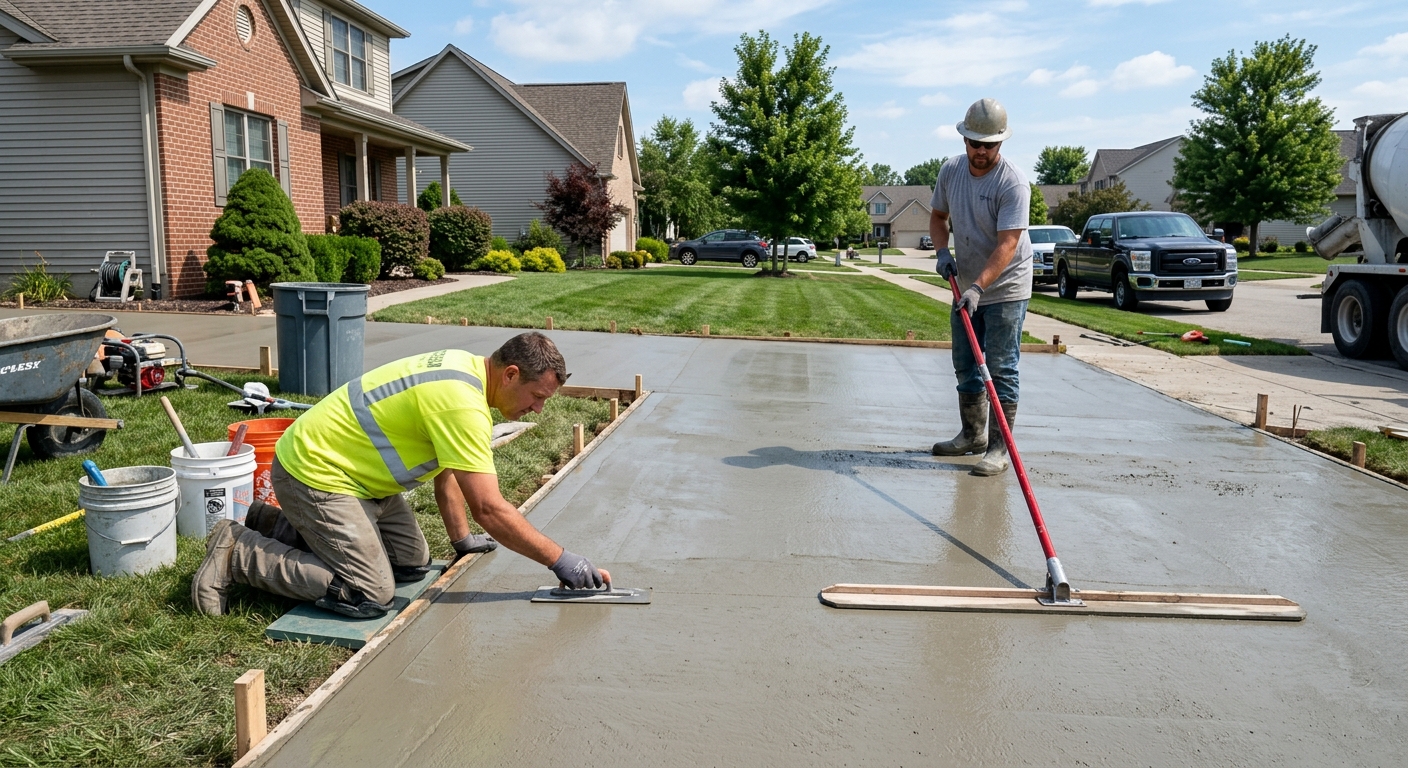
Concrete work options and costs in Mill Woods Town Centre
In Mill Woods Town Centre, Alberta, homeowners typically choose concrete for driveways, patios, walkways and foundations because it holds up well—when it’s engineered for Calgary-area freeze–thaw cycles. With a residential population of 1,247 (Statistics Canada, 2021 Census), the neighbourhood mix is small but steady, and concrete flatwork demand stays high where families are maintaining older properties or adding features like new garage slabs. In practical terms, many of the jobs we see are for homes in and around Mill Woods (east side) where access for concrete trucks and the need for proper base preparation are constant themes.
Calgary’s climate shapes the cost more than people expect: the design frost depth is about 1.2 m (roughly 4 ft), so exterior footings for houses, garages, decks and retaining structures must bear below undisturbed soil at that depth to avoid frost heave. Frequent freeze–thaw cycles also drive requirements for air-entrained mixes and good control joint planning on slabs to reduce cracking and surface scaling. On top of that, the pour season for exterior work is shorter, and cold-weather placement may require winter-grade mixes, insulated blankets and sometimes temporary heat—costs that show up in quotes.
Availability matters too: during peak spring and early summer, crews and finishing time get booked quickly, and that can affect labour rates and scheduling. Use the ranges below as a realistic starting point for comparing bids for Mill Woods Town Centre, then jump to the next section to understand what pushes any one quote above another.
| Application |
Typical Size |
Key Spec |
Finish Option |
Price Range |
| Concrete driveway (standard broom finish) |
18 ft x 10 ft (180 sq. ft.) |
Air-entrained mix for exterior; granular base; control joints |
Broom finish |
$12,000–$18,000 |
| Exposed aggregate driveway |
18 ft x 10 ft (180 sq. ft.) |
Air-entrained mix; proper retarder/cleaning process; jointing planned |
Exposed aggregate |
$15,500–$21,500 |
| Stamped concrete driveway or patio |
16 ft x 12 ft (192 sq. ft.) |
Air-entrained mix; integral colour; base compacted to spec |
Stamped patterns |
$15,000–$26,000 |
| Plain concrete patio or walkway |
12 ft x 12 ft (144 sq. ft.) |
Air-entrained exterior mix; compacted granular base |
Plain (broom edge) or light broom |
$5,000–$9,000 |
| Garage floor (interior slab) |
22 ft x 20 ft (440 sq. ft.) |
Vapour barrier under slab; fibre or mesh; proper thickness |
Plain float with saw cuts |
$9,500–$15,500 |
| Foundation footings (structural, below frost) |
Typical house/garage footing system (project dependent) |
Engineered design; excavation to frost depth; reinforced footings |
Structural concrete (uncoated) |
$28,000–$45,000 |
Prices are estimates only and vary by project scope, site access and material selection.
What affects the price of concrete work in Mill Woods Town Centre
In Mill Woods Town Centre, two quotes for the “same” concrete job can realistically diverge by 30–50% across Calgary and Alberta because what’s included (and what’s engineered) isn’t always the same. One contractor may price off the slab surface only, while another prices excavation depth, granular base, reinforcement, mix design and cold-weather precautions that are essential in this climate. Calgary-area labour and equipment timing also play a role: during spring start-ups, crew availability and scheduling can tighten, and that changes the labour component.
Frost and freeze–thaw dictate every key spec here. Footings for houses, garages and retaining structures must extend below the design frost depth of about 1.2 m (roughly 4 ft). Exterior slabs require air-entrained concrete to survive repeated freeze–thaw cycles, and the practical pour season is shorter—so in late fall or early spring, cold-weather curing precautions (heating, insulated blankets, staged protection) can add significant cost. Salt used for de-icing also accelerates surface spalling if the mix and curing aren’t right, which is why sealing is often recommended.
In this neighbourhood, costs rise when there’s poor access for a concrete truck or when excavation encounters deeper unsuitable soils—both increase haul and disposal. Costs can come down when you’re replacing like-for-like sizes with straightforward grading and good vehicle access. For example, moving from plain exterior slabs toward decorative options can be justified: a basic driveway is commonly in the $12,000–$18,000 band, while stamped concrete projects often land in the $15,000–$26,000 band because of integral colour, stamping labour and additional finishing control.
| Price Factor |
Why It Matters |
Cost Impact |
| Frost line depth — determines footing depth and form height |
Footings must bear below design frost to prevent heave and seasonal movement |
Excavation and formwork volume can drive major changes between bids |
| Site preparation — excavation, grading, compacted granular base |
Proper base prevents settlement and reduces cracking and drainage issues |
More removal/replacement of poor soil increases truck time and disposal |
| Reinforcement — rebar or wire mesh requirement |
Reinforcement helps control cracking and supports loads |
Material cost and labour for placing chairs/ties can add noticeable expense |
| Mix design — air-entrainment and compressive strength spec |
Exterior freeze–thaw durability depends on air-entrainment and proper strength |
Higher-spec mixes cost more and require better placement timing |
| Finish type — broom vs. stamped vs. exposed aggregate |
Decorative finishes require extra steps and tighter timing |
Stamped/exposed work typically moves projects into higher bands |
| Pour size and concrete truck access to site |
Smaller access zones increase labour handling and pumping/extra equipment |
Longer pour logistics and additional materials for access/controls |
| Cold-weather curing precautions — heating and blankets |
Cold placement without curing protection raises scaling and durability risk |
Blankets, heaters, and labour can add a meaningful premium |
| Control joint pattern and sealing cost |
Jointing controls where cracks occur; sealing helps repel de-icing salts |
Professional joint layout and sealer add cost, but reduce long-term damage |
Permits & regulations in Alberta
In Alberta, concrete isn’t “one-size-fits-all” for permits. Structural concrete work—such as foundation footings, foundation walls, grade beams, and other elements that carry a building’s load—typically needs a building permit and often engineered drawings reviewed through the applicable process. For concrete flatwork (driveways, patios and walkways), permits are commonly not required on their own, unless the work affects lot grading, impacts impervious surface coverage limits, drainage requirements, or involves work close to a municipal right-of-way. Because these details can vary by lot and how the work ties into drainage, always confirm before breaking ground with the local authority.
For homeowner due diligence in Mill Woods Town Centre, start with documentation. Step one: ask the contractor for their liability insurance certificate of insurance showing the correct project address and coverage. Step two: confirm they carry WSIB/WCB coverage (or a valid exemption where applicable) and that coverage is active for the time of work. Step three: verify contractor eligibility using Alberta’s licensing/registry resources where relevant to their contracting category, then request references for similar-scale projects completed in Calgary-area winter conditions. Step four: check that any permit/engineering needs are addressed in the written scope—who pulls the permit, who schedules inspections, and what the engineered drawings are based on.
If a contractor avoids naming what needs permitting (or can’t show proof of insurance and coverage), treat it as a red flag and get a second quote.
Getting concrete right in Mill Woods Town Centre's freeze-thaw climate
Concrete failures in Mill Woods Town Centre usually come back to five things: base issues, mix quality, jointing, curing, and surface durability. In a Calgary-area freeze–thaw climate, water that enters the surface or sits under a slab expands during freezing. That’s why the base must be compacted granular sub-base to the correct depth for local soils and the frost-protection strategy—not just “whatever fits.” Next, specify an air-entrained exterior mix (typically 5–7% air content for exterior flatwork) and a minimum 32 MPa compressive strength so the concrete resists scaling and spalling.
Control joints are where good workmanship shows. Plan saw-cut or formed joints so cracks relieve stress in predictable locations, not randomly through the driveway or patio. Then curing matters: in this region, minimum 7-day curing under proper conditions is critical, and in cold weather you may need winter-grade protection (insulated blankets and, in some cases, temporary heat) to avoid early strength loss. Finally, sealing should be applied after the cure (commonly around 28 days post-pour) to help repel de-icing salts and reduce surface deterioration.
Ask technical questions like: “What frost strategy are you using for excavation depth and base thickness?” and “Is your mix documented for air-entrainment, and what curing protection will you use if temperatures drop?” A dollar example helps you decide: paying for air-entrainment and proper curing might add a few hundred to about $1,000–$2,000 on a typical exterior slab, but it can prevent premature spalling that forces costly repairs long before a normal service life.
| Spec |
Why It Matters in Mill Woods Town Centre |
What to Ask For |
Impact if Skipped |
| Compacted granular base (depth?) |
Prevents settlement and reduces frost-related movement under exterior flatwork |
Base depth and compaction method tied to local soil and drainage |
Higher risk of unevenness, cracking, and premature failure |
| Air-entrained concrete mix (target air %?) |
Freeze–thaw durability depends on microscopic air bubbles for expansion space |
Documented air content (typically 5–7% for exterior flatwork) |
Spalling and surface scaling within a shorter timeframe |
| Compressive strength (MPa rating) |
Controls overall durability and resistance to loads over cycles |
Minimum 32 MPa compressive strength (and timing for strength gain) |
Soft surface, faster wear, and cracking under traffic |
| Control joints (spacing per ACI guidelines) |
Limits random cracking by controlling stress points |
Proposed joint spacing and saw-cut timing |
Random wide cracks and difficult-to-repair damage |
| Minimum 7-day curing period |
Cold climates need time to build strength before exposure to freeze conditions |
Protection plan (blankets/heating) during curing if temps drop |
Reduced strength and higher scaling risk |
| Penetrating sealer (when applied after cure) |
Salt and moisture exposure accelerate surface deterioration without protection |
Penetrating sealer applied after cure (commonly around 28 days) |
Faster surface breakdown, staining, and increased maintenance |
How to choose a concrete work contractor in Mill Woods Town Centre
Choosing the right concrete contractor in Mill Woods Town Centre starts with verification, not promises. In Alberta, confirm their liability insurance certificate of insurance (valid for the project period and naming your property appropriately) and make sure they have active WSIB/WCB coverage for their workers. How to check: request the certificates directly, verify dates and coverage limits, and ensure the paperwork matches the company name you’re contracting with. Don’t rely on screenshots you can’t cross-check—ask for official documentation.
Next, get 2–3 itemised written quotes. You want a breakdown that separates labour, concrete supply, reinforcement, excavation/grading, and finishing/curing materials. Ask what’s excluded: demolition, hauling/disposal, geotextile, pumping, permit handling (if required), and any traffic-control needs. For warranty, look for a workmanship warranty length (often tied to curing and installation), and ask whether any product/manufacturer warranties transfer to you for materials used. Payment schedule matters: never pay more than 10–15% upfront, and hold back funds until completion and cleanup are done to a documented standard.
Finally, timeline and communication: get a written start date/target window and an estimated completion date, plus what happens if weather interferes—particularly important in Calgary’s cold snaps. A contractor should be able to explain their cold-weather approach, including blankets or heat, rather than treating winter as “business as usual.”
- Request proof of liability insurance and verify it matches the project address and dates.
- Confirm WSIB/WCB coverage is active for the duration of your job.
- Ask for Alberta contracting/license details relevant to their work category.
- Get 2–3 itemised quotes with line-by-line labour and materials (not a single lump sum).
- Clarify demolition, hauling and disposal—what’s included and what’s extra.
- Confirm base preparation scope: excavation depth, granular base type, and compaction requirements.
- Ask what reinforcement is included (mesh vs rebar, chairs/ties, and placement).
- Require exterior air-entrainment documentation and confirm target specifications.
- Ask about joint pattern: spacing and saw-cut or formed joint timing.
- Get the curing plan in writing, including cold-weather measures if temperatures drop.
- Confirm sealing options and timing (typically after full cure) for driveways/patios exposed to salt.
- Review warranty terms in plain language, including who responds and for how long.
Red flags we see with concrete contractors in Mill Woods Town Centre include: no written curing plan for cold nights, vague specs like “standard concrete” without air-entrainment targets, skipping reinforcement details, jointing done too late (or at random spacing), and pressure to pay large deposits upfront before base prep and forms are complete.
Frequently asked questions — concrete work in Mill Woods Town Centre
How much does concrete work cost in Mill Woods Town Centre?
Concrete pricing in Mill Woods Town Centre depends on scope, access, and how much engineering and cold-weather protection your job needs. For example, a typical concrete driveway (around 180 sq. ft.) often lands in the $12,000–$18,000 range when base preparation and exterior air-entrained specifications are included. Plain patios and walkways commonly fall in the $5,000–$9,000 band depending on size and site conditions. When you add decorative work—like stamped concrete—you should expect to budget closer to $15,000–$26,000. Calgary-area freeze–thaw cycles can also increase costs if winter protection (insulated blankets/heating) is required to protect curing quality.
How deep must footings be for Mill Woods Town Centre's frost line?
For Alberta foundation work around Mill Woods Town Centre, footings are typically designed to bear below the design frost depth to prevent frost heave. In Calgary and the surrounding region, engineering practice uses a design frost depth of about 1.2 m (roughly 4 ft), which means excavation and footing bearing should be taken down to undisturbed soil below that depth. Your exact footing depth and size still depend on geotechnical conditions and the engineered foundation design for your specific house or garage. If a contractor proposes shallower excavation “to save cost,” that’s usually not the right place to cut corners—frost movement can create long-term settlement or cracking. Always ask for the engineered drawings used for your permit.
Why does concrete crack in Mill Woods Town Centre and how is it prevented?
Concrete cracks for predictable reasons in Mill Woods Town Centre: shrinkage during curing, thermal movement, and stress from sub-base settlement. In Calgary’s freeze–thaw climate, moisture movement adds pressure too—especially when water can enter poorly jointed or unsealed surfaces. The most reliable prevention is engineered base prep (proper granular depth and compaction), an exterior air-entrained mix, and a control joint pattern that directs where cracks occur. Good finishing and timely saw cutting are key. Finally, curing quality matters: rushing curing in late fall/early spring can reduce strength and increase scaling risk. A well-planned driveway or patio usually isn’t “crack-free,” but it should be crack-predictable and still durable.
Stamped vs broom-finish concrete — cost difference?
The cost difference between stamped and broom-finish concrete is mostly labour and timing. Broom-finish concrete is straightforward: it’s screeded, floated, finished and broom-textured. That keeps many driveway budgets in the $12,000–$18,000 band for typical sizes in Mill Woods Town Centre when base prep and exterior specifications are included. Stamped concrete adds integral colour (or surface colour), release agents, careful stamp placement, and extra finishing steps to maintain crisp edges—plus more attention to curing protection to prevent surface defects. Because of those added steps, stamped driveway or patio projects often land in the $15,000–$26,000 range depending on area and pattern complexity. If you’re comparing quotes, make sure both include the same base and air-entrainment requirements.
When is the best time to pour concrete in Mill Woods Town Centre?
In Mill Woods Town Centre, the “best time” is when temperatures allow normal curing without extensive winter protection. Practically, late spring through early fall tends to be easiest because concrete can cure without needing as much heating or insulated blanket coverage. That said, Calgary-area contractors routinely place concrete in shoulder seasons when there’s a plan: winter-grade mixes, proper form/curing protection, and protection until early strength is achieved. The key risk is rushing curing in cold weather, which can lead to scaling and durability problems over time—especially on exterior flatwork exposed to de-icing salts. Ask the contractor what their cold-weather plan is, including blankets/heating, and how they monitor curing conditions during the pour window.
How long does concrete take to cure?
Concrete curing has two timelines: initial set/early strength and longer-term strength gain. For typical exterior flatwork in Mill Woods Town Centre, plan on minimum 7 days of curing with proper protection conditions before you treat the surface as fully ready for regular stress. That matters even more in Alberta if cold nights occur—insulated blankets or temporary heat may be required to keep curing on track. Full performance continues beyond the first week, and this is why sealing is usually recommended at about 28 days post-pour: it allows the concrete to complete much of the curing process so the sealer can repel moisture and de-icing salts effectively. Always follow the contractor’s written curing plan and protection requirements before using the driveway or patio.