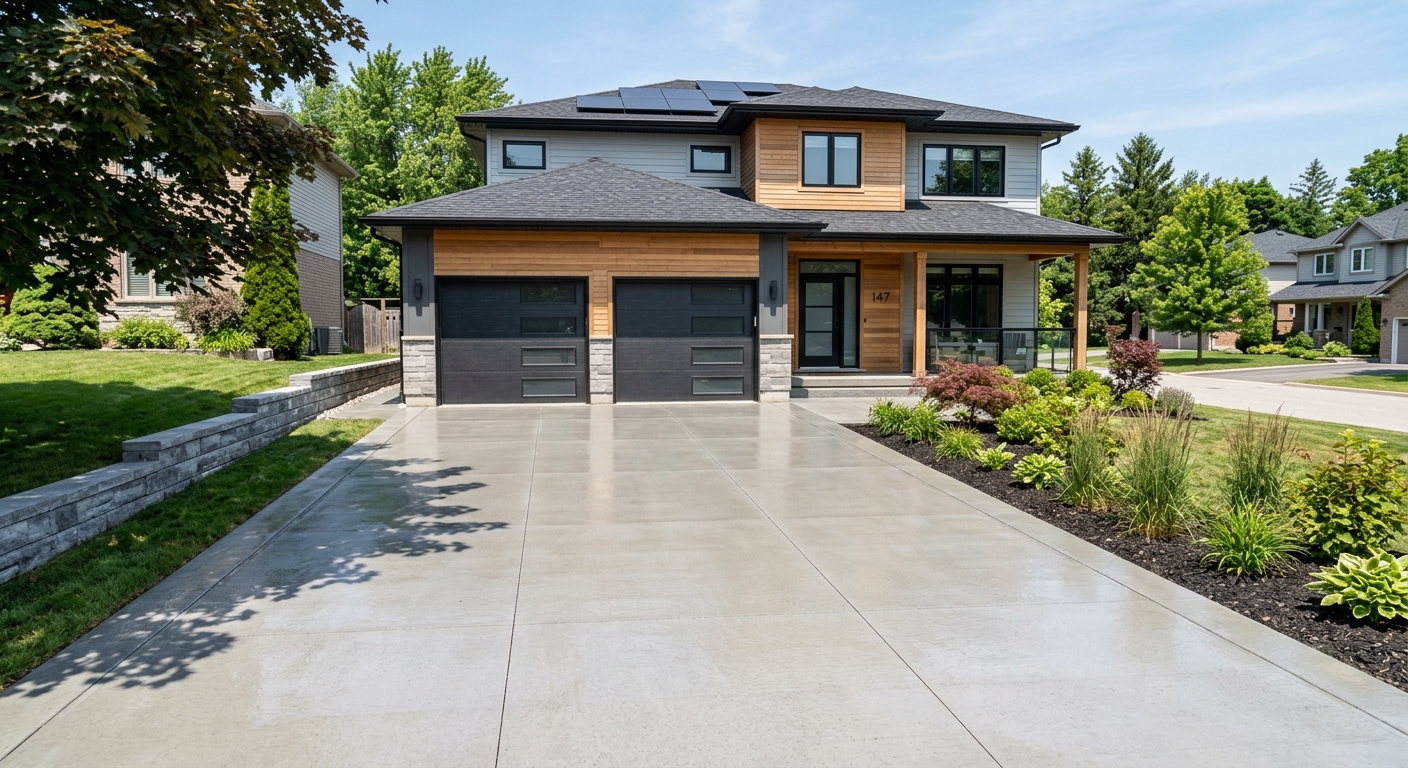
Concrete work options and costs in Lansdowne
Lansdowne, Alberta is a small community where homeowners expect concrete flatwork and foundations to last through long, cold winters. With a population of about 1,215 people (Statistics Canada, 2021 Census), the local market tends to book contractors based on season and access—so timing can affect cost as much as finish choice. In this area, many projects revolve around the typical housing stock, including single-detached homes that drive demand for driveways, patios, walkways, and garage slabs. Calgary’s broader labour pool also influences availability; when crews are booked on larger Calgary jobs, Lansdowne schedule shifts can add mobilization charges or shorten pour windows.
Pricing is heavily shaped by the Calgary economic region’s cold continental climate. Engineering practice in the region uses a design frost depth of about 1.2 m (roughly 4 ft), meaning exterior footings and structural elements for houses and garages must bear on undisturbed soil below that depth to reduce frost heave. Freeze–thaw cycles also require air-entrained mixes and tighter control over base prep. Because the practical pour season is shorter, late fall or early spring pours often require winter-grade curing measures (blankets, heaters), which can push project costs toward the upper end of the local bands.
In Lansdowne, you’ll typically see extra demand for exterior work near established residential streets—areas with easy vehicle access—because driveway and walkway replacements are straightforward when excavation and drainage tie-ins are planned.
Below is a practical comparison to help you budget for common options, then we’ll break down what moves the numbers most in the next section.
| Application |
Typical Size |
Key Spec |
Finish Option |
Price Range |
| Concrete driveway (standard broom finish) |
24 ft x 12 ft (288 sq. ft.) |
Air-entrained mix, compacted base, control joints |
Broomed finish |
$12,000–$18,000 |
| Exposed aggregate driveway |
24 ft x 12 ft (288 sq. ft.) |
Air-entrained mix, higher cement paste quality, proper curing |
Exposed aggregate (washed) |
$15,000–$22,000 |
| Stamped concrete driveway or patio |
20 ft x 20 ft (400 sq. ft.) |
Air-entrained mix, release agent, stamped mats, joint layout |
Stamped pattern + light colour hardener |
$15,000–$26,000 |
| Plain concrete patio or walkway |
12 ft x 16 ft (192 sq. ft.) |
Air-entrained mix, compacted base, edge forms |
Float + light broom / trowel |
$5,000–$9,000 |
| Garage floor (interior slab) |
20 ft x 20 ft (400 sq. ft.) |
Vapour barrier, insulation (often optional), fibre/rebar as specified |
Standard trowel/steel + optional broom touch-up |
$10,500–$17,000 |
| Foundation footings (structural, below frost) |
Typical house: 800–1,400 linear ft (varies widely) |
Concrete designed for frost exposure and settlement control |
Structural footing pour |
$28,000–$45,000 |
Prices are estimates only and vary by project scope, site access and material selection.
What affects the price of concrete work in Lansdowne
If you get two quotes for what looks like the “same” concrete job in the Calgary region, it’s not unusual to see differences of 30–50%. The main reason is that concrete is rarely just a slab: excavation to frost-depth bearing, granular base build-up, reinforcement placement, mix design, and cold-weather curing all change cost. Even finishing choices—broom versus exposed aggregate versus stamping—can change labour intensity and material usage. Because Lansdowne is served by Calgary-area crews, quote timing can also reflect how busy contractors are and how soon they can book equipment and concrete trucks.
In this climate, the frost line depth drives excavation volume and formwork height. The region’s design frost depth of about 1.2 m means exterior footings, grade beams, and structural elements must bear on soil below that depth to prevent frost heave. Freeze–thaw cycles further require air-entrained concrete for exterior slabs and pathways; if the mix isn’t engineered correctly, you’ll see scaling and spalling sooner. Cold weather also compresses the pour season—so winter-grade mixes, insulated blankets, and sometimes temporary heat are often needed to protect curing. Finally, de-icing salt in winter can accelerate surface deterioration; sealing is an inexpensive insurance step that contractors sometimes include (or omit), affecting overall pricing.
In Lansdowne specifically, costs tend to run higher when you need deeper excavation and more drainage tie-ins, while patios on already-level lots with good access can land closer to the lower end of the $5,000–$9,000 patio/walkway band. Stamped work climbs quickly: for example, a decorative driveway project priced near $15,000–$26,000 is usually justified by the extra labour for stamping, the more controlled curing, and the need for a tight joint and surface plan—because rework is costly when freeze–thaw has already begun.
| Price Factor |
Why It Matters |
Cost Impact |
| Frost line depth |
Determines footing depth and excavation volume |
More excavation and formwork can raise foundation costs by thousands |
| Site preparation |
Controls settlement and frost protection through grading |
Compaction and drainage add labour; poor access increases equipment time |
| Reinforcement |
Helps slabs resist cracking and movement |
Rebar cages and correct spacing can add material and labour hours |
| Mix design |
Air-entrainment and strength reduce freeze–thaw damage |
Engineered exterior mixes cost more and may require winter provisions |
| Finish type |
Labour intensity and curing discipline vary by finish |
Stamped and exposed aggregate generally cost more than broom finish |
| Pour size and concrete truck access to site |
Impacts batching schedule and placement speed |
Long carries, narrow gates, or delays can increase labour and mobilization |
| Cold-weather curing precautions |
Protects concrete from early freezing and surface scaling |
Blankets/heaters can push exterior flatwork toward the high end of bands |
| Control joint pattern and sealing cost |
Joints manage cracking; sealing protects from de-icing salts |
More detailed jointing plus sealant adds line items but reduces future repairs |
Permits & regulations in Alberta
In Alberta, structural concrete work typically requires a building permit and, for many projects, engineered drawings that get reviewed by the municipality. Work that usually falls into the “permit-required” category includes footings, foundation walls, grade beams, and any structural elements tied to the building’s load path. Concrete flatwork such as patios, walkways, and driveways often does not require a permit by itself—unless the work affects lot grading, drainage plans, impervious surface coverage limits, or the municipal right-of-way (for example, if you’re doing work that changes access or curb/sidewalk interfaces).
For a Lansdowne homeowner, verify things in a simple step-by-step order:
- Confirm the contractor has the right Alberta trade coverage and is properly registered (ask for their registration details and documentation).
- Request a certificate of liability insurance showing adequate coverage limits and current dates.
- Verify WSIB/WCB clearance (as applicable to the employer) to ensure workers are covered.
- Ask for references on similar projects—especially exterior concrete in Calgary-area freeze–thaw conditions.
- Have them provide the scope: excavation limits, disposal, reinforcement, mix/cold-weather plan, and whether sealing is included.
- If any structural change is involved, ask them whether they will pull the permit and coordinate inspections.
Always confirm with the local authority before breaking ground—requirements can change depending on whether you’re doing structural foundation work, changing drainage, or altering how stormwater is handled.
Getting concrete right in Lansdowne's freeze-thaw climate
Concrete fails in Lansdowne when the system is not designed as a whole. The biggest killers in the Calgary region are inadequate base preparation, poor frost protection, and exterior mixes that don’t hold up to repeated freeze–thaw. To spec the job correctly, start with base preparation: compacted granular sub-base to the depth required for local soil conditions and frost protection, with proper grading so water drains away. Next is mix design. For exterior flatwork, ensure air-entrainment (typically in the 5–7% range for many exterior placements) and a minimum compressive strength spec (commonly at least 32 MPa for structural-grade concrete uses; your engineer/contractor should align the spec to the design intent).
Control joints are also critical. They guide where cracks can relieve stress instead of letting random cracking happen. For curing, don’t shortcut: minimum 7-day curing under proper conditions is a baseline, and in cold weather the contractor should use insulating blankets and/or temporary heat to prevent early freezing that can lead to surface scaling and long-term weakness. Finally, sealing matters here because de-icing salts in winter can accelerate deterioration; a penetrating sealer applied after the concrete has properly cured helps repel moisture before freeze cycles intensify damage.
When you ask technical questions, focus on spalling risk from inadequate air-entrainment and on whether they’re planning for cold-weather curing. For example, choosing standard broom-finish driveway concrete might land near $12,000–$18,000. Paying toward the upper end is often justified if the quote includes proper air-entrainment, deeper granular preparation, correct joint spacing, and cold-weather curing provisions. Those line items reduce the odds of needing patching or re-saw cuts again in a few winters.
| Spec |
Why It Matters in Lansdowne |
What to Ask For |
Impact if Skipped |
| Compacted granular base (depth?) |
Provides frost protection and limits movement |
Ask for the granular base depth and compaction test approach |
Settlement and cracking; frost heave risk increases |
| Air-entrained concrete mix (target air %?) |
Helps concrete survive freeze–thaw cycling |
Ask for target air content range for exterior placement |
Higher chance of scaling and spalling within a few winters |
| Compressive strength (MPa rating) |
Strength affects durability under traffic and de-icing exposure |
Ask for minimum MPa and whether it matches engineering needs |
Surface wear, deeper cracking, and reduced long-term performance |
| Control joints (spacing per ACI guidelines) |
Manages where shrinkage cracks appear |
Ask for proposed joint layout and spacing |
Random cracking that can allow water entry and freeze damage |
| Minimum 7-day curing period |
Strength gain and surface protection depend on curing |
Ask how curing will be managed, especially if temperatures drop |
Early freezing can cause weakness and scaling |
| Penetrating sealer (when applied after cure) |
Repels moisture from salts and winter exposure |
Ask for sealer type and the timing (after cure) |
Faster deterioration and more frequent patching |
How to choose a concrete work contractor in Lansdowne
Start with licensing and coverage, because in Alberta concrete crews must protect homeowners and their workers. Ask the contractor for a current certificate of liability insurance, then verify the clearance letter for WSIB/WCB coverage for their staff. For the workmanship side, request their warranty terms in writing and confirm whether it’s tied to their workmanship only or also includes product/manufacturer warranties. If the contractor can’t provide clear documentation, that’s a major red flag.
Get 2–3 itemised written quotes, not lump sums. A proper quote separates labour and materials and shows key inclusions like excavation depth, granular base and compaction, reinforcement (rebar or mesh), concrete type (including air-entrainment for exterior), joints, curing method, and sealing. Also look for inclusions/exclusions: is disposal included in the price, and is the permit pull (when required) handled? If grading or drainage adjustments are needed, confirm who’s responsible for that scope.
Payment schedule matters: don’t pay more than about 10–15% upfront. Hold back a portion until the finish is complete, cleaned, and—where applicable—sealing is done or scheduled. Timeline should be written: ask for a start date range and an estimated completion date, including curing and protection time in cold weather. In a season-limited market like Calgary-area concrete, these details prevent cost creep and last-minute changes that increase risk of poor curing.
- Confirm they have liability insurance and WSIB/WCB coverage and share paperwork before work starts.
- Require an itemised scope: excavation, base, reinforcement, concrete mix, joints, finishing, curing.
- Ask whether the exterior mix is air-entrained and what target air content they use.
- Check that they address cold-weather curing with blankets/heating plan if temperatures drop.
- Verify joint spacing and location plan (don’t accept “we’ll see how it looks”).
- Request details on sealing: product type and when they’ll apply it after curing.
- Confirm rebar/wire mesh placement and whether it’s supported to the correct cover.
- Ensure disposal of excess soil and concrete waste is included (or explicitly excluded).
- Ask how they protect landscaping and neighbouring surfaces during excavation and pour.
- Get start/completion dates and pour scheduling assumptions in writing.
- Agree on payment milestones tied to completed checks (forms, inspection readiness, pour day, finish, cure, sealing).
- Require a workmanship warranty period and clarify whether it’s transferable if you sell the home.
Concrete contractor red flags in Lansdowne: they quote without discussing frost depth and air-entrainment; they offer only a single “lump sum” without base depth and joint layout; they rush curing or can’t explain cold-weather protection; they won’t provide insurance/WSIB/WCB documentation; and they skip sealing discussions despite de-icing salt exposure.
Frequently asked questions — concrete work in Lansdowne
How do I prepare the base for a concrete slab?
Base prep is where many Lansdowne slabs succeed or fail. For exterior work in the Calgary region, the contractor should excavate to frost-protected depth (often engineered around the local design frost depth of about 1.2 m) and then build a compacted granular sub-base with proper grading so water drains away from the slab. Compaction is not optional—weak fill or loose granular layers can lead to settlement and cracking after freeze–thaw cycles. Ask your contractor what granular material they’re using, the compaction method, and how they handle drainage. If your lot has soft soil, poor drainage, or tree-root issues, the scope should include stabilization before pouring. A solid base plan is often part of why well-prepared slabs last long enough to justify the $12,000–$18,000 driveway band rather than needing early repairs.
How do I compare concrete quotes?
Compare concrete quotes in Lansdowne by looking at line items, not just the bottom total. Ask for an itemised breakdown covering excavation limits and disposal, granular base depth and compaction approach, reinforcement (rebar/wire mesh and placement), concrete mix details (especially air-entrainment for exterior), and finishing steps (broom, exposed aggregate, or stamped). Then compare curing and cold-weather protection—if a pour happens near the shoulder season, the quote should explain insulating blankets and heat if needed. For sealed protection against de-icing salts, confirm whether sealing is included and when it’s applied after curing. It’s also normal to see differences of 30–50% in Alberta quotes when one contractor includes engineered frost protection and proper curing and another does not.
Can concrete be poured in cold weather in Lansdowne?
Yes, concrete can be poured in cold weather in Lansdowne, but it must be engineered and protected properly. In the Calgary region, freeze–thaw risk is real, and early freezing during curing can lead to surface scaling, reduced strength gain, and future spalling. A reputable contractor will plan for cold-weather placement using a suitable winter-grade mix, plus measures like insulated blankets and sometimes temporary heat to keep the concrete warm enough for the required curing window. Ask what their temperature trigger is (air/concrete temperature), what they’ll do if weather changes, and how they’ll protect the slab after finishing. If you’re budgeting, this is one reason costs can shift upward toward the high end of the driveway $12,000–$18,000 range, even when the slab size stays the same.
How do I maintain concrete in Lansdowne's freeze-thaw climate?
Maintenance in Lansdowne is about keeping water and salts out of the concrete surface and preserving the bond between paste and air void system. Start with proper sealing: a penetrating sealer is typically applied after the concrete has cured (often around 28 days post-pour) to repel moisture from de-icing salts. During winter, use de-icers that are recommended for concrete and avoid over-salting—salt can accelerate deterioration when combined with freeze–thaw. Keep drainage directed away from patios and driveways, and address minor issues early: hairline cracking at joints or small spalls should be cleaned and repaired promptly so water can’t migrate in. For exterior flatwork, regular visual checks after spring freeze events help you catch problems before they spread.
What causes concrete to spall in Lansdowne winters?
In Lansdowne winters, spalling is most commonly linked to moisture getting into the concrete and then expanding during freezing. The #1 technical cause is inadequate air-entrainment or poor mix quality for exterior exposure, which reduces the concrete’s ability to handle freeze–thaw pressure. Bad base prep can also contribute by allowing movement and cracking that creates pathways for water. Another common contributor is rushed curing—if concrete is placed and finished without adequate cold-weather protection, the surface may not develop strength and can become vulnerable to scaling. Finally, de-icing salt can intensify the damage by increasing moisture movement and chemical exposure at the surface. That’s why exterior work in this climate should include correct air-entrainment, proper jointing, appropriate curing, and often sealing.
What is rebar and when is it required in Alberta?
Rebar is reinforcing steel used to strengthen concrete members by improving tension capacity and controlling crack widths. In Alberta, whether rebar is “required” depends on the design—footings, foundation walls, and structural elements are typically engineered and may require rebar based on loads, soil conditions, and frost considerations. For interior slabs or garage floors, some projects use rebar or mesh, while others use fibre reinforcement or a combination; the right approach depends on thickness, usage (light storage versus heavier vehicle loads), and the engineering or code-based requirements. In cold climates like the Calgary region, exterior slabs often include reinforcement plus correct joint layout to manage cracking through freeze–thaw. Ask your contractor for the specified reinforcement type, size, spacing, and placement height (cover), because improper placement can negate the benefit even when rebar is included.