Concrete work options and costs in South Terwillegar
Concrete work in South Terwillegar, Alberta is in high demand because so many homes here are built around family-sized lots and the main practical upgrades are outdoor flatwork—driveways, patios, and walkways. According to the 2021 Census, South Terwillegar has a population of 7,532 (Statistics Canada, 2021 Census), which aligns with the steady pace of building and renovations across the Calgary area. The most common concrete jobs homeowners request are driveway slabs for everyday use, plus patios and walkways that can handle Alberta winters.
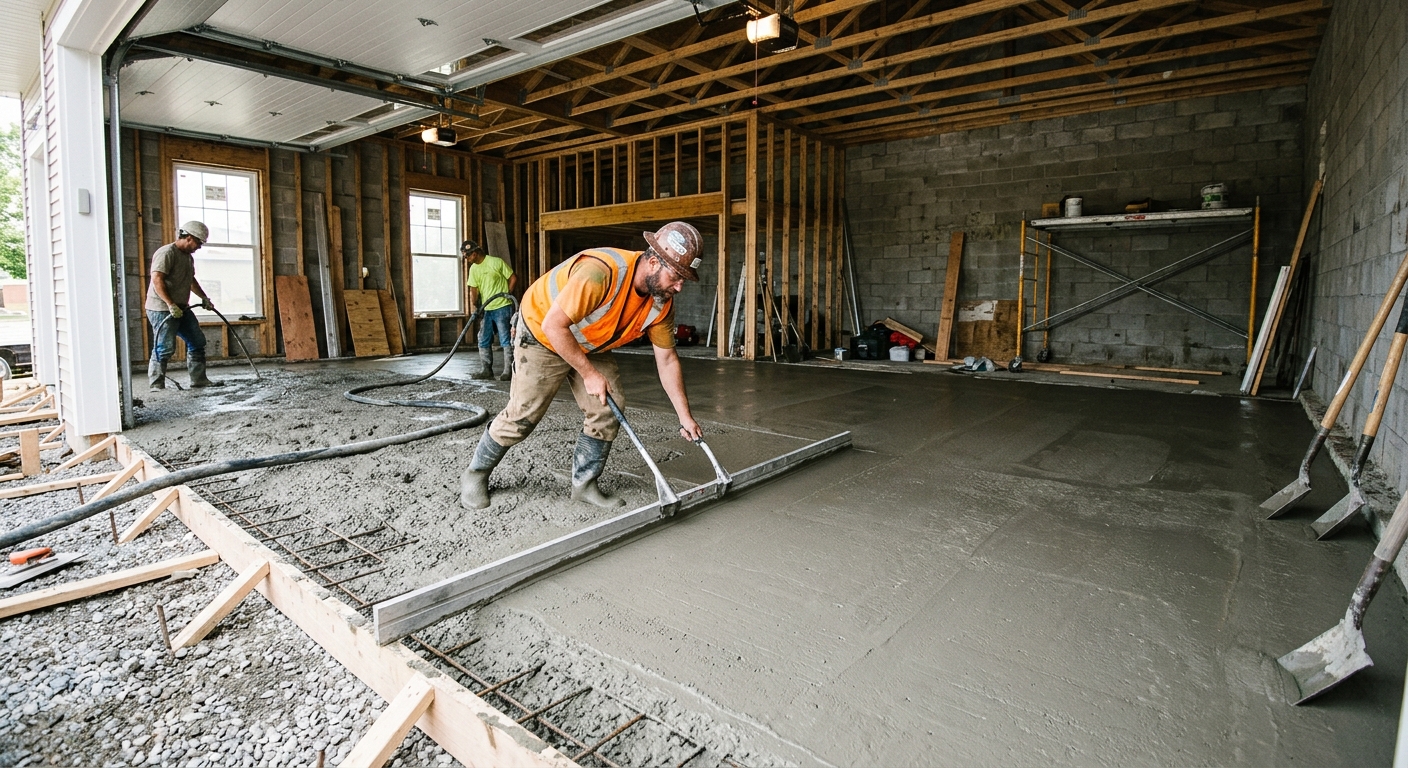
Cost is shaped by Calgary’s cold continental climate. Frost and freeze–thaw cycles force deeper engineering assumptions than in milder regions—local practice targets a design frost depth of about 1.2 m (roughly 4 ft), so foundation and footing excavations are typically more intensive, and exterior slabs rely on properly prepared granular bases. On top of that, the pour season for exterior work can be tighter, and cold-weather curing (insulated blankets and sometimes temporary heat) is often necessary to protect the concrete during the first days of set and cure.
In South Terwillegar, trade demand is especially noticeable around Terwillegar Towne, where new builds and landscaping turnovers tend to cluster. If you’re budgeting for your first driveway or upgrading existing concrete, the table below compares typical sizes, specs, and realistic price bands you’ll see from reputable contractors in the Calgary market.
| Application |
Typical Size |
Key Spec |
Finish Option |
Price Range |
| Concrete driveway (standard broom finish) |
400–500 sq. ft. |
Air-entrained concrete, compacted granular base, control joints |
Broom finish + saw-cut joints |
$12,000–$18,000 |
| Exposed aggregate driveway |
400–500 sq. ft. |
Air-entrained mix, proper base, retarder/exposure process |
Exposed aggregate finish |
$15,000–$22,000 |
| Stamped concrete driveway or patio |
300–450 sq. ft. |
Air-entrained mix, release agent, color hardener (where specified) |
Stamped pattern + integral/coat color |
$15,000–$26,000 |
| Plain concrete patio or walkway |
250–400 sq. ft. |
Compacted base, air-entrained concrete, edge forms |
Broom or light-trowel finish |
$5,000–$9,000 |
| Garage floor (interior slab) |
400–600 sq. ft. |
Proper sub-base, vapour barrier (if required), reinforcement as needed |
Smooth or light broom finish |
$8,500–$14,000 |
| Foundation footings (structural, below frost) |
Typical house/garage footprint |
Engineer/structural spec, excavation to frost depth, rebar per design |
Structural concrete (not cosmetic) |
$28,000–$45,000 |
Prices are estimates only and vary by project scope, site access and material selection.
What affects the price of concrete work in South Terwillegar
In South Terwillegar, two quotes for what sounds like the “same” concrete job can differ by 30–50% once you factor in engineering depth, base conditions, finishing labour, and cold-weather protection. Calgary-area pricing also reflects crew availability and concrete placement logistics—when timelines tighten for exterior work, trades and concrete trucks get booked quickly, which can increase scheduling and mobilization costs.
Frost depth and freeze–thaw cycles are the biggest drivers because they dictate every structural decision. Local practice assumes a design frost depth of about 1.2 m (roughly 4 ft), which means excavations and footing volumes go up when form height increases or when soils are variable. For exterior slabs, air-entrained concrete is a must to survive repeated freeze–thaw cycles, and that increases material and spec requirements versus plain mixes. Cold-weather placement in Alberta can require winter-grade mixes, insulated blankets, and sometimes temporary heat—those steps protect curing, but they add labour and equipment time. Also, because de-icing salt is common here, sealing becomes more than an aesthetic choice; it helps reduce surface wear and spalling over time.
Two common South Terwillegar examples: (1) a driveway over poorly drained or topsoil-heavy areas often needs additional excavation and granular replacement, pushing the job toward the $12,000–$18,000 driveway band and sometimes higher if regrading is extensive; (2) a stamped or decorative driveway can justify the $15,000–$26,000 band when colour hardener, stamps, and tight crack control are included—skipping those usually leads to uneven wear. Housing age matters too: older properties often have settlement issues or mismatched grades that require more saw-cutting, demolition, and re-laying base.
| Price Factor |
Why It Matters |
Cost Impact |
| Frost line depth — determines footing depth and form height |
Footings must extend below design frost to prevent frost heave and seasonal movement |
Can add major excavation and concrete volume; often the biggest cost swing on foundations |
| Site preparation — excavation, grading, compacted granular base |
Proper base prevents settlement and helps control cracking under freeze–thaw |
Extra truckloads and labour; commonly shifts quotes by 10–25% |
| Reinforcement — rebar or wire mesh requirement |
Controls cracking and improves slab performance under loads |
Adds materials and installation time; can increase cost by several thousand dollars |
| Mix design — air-entrainment and compressive strength spec |
Air-entrainment reduces damage from freeze–thaw cycles; strength supports structural durability |
Premium mix and QC; typically modest per cubic yard but meaningful at scale |
| Finish type — broom vs. stamped vs. exposed aggregate |
Finish impacts labour hours, product handling, and curing/technique |
Stamped/exposed typically adds significant labour; usually the jump you feel in decorative work |
| Pour size and concrete truck access to site |
Limited access increases waiting time, pumping needs, or extra crew for placement |
Mobilization and equipment can add hundreds to thousands |
| Cold-weather curing precautions — heating and blankets |
Protects early-age concrete so it cures correctly in sub-freezing conditions |
May increase overall pour costs by 5–15% on exterior slabs in shoulder seasons |
| Control joint pattern and sealing cost |
Joints manage cracking; sealing helps resist de-icing salt wear |
Sealer materials and labour vary; can be a cost add but reduces long-term surface issues |
Permits & regulations in Alberta
In Alberta, structural concrete work—think footings, foundation walls, and grade beams—almost always requires a building permit, and engineered drawings are typically reviewed through the municipal process before construction. For concrete flatwork such as driveways, patios, and walkways, permits usually aren’t required unless your project changes lot grading, affects impervious surface coverage limits, or touches municipal right-of-way considerations. Even then, it’s often the grading/drainage or the interface with the street, not the concrete itself, that triggers the permit conversation. For South Terwillegar homeowners, the key is to confirm with the local authority before breaking ground—especially if you’re changing elevations, adding drainage, or replacing significant areas of existing concrete.
Before you sign, verify three things: (1) the contractor has proper standing for their business and the work they’re doing, (2) they carry liability insurance, and (3) they have the required worker coverage (commonly referenced as WSIB/WCB coverage in Alberta). To do that step-by-step, ask for a certificate of insurance (showing your job listed as additional interest or confirming coverage limits), request a clearance letter where applicable, and check references for similar-scale slabs and structural concrete. Also ask whether any engineering details apply to your foundation/footings scope and whether they will provide documentation that matches the approved plans.
Getting concrete right in South Terwillegar's freeze-thaw climate
Concrete failures in South Terwillegar are usually about one thing: the slab couldn’t handle the region’s freeze–thaw cycles and winter service conditions. The right specifications start before concrete arrives. First, base preparation matters—compacted granular sub-base has to be built to the correct depth for your soils and engineered frost assumptions; leaving soft spots or topsoil under the slab leads to settlement and early cracking. Second, mix design must be built for Alberta: exterior flatwork should use air-entrainment (typically 5–7% air content) and a minimum of 32 MPa compressive strength to reduce freeze–thaw damage and scaling.
Next comes control joints. In a cold climate, joints must be placed with a consistent spacing pattern so cracks, when they occur, follow the intended path rather than going random. Curing is equally important: plan for at least 7 days of proper curing conditions, and in cold weather use blankets/heating as needed so the concrete reaches adequate early strength. Finally, sealing is a smart protective step—apply a penetrating sealer after the cure window (often around 28 days post-pour) to repel de-icing salts and reduce surface breakdown.
Here’s where the price difference is justified: upgrading from a basic broom-finish approach to a properly spec’d driveway with air-entrained mix, correct base prep, and sealing often lands in the $12,000–$18,000 range, but it can prevent the “cheap pour” outcome—surface scaling and patchwork a couple winters later. If you’re choosing stamped concrete, that extra labour can be worth it in the $15,000–$26,000 band, as long as crack control and curing aren’t cut corners.
| Spec |
Why It Matters in South Terwillegar |
What to Ask For |
Impact if Skipped |
| Compacted granular base (depth?) |
Proper base supports the slab and withstands seasonal movement under frost and thaw |
Confirm excavation depth, granular type, compaction method and target thickness |
Settlement, uneven cracking, and faster failure at the edges |
| Air-entrained concrete mix (target air %?) |
Freeze–thaw cycles rely on correct air voids to prevent scaling/spalling |
Ask for the air-entrainment target (typically 5–7% for exterior flatwork) and mix design |
Higher risk of spalling and surface breakdown after winter exposure |
| Compressive strength (MPa rating) |
Strength supports durability and load-bearing performance in a harsh climate |
Specify minimum 32 MPa and confirm the mix meeting that requirement |
Reduced long-term performance and increased cracking risk |
| Control joints (spacing per ACI guidelines) |
Controls where cracks form as concrete shrinks and temperature cycles |
Ask for joint layout plan and saw-cut timing for your slab size |
Random cracking and wider, harder-to-repair damage paths |
| Minimum 7-day curing period |
Proper curing develops strength and durability before winter conditions return |
Confirm curing steps and whether blankets/heating are used in cold weather |
Surface scaling, reduced strength gain, and brittle early-age problems |
| Penetrating sealer (when applied after cure) |
Helps resist de-icing salt and reduces surface wear during Calgary-area winters |
Ask for penetrating sealer application timing after cure (often around 28 days) |
Faster deterioration and more visible staining/pitting over time |
How to choose a concrete work contractor in South Terwillegar
For South Terwillegar homeowners, the contractor selection process should be as careful as the concrete spec. Start with verification in Alberta: ask for proof of liability insurance (certificate of insurance) and request confirmation of WSIB/WCB coverage for their workforce. Next, check their business standing and whether they carry coverage appropriate for the scope—structural concrete and foundation work should have a clear, documented plan that matches engineered drawings where required.
Then get 2–3 itemised written quotes. A solid quote lists labour and materials separately (concrete supply, rebar/wire mesh, base prep, forms, saw-cutting, finishing, and sealing), and it should show what’s included rather than hiding the important parts in “miscellaneous.” Watch for omissions: disposal of removed concrete, permit pull (if applicable), temporary protection measures, and any drainage tie-ins.
Warranty matters too. Ask for a workmanship warranty length and whether the product/manufacturer warranty applies to the concrete sealer or specialty mix. Confirm whether any warranty is transferable if you sell the home.
Payment schedule should be sensible in Alberta construction practice: never pay more than about 10–15% upfront. Hold back a portion until the job is complete, final grading is confirmed, and sealing is done (if included). For timing, insist on a start date and completion estimate in writing, especially for exterior work where freeze–thaw risk affects curing.
- Ask for the concrete mix design details: air-entrainment and minimum compressive strength (e.g., 32 MPa).
- Confirm base build: excavation depth, granular type, and compaction method.
- Request joint layout: spacing and saw-cut timing.
- Verify rebar/wire mesh scope in writing (and where it’s placed—mid-depth, not on the ground).
- Confirm whether winter-grade curing is included for late-season pours.
- Get an itemized line for sealing (and the sealer type: penetrating vs. film-forming).
- Ask who supplies and places reinforcement and who installs forms and edges.
- Confirm demolition/disposal is included if you’re removing existing concrete.
- Check truck access plan (and whether pumping is required).
- Review warranty terms for workmanship and materials, in plain language.
- Make sure the quote includes curing and protection steps—not just the pour day.
- Use a staged payment schedule with a holdback until final finish and cleanup are verified.
Red flags in South Terwillegar include quotes that don’t mention air-entrainment for exterior slabs, contractors who won’t provide insurance/coverage proof, vague scope language like “concrete as needed” with no joint plan, pressure for large upfront payments, and refusal to discuss curing/blanket plans for late fall or early spring pours.
Frequently asked questions — concrete work in South Terwillegar
What is rebar and when is it required in Alberta?
Rebar (reinforcing steel) is used to improve concrete’s strength and control cracking in areas that experience tension, loads, or shrinkage stress. In Alberta—including South Terwillegar—rebar requirements depend on the structural design, slab thickness, and the specific engineering spec. For structural elements like footings, foundation walls, and grade beams, rebar is typically engineered and detailed because the consequences of movement or failure are high. For exterior flatwork like driveways and patios, reinforcement may be required or recommended depending on slab thickness, sub-base condition, and expected loads (for example, heavier vehicle traffic), but it’s not one-size-fits-all. A reliable contractor will cite the design thickness and joint plan and explain where the reinforcement sits (properly supported during the pour), rather than simply adding wire “somewhere” in the mix.
How long does a concrete project take in South Terwillegar?
Timing in South Terwillegar depends on whether your project is interior slab work, an exterior flatwork pour, or structural foundation concrete. Most driveway or patio pours are a short placement event—the concrete truck arrives, placement happens quickly, and finishing is done the same day. However, the total timeline includes prep and cure protection. Base preparation and forming commonly take several days, and cold-weather precautions can extend the schedule because curing must be protected—blankets, heating, and careful temperature control help ensure the concrete reaches adequate early strength. As a practical expectation, many exterior flatwork jobs land in the 1–3 week calendar window from site prep to final finishing and sealing (if included). Foundation/footings work often takes longer because excavation to frost depth, inspections, and engineered sequencing can’t be rushed. If you’re pouring late in the season, ask directly how the contractor handles the curing window; in Calgary’s freeze–thaw reality, that affects durability as much as the price.
What is a concrete overlay and is it suited to South Terwillegar?
A concrete overlay is a new layer placed over an existing concrete surface—often to improve appearance or extend service life without full demolition. In South Terwillegar, overlays can be suitable when the original slab is still structurally sound: minimal spalling, limited settlement, and a stable base. The biggest risk is overlaying problems—if the existing slab is already failing due to inadequate base support, freeze–thaw damage, or widespread cracking, an overlay can simply replicate those weaknesses on top. Overlays also require strong surface preparation and appropriate bonding materials so that de-icing salt, moisture, and temperature cycling don’t cause delamination. If your current concrete is only cosmetically tired, an overlay may reduce cost compared with full replacement; but if you need a proper regrade or base rebuild, replacement is usually the more durable option. Ask your contractor to assess cracks and base stability before deciding—don’t choose overlay purely based on price.
How do I seal concrete to protect it in South Terwillegar?
In Alberta winters, sealing is mainly about reducing surface wear from moisture and de-icing salts. For South Terwillegar, the correct approach is to seal only after the concrete has cured enough—commonly around 28 days post-pour for many sealer systems—so the concrete can release moisture and develop stability. Choose a penetrating sealer when your goal is to repel water and reduce salt-related scaling and pitting. Before sealing, the slab must be clean and dry; contaminants like dust, grease, and leftover curing compounds can prevent the sealer from penetrating properly. Your contractor should also confirm whether they’re sealing new flatwork versus doing a repair/patch area, because patch curing times can vary. If sealing is included in your quote, it should specify the sealer type and timing—otherwise you can end up paying twice. If you’re budgeting, driveway projects commonly sit in the $12,000–$18,000 range, and sealing decisions affect long-term maintenance regardless of where you land in that band.
What is the difference between concrete and cement?
Concrete and cement are related, but they’re not the same thing. Cement is one ingredient in concrete—it’s the binder that reacts with water to form a paste. Concrete is the final construction material made by mixing cement with water, sand, gravel (or other aggregates), and sometimes additives like air-entrainers and admixtures. In Alberta, air-entrainment is especially important for exterior concrete because freeze–thaw cycles can damage concrete that doesn’t have the right internal air void structure. That’s why a good quote will talk about the concrete mix design, not just “cement.” For homeowners in South Terwillegar, the practical difference is that you should ask about the concrete performance: minimum compressive strength (often 32 MPa for exterior specs), air-entrainment targets (commonly 5–7% air for exterior flatwork), and the curing plan—these determine how the slab performs in winter, not just what cement brand was used.
How much does concrete work cost in South Terwillegar?
Concrete costs in South Terwillegar follow the realities of Calgary’s deeper frost assumptions, freeze–thaw exposure, and shorter exterior pour season. For a typical concrete driveway (standard broom finish), pricing commonly lands in the $12,000–$18,000 range, depending on slab size, base prep, and access. A simple patio or walkway is often in the $5,000–$9,000 band when excavation and base are straightforward. Decorative options move higher: stamped concrete driveway or patio work is commonly in the $15,000–$26,000 range because it requires more labour, product handling, and careful finishing/cure control. For structural work like foundation footings, the range is often $28,000–$45,000 depending on excavation volume and engineered reinforcement. Your final price can swing 30–50% if the site requires deeper base replacement, includes cold-weather curing precautions, or needs more engineering than expected—so always ask for an itemised quote that explains what’s included.