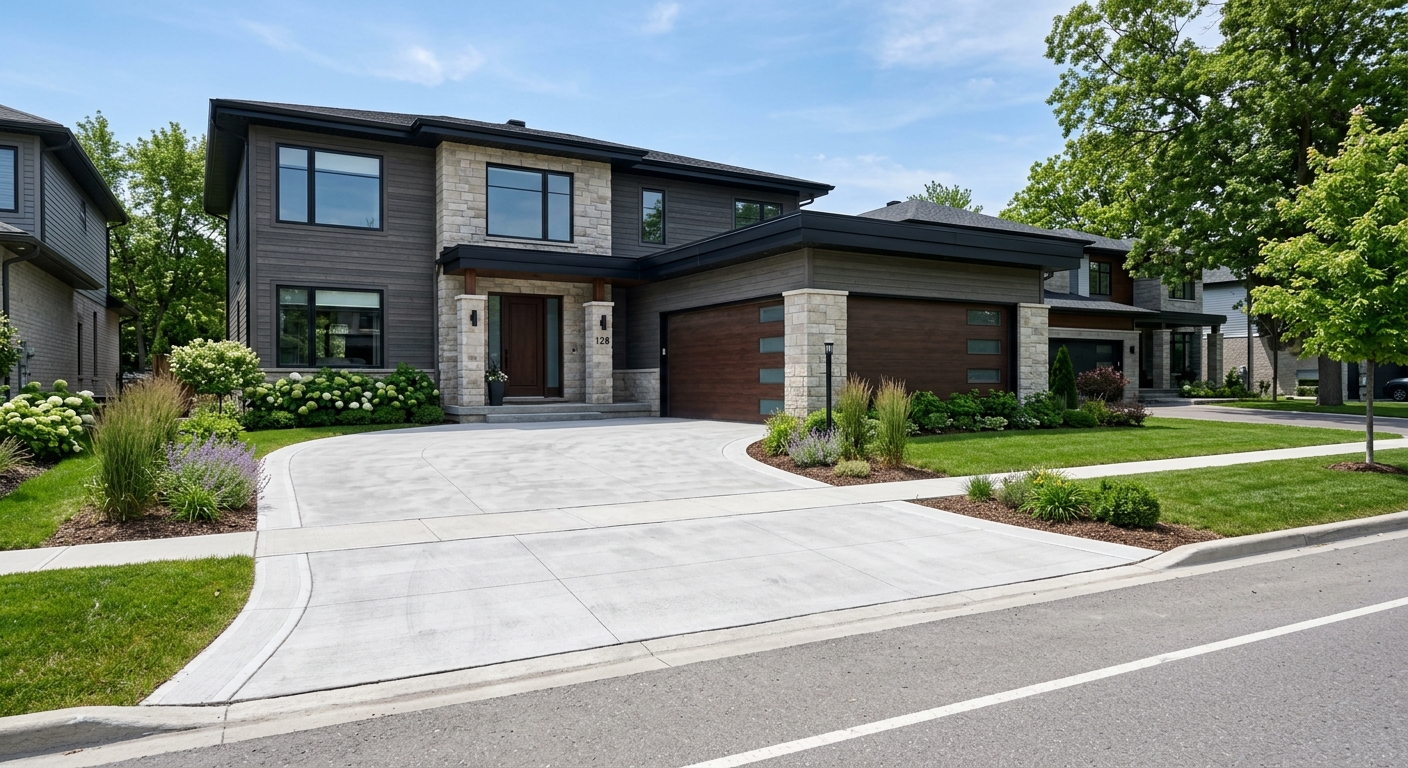
Concrete work options and costs in Lakeview
Lakeview, Alberta has a lot of home activity, and that’s reflected in the demand for durable concrete flatwork like driveways, patios and walkways. With Lakeview’s population at 5,640 (Statistics Canada, 2021 Census), the market is smaller than Calgary proper, so the trades you’ll see on-site often come from the broader Calgary region. Most homeowners here plan exterior concrete around how they actually live day-to-day—snow management, salt exposure, and the freeze–thaw cycle that can punish thin slabs.
In practice, concrete options usually fall into two categories: practical everyday finishes (like broom-finished driveways) and higher-appearance systems (like exposed aggregate or stamped concrete). Calgary’s cold continental climate drives the way we build—engineered sub-bases, air-entrained mixes, and control joints aren’t “extras” here; they’re core to performance. The design frost depth used in engineering and local construction practice is about 1.2 m (roughly 4 ft), which means excavation for footings and structural work is deeper than many homeowners expect. That deeper footing volume, plus a shorter pour window for exterior slabs, is a big reason concrete quotes can land at the higher end of the regional price bands. In neighbourhood areas like the newer-growth pockets near 52 Street SW and the surrounding Lakeview corridor, contractors are especially busy during spring and early summer when curing temperatures stay consistent.
Below is a realistic comparison of typical scopes and budgets to help you understand how each option changes cost.
| Application |
Typical Size |
Key Spec |
Finish Option |
Price Range |
| Concrete driveway (standard broom finish) |
24 ft x 10 ft (240 sq. ft.) |
Air-entrained mix, compacted granular base, control joints |
Broom finish, saw-cut joints |
$12,000–$18,000 |
| Exposed aggregate driveway |
24 ft x 10 ft (240 sq. ft.) |
Air-entrained mix, proper curing, spray or wash exposure |
Exposed aggregate with specialty surface texture |
$15,000–$22,000 |
| Stamped concrete driveway or patio |
24 ft x 10 ft (240 sq. ft.) driveway |
Air-entrained mix, integral color, release and sealing |
Stamped pattern (slip-resistant), sealer |
$15,000–$26,000 |
| Plain concrete patio or walkway |
10 ft x 16 ft (160 sq. ft.) |
Compacted base, reinforcement as needed, air-entrained mix |
Exposed or broom/plain finish |
$5,000–$9,000 |
| Garage floor (interior slab) |
20 ft x 22 ft (440 sq. ft.) |
Vapour barrier, reinforcement, proper base under interior conditions |
Broom finish |
$8,000–$16,000 |
| Foundation footings (structural, below frost) |
Typical house footings (engineered; vary by plan) |
Structural concrete, rebar, below design frost depth |
Formed foundation concrete |
$28,000–$45,000 |
Prices are estimates only and vary by project scope, site access and material selection.
What affects the price of concrete work in Lakeview
In Lakeview and the broader Calgary region, it’s common to see the “same” concrete project swing by 30–50% between quotes because concrete pricing reflects engineering, site conditions and production scheduling—not just the slab thickness. For example, two driveways that both measure 24 ft x 10 ft can still differ dramatically if one site needs deeper excavation for frost protection, more granular base replacement, and a tighter sequence of pours to hit the curing window.
First, frost depth and freeze–thaw cycles drive the whole specification in this cold climate. Local practice uses a design frost depth of about 1.2 m (roughly 4 ft), so exterior structural elements like footings must bear on undisturbed soil below that depth to prevent frost heave. Second, every exterior slab needs an air-entrained mix to resist freeze–thaw damage; without it, homeowners often end up dealing with spalling and scaling. Third, cold-weather conditions shorten the effective pour season for exterior work. When temperatures drop, contractors may need insulated blankets and controlled curing, which adds labour and materials cost. Finally, de-icing salts accelerate surface wear, so sealing becomes a practical maintenance step—especially for driveways where salts are used heavily.
Local examples that commonly raise cost in Lakeview: (1) older or poorly compacted subgrade requiring extra base and re-compaction; (2) thickened edges and reinforcement where loads are higher (like heavier vehicles in driveways); and (3) limited truck access that forces more material handling time. On the flip side, a straightforward, flat backyard patio with easy access can land closer to the lower end of the patio/walkway band of $5,000–$9,000, while a decorative driveway often tracks the stamped range of $15,000–$26,000 because of colour, stamping labour, and sealing system requirements.
| Price Factor |
Why It Matters |
Cost Impact |
| Frost line depth |
Determines footing depth and form height |
Deeper excavation raises concrete and labour costs |
| Site preparation |
Excavation, grading, compacted granular base |
More base replacement and re-compaction increases hours and material haul |
| Reinforcement |
Rebar or wire mesh requirement |
Extra steel and placement labour add cost, especially for driveway loads |
| Mix design |
Air-entrainment and compressive strength spec |
Premium mix and stricter specs increase material cost |
| Finish type |
Broom vs. stamped vs. exposed aggregate |
Decorative finishes add labour, tools and colour/sealer systems |
| Pour size and concrete truck access to site |
Limits batching, placement time and labour coordination |
Tight access can require extra handling and longer crew time |
| Cold-weather curing precautions |
Heating and blankets |
Blankets/heaters extend scope and reduce risk of surface scaling |
| Control joint pattern and sealing cost |
Controls cracking and protects from salts |
More joints (where required) and sealer application add to the budget |
Permits & regulations in Alberta
In Alberta, structural concrete work—like footings, foundation walls, and grade beams—typically requires a building permit and often engineered drawings that the municipality reviews as part of the permitting process. Concrete flatwork (such as patios, walkways and most driveways) usually does not require a permit unless it affects lot grading, changes drainage patterns, or triggers municipal requirements around impervious surface coverage or proximity to municipal right-of-way features. Because rules can vary by the details of your lot and design, confirm with the local authority before breaking ground.
For Lakeview homeowners, the practical verification steps are straightforward. First, ask the contractor for their current liability insurance certificate—ensure it lists your project address (or at least the insured contractor name) and includes adequate coverage limits. Next, verify they carry WSIB/WCB coverage. In Alberta, you’ll typically request a clearance letter or proof of coverage. Then, check their standing using relevant online resources for business/contractor compliance and any trade requirements that may apply to your project scope.
Finally, request references for similar-scale work in Calgary/Lakeview conditions, not just photos. A contractor who can explain their frost-depth excavation approach, curing plan, and how they manage drainage typically builds to the same standard that municipalities expect for structural concrete.
Getting concrete right in Lakeview's freeze-thaw climate
In Lakeview, concrete failures almost always trace back to one of five things: inadequate base preparation, poor mix design for freeze–thaw durability, wrong reinforcement (or none where needed), improper curing, or missing joint/sealing strategy. Because Calgary’s design frost depth is about 1.2 m (roughly 4 ft), the ground movement risk is real—if footings bear on disturbed soil or if exterior slabs are supported on weak fill, you can get settlement and cracking. Freeze–thaw cycles also demand air-entrained concrete; without the correct air content, freeze action can damage the paste and lead to spalling and surface scaling, especially on driveways that see de-icing salts.
To spec the job correctly, focus your questions on the system, not just the finished look. For base preparation, require compacted granular sub-base placed to the correct depth for your soil and frost exposure. For the mix, ask for air-entrainment suitable for exterior exposure and a minimum compressive strength target (commonly at least 32 MPa for many structural and durable exterior applications). For cracking control, ask about control joint spacing so cracks happen where you can live with them. For curing, request minimum curing time under suitable temperature conditions; in colder weather, contractors may use blankets or temporary heat. For protection, plan for a penetrating sealer applied after the concrete has cured (commonly after 28 days) to help repel salts.
A cost example: homeowners choosing stamped driveway work often pay toward $15,000–$26,000 because of colour, stamping labour and a robust sealing system. If a contractor tries to cut corners on air-entrainment or joints to save money, the “saved” dollars are usually quickly lost to repairs—so the premium is justified only when the durability specs are done properly.
| Spec |
Why It Matters in Lakeview |
What to Ask For |
Impact if Skipped |
| Compacted granular base (depth?) |
Supports the slab against frost-related movement and settlement |
Base depth and compaction method sized for local soil and frost exposure |
Settlement, cracking, and uneven slab movement |
| Air-entrained concrete mix (target air %?) |
Resists freeze–thaw damage from winter conditions and salts |
Exterior air-entrainment target (typically 5–7% for exterior flatwork) |
Spalling, scaling, and early surface deterioration |
| Compressive strength (MPa rating) |
Ensures durability for loads and freeze–thaw cycling |
Minimum 32 MPa rating (or engineer/plan-specific requirement) |
Surface wear, cracking, and reduced load capacity |
| Control joints (spacing per ACI guidelines) |
Controls where shrinkage cracks occur in the freeze–thaw cycle |
Joint spacing and timing (saw-cut/formed) to match slab size |
Random cracking patterns and higher repair risk |
| Minimum 7-day curing period |
Builds strength before exposure to cold snaps and moisture cycling |
Temperature/blanket plan for proper curing conditions |
Reduced strength gain and increased surface scaling |
| Penetrating sealer (when applied after cure) |
Helps limit salt and moisture intrusion in winter |
Apply after cure—commonly after 28 days—before heavy winter use |
Faster deterioration from de-icing salts and freeze cycles |
How to choose a concrete work contractor in Lakeview
Choosing the right contractor in Lakeview comes down to proof, process and details. Start by verifying Alberta licensing where applicable to your scope and ensure the company is properly registered to operate. Next, confirm they have liability insurance (request a certificate of insurance) and WSIB/WCB coverage for their workers. The best contractors can produce a clearance letter or direct proof of coverage without hesitation. If they can’t, that’s a red flag—especially for excavations and truck-based placement where jobsite risk is higher.
Then get 2–3 itemised written quotes rather than one lump-sum number. You want a breakdown separating labour and materials: excavation/grading, granular base, reinforcement, the concrete mix spec (including air-entrainment), placement and finishing, joint cutting, curing provisions, and sealing. Ask explicitly whether a permit pull is included (for structural scopes it usually should be), and whether disposal/haul-off of excess material is included.
Warranty matters too. Ask for the workmanship warranty length, and whether the product/manufacturer warranty applies (and if it’s transferable to subsequent owners). Finally, protect your cash position: avoid paying more than 10–15% upfront. Hold back part of the total until completion and final cleanup. Make sure you get a start date and estimated completion timeline in writing so scheduling conflicts don’t force rushed cold-weather curing.
- They can name the concrete mix spec and confirm it’s air-entrained for exterior freeze–thaw exposure.
- They provide a detailed scope: excavation depth, base thickness, reinforcement and joint plan.
- They show photos of Lakeview/Calgary winter-season work, not just summer pours.
- They include curing precautions (blankets/heating plan) if temperatures dip.
- They explain drainage: what prevents surface water from undermining the slab.
- They quote for sealing and state the expected sealer type and timing (after curing).
- They confirm disposal/haul-off and whether you’ll be left with topsoil/grade adjustments.
- They list equipment and crew plan for concrete truck access and placement timing.
- They provide proof of liability insurance and WSIB/WCB coverage before signing.
- They offer a written workmanship warranty and a clear claim process.
- They avoid large upfront payments and agree to milestone-based billing.
- They include start and completion dates in writing, tied to weather considerations.
In Lakeview, concrete contractor red flags include vague quotes that don’t mention base depth or air-entrained mix, skipping engineered frost considerations for structural work, offering “cheap” stamped work without detailing sealing and curing, demanding full payment up front, and refusing to put curing/jointing plans in writing.
Frequently asked questions — concrete work in Lakeview
How do I seal concrete to protect it in Lakeview?
In Lakeview and the Calgary region, sealing is about reducing moisture and salt intrusion that accelerates freeze–thaw damage. For best results, wait until the concrete has reached full cure—commonly about 28 days—then apply a penetrating sealer designed for exterior slabs. Before sealing, the surface should be clean and dry, and any efflorescence or laitance needs to be addressed so the sealer actually bonds. If your driveway will see de-icing salts regularly, sealing is one of the few “preventative maintenance” steps homeowners can control after installation. If you’re budgeting, sealing is usually already included in higher-end decorative projects that sit around the stamped range of $15,000–$26,000, but plain concrete patio/walkway work closer to $5,000–$9,000 may require a separate line item—confirm it in the quote.
What is the difference between concrete and cement?
Concrete is the final construction material you see in your driveway or patio—it’s a mix of cement, water, sand, gravel (and sometimes air-entrainment agents or other admixtures). Cement is one ingredient inside concrete: it’s the binder that reacts with water and helps create the hardened matrix. In Calgary-area freeze–thaw conditions, what matters most for performance is the overall concrete mix design, including air-entrainment and target strength—not just the type of cement. That’s why good contractors specify things like air content and compressive strength, rather than giving only a “cement brand” answer. When you compare quotes in Lakeview, look for discussion of exterior air-entrained mix, curing precautions and joint pattern, because those are the factors that reduce spalling and scaling over time.
How much does concrete work cost in Lakeview?
Concrete costs in Lakeview generally track Calgary’s market rates, with price differences driven by frost-depth excavation, base replacement, reinforcement, finish level and access. For exterior flatwork, a standard broom-finished driveway often lands in the regional band of $12,000–$18,000 depending on size and site conditions. Plain patios and walkways are commonly budgeted around $5,000–$9,000 for typical backyard scopes. For decorative work, stamped concrete usually costs more, often within $15,000–$26,000 when colour, stamping labour and a proper sealing system are included. Foundation/footings are a different category due to engineered structure and below-frost excavation, commonly estimated around $28,000–$45,000. If you get two wildly different quotes, ask what changed: base depth, reinforcement, air-entrainment, curing plan and whether disposal is included.
How deep must footings be for Lakeview's frost line?
For Lakeview construction practices in the Calgary economic region, footings for houses, garages, decks and similar structures need to extend below the design frost depth to reduce frost heave and seasonal movement. Local practice commonly references a design frost depth of about 1.2 m (roughly 4 ft). The exact depth on your property can still be influenced by engineered drawings, soil conditions, drainage and the foundation system. That’s why good footing quotes reference “below frost” and include excavation to the required depth rather than assuming a simple uniform trench. If you’re comparing bids, don’t accept vague statements—ask for the footing depth/grade beam notes and confirm they’re building to the engineered requirement and local frost protection approach used for Alberta winters.
Why does concrete crack in Lakeview and how is it prevented?
Concrete cracking in Lakeview usually isn’t a mystery—it’s a predictable outcome of shrinkage, temperature swings and ground movement during freeze–thaw cycles. Concrete naturally shrinks as it cures, and in a cold continental climate those movements can be exaggerated if curing is rushed or if the base isn’t prepared correctly. Prevention comes from engineering the whole system: a properly compacted granular base, a durable air-entrained mix for exterior exposure, reinforcement where required, and a control joint plan that lets shrinkage cracks form where you intended. Control joints should be spaced appropriately for the slab size and cut at the right time, so random cracking is minimized. Sealing also helps reduce moisture and salt intrusion along surface pathways. If a contractor can’t explain their air-entrainment and joint timing, that’s when you should worry—spalling and surface damage can follow cracks in Alberta winters.
Stamped vs broom-finish concrete — cost difference?
Stamped concrete costs more than broom-finished concrete because it’s a multi-step decorative system: integral colour, release agents, stamping labour, additional surface finishing, and typically a sealing plan tailored to protect the appearance in freeze–thaw conditions. In Lakeview, that difference often shows up in the market ranges: standard broom-finished driveway work frequently falls around $12,000–$18,000, while stamped driveway or patio scopes often budget toward $15,000–$26,000. The key is value: you’re paying for the appearance and the added steps that protect it. However, don’t assume stamped concrete is automatically “better.” It should still include exterior-grade air-entrained mix, proper base prep and control joints—otherwise decorative surfaces fail just like plain ones. Ask each contractor to itemize these specs so you can compare apples-to-apples.