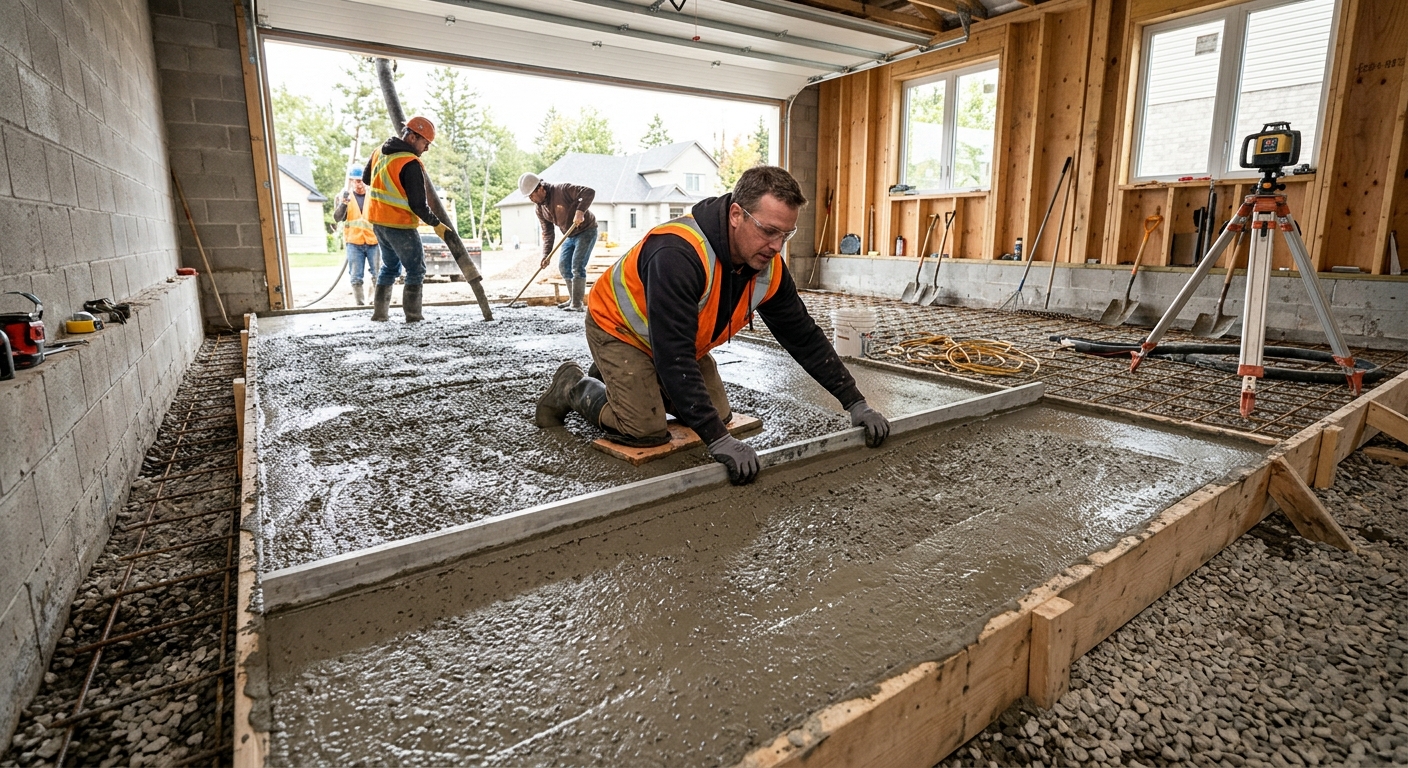
Concrete work options and costs in Jasper
Jasper homeowners typically use concrete for driveways, patios and walkways because it performs well when it’s built for freeze-thaw. In Jasper specifically, about 50.4% of households own their homes, and 33.4% of dwellings are single-detached—exactly the housing type where most exterior flatwork gets replaced or upgraded. Just as important, 57.9% of homes were built before 1981, which often means existing walkways and slabs may be older, with less robust base prep and less forgiving joints.
In the Banff–Jasper–Rocky Mountain House region, concrete pricing is driven by cold-weather risk management, not just the material. Freeze-thaw exposure and frost depth force contractors to dig below the design frost line, build a compacted granular base, and use air-entrained mixes for exterior work. Because the pour season is shorter and early curing is slower, crews often spend more time on planning, insulation or heat blankets, and protecting the slab as it gains strength. If you’re in areas like the Jasper East or nearby town core where access is tighter and truck positioning matters, mobilization can also nudge labour costs upward.
To compare options, use the price ranges below as a backbone for Jasper jobs, then match the finish and structural requirements to your site.
| Application |
Typical Size |
Key Spec |
Finish Option |
Price Range |
| Concrete driveway (standard broom finish) |
400–600 sq. ft. |
Air-entrained exterior mix, control joints |
Broom |
$14,000–$26,000 |
| Exposed aggregate driveway |
400–600 sq. ft. |
Air-entrained mix, higher finish-control |
Exposed aggregate (bush-hammer or wash) |
$18,000–$30,000 |
| Stamped concrete driveway or patio |
300–500 sq. ft. |
Air-entrained mix, colour hardener/sealer plan |
Stamped & coloured |
$22,000–$40,000 |
| Plain concrete patio or walkway |
200–400 sq. ft. |
Air-entrained mix, compacted base, joints |
Smooth/screeded |
$12,000–$22,000 |
| Garage floor (interior slab) |
400–600 sq. ft. |
Vapour barrier, reinforcement as required |
Broom or power trowel (light traffic) |
$14,000–$24,000 |
| Foundation footings (structural, below frost) |
Per linear foot equivalent |
Engineered sizing, rebar cage, below-frost excavation |
Structural concrete |
$35,000–$70,000 |
Prices are estimates only and vary by project scope, site access and material selection.
What affects the price of concrete work in Jasper
In Jasper and across the Banff–Jasper–Rocky Mountain House region, two contractors can quote the “same” concrete job and still be 30–50% apart, because the price is really for risk management and preparation—not just pouring. Frost depth, freeze-thaw cycles, and a shorter warm-weather pour season change what must be done before the truck arrives and what protection is required after the pour. Labour rates and mobilization also vary by crew availability; when a winter freeze approaches, crews prioritize critical-path work and weather windows, which can increase cost.
For exterior concrete, footings must extend below the design frost depth to reduce heave. In Alberta, frost protection often means deeper excavation and more base prep than homeowners expect, and it’s a major reason foundation and footing work sits at the top end of the regional bands (foundation/footings commonly run $35,000–$70,000). For slabs—driveways, patios, and walks—air-entrained concrete is standard so the surface survives freeze-thaw cycles. Cold-weather curing precautions (heating, insulating blankets, and slower strength gain) can add real labour and material costs because cold weather affects how quickly concrete reaches safe strength.
In practice, a driveway can cost more if your soil is saturated or previously disturbed, because grading and granular base thickness increase. A stamped job costs more than broom finish (often within $22,000–$40,000) because colour hardeners, tighter finishing windows, and sealing systems require more steps and careful timing. Finally, many Jasper homes were built before 1981, so older drainage and grading can require extra demolition and rework to protect new slabs—sometimes adding thousands even when the square footage is similar.
| Price Factor |
Why It Matters |
Cost Impact |
| Frost line depth |
Footings must sit below the design frost line to limit heave |
Excavation depth, form height, and base volumes increase |
| Site preparation |
Proper grading and compacted granular base prevents settlement and pumping |
Higher excavation and compaction time |
| Reinforcement |
Rebar or mesh controls cracking and supports structural loads |
Material and labour for placement and chairing |
| Mix design |
Air-entrainment and strength spec improve freeze-thaw durability |
Higher materials and tighter batching/placement requirements |
| Finish type |
Broom vs stamped vs exposed aggregate changes labour and finishing window |
Decorative steps and added sealer/colour materials |
| Pour size and concrete truck access to site |
Smaller pours and limited access can increase handling time |
Additional mobilization and labour for wheelbarrowing/pumping |
| Cold-weather curing precautions |
Heating/blankets protect early strength gain in cold temperatures |
Rental supplies, time-on-site, and added protection labour |
| Control joint pattern and sealing cost |
Joints limit random cracking; sealing improves resistance to de-icing salts |
Layout labour, saw-cutting, and material for sealer system |
Permits & regulations in Alberta
In Alberta, the typical rule of thumb is that structural concrete work needs a building permit and often engineered drawings reviewed during the permit process. That includes footings, foundation walls, grade beams and other structural elements that support a building. Concrete flatwork—like driveways, patios, walkways and garage slabs—often does not require a separate permit, unless the work affects lot grading, impervious surface limits, drainage patterns, or a municipal right-of-way.
For Jasper homeowners, the safest approach is to confirm requirements with the local authority before breaking ground, especially if you’re changing drainage or raising/elevating surfaces. Regardless of permit needs, you should verify the contractor can legally work in Alberta and has the right coverage: liability insurance and WSIB/WCB (or the appropriate Alberta equivalent depending on the contractor’s situation). Ask for references on projects with similar frost exposure and square footage, because flatwork failures commonly come from inadequate base prep or early traffic/loading, not from “bad concrete.”
Step-by-step checks you can do:
- Ask for the company’s Alberta licence details (and contractor identification) and write down the business name exactly as shown on their documents.
- Request a current certificate of insurance (liability) and confirm coverage limits and dates.
- Ask for WSIB/WCB clearance or coverage proof—have them provide the most current document.
- Confirm in writing whether the contractor will pull any permits and whether that cost is included.
- Verify the scope includes excavation/disposal and final grading, not just “pour and finish.”
Getting concrete right in Jasper's freeze-thaw climate
Concrete fails in Jasper mainly due to freeze-thaw damage, poor drainage, and cracking that allows water to get under and around the slab. The most expensive problems are usually preventable: insufficient base preparation, the wrong mix (not enough air), and rushing curing or sealing. In the Banff–Jasper–Rocky Mountain House market, the correct spec starts with compacted granular base sized for local soils and frost movement, then air-entrained concrete designed for exterior exposure, and control joints placed to manage shrinkage. If you’ve watched older slabs heave or spall around edges, it’s often a base/drainage issue combined with surface durability not being built for Alberta winters.
Here’s what to spec for a durable result: (1) base prep with compacted granular sub-base to the right depth for your site and frost requirements; (2) air-entrained mix with about 5–7% air for exterior flatwork and a minimum 32 MPa compressive strength; (3) control joints spaced to limit random cracking; (4) curing for at least 7 days under proper conditions, with cold-weather precautions (insulating blankets/heating when needed) so you don’t load too early; and (5) penetrating sealer applied after the concrete has cured—commonly after 28 days—so it can better repel de-icing salts.
When you’re comparing quotes, ask directly how they prevent spalling from inadequate air-entrainment. For example, a broom-finish driveway might fall near the lower end of the region’s driveway band ($14,000–$26,000), while adding stamping and colour/sealer steps can push you toward $22,000–$40,000. That difference is justified when the contractor is also protecting the slab properly with air-entrainment, joints, and curing—otherwise you’re paying for appearance with no durability.
| Spec |
Why It Matters in Jasper |
What to Ask For |
Impact if Skipped |
| Compacted granular base (depth?) |
Prevents settlement and limits water under the slab during freeze-thaw |
State base thickness and compaction method; confirm disposal/grading plan |
Uneven cracking, pumping, and faster edge deterioration |
| Air-entrained concrete mix (target air %?) |
Allows freeze-thaw stress relief so the surface doesn’t spall |
Ask for air content target of about 5–7% for exterior flatwork |
Spalling and scaling within a few winters |
| Compressive strength (MPa rating) |
Ensures adequate strength gain for winter durability |
Confirm minimum 32 MPa at specified age |
Surface damage from early wear or loading |
| Control joints (spacing per ACI guidelines) |
Reduces random shrinkage cracking patterns |
Ask for joint layout and spacing plan for your slab dimensions |
Random cracking and water infiltration |
| Minimum 7-day curing period |
Cold temperatures slow strength gain and increase risk if rushed |
Ask what curing method/protection is used when it’s cold |
Surface weakness and early cracking |
| Penetrating sealer (when applied after cure) |
Helps resist de-icing salts that can break down surface paste |
Ask for sealer type and timing—commonly after 28 days |
Accelerated scaling and more frequent maintenance |
How to choose a concrete work contractor in Jasper
Start by verifying Alberta coverage and credentials before you ever discuss finish style. Ask the contractor for: (1) proof of current liability insurance (certificate of insurance) with dates and coverage limits; and (2) WSIB/WCB coverage confirmation or clearance document as applicable. If they can’t provide documents quickly, that’s a red flag—concrete jobs can involve deep excavations, heavy rebar, and risk during finishing and curing.
Then, get 2–3 written, itemised quotes—not just a lump sum. A solid quote breaks down labour and materials (excavation, haul/disposal, base prep, reinforcement, concrete supply, finish, saw cutting, and sealing if included). Watch for exclusions like removal of old slab, trenching for drainage, permission/permit handling, or how they’ll manage truck access and mud control.
Warranty matters in Alberta’s climate. Ask for a workmanship warranty length, what exactly it covers (cracks due to settlement vs surface defects), and whether the warranty is tied to maintenance like sealing. Also ask about product/manufacturer warranty for decorative systems (stamps/colour) and whether it’s transferable to future owners.
For payment scheduling, don’t pay more than 10–15% upfront. Use a holdback until substantial completion and final cleanup are done. Get your start date and completion estimate in writing so you’re protected if weather windows shift.
- Confirm the scope includes excavation, base compaction, and disposal/haul.
- Ensure the quote specifies air-entrained concrete and exterior jointing for freeze-thaw durability.
- Ask whether reinforcement is included and where it’s installed (chairs/spacing).
- Confirm cold-weather curing plan (blankets/heating) if temperatures drop.
- Verify saw-cut timing and control joint layout.
- Ask when sealing is applied and whether it’s included (often after 28 days).
- Check how they handle truck access and whether pumping/wheelbarrowing is priced.
- Request a detailed finish description for stamped/exposed aggregate work.
- Get confirmation of warranty terms in writing, not just “we’ll take care of it.”
- Verify insurance documents and WSIB/WCB clearance before any work starts.
- Clarify who pulls permits and whether permit fees are included.
- Make sure your quote has a change-order process in writing.
In Jasper, 4–5 common contractor red flags are: quoting without specifying air content or joint spacing, skipping base compaction details, vague curing timelines (“we’ll pour and it’ll be fine”), refusing to show insurance/WSIB/WCB documents, and bundling decorative work without explaining sealer timing and maintenance.
Frequently asked questions — concrete work in Jasper
How do I seal concrete to protect it in Jasper?
In Jasper (and across Alberta), sealing is about resisting de-icing salts and reducing how quickly water and salt solutions penetrate the surface paste. For exterior slabs like driveways and patios, ask your contractor for a penetrating sealer plan and timing. Concrete should be fully cured before sealing—commonly after 28 days—so the sealer can bond and perform as intended. Make sure the quote includes surface prep (cleaning and any necessary repairs) and confirm whether the sealer is compatible with your finish type (broom, stamped, or exposed aggregate). If you’re comparing costs, sealing is one reason decorative jobs can move toward the $22,000–$40,000 band, but the durability benefit is real in freeze-thaw conditions when done after cure.
What is the difference between concrete and cement?
Most homeowners hear the word “cement” and “concrete” used interchangeably, but they’re not the same thing. Cement is one ingredient—typically Portland cement—that acts as the binder. Concrete is the full mix: cement plus water, sand, gravel (or other aggregates), and sometimes admixtures like air-entrainment for exterior freeze-thaw durability. In Jasper, the key performance factor for exterior flatwork is air-entrainment and proper curing, not just brand-name cement. That’s also why quotes can vary: two contractors might both say “concrete,” but only one may specify the correct air content, minimum strength, and cold-weather curing steps. If you want a dependable result, ensure your written quote states air-entrained concrete and the curing/protection approach.
How much does concrete work cost in Jasper?
Concrete costs in Jasper depend mainly on what you’re building (flatwork vs. structural), how much excavation and base prep is needed, and the finish system. For driveways and slabs, regional price bands typically put broom-finish concrete driveway work around $14,000–$26,000 depending on size and access. Plain patios and walkways often land around $12,000–$22,000, while stamped and decorative concrete usually falls within $22,000–$40,000 because of added steps and tighter finishing conditions. Foundation and footing work is a separate category and commonly ranges from $35,000–$70,000 due to below-frost excavation, reinforcement, and structural requirements. Jasper’s older housing stock and cold curing needs can push site prep costs up even when the square footage looks similar.
How deep must footings be for Jasper's frost line?
Footings must be placed below the design frost depth to reduce frost heave. In Alberta, that typically means deeper excavation than many homeowners expect, and it drives form height, excavation quantity, and base conditioning. A common rule-of-thumb used in colder Alberta areas is about 4 feet as a frost-depth guideline, but your exact design should be tied to the building/engineering requirements for the site and the local frost design parameters. Because Jasper sits in a freeze-thaw heavy environment, contractors generally treat below-frost placement as non-negotiable. If you’re comparing quotes for foundations/footings, pay attention to whether the contractor references below-frost excavation and engineered sizing. Skimping here can lead to long-term movement and structural stress.
Why does concrete crack in Jasper and how is it prevented?
Concrete cracks in Jasper mainly due to shrinkage (as it cures), temperature movement, and freeze-thaw cycles when water gets into cracks. Cracking isn’t always “failure,” but uncontrolled cracking can become a pathway for moisture, leading to spalling or edge deterioration over multiple winters. Prevention is about a complete system: correct base prep and compaction, air-entrained exterior concrete to resist freeze-thaw, and properly planned control joints so shrinkage cracks happen where they’re intended. Joint layout and saw-cut timing matter, as does curing—cold weather slows strength gain, so rushing traffic or loading increases risk. Also, sealing after full cure helps limit how much de-icing salts and water can penetrate at the surface. Ask your contractor to explain their air-entrainment, joint spacing, and curing/protection plan in writing.
Stamped vs broom-finish concrete — cost difference?
Stamped concrete typically costs more than broom-finish because it’s more labour-intensive and time-sensitive. Stamping requires additional materials (release agents, colour systems such as colour hardener or integral colour), more careful finishing to get the right texture depth, and a tighter finishing window—especially relevant in Jasper’s colder shoulder seasons. The decorative system also usually includes sealing as part of the appearance and protection strategy. In Jasper pricing terms, broom-finish driveway work often fits around $14,000–$26,000, while stamped decorative concrete is more likely to fall in the $22,000–$40,000 range. If the quote for stamping doesn’t clearly address air-entrainment, control joints, and curing, you may be paying for decoration without the durability you need for freeze-thaw durability.