Concrete work options and costs in Suder Greens
In Suder Greens, concrete work is one of the most reliable upgrades homeowners make because it holds up better than untreated paving when Alberta swings between deep cold and fast thaws. Suder Greens has a small, stable population (2,811 people in 2021, Statistics Canada, 2021 Census), and the area’s housing mix is anchored by families living in detached and single-family neighbourhoods—exactly the kind of market that drives demand for driveways, patios and walkways. You’ll also see ongoing infill and refresh projects around the Calgary region, so contractors stay busy, especially in the shoulder months when foundation and flatwork schedules are coordinated.
Pricing in Suder Greens is shaped less by “nice weather” and more by engineering around Calgary’s cold continental climate. The local frost depth used in design is roughly 1.2 m (about 4 ft), which means footings are built to sit below the active freeze–thaw zone. Exterior slabs also rely on air-entrained mixes and good base prep to resist scaling and spalling as freeze–thaw cycles repeat. That combination—bigger excavation volumes, stricter mix requirements, and a shorter exterior pour season—pushes up foundation and exterior slab costs compared to milder regions.
If you’re considering flatwork, expect strong interest in family-heavy pockets near the newer developments and busier service corridors in Suder Greens, where homeowners commonly upgrade parking pads, backyard patio areas, and entry walkways. Below are typical options and cost ranges you can use as a starting point, then we’ll break down what moves the number up or down.
| Application |
Typical Size |
Key Spec |
Finish Option |
Price Range |
| Concrete driveway (standard broom finish) |
18 ft x 20 ft (360 sq. ft.) |
Air-entrained exterior mix, compacted base, control joints |
Broom finish |
$12,000–$18,000 |
| Exposed aggregate driveway |
18 ft x 20 ft (360 sq. ft.) |
Air-entrained exterior mix, appropriate wash/retarder timing |
Exposed aggregate |
$15,000–$22,000 |
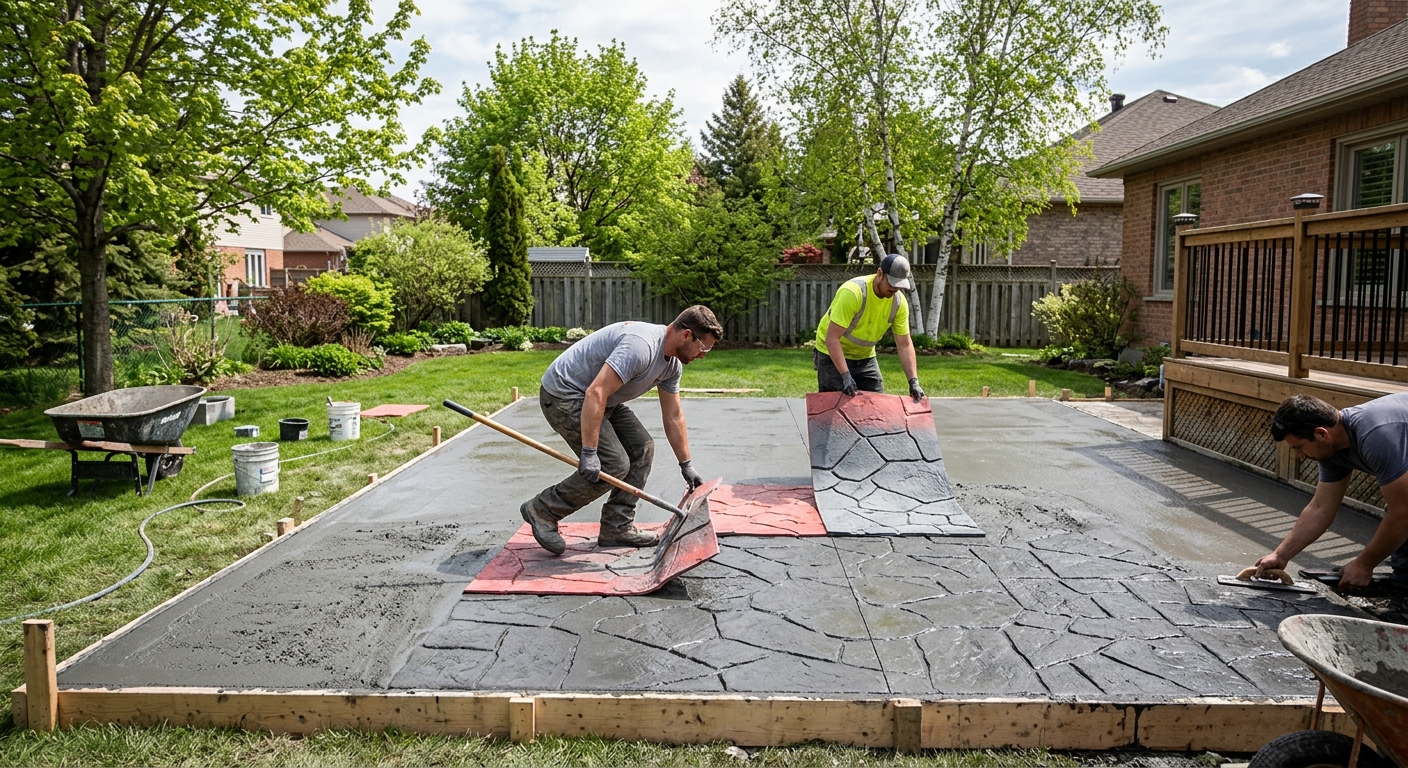
| Stamped concrete driveway or patio |
12 ft x 22 ft driveway pad (264 sq. ft.) or patio 300 sq. ft. |
Air-entrained mix, release agent, wear coating |
Stamped pattern + colour |
$15,000–$26,000 |
| Plain concrete patio or walkway |
10 ft x 14 ft (140 sq. ft.) walkway varies |
Exterior slab thickness, air-entrainment, base compaction |
Plain float + broom edge |
$5,000–$9,000 |
| Garage floor (interior slab) |
22 ft x 20 ft (440 sq. ft.) |
Vapour barrier (as applicable), steel reinforcement, controlled curing |
Plain / broom-ready finish |
$10,000–$16,000 |
| Foundation footings (structural, below frost) |
House/garage footprint varies |
Below design frost depth, reinforced concrete, engineered formwork |
Structural concrete |
$28,000–$45,000 |
Prices are estimates only and vary by project scope, site access and material selection.
What affects the price of concrete work in Suder Greens
Even when homeowners ask for the “same” concrete driveway or patio, quotes can vary by 30–50% across the Calgary region and Alberta because the real drivers aren’t only concrete—they’re excavation, base preparation, reinforcement, mix design, and curing protection. In a cold continental climate, contractors also price risk: if the schedule slips into late fall or early spring, winter-grade placement and curing measures become non-negotiable to protect long-term durability.
Frost and freeze–thaw cycles dictate nearly every specification here. With a design frost depth of about 1.2 m (roughly 4 ft), footings for houses, garages and retaining structures must extend below undisturbed soil to reduce frost heave and seasonal movement. That deeper bearing also means more intensive excavation and higher concrete volumes, pushing foundation work toward the lower to mid range of $28,000–$45,000. For exterior slabs—driveways, patios and walkways—Calgary-area practice relies on air-entrained mixes and well-spaced control joints to manage cracking and surface scaling during repeated freeze–thaw cycles. It’s why a standard broom driveway may land near the $12,000–$18,000 band, while decorative options like stamped or exposed aggregate usually cost more due to materials, finishing time, and added surface protection.
Two common Suder Greens examples: (1) If your driveway ties into existing grades, the contractor may need extra forms and additional base thickness to keep drainage correct—this can add a noticeable cost. (2) If de-icing salt will be used heavily, the job should include proper sealing timing and surface prep; otherwise, you can pay twice through early spalling or scaling. Housing stock also matters: newer builds sometimes have easier access and cleaner base conditions, while older properties with mature landscaping often require more removal, haul-off, and re-grading.
| Price Factor |
Why It Matters |
Cost Impact |
| Frost line depth |
Determines footing depth and form height |
Higher excavation and formwork; can push foundation pricing upward within the $28,000–$45,000 band |
| Site preparation |
Excavation, grading, compacted granular base |
More dig/haul and base replacement increases labour and material; often the biggest variation between quotes |
| Reinforcement |
Rebar or wire mesh requirement |
Adds material cost and labour; skipping reinforcement in load areas increases failure risk |
| Mix design |
Air-entrainment and compressive strength spec |
Winter-grade mixes and correct air content can raise cost but materially improves freeze–thaw durability |
| Finish type |
Broom vs. stamped vs. exposed aggregate |
Stamped/exposed requires specialized labour and materials; typically shifts projects from the lower to upper exterior bands |
| Pour size and concrete truck access to site |
Distance from truck to forms impacts handling time |
Limited access may require smaller loads or extra labour, increasing total cost |
| Cold-weather curing precautions |
Heating and blankets |
Can add day-to-day labour and equipment; essential when temperatures threaten curing |
| Control joint pattern and sealing cost |
Controls cracking and reduces salt/water attack |
Good detailing and sealing cost more upfront, but reduces the chance of early scaling |
Permits & regulations in Alberta
In Alberta, structural concrete work typically falls under the permit and inspection process, while most cosmetic or typical flatwork generally does not. For homeowners in Suder Greens, the key difference is whether the concrete is part of the structural system or whether it materially changes site grading and drainage. Concrete elements such as foundation footings, foundation walls, grade beams, and engineered structural members normally require a building permit. Those structural elements often also require engineered drawings or design confirmation that the municipality reviews as part of the permit process.
Concrete flatwork—patios, walkways, standard driveways, and interior garage slabs—usually does not require a separate permit. However, you should expect to check for requirements when the work impacts lot grading, changes stormwater flow, alters impervious surface coverage limits, or involves municipal right-of-way or boulevard areas.
To verify a contractor properly, use a simple step-by-step approach:
- Confirm the contractor’s credentials and business details (they should provide a clear Alberta business contact and project references).
- Ask for a current Certificate of Insurance showing general liability coverage and ensure the effective dates cover your pour.
- Request proof of WSIB/WCB coverage (or the appropriate clearance documentation for their operations in Alberta).
- Get your project scope in writing and confirm who pulls permits (if applicable) and who pays for inspections.
- Verify they’ve completed similar-size footings and exterior slabs in cold-weather conditions.
Before breaking ground, always confirm permit expectations with the local authority and ensure your contractor carries proper coverage for the specific work being done.
Getting concrete right in Suder Greens's freeze-thaw climate
Concrete can fail in Suder Greens mainly because freeze–thaw cycles push water in and out of the slab and paste. When the base isn’t well compacted or the mix isn’t properly air-entrained, the surface can scale and the concrete can spall—often showing up after a couple winters rather than immediately. The way we spec and build in Calgary-area conditions is designed to prevent that: (1) base preparation must be compacted to the right depth so the slab remains stable below the active frost zone; (2) the mix must include air entrainment and meet strength requirements for exterior exposure; (3) control joints must be placed and sealed properly to guide cracking; (4) curing must be protected long enough to develop strength; and (5) sealing should be timed correctly to repel water and de-icing salts.
For exterior flatwork, we typically target 5–7% air content for air-entrained concrete and a minimum compressive strength of 32 MPa so the paste has the durability needed for freeze–thaw. Control joints are spaced to limit random cracking, and we plan curing protection when temperatures drop. Sealer is generally applied after proper cure—commonly at 28 days—so it can perform as intended.
One dollar example: a homeowner comparing a basic broom-finish driveway to a stamped driveway may see a bigger difference than expected at first glance. If standard broom work lands around $12,000–$18,000 but stamped comes in near the $15,000–$26,000 band, the upgrade can be justified when the decorative finish includes correct air-entrainment, proper base, and a wear-friendly seal system. Without those durability elements, decorative work doesn’t protect the structure—it only makes surface cracking more noticeable.
Ask your contractor specifically how they prevent spalling (not just how it looks). In this climate, adequate air-entrainment is a primary line of defence.
| Spec |
Why It Matters in Suder Greens |
What to Ask For |
Impact if Skipped |
| Compacted granular base (depth?) |
Supports the slab and helps keep it stable through frost movement |
Confirm excavation depth, compacted granular sub-base thickness, and compaction testing method |
Settlement and cracking; increased risk of spalling as water migrates |
| Air-entrained concrete mix (target air %?) |
Creates freeze–thaw resistance by providing relief pathways in the paste |
Request air content target (commonly 5–7% for exterior flatwork) and whether it’s winter-rated if needed |
Higher likelihood of scaling and spalling over successive winters |
| Compressive strength (MPa rating) |
Ensures the concrete reaches adequate durability and load capacity |
Specify minimum 32 MPa and curing/temperature plan to achieve it |
Surface wear, reduced durability, and premature deterioration |
| Control joints (spacing per ACI guidelines) |
Controls where cracking occurs as temperatures and moisture change |
Ask for joint spacing plan, saw-cut timing, and sealing approach |
Random cracking; water intrusion; faster deterioration at crack lines |
| Minimum 7-day curing period |
Strength development supports long-term performance in cold weather |
Confirm cure time, blanket/heating plan when cold nights occur, and test/verification approach |
Scaling and surface weakness; increased long-term failure risk |
| Penetrating sealer (when applied after cure) |
Helps repel moisture and de-icing salts that accelerate surface breakdown |
Ask for penetrating sealer and application timing (commonly after full cure, about 28 days) |
Faster salt/water damage and earlier spalling/scaling cycles |
How to choose a concrete work contractor in Suder Greens
Choosing the right contractor matters more in Suder Greens than in warmer areas because the freeze–thaw environment punishes shortcuts. Start by verifying Alberta compliance and coverage. Ask for proof of liability insurance (Certificate of Insurance with valid effective dates) so you’re protected if damage occurs during excavation or formwork. Then request WSIB/WCB clearance or documentation for their workers and subcontractors working on your site. Don’t accept “we’ll take care of it”—get the paper and verify the dates cover your project period.
Next, get 2–3 itemised written quotes. You want line items that show labour vs materials and should clearly outline scope such as excavation, disposal/haul-off, granular base, reinforcement, concrete type (including air entrainment), finishing, and curing protection. Avoid comparing only lump sums—two quotes can look close while one includes adequate base prep and cold-weather curing and the other doesn’t.
Read the exclusions section carefully: is permit pulling included (if needed), is disposal included, and is saw-cut control joint sealing included? Confirm warranty details: a workmanship warranty should be spelled out (length and what’s covered), and any product/manufacturer warranty should be documented. Understand payment scheduling too—never pay more than 10–15% upfront, and hold back payment until the surface and joints are finished and cleaned. Finally, ask for a start date and a written completion estimate, not just “we’ll do it soon.”
- Ask for recent photos of similar Suder Greens or Calgary-area cold-weather pours.
- Confirm they will design/engineer for below-frost bearing for footings.
- Request the mix specification: air content and strength target.
- Ask how they protect curing in cold snaps (blankets/heating).
- Verify granular base type, depth, and compacted lift approach.
- Confirm reinforcement plans (mesh vs rebar) for your slab type.
- Make sure control joints and saw-cut timing are included.
- Ask if a penetrating sealer is included and when it will be applied (post-cure).
- Confirm disposal/haul-off and site restoration are in the quote.
- Check whether truck access constraints are addressed in the plan.
- Get warranty terms in writing and ask if it’s transferable if you sell.
- Confirm the schedule is realistic for Suder Greens temperatures.
Red flags: “too-good-to-be-true” pricing compared to typical bands, vague specs (no air-entrainment/strength details), refusal to provide insurance/WSIB/WCB proof, no clear curing plan in shoulder-season weather, and missing details on base depth or control joints—these omissions are where early cracking and spalling usually start.
Frequently asked questions — concrete work in Suder Greens
How do I seal concrete to protect it in Suder Greens?
In Suder Greens (Alberta), sealing is about resisting moisture and de-icing salts that drive freeze–thaw damage. After your concrete is fully cured, typically around 28 days for exterior slabs, apply a penetrating sealer designed for freeze–thaw exposure. The surface should be clean and dry—no dust, mud or leftover curing compounds—so the sealer can soak in rather than just sit on top. If your driveway or patio sees heavy winter salt use, sealing is especially valuable because it slows water absorption into tiny pores, which helps reduce scaling and early spalling. If your contractor offers a sealer, ask which product type they use (penetrating vs film-forming), who applies it and what the warranty covers.
What is the difference between concrete and cement?
In plain terms, cement is one ingredient, while concrete is the finished building material. Cement is the binding component made from clinker and other additives; when you mix cement with water, sand and gravel (and sometimes admixtures), you create concrete. For exterior work in Suder Greens, contractors specify not just strength, but performance features like air-entrainment and durability under freeze–thaw cycles. That means the “mix design” includes the total formulation—cement content, water-to-cement ratio, air entrainment (commonly 5–7% for exterior flatwork), and sometimes winter-grade adjustments. So when you compare quotes, don’t just ask “cement type”—ask for the mix specification and whether they are using an air-entrained exterior mix suitable for Calgary-area winters.
How much does concrete work cost in Suder Greens?
Costs in Suder Greens generally track the Calgary-area pricing bands, because the same climate engineering applies. For example, a standard broom-finish driveway often falls around $12,000–$18,000 depending on size, excavation, and how difficult the access is. Plain patios and walkways commonly land in the $5,000–$9,000 range depending on square footage and base prep needs. Foundations/footings are typically more substantial—often $28,000–$45,000—because footings must bear below the design frost depth (about 1.2 m), which increases excavation and reinforced concrete volumes. Decorative work like stamped concrete is usually higher, commonly in the $15,000–$26,000 band due to specialized finishing time and materials. Your site conditions and schedule window will be the biggest swing factors.
How deep must footings be for Suder Greens's frost line?
For Suder Greens and the Calgary region, design practice uses a frost depth of about 1.2 m (roughly 4 ft). In practical terms, that means exterior structural footings for houses, garages and retaining structures should be founded below that depth on undisturbed soil to help prevent frost heave and seasonal movement. The exact elevation can vary based on your engineered drawings, soil conditions, and the finished grade plan for your specific build. This is why you should avoid “rule-of-thumb” footing depths; ask your builder or engineer to confirm footing bearing elevation relative to the local frost depth and your site. If someone quotes foundation work without discussing below-frost bearing and engineered reinforcement requirements, it’s a risk in Alberta’s freeze–thaw climate.
Why does concrete crack in Suder Greens and how is it prevented?
Concrete cracks are common in Suder Greens because temperature and moisture changes cause shrinkage and expansion, and Alberta’s freeze–thaw cycles can stress the slab repeatedly. The most damaging cracks are uncontrolled ones that allow water to enter, freeze, and worsen the deterioration. Prevention comes from proper base prep (compacted granular sub-base), correct mix design (including air-entrainment for durability), and a deliberate control joint pattern sized for the slab. Control joints are designed to make the slab crack where it’s planned, not randomly. In exterior work, sealing after cure also helps slow water and de-icer salt penetration. When your contractor includes control joints, appropriate saw-cut timing, and air-entrained exterior concrete, the cracking you do see is usually narrower and less harmful.
Stamped vs broom-finish concrete — cost difference?
Stamped concrete typically costs more than broom-finish because it involves additional materials and significantly more finishing labour. A standard broom driveway often sits around $12,000–$18,000 for typical Suder Greens sizes, while stamped concrete is commonly in the $15,000–$26,000 range due to pattern mats, release agents, colour hardeners/integral colouring options, and finishing time. The key point in Calgary-area freeze–thaw: decorative work must still be built for durability—correct air-entrainment, adequate base compaction, reinforcement where needed, proper curing, and then sealing after cure. If a contractor tries to “save money” by cutting those durability specs, the stamped surface will still suffer scaling or spalling over winters even though it looks nicer at first.