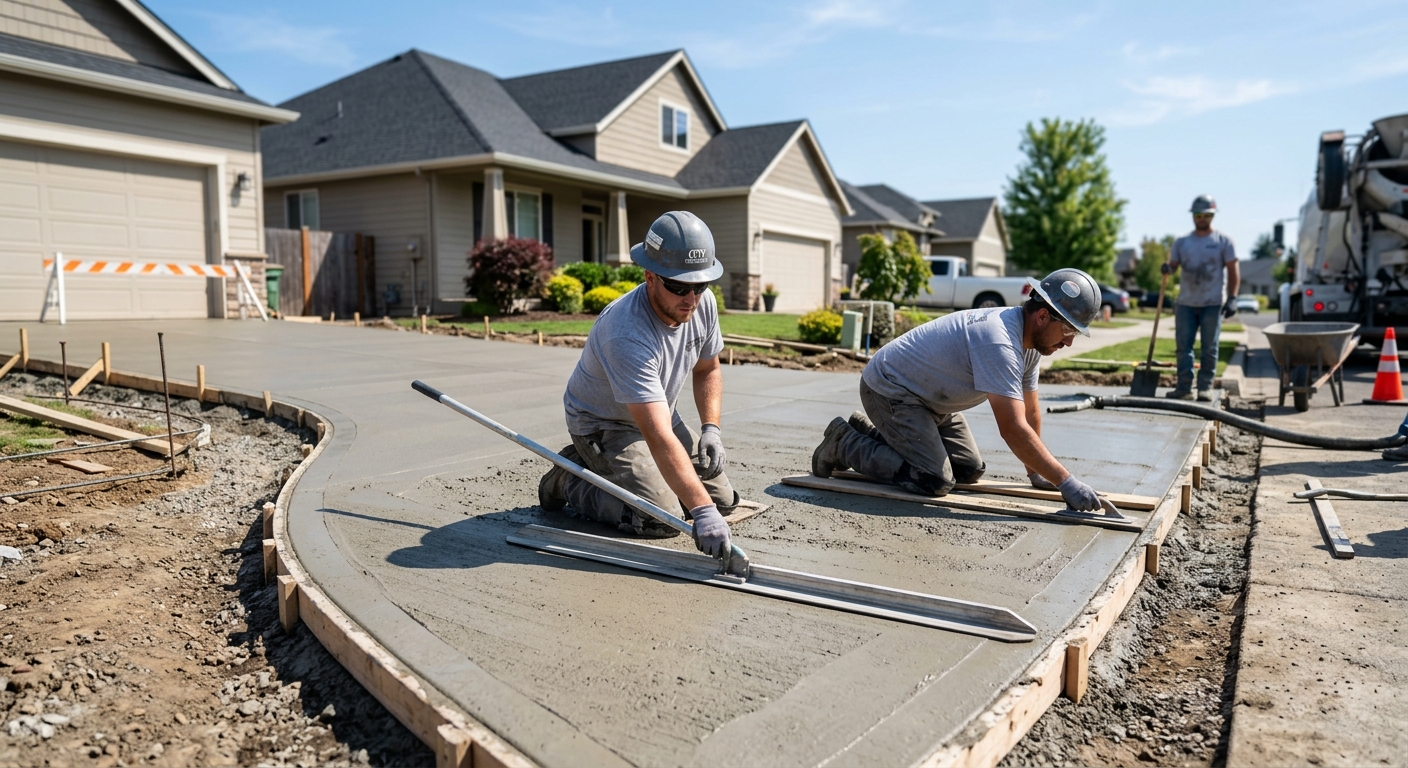
Concrete work options and costs in Rosedale
Rosedale homeowners typically choose concrete for driveways, patios, walkways and foundations because it’s durable and predictable—when it’s designed for our climate. Rosedale is a small community (population 1,495, Statistics Canada, 2021 Census), and a lot of the concrete work demand comes from the housing types that define the area, especially single-detached homes that need long-lasting flatwork and solid foundation performance. In the Calgary area, concrete contractors stay busy in neighbourhood clusters such as Rosedale Estates where driveways and rear-yard patios get rebuilt or expanded after landscaping refreshes.
Pricing in Rosedale is strongly shaped by Calgary’s cold continental winters. The design frost depth is about 1.2 m (roughly 4 ft), so footings must sit on undisturbed soil below that level to reduce frost heave and seasonal movement. Freeze–thaw cycles are frequent, which means exterior slabs need air-entrained mixes and a careful control-joint plan to limit random cracking and surface scaling. Compared with warmer regions, excavation is more intensive and footing volumes are higher—so foundation costs are typically higher than you might see in milder parts of Canada.
Labour availability and the placement window also matter: the practical pour season for exterior slabs is shorter, and cold-weather curing (insulated blankets, winter-grade mixes, sometimes heated enclosures) can add cost. That’s why the same driveway size can land in different budget bands depending on finish choice and schedule timing. Below is a realistic comparison of common options so you can line up expectations before you request quotes.
| Application |
Typical Size |
Key Spec |
Finish Option |
Price Range |
| Concrete driveway (standard broom finish) |
10 m x 3.5 m (about 35 m²) |
Air-entrained mix, compacted base, control joints |
Broom finish, light saw-cut joints |
$12,000–$18,000 |
| Exposed aggregate driveway |
10 m x 3.5 m (about 35 m²) |
Air-entrained mix, washed aggregate exposure, sealed |
Exposed aggregate finish for texture and slip resistance |
$16,000–$22,500 |
| Stamped concrete driveway or patio |
10 m x 3.0 m (about 30 m²) outdoor |
Air-entrained mix, integral colour or stain, release & detailing |
Stone/brick stamp patterns |
$15,000–$26,000 |
| Plain concrete patio or walkway |
5 m x 4 m (about 20 m²) |
Air-entrained mix, compacted base, light broom texture |
Plain finish with saw-cut joints |
$5,000–$9,000 |
| Garage floor (interior slab) |
6 m x 6 m (about 36 m²) |
Vapour control where needed, base prep, typically reinforced |
Standard finish (broom or trowel-lite) |
$7,000–$13,000 |
| Foundation footings (structural, below frost) |
Typical house perimeter (varies) |
Structural concrete, rebar per engineering, below ~1.2 m frost depth |
Structural formwork, tied rebar, engineered embedments |
$28,000–$45,000 |
Prices are estimates only and vary by project scope, site access and material selection.
What affects the price of concrete work in Rosedale
In Rosedale and the broader Calgary market, it’s common to see quotes for the “same” concrete project come in 30–50% apart once you look past the surface size and into the details. The biggest drivers are frost depth requirements, freeze–thaw durability specs, and how much preparation and curing protection the contractor builds into the price. In our region, footings for houses, garages, decks and retaining structures are designed around a frost depth of about 1.2 m, which pushes excavation deeper and increases foundation concrete volumes versus areas where frost is shallower.
Freeze–thaw cycles also dictate mix design and joint strategy. Exterior slabs need air-entrained concrete so the hardened surface resists scaling and spalling over winters. If cold-weather placement happens in late fall or early spring, the job may require winter-grade measures—insulated blankets, controlled curing, and sometimes temporary heat—to achieve proper strength gain. That curing window is non-negotiable in a climate that repeatedly freezes and thaws.
Two quick examples from local conditions: if your driveway ties into existing asphalt with limited access, costs often climb because crews spend more time on traffic staging and careful edge work; your driveway budget may still fall within the $12,000–$18,000 band for a standard broom finish, but add-ons like exposed aggregate can push toward higher totals. On the other hand, a straightforward backyard walkway with good truck access can land toward the low end of the $5,000–$9,000 patio/walkway range because there’s less excavation and fewer constraints. Lastly, many Rosedale homes have older grading patterns around the house—if drainage management is poor, contractors may recommend additional base and slope corrections, which raises foundation and slab prep costs.
| Price Factor |
Why It Matters |
Cost Impact |
| Frost line depth — determines footing depth and form height |
Footings must sit below the design frost zone to reduce heave |
Higher excavation and concrete volume; often the single biggest driver for foundations |
| Site preparation — excavation, grading, compacted granular base |
Concrete longevity depends on stable, properly compacted sub-base |
Extra depth, haul/disposal, and re-compaction can add substantial labour |
| Reinforcement — rebar or wire mesh requirement |
Controls cracking and improves load capacity |
Steel and tying time increase cost, especially for garage slabs and larger driveways |
| Mix design — air-entrainment and compressive strength spec |
Freeze–thaw resistance and durability in winter road-salt conditions |
Winter and air-entrained requirements can raise material costs and planning time |
| Finish type — broom vs. stamped vs. exposed aggregate |
Labour intensity and materials for texture, colour and tooling |
Standard broom is usually least; stamped/exposed can add significant labour and supplies |
| Pour size and concrete truck access to site |
Access affects pump use, hose lengths, staging and schedule |
Poor access can increase labour and risk of cold joints |
| Cold-weather curing precautions — heating and blankets |
Proper curing is harder when temperatures drop overnight |
Insulation/heating adds cost but prevents early scaling and long-term defects |
| Control joint pattern and sealing cost |
Joints manage shrinkage; sealing helps repel de-icing salts |
More joints and a scheduled seal can add a modest line item that protects the surface |
Permits & regulations in Alberta
In Alberta, structural concrete work typically requires oversight because it becomes part of the building’s engineered load path. For Rosedale homeowners, that usually means the projects that DO require a building permit include: foundation footings, foundation walls, grade beams, underpinning, and other below-grade structural concrete. These jobs often need engineered drawings and municipal review, especially where rebar placement, embedments, and bearing conditions are involved.
Concrete flatwork such as driveways, patios and walkways usually DO NOT require a permit on its own, provided it doesn’t change drainage in a way that conflicts with municipal requirements, alter lot grading, or exceed any impervious surface/coverage limits. Even when permits aren’t required, site rules around drainage, right-of-way, and accessibility can still apply—so confirm with the local authority before breaking ground.
Step-by-step, here’s how you verify a contractor in Rosedale/Alberta: (1) ask for their business licence number or proof of registration (and confirm it matches the company name on the quote); (2) request a certificate of liability insurance and verify coverage is current and adequate; (3) confirm they carry the required worker coverage (WSIB/WCB) for their crew; (4) check that the certificate lists your project address where applicable and review any exclusions; (5) ask for references on similar-scale Calgary-area jobs with freeze–thaw exposure. A reputable contractor will provide these documents quickly and transparently.
Getting concrete right in Rosedale's freeze-thaw climate
Concrete failures in Rosedale are usually preventable, but the root causes are very specific to freeze–thaw. The most common issues we see after harsh winters are surface scaling, spalling, and random cracking. Those problems usually trace back to three gaps: base prep that wasn’t compacted to the right depth, a mix that wasn’t properly air-entrained, and curing that was rushed or done in cold conditions without protection. In a cold continental climate, our design approach relies on footings and exterior elements being engineered for frost performance—remember, the design frost depth in this region is about 1.2 m, so inadequate excavation or shallow bearing invites movement that stresses slabs and edges.
To spec the job correctly, insist on: (1) compacted granular base to the designed thickness for your soil and frost conditions; (2) an air-entrained mix—for exterior flatwork, a typical target is about 5–7% air—with a minimum 32 MPa compressive strength specification; (3) a control joint plan that limits random cracking; (4) minimum 7 days curing under proper conditions, with cold-weather precautions when temperatures drop; and (5) sealing after cure to repel de-icing salts.
Ask direct technical questions about freeze–thaw durability, especially air entrainment. For example, if you’re deciding between a standard broom driveway and a decorative finish, paying for a properly engineered mix and curing is what makes either option last. A stamped driveway can cost more (often within the $15,000–$26,000 band), but the price difference isn’t “just aesthetics”—it’s additional labour and finishing steps. If a contractor tries to discount by skipping air entrainment or rushing cure, that’s where you lose durability later.
| Spec |
Why It Matters in Rosedale |
What to Ask For |
Impact if Skipped |
| Compacted granular base (depth?) |
Stable support reduces settlement and cracking under winter freeze cycles |
Base thickness based on your soil and design, plus compaction testing or proof of compaction |
Uneven settlement, edge failure, faster cracking |
| Air-entrained concrete mix (target air %?) |
Air entrainment helps concrete survive freeze–thaw without scaling and spalling |
Confirm target air content for exterior exposure (typically 5–7% for exterior flatwork) |
Surface scaling/spalling in winter, especially with de-icing salt |
| Compressive strength (MPa rating) |
Adequate strength ensures long-term durability and load capacity |
Minimum 32 MPa compressive strength (or higher if specified by design) |
Premature wear, reduced durability and cracking risk |
| Control joints (spacing per ACI guidelines) |
Joints manage shrinkage so cracking stays where you planned it |
Joint spacing and saw-cut timing plan that matches slab thickness and layout |
Random cracking patterns and possible water infiltration at cracks |
| Minimum 7-day curing period |
Cold nights and rapid temperature swings can stop proper strength gain |
How curing will be protected; winter curing method if temperatures are near/under freezing |
Weak surface, scaling, and long-term strength loss |
| Penetrating sealer (when applied after cure) |
Sealer helps repel de-icing salts and slows moisture ingress |
Penetrating sealer application 28 days after pour (or per manufacturer directions) |
Accelerated surface deterioration and spalling risk |
How to choose a concrete work contractor in Rosedale
Choosing the right contractor matters more in Rosedale than in milder parts of Canada because the “cheap” option often cuts into base prep, mix design, air entrainment, or winter curing. Start by verifying Alberta-related credentials: ask for their contractor registration/business licence information and confirm the company details match the quote. Next, request a current certificate of liability insurance—read the expiry date and coverage limits, and ensure it’s issued to the correct business name. Finally, confirm they carry the required worker coverage (WSIB/WCB) so you’re not exposed if someone is injured on site. If they can’t produce documents quickly, treat that as a red flag.
Get 2–3 itemised written quotes that break out labour and materials (excavation/granular base, rebar/mesh, formwork, concrete supply, finishing, saw cutting, curing protection, and sealing). Avoid a one-line lump sum unless the scope is crystal clear. Review what’s included and what’s excluded: permit pull (if required for structural concrete), disposal/haul-away, pump vs. truck placement, moisture barrier/vapour control for interior slabs, and whether they handle reinstatement for landscaping edges.
Warranty also needs specifics. Ask for a workmanship warranty length and whether it’s tied to conditions like proper maintenance and sealing schedule. Is the product/manufacturer warranty separate? Is it transferable? Payment should be controlled—never pay more than about 10–15% upfront, and hold a portion back until completion and cleanup. Also insist on a written timeline with a start date and completion estimate, especially because Calgary winter planning affects curing.
- Ask for air-entrainment and curing details in writing (not just “we’ll use standard concrete”).
- Request a detailed scope: base depth, compaction approach, and disposal/haul-away.
- Confirm reinforcement type: rebar vs. wire mesh, tie-in locations, and cover.
- Verify joint pattern: spacing and saw-cut timing for exterior slabs.
- Ask who supplies and places the concrete (and whether winter-grade measures are included).
- Require cold-weather curing measures in the quote if work might extend into shoulder seasons.
- Confirm sealing plan: whether a penetrating sealer is included and when it will be applied.
- Check that the contractor’s insurance and WCB/WSIB coverage match the project dates.
- Get clarification on rework policy if cracking occurs within the warranty period.
- Ensure the quote includes site access plan (truck placement, hose lengths, or pump if needed).
- Verify cleanup and edge reinstatement are included (topsoil/seed, if disturbed).
- Use a written payment schedule tied to milestones—not just “deposit and done.”
Red flags I watch for in Rosedale: contractors who won’t discuss frost and air-entrainment specs; quotes that don’t mention curing protection for cold weather; “unlimited warranty” promises with no written terms; cash-only requests or missing insurance/WSIB/WCB documentation; and finishing techniques that skip control joints or sealing where de-icing salt exposure is expected.
Frequently asked questions — concrete work in Rosedale
How do I maintain concrete in Rosedale's freeze-thaw climate?
In Rosedale, maintenance is mostly about managing moisture and de-icing salt exposure so freeze–thaw can’t break down the surface. First, keep the area clear of standing water and fix any drainage issues near edges—water that sits against a slab or steps will amplify cracking and spalling. Second, use de-icing products carefully (and consider sand for traction rather than heavy salt loads). Third, if your driveway or walkway is older or newly sealed, re-check the sealer performance; penetrating sealers are typically applied around 28 days post-pour, and they need periodic refresh depending on traffic and winter chemical exposure. If you’re budgeting, a standard broom driveway often sits around $12,000–$18,000, and sealing is a smart add-on because it protects that surface investment through Calgary winters.
What causes concrete to spall in Rosedale winters?
Spalling in Alberta winters is usually a freeze–thaw durability problem. The most common cause is inadequate air entrainment: without the right air content, water that enters pores during wet conditions freezes, expands, and breaks off the surface paste layer—especially when de-icing salt is present. A second frequent cause is rushing curing after placement in cold weather. If concrete doesn’t cure long enough or isn’t protected with insulated blankets/heating when temperatures drop, the surface can be weaker and more vulnerable to scaling. Third, poor base preparation or settlement can stress the surface and create micro-cracks that turn into spalling pathways. If you’re comparing options, stamped or exposed work can be pricier (often within the $15,000–$26,000 band), but it’s only worth it when the contractor delivers the right mix and curing to survive freeze–thaw.
What is rebar and when is it required in Alberta?
Rebar (reinforcing bar) is steel placed inside concrete to control cracking and improve structural capacity. In Alberta, whether rebar is required depends on engineering design, slab thickness, soil conditions, and the load the slab must carry—not just on a “typical” rule. For example, foundation footings and grade beams are structural elements and are almost always designed with rebar per engineered drawings. Garage floors and exterior slabs may also require reinforcement, especially where loads are higher (vehicles, heavy equipment) or where the slab design specifies it. In Rosedale, the freeze–thaw climate makes stable support critical; if the base is weak, even reinforced slabs can crack, but they usually perform better than plain concrete. Always require the contractor to state the reinforcement type and placement plan in the quote, particularly for structural work.
How long does a concrete project take in Rosedale?
Timeline depends on scope, access, and weather, but Calgary-area scheduling follows concrete placement realities and curing needs. Small interior slabs (like a typical garage floor) can often be completed in a few days for the pour and finishing, with curing/strength gain continuing after that. Exterior flatwork varies more because excavation, forming, base compaction, and joint cutting are weather-sensitive. Even when work is physically done quickly, the concrete still needs proper curing; many contractors target at least a 7-day curing period before assuming full performance, and sealing typically waits until the concrete has cured (commonly around 28 days). Weather planning matters in Alberta: if temperatures are near freezing, winter-grade placement measures can extend the schedule. If you’re budgeting, it’s normal to get a start window and finishing plan in writing—especially in shoulder season—so the crew can protect curing and avoid long-term scaling.
What is a concrete overlay and is it suited to Rosedale?
A concrete overlay is a new concrete layer placed on top of an existing slab after surface preparation. It can be an option when the existing driveway is mostly sound but has surface wear, minor deterioration, or uneven colour/texture. In Rosedale and Calgary’s freeze–thaw climate, overlay suitability depends heavily on the condition of the original slab: if there are major structural cracks, significant settlement, or water-holding problems, an overlay may fail because it can’t “fix” movement below. Proper grinding/prep, bonding method (where applicable), and ensuring joints and drainage remain functional are critical. For many homeowners, replacing a damaged section fully is more reliable, particularly at edges exposed to salt and thaw cycles. If you’re weighing cost, overlays can sometimes cost less than full replacement, but I’d still confirm durability specs (air entrainment, curing protection, and joint pattern) before you sign off—those determine whether it survives winter.
How do I seal concrete to protect it in Rosedale?
Sealing helps protect against moisture ingress and can slow down the surface damage driven by de-icing salts in Rosedale winters. The key timing rule is that you should seal after the concrete has cured—commonly about 28 days post-pour or per the sealer manufacturer’s directions. Before sealing, the surface needs to be clean and dry; curing residue and trapped moisture can prevent proper penetration. Choose a penetrating sealer designed for exterior concrete; it should repel water rather than just forming a surface film. After sealing, maintain it by cleaning off salt residue and avoiding heavy salt loads where practical. If you’re planning a driveway in the $12,000–$18,000 standard broom range, sealing is often one of the best “protect the investment” steps you can add, especially given Calgary’s frequent freeze–thaw cycles.