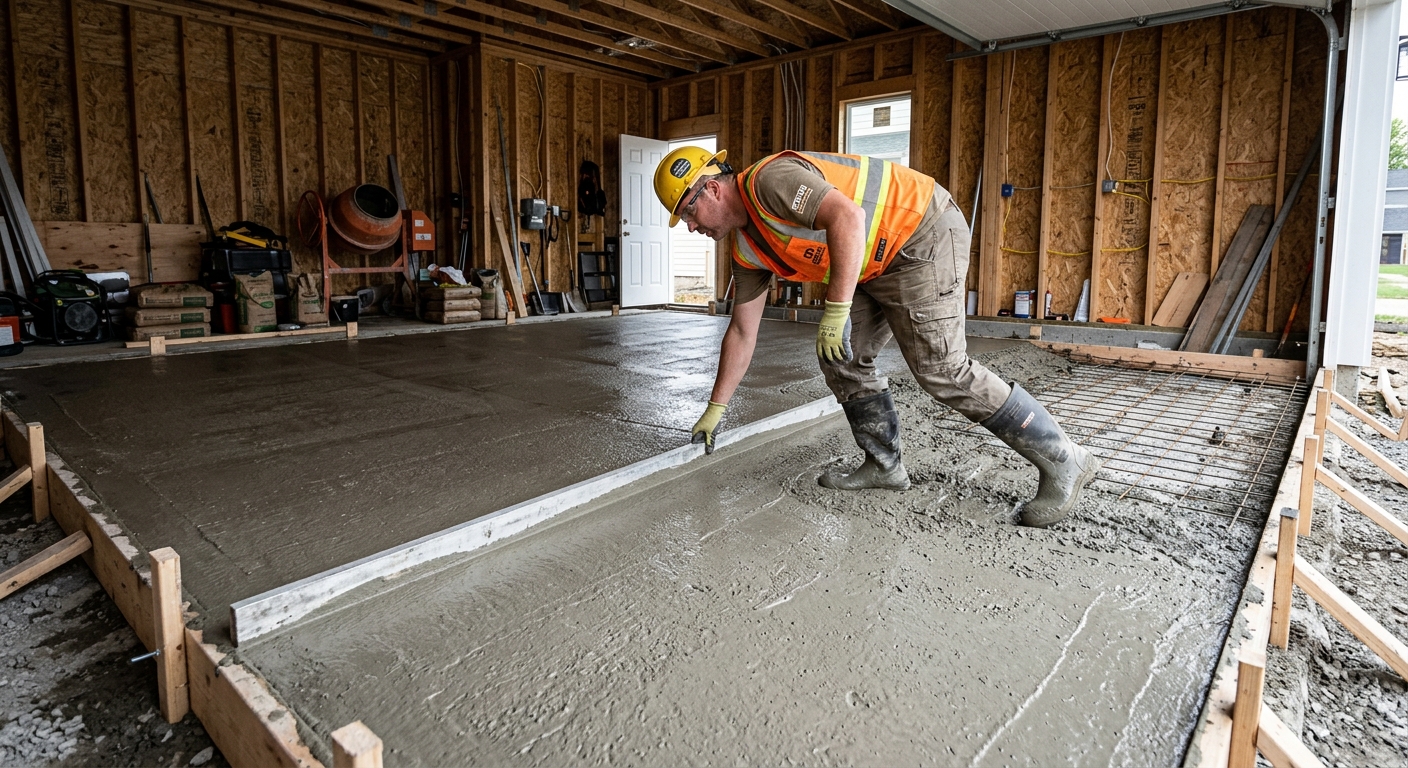
Concrete work options and costs in Whitehorn
Whitehorn is a growing community in Calgary’s northeast, and concrete flatwork shows up constantly on streets and cul-de-sacs where new builds and home upgrades are happening. With a Whitehorn population of 11,085 (Statistics Canada, 2021 Census), you’ll feel demand for driveways, patios, walkway replacements, and garage slabs—work that tends to be busiest where homeowners are modernizing older lots and where new single-detached homes are being completed. The area also sits in a cold continental climate, so every quote has to budget for frost protection, proper base compaction, and air-entrained mixes built to handle freeze–thaw cycles.
In Calgary, the cost difference you see between contractors is often tied to how they engineer around frost and seasonal movement. For footings and any structural concrete, local engineering practice targets bearing below the design frost depth (about 1.2 m / 4 ft), which means more excavation and higher foundation volumes than in milder regions. For exterior slabs like driveways and patios, freeze–thaw drives granular base prep, control joints, and curing discipline—pouring too late in the season or skipping cold-weather curing precautions can raise long-term maintenance costs.
In Whitehorn—especially around the newer pockets near Saddlecrest and the Highway 9/Deerfoot corridor side—contractors are in demand because lots are getting upgraded quickly. The result: you can usually get multiple options at different price points, from standard broom finishes to decorative stamped systems.
Use the table below to compare the common options and realistic cost ranges for your project.
| Application |
Typical Size |
Key Spec |
Finish Option |
Price Range |
| Concrete driveway (standard broom finish) |
480 sq. ft. (22' x 22') |
Air-entrained mix, granular base, control joints |
Broom finish, light sealer recommended |
$12,000–$18,000 |
| Exposed aggregate driveway |
480 sq. ft. (22' x 22') |
Air-entrained mix, proper surface retarder timing |
Exposed aggregate (2–3 colour options) |
$15,000–$21,000 |
| Stamped concrete driveway or patio |
300 sq. ft. (20' x 15') |
Air-entrained mix, integral colour, reinforcement as needed |
Stamped pattern (ashlar/fieldstone style) |
$15,000–$26,000 |
| Plain concrete patio or walkway |
180 sq. ft. (12' x 15') |
Air-entrained mix, compacted base, joints |
Broom or steel-trowel finish (non-slip texture) |
$5,000–$9,000 |
| Garage floor (interior slab) |
400 sq. ft. (20' x 20') |
Vapour barrier, reinforcement, proper curing |
Plain broom or lightly trowelled finish |
$8,500–$14,000 |
| Foundation footings (structural, below frost) |
Typical house footprint |
Excavation to below frost, rebar, engineered dimensions |
Structural concrete (no finish) |
$28,000–$45,000 |
Prices are estimates only and vary by project scope, site access and material selection.
What affects the price of concrete work in Whitehorn
Even when homeowners describe the “same” concrete job in Whitehorn, quotes can vary by 30–50% across Calgary and Alberta because the biggest cost drivers—excavation conditions, frost protection requirements, reinforcement, and finishing scope—aren’t always visible until the contractor prices them with a site visit. Some contractors price to the surface (pour and finish), while others price the full engineering package that keeps concrete stable through freeze–thaw.
In our region, frost depth and freeze–thaw cycles dictate the spec. Footings must extend below the design frost depth (about 1.2 m / 4 ft) so the concrete bears on undisturbed soil and doesn’t heave seasonally. Exterior slabs also require air-entrained concrete mixes to survive repeated expansion and contraction. Calgary’s shorter practical pour season means cold-weather placement often requires cold-weather curing precautions—insulated blankets, sometimes heat—so the concrete reaches strength before weather becomes a problem. Finally, de-icing salt accelerates surface scaling if the mix and curing aren’t right; sealing is often the difference between “looks fine now” and “spalls after a couple winters.”
In Whitehorn, costs can jump if your driveway needs deeper excavation for a stable base, if you have soft landscaping fill or drainage issues, or if access limits truck placement (extra labour and smaller pour logistics). A simple patio replacement on firm, accessible grade can land near the $5,000–$9,000 band, while decorative upgrades like stamped work can justify stepping into the $15,000–$26,000 band because of added labour for forms, pattern work, and integral colour/finishing.
Home age matters too: older sites often have unknown base conditions under existing slabs. If the slab removal turns into more excavation, the foundation and flatwork cost pressure increases quickly—sometimes by thousands—because the “hidden” ground prep is where most of the labour is.
| Price Factor |
Why It Matters |
Cost Impact |
| Frost line depth — determines footing depth and form height |
Bearing below frost reduces heave and seasonal movement |
Higher excavation and taller forms typically add significant cost |
| Site preparation — excavation, grading, compacted granular base |
Stable base prevents settlement and slab cracking |
Soft/filled soils and haul-off/disposal can push costs up 10–30%+ |
| Reinforcement — rebar or wire mesh requirement |
Controls cracking and improves load capacity |
More steel plus tying labour increases material and labour costs |
| Mix design — air-entrainment and compressive strength spec |
Durability through freeze–thaw and salt exposure |
Engineered mixes add modest material cost but reduce failure risk |
| Finish type — broom vs. stamped vs. exposed aggregate |
Finish systems require specialized labour and/or timing |
Decorative finishes commonly add several thousand dollars |
| Pour size and concrete truck access to site |
Large/awkward sites need staging, pumping, or multiple loads |
Truck staging or pump time can add labour and equipment charges |
| Cold-weather curing precautions — heating and blankets |
Proper strength gain prevents scaling and surface defects |
Blankets/heaters can add cost especially near shoulder seasons |
| Control joint pattern and sealing cost |
Joints manage shrinkage; sealing repels salt and water |
Better joint design + sealer are additional line items but lower long-term risk |
Permits & regulations in Alberta
In Alberta, structural concrete work such as foundation footings, foundation walls, and grade beams typically requires a building permit, and engineered drawings are often reviewed by the municipality as part of the approval process. For concrete flatwork—patios, walkways, and most standard driveways—permits are usually not required unless the work affects lot grading, drainage, impervious surface coverage limits, or the municipal right-of-way/sidewalk approach area. If your driveway ties into a curb cut or you’re changing drainage patterns, it’s wise to confirm requirements before you break ground.
For a homeowner in Whitehorn, the verification process should be step-by-step:
- Confirm the scope: ask whether the contractor is handling any permit paperwork and whether engineered drawings are needed.
- Verify liability insurance: request a current Certificate of Insurance naming the right party (as required by your agreement), and check the coverage limits match the project size.
- Check WSIB/WCB coverage: ask for clearance documentation or proof of active coverage for the contractor and relevant subcontractors.
- Request references on similar-scale jobs in Calgary: look for projects with comparable frost exposure (driveways and exterior slabs).
- Get the contractor to itemize exclusions: permit pull responsibilities, disposal, and any utility locating requirements should be clearly stated.
Finally, don’t rely on “we’ve done it before” alone—confirm the current permit and inspection requirements with the local authority before work starts.
Getting concrete right in Whitehorn's freeze-thaw climate
In Whitehorn, concrete failures are usually about water and freeze–thaw. If water gets under a slab or within the surface layer, it expands when it freezes and can cause settlement, random cracking, and—most commonly—surface scaling and spalling. The fix starts before the pour: proper base preparation and drainage, then a mix design that’s durable in Alberta’s conditions, and finally disciplined curing and sealing.
To spec the job correctly, focus on five areas. First, base preparation: excavate to the proper depth and build a compacted granular sub-base suited to the soil and expected frost movement. Second, mix design: for exterior flatwork, use air-entrainment (target typically 5–7% air content for freeze–thaw durability) and require a minimum 32 MPa compressive strength. Third, control joints: space joints to limit where cracks will form, so they don’t become random “ugly lines.” Fourth, curing: plan for at least 7 days of curing under proper conditions; in cold weather, insulation blankets and/or heat may be necessary so the concrete reaches strength before it’s stressed by freeze cycles. Fifth, sealing: apply a penetrating sealer after the cure period (commonly around 28 days) to help repel de-icing salts and reduce scaling risk.
If you’re comparing options, it’s easy to overpay for looks or underpay for durability. For example, moving from broom finish to stamped concrete can be a smart upgrade, but don’t assume the extra cost is “free durability.” A stamped driveway may land in the $15,000–$26,000 band, while a standard broom broom-finish driveway may sit in the $12,000–$18,000 band—your money should go to the right engineering specs first (base, air-entrainment, joints, curing). If those basics are weak, even the prettiest finish can fail early.
When you interview contractors, insist they explain how they prevent spalling from inadequate air-entrainment and how they handle curing during Calgary shoulder seasons.
| Spec |
Why It Matters in Whitehorn |
What to Ask For |
Impact if Skipped |
| Compacted granular base (depth?) |
Prevents settlement and reduces freeze-related movement under slabs |
Ask for the engineered/contractor base depth and compaction method |
Higher risk of dips, cracking, and premature joint failure |
| Air-entrained concrete mix (target air %?) |
Air voids protect paste from freeze–thaw damage |
Request target air content (typically 5–7% for exterior) and mix design sheet |
Surface scaling and spalling, especially after winter salt exposure |
| Compressive strength (MPa rating) |
Strength gain affects durability and long-term performance |
Confirm minimum 32 MPa rating and cylinder testing/records if used |
Weaker concrete can crack and deteriorate faster in cold cycles |
| Control joints (spacing per ACI guidelines) |
Directs shrinkage cracks and limits random cracking |
Ask for joint layout and spacing plan for your slab size |
Random cracking, water paths, and more patching costs |
| Minimum 7-day curing period |
Cold nights can stall strength gain if curing is rushed |
Confirm curing plan, especially for late-season pours (blankets/heating) |
Surface defects, scaling risk, and reduced durability |
| Penetrating sealer (when applied after cure) |
Repels de-icing salts and reduces water uptake |
Ask for sealer type and timing (commonly ~28 days post-pour) |
Faster spalling/scaling and a dull, rough surface over winters |
How to choose a concrete work contractor in Whitehorn
Choosing the right concrete contractor in Whitehorn is mostly about verification and documentation. In Alberta, confirm insurance and work eligibility before any work starts. Ask for a current Certificate of Liability Insurance and check that the coverage limits are appropriate for your project size and the contractor’s workforce. Then request proof of WSIB/WCB coverage (often provided as a clearance letter or documentation showing the account is active). If you see any gaps—no proof, expired documents, or “we’ll get it later”—walk away.
Next, get 2–3 itemised written quotes. You want a breakdown that separates labour, concrete supply, excavation, reinforcement, forms, disposal, and any cold-weather curing provisions. Avoid a “total price only” quote because it hides the scope that drives cost in Calgary’s freeze–thaw conditions. Carefully review what’s excluded: permit pull included or not, utility locating, haul-away/disposal of removed concrete, and whether waterproofing tie-ins or drainage adjustments are part of the package.
Warranty also matters. Ask for the workmanship warranty length and what it covers (cracks, spalling, joint failures, and what maintenance—like sealing—may be required). Understand whether product/manufacturer warranties are transferable and whether they apply only to materials or also to labour. For payment scheduling, never pay more than about 10–15% upfront; hold back a portion until the job is complete and surfaces are cured and finished to spec. Finally, insist on a start date and a completion estimate in writing, especially if temperature swings could affect curing.
- Ask for Alberta insurance and WSIB/WCB proof before signing.
- Request references for driveway/patio projects in Calgary with similar exposure to winter salt.
- Demand an itemized quote (labour, materials, base prep, reinforcement, disposal).
- Confirm whether permit/inspection work is included for structural concrete.
- Get curing and cold-weather plan in writing (blankets/heaters if needed).
- Ask for mix details: air-entrainment and minimum strength spec.
- Verify reinforcement details (mesh vs rebar, thickness, support chairs).
- Confirm joint layout and sealing plan/timing.
- Check that the quote includes excavation and granular base to an agreed depth.
- Clarify access logistics: truck placement, pumping, and protection of landscaping.
- Review warranty wording for workmanship and exclusions.
- Use a payment schedule with a holdback until you pass final inspection.
Red flags in Whitehorn: (1) they won’t discuss air-entrainment targets and curing; (2) they quote a driveway with unusually low excavation/base prep; (3) they ask for a large upfront payment (beyond 10–15%); (4) they avoid discussing joint spacing and sealing; and (5) they can’t provide proof of liability insurance and WSIB/WCB coverage before starting.
Frequently asked questions — concrete work in Whitehorn
How do I seal concrete to protect it in Whitehorn?
In Whitehorn and across Alberta, sealing helps because de-icing salts and repeated freeze–thaw can pull moisture into the concrete surface, leading to scaling or spalling. The usual approach is to let the concrete cure fully first—often around 28 days—then apply a penetrating sealer designed for salt exposure. Before sealing, the slab should be clean, dry, and free of dust, curing compounds, or efflorescence; otherwise the sealer won’t penetrate evenly. For driveways and walkways, ask your contractor what sealer system they use and whether they recommend re-application intervals based on traffic and winter use. If your current slab is already scaling, sealing may slow further damage, but it won’t “undo” failed air-entrainment or poor base prep.
What is the difference between concrete and cement?
Concrete is the full mixture used for slabs and foundations—cement is only one ingredient. Cement is the binder (powder) that reacts with water to form the paste that holds everything together. Concrete also includes aggregates (sand and gravel or crushed stone), water, and often air-entraining admixtures for exterior work in freeze–thaw climates. In Whitehorn, the “cement-to-water” ratio and the admixtures matter because they control strength gain and durability. When a contractor discusses specs like minimum 32 MPa and target air content (commonly 5–7% for exterior flatwork), that’s about the concrete mix design—not just cement.
How much does concrete work cost in Whitehorn?
For Whitehorn, pricing generally follows Calgary-area bands, but the total depends heavily on excavation, access, reinforcement, and finish. As a quick reference, a concrete driveway (standard broom finish) often lands in the $12,000–$18,000 range, while a patio or walkway commonly falls in the $5,000–$9,000 range. Stamped or decorative driveway/patio work is higher, often in the $15,000–$26,000 range due to integral colour, forms, and added labour. Foundation/footings structural concrete tends to be in the $28,000–$45,000 band because it includes excavation below frost depth and engineered requirements. In this climate, cold-weather curing provisions can add cost if you’re pouring late in the season.
How deep must footings be for Whitehorn's frost line?
For Whitehorn, the design frost depth used in Calgary-area practice is about 1.2 m (roughly 4 ft). Footings and structural foundation elements are typically required to bear below that depth on undisturbed soil to reduce frost heave and seasonal movement. The exact depth on your property should be confirmed through the engineering and permit drawings for your foundation plan, because soil conditions, slab type, and drainage can influence final dimensions. That’s why quotes for foundation work aren’t really comparable on price alone—excavation depth, haul-off, rebar placement, and formwork height driven by the frost line are major cost components.
Why does concrete crack in Whitehorn and how is it prevented?
Concrete cracks in Whitehorn mostly due to shrinkage and freeze–thaw moisture movement. Even well-placed concrete will crack slightly as it cures and as temperatures change; the goal is to control where that cracking happens. Prevention starts with base preparation (compacted granular sub-base), using air-entrained concrete for exterior slabs, and placing reinforcement as specified. Control joints are critical: they’re designed to create “planned weak points” so cracks form in a predictable pattern rather than randomly. Proper curing is also essential—rushing the first week can weaken the surface and increase defect risk. Finally, sealing helps protect against water and de-icing salts. If a contractor skips air-entrainment or joint planning, spalling and random cracking become much more likely over multiple winters.
Stamped vs broom-finish concrete — cost difference?
Stamped and broom-finish concrete differ mainly in finish system complexity and labour. A broom-finish driveway is typically more straightforward: standard texture, fewer materials, and faster placement, so it often fits around the $12,000–$18,000 range for typical driveway work. Stamped concrete uses integral colour (or hardeners), release agents, mats/stamps, and more detailed finishing and timing—so it commonly sits in the $15,000–$26,000 range. The best comparison isn’t just the look—it’s what’s included in both quotes: base depth, reinforcement, air-entrainment, curing, joint spacing, and whether sealing is recommended. In Whitehorn’s freeze–thaw climate, durability specs should be the same foundation; the decorative system should be the only meaningful cost difference.