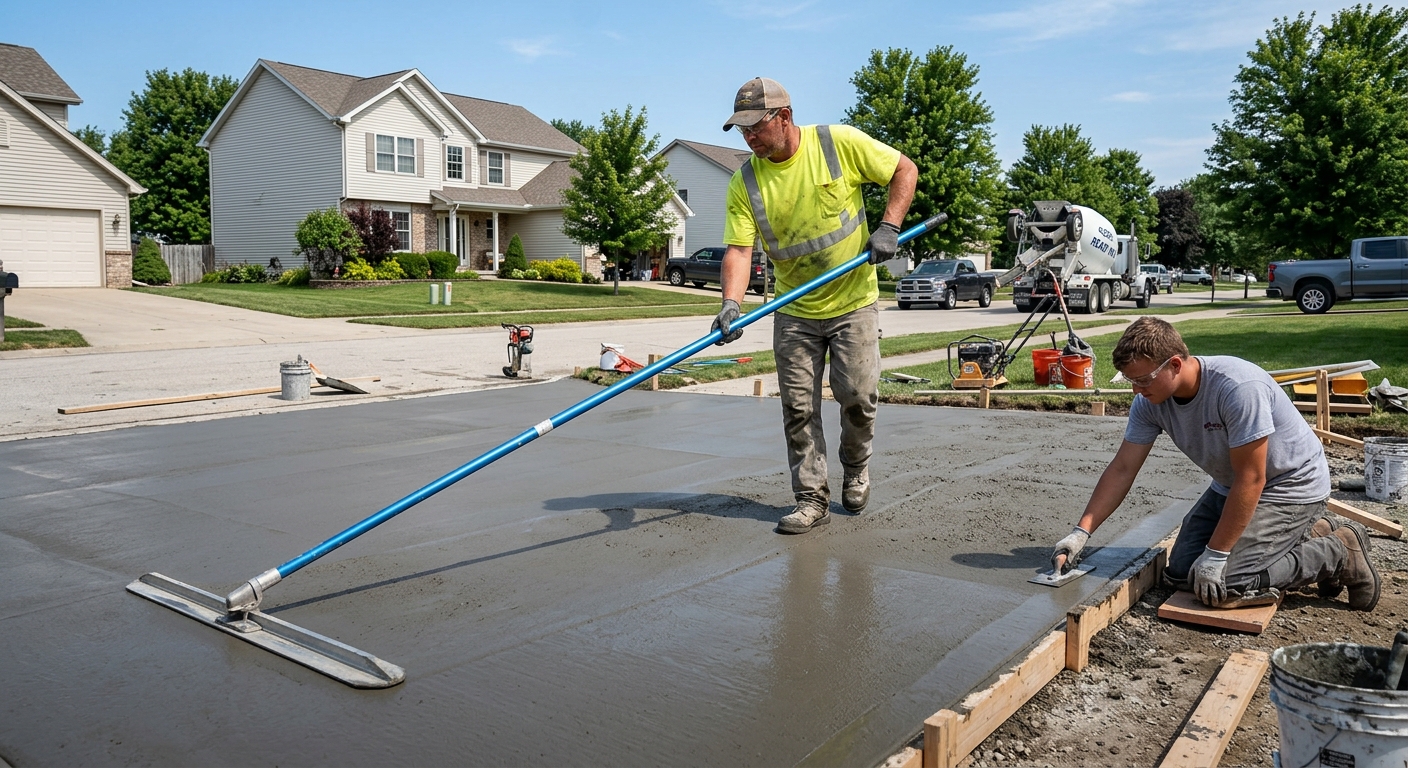
Concrete work options and costs in Blackmud Creek
Blackmud Creek, Alberta is a classic Calgary-area market where homeowners want durable driveways, patios and foundations that can handle deep frost and frequent freeze–thaw. With a population of 2,583 (Statistics Canada, 2021 Census), the community has enough repeat work to keep crews busy, but each neighbourhood still needs careful scheduling and proper cold-weather planning. Most of the demand is driven by detached-home owners who typically expand or refresh their exterior concrete around long-term ownership milestones—think new driveway replacement, adding a rear patio, or addressing aging walkways after a few winters of salt exposure.
In this cold continental climate, concrete pricing isn’t just about surface “look”—it’s about engineering and durability. Calgary’s practical pour season is shorter, and the local design frost depth is about 1.2 m (roughly 4 ft), so foundation and footing excavations are deeper and bulkier than in milder regions. Driveways and exterior slabs also need air-entrained mixes, granular base prep, and well-spaced control joints to reduce cracking and spalling as temperatures swing. That extra excavation, higher material specs, and sometimes winter-grade curing measures (insulated blankets, temporary heat, and tighter scheduling) are key reasons you’ll see local estimates move within the wider Alberta bands.
In Blackmud Creek, trades are especially busy on residential streets close to major routes connecting to Calgary—access and parking constraints affect truck count, pumping, and how crews manage the pour day. Next, the comparison table breaks down realistic price ranges for common options so you can sanity-check any quote you receive.
| Application |
Typical Size |
Key Spec |
Finish Option |
Price Range |
| Concrete driveway (standard broom finish) |
24 ft x 10 ft (~240 sq. ft.) |
Air-entrained, frost-capable mix; compacted granular base; control joints |
Broom finish |
$12,000–$16,500 |
| Exposed aggregate driveway |
24 ft x 10 ft (~240 sq. ft.) |
Air-entrained mix; properly graded base; washed/retarded surface process |
Exposed aggregate |
$15,000–$18,000 |
| Stamped concrete driveway or patio |
16 ft x 12 ft (~192 sq. ft.) |
Air-entrained, minimum compressive strength spec; integral colour & release agent |
Stamped pattern |
$15,000–$26,000 |
| Plain concrete patio or walkway |
12 ft x 10 ft (~120 sq. ft.) |
Air-entrained exterior mix; compacted base; joints and edge finishing |
Smooth or light broom |
$5,000–$9,000 |
| Garage floor (interior slab) |
20 ft x 22 ft (~440 sq. ft.) |
Vapour control where needed; reinforced slab per design; proper base prep |
Float finish |
$10,000–$17,000 |
| Foundation footings (structural, below frost) |
House perimeter + piers (varies) |
Footings engineered to bear below design frost depth; excavation & formwork |
Structural concrete only |
$28,000–$45,000 |
Prices are estimates only and vary by project scope, site access and material selection.
What affects the price of concrete work in Blackmud Creek
In Calgary and the surrounding region, quotes for the “same” concrete job can swing by 30–50% because the unseen work drives cost: excavation, base prep, reinforcement, trucking and how cold-weather curing is handled. Two contractors can both call for “a driveway,” but if one includes proper granular base depth, engineered reinforcement, air-entrained concrete with the right strength, and freeze-thaw-ready curing measures, the final price will reflect that durability. In older Blackmud Creek homes and infill builds, site conditions also differ—tree roots, old sub-grade, and limited access on residential streets change labour hours and disposal costs.
Local climate is the big reason specifications change. Alberta’s design frost depth is about 1.2 m (roughly 4 ft), and the footings must bear on undisturbed soil below that depth to prevent frost heave and seasonal movement. Exterior slabs need air-entrained concrete mixes to survive repeated freeze–thaw, and they often require a more carefully planned pour schedule to protect curing. When you’re pouring in late fall or early spring, the shorter pour season means cold-weather placement precautions—insulated blankets and sometimes temporary heat—are more likely, and that adds cost. Finally, de-icing salts accelerate spalling on poorly sealed or poorly specified surfaces, so sealing becomes a smart “insurance” step for driveways and patios.
Here are a few real examples of what moves your budget in Blackmud Creek. If your driveway is 240 sq. ft. and the contractor has to over-excavate poor sub-grade and replace with compacted granular base, the job can push from the lower end of the $12,000–$18,000 band toward the high side. If you choose stamped or decorative concrete, you’re typically paying more for labour, integral colour and finishing complexity—often landing in the $15,000–$26,000 range—while a plain patio tends to stay nearer $5,000–$9,000. Add in that many homeowners are replacing existing flatwork after multiple winters of salt, and that removal/haulage can add thousands versus building new on clean grade.
| Price Factor |
Why It Matters |
Cost Impact |
| Frost line depth — determines footing depth and form height |
Footings must bear below design frost to resist heave |
Deeper excavation increases concrete and labour; can move foundation scope by thousands |
| Site preparation — excavation, grading, compacted granular base |
Concrete longevity depends on stable, well-compacted support |
Over-excavation, hauling and granular replacement add significant cost |
| Reinforcement — rebar or wire mesh requirement |
Reduces cracking and controls slab movement under load |
More steel, tying labour and lift height requirements increase pricing |
| Mix design — air-entrainment and compressive strength spec |
Air content and strength help prevent scaling/spalling in freeze–thaw |
Specialty mix and QC steps add cost, especially for exterior pours |
| Finish type — broom vs. stamped vs. exposed aggregate |
Finish affects labour time, crew skills and material handling |
Decorative work often shifts you toward $15,000–$26,000 instead of plain flatwork |
| Pour size and concrete truck access to site |
Access controls pumping/placing time and number of truck visits |
Limited access can increase labour and equipment rentals |
| Cold-weather curing precautions — heating and blankets |
Protects early-age strength gain and durability |
Insulation/temporary heat can add daily costs and tight scheduling overhead |
| Control joint pattern and sealing cost |
Joints manage cracks; sealing helps resist salt-driven damage |
More joints and proper sealing products add line-item cost but reduce failure risk |
Permits & regulations in Alberta
In Alberta, structural concrete work generally requires more formal approval than flatwork. For Blackmud Creek homeowners, the rule of thumb is: if the concrete is part of the structure, expect a building permit and often engineered documentation reviewed by the municipality. That means work like foundation walls, grade beams, footings (structural), and other structural load-bearing concrete elements typically requires a permit. Engineered drawings and inspections are common because frost considerations, bearing conditions and reinforcement detailing must be correct.
On the other hand, concrete flatwork—driveways, patios, and walkways—usually does not require a permit unless it affects things like lot grading, drainage, or municipal impervious surface coverage limits, or if the work impacts municipal right-of-way/sidewalk areas. If you’re changing drainage patterns, lowering/raising grade near a foundation, or tying into curb/sidewalk infrastructure, confirm first.
Before any concrete is placed, verify your contractor can legally do the work and carries coverage. Step-by-step: (1) check the contractor’s business licensing/registration status through Alberta’s relevant online resources (and confirm the correct legal name on your contract), (2) ask for a certificate of insurance showing liability coverage, (3) confirm WSIB/WCB coverage for workers (you should receive proof documents), and (4) request references on similar-scale Calgary-area cold-weather pours. Also ask whether they will provide documentation needed for inspections if a permit is required.
Getting concrete right in Blackmud Creek's freeze-thaw climate
Concrete failures in Blackmud Creek usually trace back to one of five issues: weak support, incorrect mix design, poor jointing, rushed curing, or missing surface protection. In a Calgary-area freeze–thaw cycle, water moves into pores and along tiny cracks, then expands in winter. If the concrete doesn’t have proper air-entrainment and a stable base, you’ll see early scaling and spalling—especially after de-icing salt hits the surface.
To spec the job correctly, start with base preparation: excavation and regrading must reach a compacted granular sub-base sized for local soils and frost considerations (engineer/design dependent). Next is the mix design: for exterior flatwork, request air-entrained concrete with an air content target around 5–7% air and a minimum 32 MPa compressive strength for typical applications. Control joints are non-negotiable in this climate; they guide cracking into predictable lines. Plan curing properly: allow at least 7 days of curing under favourable conditions, and in colder periods require cold-weather measures—insulated blankets and, when needed, temporary heat—to protect early strength gain. Finally, apply a penetrating sealer after cure (commonly around 28 days post-pour) so water and salt don’t aggressively attack the surface.
Here’s a dollar example. If a driveway replacement quote is cheaper by $2,500 because the contractor plans to skip detailed base compaction and/or uses a non-air-entrained mix, the savings can evaporate quickly when you start seeing surface pop-outs or scaling. For a driveway in the local $12,000–$18,000 band, it’s usually better to pay the extra for the right specs than to redo concrete in a few seasons.
| Spec |
Why It Matters in Blackmud Creek |
What to Ask For |
Impact if Skipped |
| Compacted granular base (depth?) |
Stable support reduces settlement and cracking under freeze–thaw |
Confirm granular base depth and compaction method/test results |
Settlement cracks, premature failure, uneven slab movement |
| Air-entrained concrete mix (target air %?) |
Air bubbles provide freeze–thaw protection and reduce scaling/spalling |
Ask for target air content around 5–7% for exterior flatwork |
Spalling, surface scaling and durability loss after winter |
| Compressive strength (MPa rating) |
Adequate strength supports loads and reduces surface damage |
Confirm minimum 32 MPa (or engineered spec for structural work) |
Lower strength leads to cracking, scaling and reduced service life |
| Control joints (spacing per ACI guidelines) |
Controls random cracking patterns in a temperature cycling climate |
Ask about joint spacing plan and sawcut timing |
Random cracks, water infiltration and accelerated deterioration |
| Minimum 7-day curing period |
Early-age strength gain is critical before cold temperatures return |
Confirm curing plan, protection method and cold-weather measures |
Weak early concrete, scaling risk and long-term durability issues |
| Penetrating sealer (when applied after cure) |
Repels water and salt exposure on exterior slabs |
Ask for penetrating sealer applied after cure, commonly around 28 days |
Faster salt-driven scaling and spalling, more frequent maintenance |
How to choose a concrete work contractor in Blackmud Creek
Picking the right contractor in Blackmud Creek comes down to proof, not promises. Start by verifying Alberta credentials: ask for their contractor documentation and confirm the correct business name matches your quote/contract. Next, request a certificate of insurance showing liability coverage suitable for concrete work (including jobsite risk). Then confirm WSIB/WCB coverage—it’s not optional when workers are on site. If a company won’t provide proof right away, treat that as a major red flag.
For pricing, don’t accept a “one number” estimate without structure. Get 2–3 itemised written quotes that separate labour and materials (excavation, forms, granular base, concrete supply, reinforcement, finishing, joints, sealing, and disposal). Look for what’s excluded: for example, snow clearing before the pour, temporary heat for cold-weather work, sawcutting/jointing timeframe, and whether permit-related steps are included for structural jobs. Also clarify whether they haul away spoils and debris or whether that’s your responsibility.
Warranty matters too. Ask for the workmanship warranty length, whether product/manufacturer warranties apply to the materials used (sealer, curing products), and whether the warranty is transferable if you sell your home. Payment schedule should be conservative: typically no more than 10–15% upfront, with progress payments tied to milestones and a holdback until completion and cleanup. Finally, insist on a timeline in writing—start date, curing/protection period expectations, and estimated completion.
- Confirm contractor’s legal business name and Alberta registration/licensing status matches the quote.
- Request liability insurance proof (certificate) before work starts.
- Confirm workers’ coverage (WSIB/WCB) and keep the proof for your records.
- Get itemised quotes: excavation, granular base, reinforcement, concrete supply, finishing, joints.
- Clarify whether demolition/removal of old concrete is included.
- Ask who is responsible for disposal/haul-away and what happens with unsuitable soil.
- Confirm cold-weather procedures (blankets/heat plan) if pouring near shoulder seasons.
- Require a joint plan: spacing, sawcut timing, and whether edges are properly finished.
- Ask if the concrete mix is air-entrained and what target air content is used.
- Confirm curing requirements and protection for the first week.
- Ask whether penetrating sealer is included and when it will be applied (after cure, commonly ~28 days).
- Set a milestone schedule with a holdback until final inspection/cleanup is complete.
In Blackmud Creek, common contractor red flags include: quoting “plain concrete” while skipping air-entrainment details for exterior work, under-stating excavation/base prep, refusing to show proof of insurance or WSIB/WCB, promising a late-season pour with no cold-weather curing plan, and using vague warranty language (or no warranty at all).
Frequently asked questions — concrete work in Blackmud Creek
How do I prepare the base for a concrete slab?
Base prep is where most concrete performance is won or lost in Blackmud Creek. The contractor should excavate to reach suitable soil, then install a compacted granular sub-base (and possibly a vapour barrier depending on interior vs. exterior and engineer/design requirements). Proper grading matters because water must drain away from the slab; trapped moisture accelerates deterioration during freeze–thaw. Ask how much granular base will be placed, what compaction method is used, and whether the crew will test compaction. For exterior flatwork, the base depth and stability are especially important because the local frost depth (about 1.2 m) drives the need for engineering-grade support where required. A well-prepped base can be the difference between a driveway staying in the $12,000–$18,000 range with long service life versus needing early repairs.
How do I compare concrete quotes?
When comparing quotes in Alberta, don’t compare only the total number—compare the line items and the specs behind them. Ask whether each quote includes air-entrained concrete for exterior slabs, the minimum compressive strength target (commonly 32 MPa for typical flatwork), granular base scope and compaction, reinforcement requirements, control joint plan, and curing protection. Also confirm whether decorative scope changes pricing: stamped concrete often lands in the $15,000–$26,000 range because of integral colour, labour and finishing complexity. Another comparison point is site access—driveway replacement where trucks can’t park close can add labour and equipment costs. Finally, check what each quote excludes: demolition/haul-away, permit pulls (if structural), temporary heat/blankets for cold weather, and sealer options. The best quotes are itemised and explain the “why,” not just the “what.”
Can concrete be poured in cold weather in Blackmud Creek?
Yes, but it needs a plan. In Blackmud Creek and the broader Calgary region, cold snaps can return quickly during the late fall and early spring shoulder periods. Concrete can be placed in cold weather when the contractor uses cold-weather precautions such as insulated blankets and, in some cases, temporary heat to protect early-age curing and achieve proper strength gain. The key is preventing freezing of fresh concrete and avoiding premature surface damage. Ask the contractor what temperature range they’re working in, how long the curing protection will be maintained, and whether winter-grade mix design is used. If a contractor suggests “pour and leave it” during sub-zero conditions, that’s not a durability approach for exterior slabs. For homeowners, rushing curing increases the risk of scaling and spalling, which can turn a driveway or patio project that was supposed to fall within the $12,000–$18,000 or $5,000–$9,000 bands into a much more expensive redo.
How do I maintain concrete in Blackmud Creek's freeze-thaw climate?
Maintenance in Blackmud Creek is about keeping water and salts from attacking the surface and joints. Start with cleaning: remove debris and sand/grit after winter storms so it doesn’t abrade the surface. Use de-icing products carefully—salt is often unavoidable, but heavy, frequent salt exposure can worsen spalling on exterior slabs if the surface protection isn’t strong. That’s why a penetrating sealer applied after curing (commonly around 28 days post-pour) is a smart step for driveways, patios and walkways. Re-skinning or resealing schedules depend on traffic and product choice, but inspect annually for hairline cracks, joint deterioration and any “pop-outs.” Keep downspouts and grading draining away from the slab so water doesn’t pool near edges. If you see joint failure, address it quickly so water can’t infiltrate and freeze inside cracks.
What causes concrete to spall in Blackmud Creek winters?
Spalling in the Calgary-area freeze–thaw cycle is usually tied to water movement and inadequate freeze protection. The most common root cause is insufficient air-entrainment in the mix, which means the concrete can’t safely manage freeze expansion. When water enters pores and near-surface voids, repeated freezing expands it, then surface material breaks away—especially after de-icing salt exposure. Another contributor is poor base prep or jointing, which allows water to collect and infiltrate cracks. Curing problems also matter: if the concrete is placed or protected poorly during cold weather, early strength gain can be compromised, leaving a weaker surface layer that scales more readily. Exterior slabs without proper joint patterns can crack randomly, and those cracks become water pathways. In other words, spalling isn’t “normal wear”—it’s a sign the mix, joints, or curing weren’t engineered for Blackmud Creek’s winter conditions.
What is rebar and when is it required in Alberta?
Rebar (reinforcing steel bars) is embedded in concrete to control cracking and provide structural strength, particularly where loads, shrinkage and soil movement can create tension. In Alberta, whether rebar is required depends on the engineered design and slab type. For structural elements such as foundation footings and foundation walls, reinforcement is almost always specified by engineers, especially because the frost depth and soil conditions require designed performance below frost. For concrete flatwork like patios, sidewalks and many driveways, reinforcement might be required when the slab is larger, when there’s higher load (like a driveway that sees heavier vehicles), or when the design calls for it to control cracking. Ask your contractor for the reinforcement plan—mesh vs. rebar, spacing, and chair supports—because “we’ll figure it out on site” is not acceptable for freeze–thaw durability. The best quotes will show reinforcement details and match them to the scope.