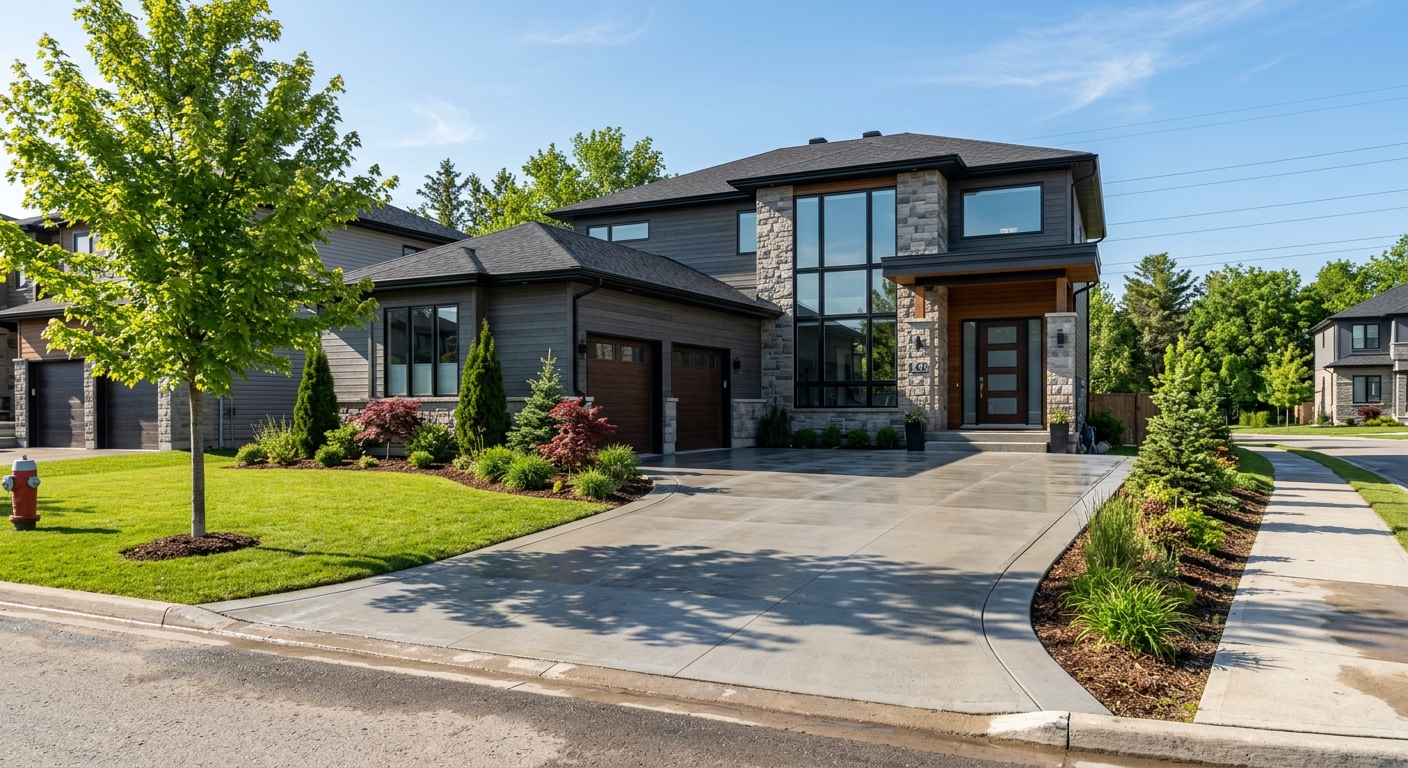
Concrete work options and costs in Parkview
Parkview is a small community on the east side of Calgary, with a lot of homeowners building and improving “everyday” concrete—driveways, patios, walkways and garage slabs. With a population of 3,327 (Statistics Canada, 2021 Census), the local market is more tight-knit than the core City of Calgary, so scheduling can depend on contractor availability around the practical exterior-pour season. The housing base tends to lean toward single-detached lifestyles typical of the Calgary region, which is why concrete flatwork demand stays steady year-round.
In Calgary’s cold continental climate, freeze–thaw cycles are the big driver behind how concrete is spec’d and priced. Concrete is engineered around a design frost depth of about 1.2 m (roughly 4 ft), meaning exterior footings and structural foundation work must bear on undisturbed soil below that depth to avoid frost heave. For slabs, air-entrained mixes and a granular, well-compacted base reduce cracking and scaling. When temperatures drop, contractors also have to plan for cold-weather curing using insulation blankets and—on some pours—temporary heat, which adds cost and limits the window for outdoor work.
In Parkview, you often see concentrated demand along busier local approaches and residential lots where residents upgrade worn asphalt or gravel with new driveways and backyard patios—commonly in developed pocket areas like the newer service lanes off the main roads. Below is a practical comparison of the most requested options, so you can line up the quote you’re getting with the right scope and finish.
| Application |
Typical Size |
Key Spec |
Finish Option |
Price Range |
| Concrete driveway (standard broom finish) |
24 ft x 10 ft (240 sq. ft.) |
Reinforced slab, air-entrained mix for exterior exposure |
Broom finish, basic control joints |
$12,000 – $18,000 |
| Exposed aggregate driveway |
24 ft x 10 ft (240 sq. ft.) |
Air-entrained concrete, seeded aggregate with consistent wash timing |
Exposed aggregate with anti-slip texture |
$14,000 – $20,500 |
| Stamped concrete driveway or patio |
20 ft x 12 ft (240 sq. ft.) |
Air-entrained mix, higher cementitious content for crisp stamping |
Stamped pattern + colour release |
$15,000 – $26,000 |
| Plain concrete patio or walkway |
12 ft x 16 ft (192 sq. ft.) |
Exterior-rated base prep for frost protection |
Broom or light trowel finish, joints as required |
$5,000 – $9,000 |
| Garage floor (interior slab) |
24 ft x 22 ft (528 sq. ft.) |
Vapour control where required, reinforced slab |
Steel trowel finish, control joints |
$10,000 – $16,500 |
| Foundation footings (structural, below frost) |
Typical house footprint: 1,000–1,600 sq. ft. of footing area |
Excavation + engineered footing sizes bearing below design frost depth |
Structural concrete with specified rebar cage |
$28,000 – $45,000 |
Prices are estimates only and vary by project scope, site access and material selection.
What affects the price of concrete work in Parkview
In Parkview and the wider Calgary area, you can see the “same” concrete job land 30–50% apart between quotes because the scope is never truly identical. One contractor may include proper excavation and a compacted granular base to the frost-protected depth, while another assumes existing material is acceptable. Likewise, the mix design (air-entrained content and strength spec), the reinforcement strategy (rebar versus wire mesh), and the finish system (broom vs exposed aggregate vs stamped work) can swing costs fast. Labour availability also changes with the short exterior pour season in this region, especially when temperatures drop and crews need to mobilize for cold-weather curing.
Frost line depth and freeze–thaw cycles dictate every spec. In Alberta, footings and structural foundations must extend below the design frost depth to reduce frost heave, which means more excavation, more formwork and more concrete volume—direct drivers for foundation pricing in the $28,000 – $45,000 range. For exterior slabs like driveways and patios, air-entrained mixes are standard because they help concrete survive repeated expansion and contraction. Cold-weather curing precautions—insulated blankets, winter-grade mixes, and sometimes short-term heating—can add real dollars if you’re trying to pour near the shoulder seasons. Finally, winter de-icing salt accelerates surface scaling if the surface is not sealed and if the mix and finishing process aren’t right.
Two common Parkview examples: (1) replacing a gravel pad under a driveway usually costs less than rebuilding after heavy root disruption—because excavation and disposal are the expensive part; (2) opting for stamped concrete can add labour and material complexity, so it makes sense when you’re replacing a full driveway or patio area (often aligning with the $15,000 – $26,000 band) rather than trying to stamp small patchwork.
| Price Factor |
Why It Matters |
Cost Impact |
| Frost line depth |
Determines footing depth and required excavation |
Can shift foundation budgets by tens of thousands if soil conditions force deeper bearing |
| Site preparation |
Excavation, grading, removal of unsuitable soils, compacted granular base |
Typically one of the biggest variables; increases with poor access or extensive disposal |
| Reinforcement |
Rebar cages or properly placed mesh improve structural crack control |
Adds material and labour; omission can lead to early cracking and costly repairs |
| Mix design |
Air-entrainment and compressive strength targets for exterior durability |
Cold-climate specs raise material cost but reduce failure risk |
| Finish type |
Broom, exposed aggregate, and stamped finishes have different labour intensity |
Stamped/exposed work usually adds 15–45% over basic broom on comparable areas |
| Pour size and concrete truck access to site |
Large pours need coordinated placement; access affects pump/hosing or extra labour |
Limited access can add hauling, pump fees, and extra crews |
| Cold-weather curing precautions |
Heating blankets and insulated curing help prevent scaling and strength loss |
Can add noticeable cost near fall/spring, especially for exterior slabs |
| Control joint pattern and sealing cost |
Joint layout manages cracking; sealing helps defend against salt scaling |
Skipping or under-specifying joints/sealant usually lowers upfront cost but increases long-term risk |
Permits & regulations in Alberta
In Alberta, structural concrete work typically needs a building permit and often engineered drawings for review by the municipality. That means work such as foundation footings, foundation walls, grade beams, and other structural elements that support the house must be permitted and inspected through the normal building process. For concrete flatwork—like driveways, patios, walkways and garage slabs—a permit is usually not required on its own. However, permits can come into play if the project affects lot grading, drainage, impervious surface coverage limits, or anything close to a municipal right-of-way. Before excavation, confirm the requirement with the local authority for your Parkview address.
To protect yourself, verify the contractor properly before signing:
Step 1: Check the contractor’s licensing status using the province’s online registry resources (where applicable for their business structure and trade scope). Step 2: Request a Certificate of Liability Insurance showing coverage effective dates and adequate limits; make sure you’re listed as an interested party where your contract requires it. Step 3: Ask for proof of WSIB/WCB coverage (or a clearance letter, if they’re exempt) and keep a copy with your contract. Step 4: Look for references on similar-scale work in the Calgary region—especially cold-weather exterior pours with air-entrained concrete and documented curing practices.
Getting concrete right in Parkview's freeze-thaw climate
Concrete failure in Parkview usually comes down to one or more of five weaknesses: poor base prep, the wrong mix, inadequate air entrainment, weak curing, and careless jointing. In a freeze–thaw environment, water expands as it freezes, and if concrete can’t tolerate that movement (or if water is allowed in), you’ll see surface scaling and eventually spalling. The key is to spec the job so it’s built for Calgary-area winter service, not for a “best day” pour.
Start with base preparation: you want a compacted granular sub-base to the required depth and condition so the slab remains supported below the frost-affected zone. For mix design, exterior flatwork should be air-entrained (typically 5–7% air content for durable freeze–thaw performance) with a minimum 32 MPa compressive strength target—so it gains strength reliably through the curing window. Next, control joints: they’re designed to give cracks a planned path. In Parkview, I recommend you ask for spacing that follows ACI guidance based on slab thickness and geometry. Finally, curing and sealing matter. Plan for at least 7 days of proper curing under suitable conditions, and apply a penetrating sealer after the slab cures (often around 28 days) to help repel de-icing salts.
On pricing: it’s common to see broom-finish patios fall around the $5,000 – $9,000 range, while stamped options can reach the $15,000 – $26,000 band. The price difference is justified when the contractor is also doing the “invisible” work right—base, air-entrainment and joints—because that’s what protects your investment from winter scaling.
| Spec |
Why It Matters in Parkview |
What to Ask For |
Impact if Skipped |
| Compacted granular base (depth?) |
Proper frost protection support prevents lifting and cracking |
Ask for the engineered base depth and compaction method tied to soil conditions |
Settlement and frost-related movement leading to uneven cracking |
| Air-entrained concrete mix (target air %?) |
Freeze–thaw resistance depends on controlled air voids |
Ask for 5–7% air content for exterior flatwork |
Higher risk of scaling and spalling from winter cycles |
| Compressive strength (MPa rating) |
Strength gain supports durability and load capacity |
Ask for minimum 32 MPa at specified curing/age |
Surface failure, wear-out, and early cracking under normal use |
| Control joints (spacing per ACI guidelines) |
Controls where cracks form as the slab cures and moves |
Ask for joint spacing, thickness and saw-cut timing plan |
Random cracking and potential trip hazards |
| Minimum 7-day curing period |
Cold nights can slow strength gain and increase surface defects |
Ask how they protect/insulate the slab when temperatures drop |
Inadequate strength and increased surface scaling risk |
| Penetrating sealer (when applied after cure) |
Helps reduce salt penetration and surface deterioration |
Ask for penetrating sealer applied after full cure (often ~28 days) |
More aggressive salt wear and faster spalling over time |
How to choose a concrete work contractor in Parkview
Choosing the right contractor matters more in Alberta than many homeowners expect, because the success of a concrete job is tied to winter-spec details—air entrainment, base prep and curing protection. First, verify Alberta compliance and coverage. Ask for their liability insurance certificate and confirm it’s current. Request WSIB/WCB documentation (or a clearance letter where applicable) so you’re not exposed if a worker is injured on your site. Licensing requirements can vary by trade scope, so confirm what credentials apply to the exact work you’re hiring them to do.
Next, get 2–3 written, itemised quotes. You want breakdowns that show labour and materials, not just one lump sum. The estimate should spell out excavation and disposal, granular base and compaction, reinforcement (rebar and tie placement or mesh type), concrete mix spec, formwork, finish method and joint plan, plus whether sealing is included. Confirm whether a permit is required and whether the contractor handles it or you do it.
Warranty should be clear and in writing: workmanship warranty length, what’s covered (cracking vs spalling vs settlement), and whether product/manufacturer warranties apply and are transferable to future homeowners. Payment schedules should stay conservative: don’t pay more than 10–15% upfront. Hold back the balance until the job is complete, cleaned, and reviewed.
Finally, lock in your timeline: ask for an estimated start date and completion date in the contract so you’re not left waiting through weather delays.
- Ask for the exact concrete mix type and confirm air entrainment for exterior work.
- Confirm reinforcement plan (rebar size, spacing, or mesh type) and how it’s supported off the base.
- Require a written base prep scope: excavation depth, granular type, and compaction.
- Clarify access: will they use a pump or extra labour if the truck can’t reach?
- Ask when control joints will be cut and the intended spacing.
- Ask how they protect curing in cold conditions (blankets, heat, curing blankets).
- Confirm whether saw-cutting timing is included and who supplies the tools.
- Check if sealing is included, and the application timing (after full cure).
- Verify disposal and haul-off are included if excavation exposes unsuitable soils.
- Review their insurance certificate—effective dates, limits, and contractor naming.
- Request WSIB/WCB clearance or proof of coverage before work begins.
- Get a written warranty document and what exclusions apply.
Concrete red flags I see in Parkview include: vague quotes that don’t mention base depth or air-entrained mix, “cheap fixes” that omit reinforcement or joints, crews pouring in cold weather without insulation/heat protection, finishing too aggressively without appropriate curing protection, and contracts that require full payment upfront with no holdback for final review.
Frequently asked questions — concrete work in Parkview
How do I maintain concrete in Parkview's freeze-thaw climate?
For concrete in Parkview, maintenance is mostly about managing water and salts. Keep the surface clean so de-icing residue doesn’t build up—sweep first, then wash when conditions allow. Use a de-icer that’s appropriate for concrete (and avoid repeated heavy salt “soaks” where possible). Inspect quarterly for early signs of scaling, small spalls at edges, or widening at control joints; catching issues early is cheaper than full-area repairs. If you had exterior flatwork sealed, re-check the sealant condition over time and renew when water no longer beads and penetrates quickly. Finally, avoid pressure washing too aggressively near joints or edges because it can remove surface protection. In Alberta winters, proper drainage away from the slab is also critical to reduce freeze–thaw stress.
What causes concrete to spall in Parkview winters?
Spalling usually happens when water gets into the concrete and then freezes, causing internal expansion and breaking down the surface. In Parkview and the wider Calgary region, the most common triggers are inadequate air-entrainment, rushed finishing/curing, or a base that allows settlement or standing water. If the mix wasn’t designed for freeze–thaw durability, you can get surface scaling first and then spalling over multiple winters. Another contributor is heavy de-icing salt use paired with no sealing or late sealing—salt can accelerate surface deterioration. Finally, poor joint spacing or missed joint sealing can force cracking to appear randomly, giving water more pathways. If you’re comparing quotes, make sure the estimate explicitly includes air-entrained mix requirements and curing precautions; those details protect you more than finish style does.
What is rebar and when is it required in Alberta?
Rebar is reinforcing steel embedded in concrete to handle tension stresses and control cracking. In Alberta, whether rebar is required depends on the structural design and the type of concrete work. For foundation systems like footings and foundation walls, reinforcement is typically engineered and required because those elements must carry load and resist movement. For exterior slabs like driveways and garage floors, reinforcement is often recommended for crack control and durability—especially where traffic loads or larger slab areas are involved. A contractor should specify reinforcement type and placement (including supports to keep steel at the right depth), rather than assuming “mesh is enough” or leaving it out. For a realistic homeowner benchmark, driveway pricing in Parkview commonly sits in the $12,000 – $18,000 band, where a proper reinforcement and base prep scope is usually included; if a quote is much lower, ask what reinforcement and specs are being reduced.
How long does a concrete project take in Parkview?
Timelines in Parkview depend on weather and the scope, but the typical sequence is consistent. Preparation (layout, excavation, base grading and compaction) often takes 1–3 days for flatwork, sometimes longer if access is tight or if soils need removal. The pour day is usually only 1 day, but crews must coordinate concrete delivery and finish sequencing. After the pour, concrete needs time to cure: at minimum, plan for about 7 days before expecting normal light use, and more for full strength depending on temperature and exposure. If the job includes sealing, that typically happens after the concrete has cured properly—commonly around 28 days. In Alberta winters, cold-weather curing precautions can add time for setup and protection. If you’re scheduling, ask for a start date and completion estimate in writing so weather delays don’t automatically turn into indefinite waiting.
What is a concrete overlay and is it suited to Parkview?
A concrete overlay is an additional layer of concrete placed over an existing slab (after surface preparation) to improve appearance and service life. It can be suited to Parkview when the existing concrete is still structurally sound—meaning it hasn’t lifted, sunk, or failed extensively—and when prep is done correctly (typically grinding/profiling, removing weak concrete, and addressing cracks before overlay). If the old slab is badly spalled, heavily cracked, or has settlement, overlay may just trap the problem and you can still see deterioration come back at joints and weak areas. Overlay durability also depends on freeze–thaw and de-icing salt resistance, so the mix design and bonding preparation are critical. In terms of cost, overlays can be less than a full replacement, but the best choice hinges on condition. If your driveway is in the $12,000 – $18,000 replacement range, compare overlay pricing against the risk of underlying failure—especially in Calgary-area winter conditions.
How do I seal concrete to protect it in Parkview?
Sealing is your best “defence layer” against winter salt and surface scaling, especially on driveways and walkways. In Parkview (Alberta), sealing should happen only after the concrete is properly cured—commonly about 28 days—so the sealer can penetrate effectively. Before sealing, the surface should be clean and dry; dirt, curing compounds, and lingering moisture can prevent good adhesion. Ask for a penetrating sealer (not just a film-forming coating) designed for freeze–thaw environments. Apply according to the manufacturer’s coverage rate and temperature requirements. After sealing, maintain by sweeping regularly and reducing salt “piling.” Re-seal when water absorption returns (signs include faster darkening from puddles or loss of water repellency). When you’re comparing quotes for exterior finishes, make sure sealing is either included or clearly listed as a separate item, because that can meaningfully affect long-term performance and repair frequency.