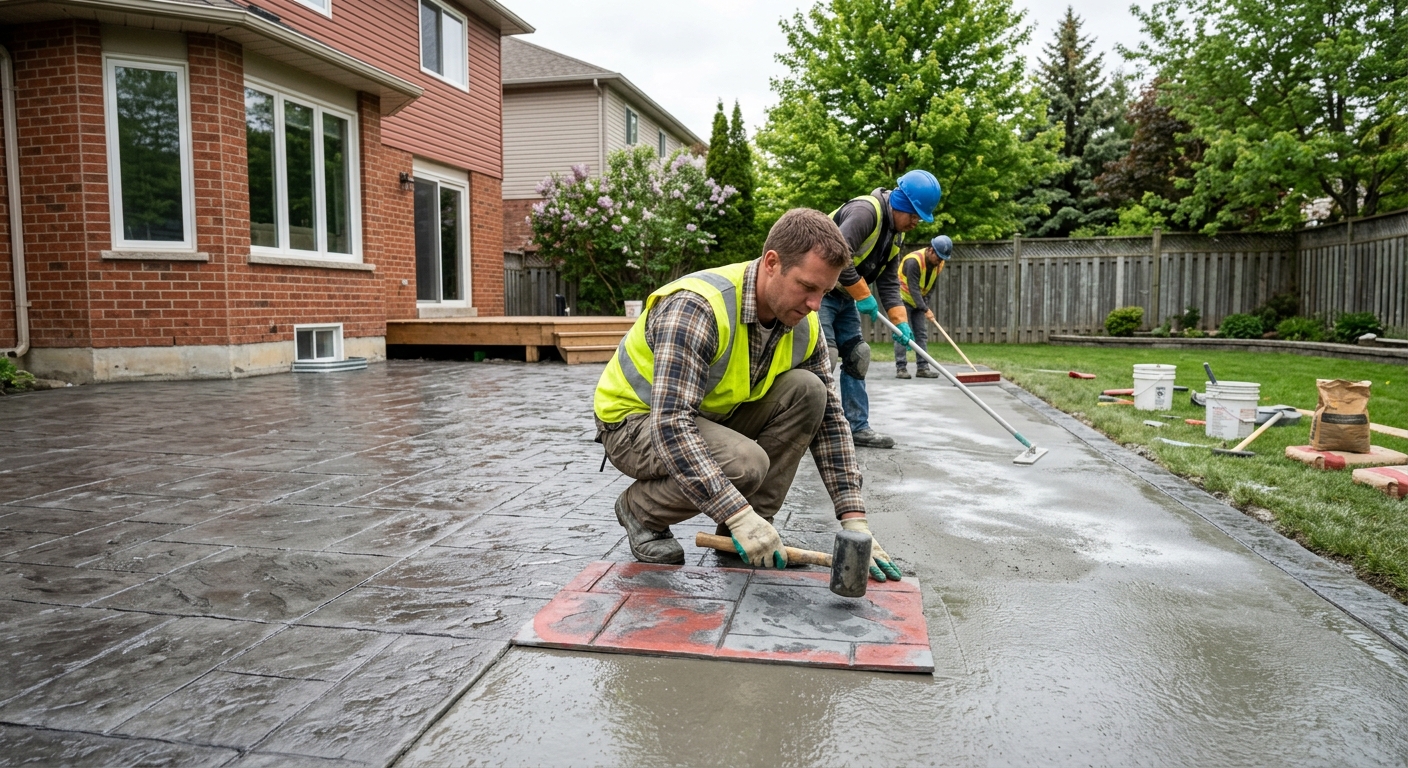
Concrete work options and costs in Ogden
Ogden, Alberta is a close-knit community inside the Calgary region, and most concrete flatwork demand here tracks what homeowners want to improve first: driveways, patios, walkways, and sometimes garage slabs. In the 2021 Census, Ogden’s population is 8,315 (Statistics Canada, 2021 Census), and that steady owner-occupant mix supports regular calls for exterior concrete and foundation-related upgrades when older homes need repairs or additions. As the area grows around neighbourhoods like Martindale and the broader southeast Calgary/near-Ogden building corridor, contractors often get booked quickly for spring and early summer pours.
Calgary’s cold continental climate is a big reason pricing moves: the local design frost depth is about 1.2 m (roughly 4 ft), so footings for houses, garages, decks, and retaining work must bear below frost to reduce frost heave and seasonal movement. Frequent freeze–thaw cycles also push specs toward air-entrained mixes, granular base prep, and control joints on slabs that will see winter moisture and de-icing salt. On exterior projects, the practical pour season is shorter, and winter-grade curing precautions (insulating blankets, sometimes heat) can add cost if you pour late in the year or early in spring.
Below are typical cost ranges you can use to compare quotes for common concrete applications in Ogden—then we’ll break down exactly what drives those numbers.
| Application |
Typical Size |
Key Spec |
Finish Option |
Price Range |
| Concrete driveway (standard broom finish) |
24 ft x 12 ft (288 sq. ft.) |
Air-entrained mix, control joints, compacted granular base |
Broom finish |
$12,000–$18,000 |
| Exposed aggregate driveway |
24 ft x 12 ft (288 sq. ft.) |
Air-entrained mix, proper curing for surface exposure |
Exposed aggregate |
$15,000–$22,000 |
| Stamped concrete driveway or patio |
300–500 sq. ft. |
Air-entrained mix, integral colour, release + timing |
Stamped |
$15,000–$26,000 |
| Plain concrete patio or walkway |
200 sq. ft. patio or 4 ft x 30 ft walkway |
Air-entrained mix, compacted base, joints as required |
Plain (broom edge or light float) |
$5,000–$9,000 |
| Garage floor (interior slab) |
22 ft x 24 ft (528 sq. ft.) |
Vapour barrier as applicable, reinforcement, proper sub-base |
Standard float with broom toe kicks/finishes as specified |
$10,000–$16,000 |
| Foundation footings (structural, below frost) |
Typical house: 24 ft x 40 ft, multiple walls |
Reinforced footings sized to loads; embedment below frost |
Structural concrete (no decorative finish) |
$28,000–$45,000 |
Prices are estimates only and vary by project scope, site access and material selection.
What affects the price of concrete work in Ogden
In Ogden, it’s common to see quotes for the same overall concrete project land 30–50% apart across the Calgary region and Alberta. The difference usually isn’t “mystery pricing”—it’s engineering and workmanship details: the thickness and depth of excavation, how deep footings must go for frost protection, how much granular base is compacted, the amount of reinforcement, and whether the contractor is budgeting for cold-weather curing and proper finishing. When a company prices only the pour and glosses over base prep or curing, you’ll often pay later in patching or early cracking.
Frost line depth and freeze–thaw cycles dictate every spec in our region. In Alberta, exterior foundation elements are engineered to bear below the design frost depth of about 1.2 m (roughly 4 ft), and excavation is more intensive than in warmer provinces. For exterior slabs and flatwork, air-entrained concrete mixes are required to survive repeated freeze–thaw cycles and resist scaling/spalling. Calgary’s shorter pour season means cold-weather placement often needs winter-grade practices—insulated blankets, curing heat, and scheduling that avoids temperature swings—so costs can jump quickly if you’re aiming for a late-season date. Also, de-icing salt accelerates surface wear, which is why sealing and proper mix/finishing matter.
Two local examples: a standard broom-finish driveway (often in the $12,000–$18,000 range for typical sizing) tends to price fairly predictably because the finish steps are straightforward. A stamped driveway or patio usually lands higher (often $15,000–$26,000) because colour, timing, stamp tooling, and additional labour time are built into the process. Finally, if you’re dealing with older drainage patterns near an existing foundation or a yard that needs regrading, excavation and disposal can become a major cost driver—especially in a freeze–thaw climate where moisture management affects long-term performance.
| Price Factor |
Why It Matters |
Cost Impact |
| Frost line depth — determines footing depth and form height |
Footings must bear below design frost to prevent heave and movement |
Higher excavation volume and formwork increases structural pricing |
| Site preparation — excavation, grading, compacted granular base |
Compacted base reduces settlement and cracking in freeze–thaw conditions |
More hauling, granular fill, and labour can add significant cost |
| Reinforcement — rebar or wire mesh requirement |
Controls cracking and improves load capacity |
Material and placing labour increase, especially for larger slabs |
| Mix design — air-entrainment and compressive strength spec |
Air entrainment helps resist freeze–thaw scaling/spalling |
Cold-weather and specialty mix pricing can increase concrete costs |
| Finish type — broom vs. stamped vs. exposed aggregate |
Finishes require different labour time and process controls |
Stamped/exposed work adds labour and materials for colour/release/exposure |
| Pour size and concrete truck access to site |
Access affects pump use, labour, and schedule |
Pump/extra labour and longer carry distances can raise totals |
| Cold-weather curing precautions — heating and blankets |
Protects strength gain when temperatures drop |
Heating/blanket rentals and extra steps increase cost, sometimes quickly |
| Control joint pattern and sealing cost |
Joints limit random cracking; sealing reduces salt/chems impact |
More layout precision and seal product/labour add to pricing |
Permits & regulations in Alberta
In Alberta, structural concrete work typically needs more formal approvals than simple surface flatwork. For homeowners in Ogden, this usually means footings, foundation walls, grade beams, and structural reinforced slabs tied to the building foundation will require a building permit and often engineered drawings that are reviewed through the municipal process. Concrete flatwork—like driveways, patios, and walkways—commonly does not require a permit unless it affects lot grading, stormwater/impervious surface considerations, or any municipal right-of-way impacts (for example, work encroaching near road allowances or changing drainage toward a curb/ditch).
Practical step-by-step verification is worth the time:
- Confirm the scope: ask whether the project is permit-only for structural work or if flatwork affects grading/servicing.
- Ask the contractor for their liability insurance and a certificate of insurance showing your job listed (or at least your municipality as applicable).
- Verify WSIB/WCB coverage: request proof of clearance/active coverage (the document should clearly show the contractor’s status).
- For contractor licensing, ask which Alberta trade category applies and check any relevant provincial/registration requirements through the official registry channels.
- Check references for similar-scale projects (same type of concrete, similar access limits, similar exterior freeze–thaw exposure).
If anything is unclear, ask before crews arrive—once excavation starts in freeze–thaw season, changes often become expensive.
Getting concrete right in Ogden's freeze-thaw climate
Concrete failures in Ogden are usually predictable: freeze–thaw damage, poor base support, or curing that doesn’t reach the early strength it needs. If you want the job to perform through Alberta winters, spec the work around five essentials. First, base preparation: use compacted granular sub-base to the correct depth and density for the local soil and frost requirements. Second, mix design: exterior flatwork should use air-entrainment—commonly targeted around 5–7% air for freeze–thaw durability—and a minimum 32 MPa compressive strength so the slab develops reliable capacity. Third, control joints: plan a joint pattern that limits random cracking from shrinkage and temperature cycling. Fourth, curing: allow at least 7 days under proper conditions; in cold snaps, insulation blankets or other cold-weather procedures help protect strength gain. Fifth, sealing: apply a penetrating sealer about 28 days after the pour to help repel de-icing salts.
When homeowners compare options, the biggest “value” difference is often not the broom versus plain look—it’s the durability spec. For example, choosing stamped concrete may add labour and materials (often within the $15,000–$26,000 band for typical stamped driveway/patio scope), but skipping air-entrainment or shortening curing is the kind of trade-off that shows up as scaling and spalling later. The most common failure I see is spalling from inadequate air-entrainment plus surface exposure to salt and moisture. Ask your contractor how they’ll prevent that, not just how they’ll make it look good.
| Spec |
Why It Matters in Ogden |
What to Ask For |
Impact if Skipped |
| Compacted granular base (depth?) |
Supports the slab and reduces freeze–thaw-driven movement in cold Alberta winters |
State excavation depth and compacted granular base thickness (and density targets) |
Settlement, cracking, and early edge deterioration |
| Air-entrained concrete mix (target air %?) |
Air spaces prevent freeze–thaw scaling/spalling on exterior surfaces |
Target air content (commonly 5–7% for exterior flatwork) and document the mix type |
Surface scaling and spalling within a few winters |
| Compressive strength (MPa rating) |
Ensures the slab/footings reach strength under Ogden’s temperature swings |
Minimum 32 MPa and confirmation of cold-weather placement handling |
Lower durability, cracking, and reduced service life |
| Control joints (spacing per ACI guidelines) |
Controls shrinkage and movement to avoid uncontrolled cracking |
Joint spacing plan and saw-cut timing or construction joint layout |
Random cracking that can widen with freeze–thaw cycles |
| Minimum 7-day curing period |
Strength gain depends on temperature and moisture; cold slows curing |
What curing plan is used in chilly weeks (blankets/heat if required) |
Weak surface, dusting, and increased failure risk |
| Penetrating sealer (when applied after cure) |
Helps resist de-icing salt and moisture that drive spalling |
Confirm sealer type and application timing (about 28 days post-pour) |
Faster surface wear and staining |
How to choose a concrete work contractor in Ogden
Choosing the right contractor in Ogden starts with proof—because concrete failures are expensive to fix after winter has its way with the slab. First, verify Alberta coverage paperwork. Ask for their liability insurance certificate (and confirm the policy is active for your dates) and request proof of WSIB/WCB coverage. Clearance letters or active status documents should show the contractor is in good standing; don’t rely on verbal confirmation. For licensing, ask which Alberta registration applies to their trade category and confirm through the relevant provincial registry where applicable.
Next, get 2–3 itemised written quotes rather than one lump-sum number. A strong quote breaks out labour and materials—excavation, granular base, reinforcement, concrete supply/mix spec, finishing steps (broom, stamped, or exposed), curing methods, joints, sealing, and disposal. Be explicit about exclusions: is regrading included, is pump or temporary access included, and is concrete washout/disposal handled properly?
Finally, match the quote to your timeline and how long it takes to do it correctly. Concrete work in Calgary’s climate may require schedule adjustments for cold-weather curing. Ask for a start date and completion estimate in writing. For payments, don’t pay more than 10–15% upfront; hold back a portion until the finish and curing plan is complete. Warranty matters too: request the workmanship warranty length, any product/manufacturer warranty coverage, and whether warranties are transferable.
- Ask for documented concrete mix specs (air content target and compressive strength).
- Confirm control joint spacing and who is responsible for saw-cut timing.
- Request a detailed scope for excavation and granular base depth/density.
- Verify pump/truck access plan and whether equipment fees are included.
- Ask how they handle cold-weather curing (blankets, heat, and timing).
- Confirm sealing plan for exterior slabs (type and application timing around 28 days).
- Get disposal details: waste hauling included or extra?
- Request a reinforcement plan (mesh vs rebar, and slab thickness context).
- Check references from similar jobs in Calgary/near-Ogden for exterior exposure.
- Ensure liability insurance and WSIB/WCB proof is provided before work starts.
- Require the contract to name start date and expected completion window.
- Clarify change-order pricing: how are extras measured and approved?
Concrete red flags I see around Ogden include: (1) quotes that don’t specify air entrainment or curing steps, (2) vague “we’ll pour in any weather” promises without insulation/heat plans, (3) missing proof of WSIB/WCB or liability coverage, (4) no joint layout shown (or joints “later if needed”), and (5) refusing itemised pricing for base prep, reinforcement, and finishing.
Frequently asked questions — concrete work in Ogden
Stamped vs broom-finish concrete — cost difference?
In Ogden, stamped concrete costs more than a broom-finish driveway because stamping requires additional labour time, colour/release materials, and tighter finishing control during the window after placement. For a typical driveway size, a broom-finish pour often sits around the $12,000–$18,000 band, while stamped driveway or patio scope commonly falls into the $15,000–$26,000 band depending on square footage and details like edging, borders, and reinforcement. The climate also matters: regardless of appearance, exterior flatwork should still be air-entrained and built with a compacted granular base to handle freeze–thaw and de-icing salt. When comparing quotes, make sure both options include the same mix spec and curing plan—otherwise the price difference doesn’t reflect only the finish.
When is the best time to pour concrete in Ogden?
The best window in Alberta’s Calgary region is typically late spring through early fall when temperatures are stable enough to support proper curing without expensive heat/blanket measures. In Ogden, freeze–thaw cycles can begin earlier than homeowners expect, and cold nights can slow early strength gain, which increases the risk of scaling. If you must pour near the shoulder seasons, ask the contractor what cold-weather curing precautions they will use (insulated blankets, temperature monitoring, and winter-grade mix handling). Contractors who work regularly in this region plan around that short exterior pour season, so availability can tighten in summer. If you’re aiming for a driveway or patio, you’ll generally get the smoothest result by scheduling when crews can complete finishing and curing without emergency adjustments.
How long does concrete take to cure?
Concrete has two “clocks”: initial set and strength gain. Practically, for exterior projects in Ogden, you should expect at least 7 days of curing under proper conditions before treating the slab as ready for typical use, and you should follow the contractor’s curing plan if temperatures drop at night. Full strength development takes longer—often around 28 days—especially when you’re dealing with colder weather or thicker sections. This is also why sealing is generally recommended about 28 days after the pour: the concrete needs to be sufficiently cured so the sealer bonds effectively and can better repel de-icing salt. Ask your contractor how they’ll protect the slab during curing (moisture retention, temperature control, and curing duration), because that’s one of the biggest differences between durable work and premature surface issues.
Do I need a permit for concrete work in Alberta?
In Alberta, it depends on what you’re building. Structural concrete work such as footings, foundation walls, and grade beams typically requires a building permit and often engineered drawings reviewed through the municipal process. Simple exterior flatwork—driveways, patios, and walkways—usually does not require a permit by default unless it changes lot grading, impacts impervious surface rules, affects drainage toward services, or encroaches in a municipal right-of-way. For an Ogden homeowner, the easiest approach is to confirm the scope with the local authority before excavation. Also verify your contractor has liability insurance and active WSIB/WCB coverage so you’re protected throughout the job.
Concrete vs pavers for a patio in Ogden?
Both can work well in Ogden, but concrete usually wins on durability-per-square-foot when it’s built with the correct specs for Calgary’s freeze–thaw climate: air-entrained mix, compacted granular base, and a proper joint plan. Concrete patio pricing often lands around the $5,000–$9,000 range for typical smaller slabs, while pavers can cost similarly or more depending on excavation, base depth, edge restraint, and removal of existing material. Pavers offer flexibility and easier localized repairs if a section fails, but they rely heavily on base construction and drainage. If your patio location sees heavy de-icing salt exposure or drainage runoff, ask whichever option you choose how they manage moisture and jointing, because that’s what affects long-term performance in Alberta winters.
How long does a concrete driveway last?
A properly built concrete driveway in Ogden can last decades, but the service life depends on the build quality and how it’s treated through winters. The biggest longevity drivers are correct frost-aware base prep, air-entrained concrete for freeze–thaw, good jointing, and curing that reaches early strength. Sealing matters too: applying penetrating sealer about 28 days after the pour helps reduce the impact of de-icing salts. If your driveway is priced in the $12,000–$18,000 band, that can still produce a long-lived result—if the quote includes the same durability specs (mix, base depth, reinforcement, curing plan). If a contractor cuts corners—thin base, no air-entrainment, or rushed curing—you may see scaling and cracking much sooner, often within a few winters.