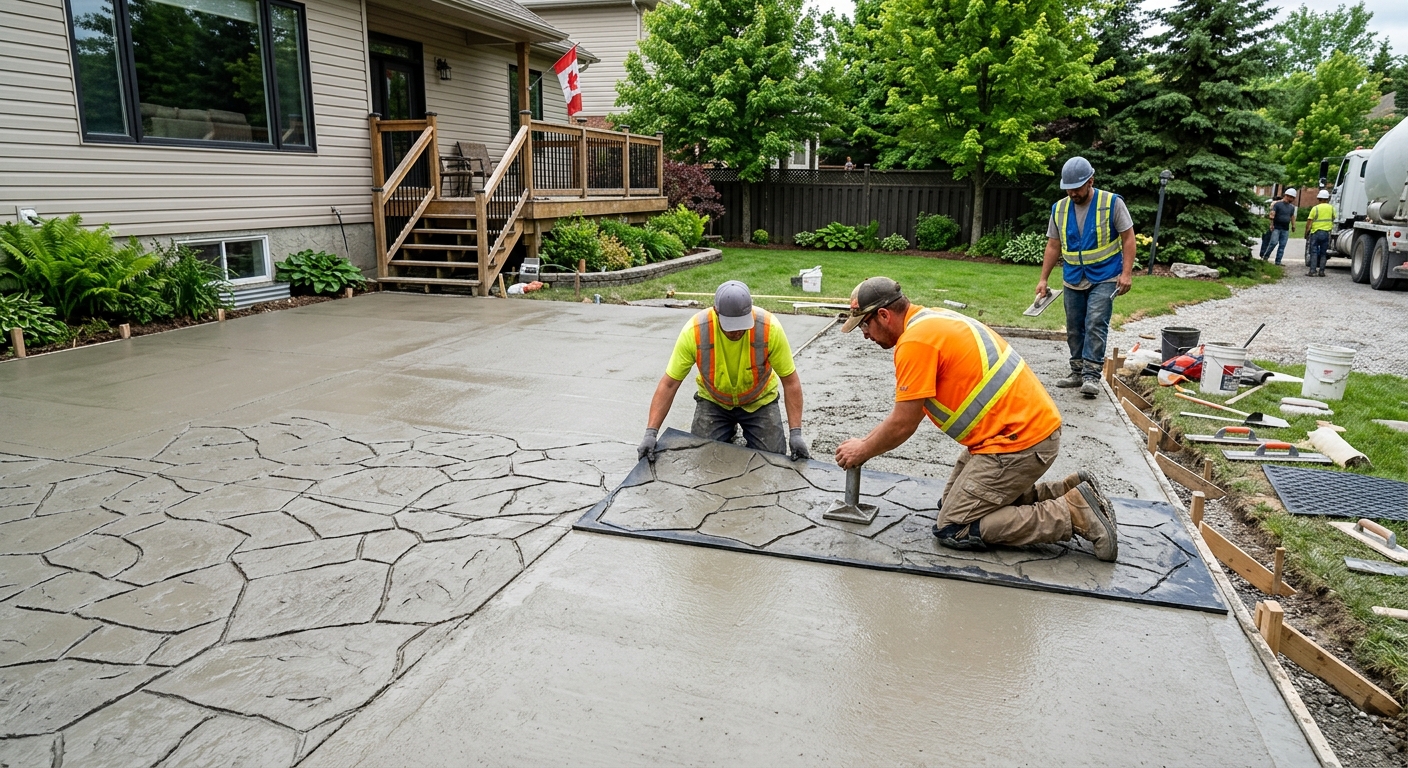
Concrete work options and costs in McKenzie Lake
McKenzie Lake, Alberta is a great place for long-lasting concrete flatwork, and the demand is real because this community is built around single-family living—Statistics Canada reports a large share of Canadian households are single-detached homes (Statistics Canada, 2021 Census). With a population of 13,290 (Statistics Canada, 2021 Census), there’s steady turnover for driveways, patios, walkways, and foundation work as homes expand, update garages, or replace older slabs. In the Calgary economic region, pricing tends to land where it does because crews are constantly scheduling around the cold continental climate: freeze–thaw cycles are common, and exterior pours have to be engineered for frost protection and proper curing. That usually means deeper excavation, thicker granular base prep, and air-entrained concrete mixes. It also affects availability—late-spring and summer are busiest, while autumn pours can cost more if winter-grade measures (insulated blankets and sometimes on-site heating) are needed to achieve the right curing conditions.
In McKenzie Lake and nearby collector roads, concrete work is especially in demand around the busiest residential pockets where drive access and grading are tighter—projects often include thicker base and more labour for subgrade correction. If you’re comparing options, it helps to see how finish and structural depth translate into costs.
Below is a practical comparison of common concrete applications we see in McKenzie Lake, Alberta—then you can match scope and finishes to the quote you receive.
| Application |
Typical Size |
Key Spec |
Finish Option |
Price Range |
| Concrete driveway (standard broom finish) |
24 ft x 20 ft (480 sq. ft.) |
Air-entrained mix, compacted base, control joints |
Broom finish, saw-cut joints |
$12,000–$18,000 |
| Exposed aggregate driveway |
24 ft x 20 ft (480 sq. ft.) |
Air-entrained mix, aggregate reveal, proper curing |
Exposed aggregate with sealing |
$15,000–$22,000 |
| Stamped concrete driveway or patio |
24 ft x 14 ft (336 sq. ft.) |
Air-entrained mix, color hardener, release agent |
Stamped patterns (field layout + border options) |
$18,000–$26,000 |
| Plain concrete patio or walkway |
200 sq. ft. patio or 60–80 sq. ft. walkway |
Air-entrained mix, compacted base, joints |
Float/screed then broom or trowel finish |
$5,000–$9,000 |
| Garage floor (interior slab) |
22 ft x 22 ft (484 sq. ft.) |
Vapour barrier (where required), reinforcement as specified |
Standard finish, optional burnished top |
$6,500–$12,000 |
| Foundation footings (structural, below frost) |
Per plan—commonly 2–3 rows of footing walls |
Engineered rebar cage, excavation to frost depth, concrete volume |
Structural only (not decorative) |
$28,000–$45,000 |
Prices are estimates only and vary by project scope, site access and material selection.
What affects the price of concrete work in McKenzie Lake
In McKenzie Lake, Alberta, two quotes for the same-looking job can differ by 30–50% because Calgary concrete pricing is driven less by “concrete itself” and more by what the climate forces you to do before and after the pour. Frost protection is the big one. Local engineering practice uses a design frost depth of about 1.2 m (roughly 4 ft), and in Alberta that often translates into deeper excavation, larger footing volumes, and more formwork height. Freeze–thaw cycles also demand air-entrained mixes and well-planned control joints so you don’t end up with early scaling or spalling—common failure modes when specs are cut. Finally, the pour season for exterior slabs is shorter; if you’re scheduling in late fall or early spring, contractors may need winter-grade placement methods (insulated blankets and sometimes heating) to protect curing. That can add labour and consumables, which moves totals quickly.
You’ll also see cost swings based on site conditions. For example, a driveway replacement that includes hauling out unsuitable soil and rebuilding a compacted granular base can land closer to the higher end of the $12,000–$18,000 driveway band. A stamped patio, on the other hand, is often priced at the $15,000–$26,000 range because pattern labour, colour work, and extra finishing steps take time—even if the square footage is smaller.
In McKenzie Lake specifically, older lots and backfilled areas can require extra subgrade correction and re-compaction. If the contractor has to over-excavate deeper to reach stable material, your base prep cost rises. Conversely, a straightforward tear-out and rebuild on stable, accessible grades can come in closer to the low end.
| Price Factor |
Why It Matters |
Cost Impact |
| Frost line depth — determines footing depth and form height |
Footings must bear below the design frost depth to prevent frost heave. |
Higher excavation and formwork; can be a major driver on foundations. |
| Site preparation — excavation, grading, compacted granular base |
Proper base reduces settlement and helps manage drainage. |
Unstable soil removal and re-compaction add equipment and labour. |
| Reinforcement — rebar or wire mesh requirement |
Controls cracking and adds structural capacity. |
Material cost + placement labour; needed more often on larger slabs. |
| Mix design — air-entrainment and compressive strength spec |
Exterior durability relies on correct air content and strength. |
Winter-grade materials and testing can raise unit costs. |
| Finish type — broom vs. stamped vs. exposed aggregate |
Finish affects labour hours and material steps. |
Decorative finishes typically push projects toward higher bands. |
| Pour size and concrete truck access to site |
Smaller access windows increase handling time and may require pumps. |
Pump/extra hauling and slower placement add cost. |
| Cold-weather curing precautions — heating and blankets |
Curing must be protected through cold periods for durability. |
Heaters/blankets and monitoring can add meaningful overhead. |
| Control joint pattern and sealing cost |
Joints manage shrinkage cracking; sealing helps with de-icing salts. |
Labour for saw cutting + sealer materials can be overlooked but matter. |
Permits & regulations in Alberta
In Alberta, whether you need a permit often comes down to whether the work changes the structure or grading/impact to lot drainage. Structural concrete work—such as foundation footings, foundation walls, grade beams and other load-bearing elements—typically requires a building permit, and engineered drawings are usually reviewed as part of permitting. For concrete flatwork like patios, walkways and driveways, permits are usually not required when the work is strictly “like-for-like” and doesn’t alter lot grading, create drainage problems, or conflict with municipal requirements around impervious surface coverage and right-of-way impacts. In McKenzie Lake, always confirm with the local authority before breaking ground, especially if you’re changing slopes to improve drainage, tying into existing curbs, or adjusting elevations at property lines.
Before you hire anyone, verify insurance and worker protections. Step-by-step: (1) ask the contractor for their proof of general liability insurance (certificate of insurance) naming you as an additional insured where possible; (2) request evidence they’re registered for WSIB/WCB coverage for their workers; and (3) confirm they have the right business registration/licensing for the scope. To check, start with the contractor’s paperwork you receive, then confirm through the appropriate Alberta online registration tools if they provide references or numbers. Also ask for references on similar-scale Calgary-area concrete jobs, because cold-climate detailing (air-entrainment, jointing, curing) is where many failures begin.
Getting concrete right in McKenzie Lake's freeze-thaw climate
Concrete can fail fast in McKenzie Lake when the job is spec’d for “warm weather” performance and then exposed to Calgary-area freeze–thaw cycles. The most common problems I see are surface scaling and spalling—often tied to inadequate air-entrainment and poor curing protection. To spec your project correctly, start at the base: use compacted granular sub-base sized to local soil conditions and excavated to the right depth for frost performance. Next, require an air-entrained mix. For exterior flatwork, we target about 5–7% air content and a minimum 32 MPa compressive strength so the concrete can handle water movement during freeze–thaw. Then plan cracking control: control joints should be cut at practical intervals to limit random cracking and reduce where water can infiltrate. Curing matters as much as the mix—aim for a minimum 7-day curing period under suitable conditions, and in cold weather you may need insulated blankets or heat to keep hydration on track. Finally, sealing is not optional in the real world: apply a penetrating sealer after the proper cure window (commonly around 28 days post-pour) to help repel de-icing salts and reduce moisture ingress.
Ask direct questions, because these are the specs that protect the slab under Alberta winters. For example, paying for the correct air-entrained mix and curing blankets can cost more upfront, but it can protect a driveway that otherwise may need patching or partial replacement much sooner. If a broom-finish driveway is around the $12,000–$18,000 band, a properly engineered prep and curing plan is what keeps it from becoming a repeated maintenance cycle.
| Spec |
Why It Matters in McKenzie Lake |
What to Ask For |
Impact if Skipped |
| Compacted granular base (depth?) |
Stable base reduces settlement and helps the slab resist frost movement. |
Confirm excavation depth, compacted lifts, and granular type. |
Uneven settling, cracking, and early joint failure. |
| Air-entrained concrete mix (target air %?) |
Air content buffers freeze–thaw pressure and improves durability. |
Require 5–7% air content for exterior flatwork. |
Spalling/scaling, especially where salts are used. |
| Compressive strength (MPa rating) |
Strength supports load capacity through winter and thawing cycles. |
Minimum 32 MPa compressive strength (or as engineered). |
Surface wear, reduced long-term performance. |
| Control joints (spacing per ACI guidelines) |
Joint spacing manages shrinkage and limits random cracking. |
Request intended joint layout and cutting schedule. |
Random cracks that become water pathways. |
| Minimum 7-day curing period |
Proper curing ensures strength and surface quality develop correctly. |
Ask how they protect the slab during cold nights. |
Weak surface, dusting, and durability loss. |
| Penetrating sealer (when applied after cure) |
Helps resist moisture and de-icing salt intrusion during winter. |
Apply after cure window (commonly ~28 days post-pour). |
Faster surface deterioration around edges and joints. |
How to choose a concrete work contractor in McKenzie Lake
Choosing the right contractor in McKenzie Lake starts with verification. In Alberta, ensure the company can legally take on your type of work and that they carry appropriate insurance. How to check each item: request their certificate of insurance (general liability) and confirm the coverage is active; ask for WSIB/WCB coverage details for their workers; and verify their business registration and licensing information for the scope you’re buying. Don’t rely on verbal assurances—get the documents and read the expiry dates.
Next, get 2–3 written, itemised quotes rather than a single lump sum. You want a labour-and-materials breakdown that shows concrete quantities, rebar/wire mesh (if required), excavation and granular base, disposal, formwork, finishing, saw-cut joints, and sealing (for exterior slabs). Make sure the quote clearly states what’s excluded: old slab removal? disposal fees? permit/inspection handling (if applicable)? winter-grade curing supplies if the pour is near shoulder season? Those “small” exclusions are where change orders start.
For warranties, ask for both workmanship duration and any product/manufacturer warranty details, and whether coverage transfers if you sell the home. Payment terms matter too: never pay more than 10–15% upfront; keep a holdback until the job is complete and cured as required. Finally, insist on a start date and a completion estimate in writing—weather-sensitive curing and finishing in Alberta depend on scheduling discipline.
- Provide proof of general liability insurance and confirm it’s current.
- Provide WSIB/WCB coverage evidence for workers on-site.
- Give a clear scope: demolition, excavation, hauling, base build, and backfill.
- Include reinforcement details (rebar/wire mesh type, spacing, and cover).
- State the concrete mix requirements (air-entrainment and target strength).
- Specify control joint layout (spacing and timing) in the written proposal.
- Explain curing protection plan for cold nights (blankets/heating if needed).
- Confirm sealing is included for exterior slabs and when it will be applied.
- Ask about drain routing and grading so water doesn’t pond near the slab.
- Use an itemised allowance for concrete, disposal, and concrete truck/pump access.
- Request a workmanship warranty in writing and clarify transferability.
- Set a payment schedule with a holdback until completion and close-out.
Red flags I watch for in McKenzie Lake: (1) no mention of air-entrainment or jointing in the quote, (2) lump-sum bids that exclude excavation/disposal without clarification, (3) promises to pour and “finish fast” in shoulder season without curing protection, (4) reluctance to provide insurance/WSIB/WCB paperwork, and (5) sketches or sketches only—no engineered or site-specific plan for how frost and drainage will be handled.
Frequently asked questions — concrete work in McKenzie Lake
What is the difference between concrete and cement?
In everyday conversation, people say “cement” when they mean concrete, but they’re not the same product. Cement is one ingredient—it’s the binding material (usually Portland cement) that reacts with water to form paste. Concrete is the full mix: cement plus water, sand, gravel (or other aggregates), and often admixtures. In McKenzie Lake and across Alberta’s Calgary region, the concrete formulation matters because freeze–thaw cycles and de-icing salts require durability specs like air-entrainment. That’s why reputable contractors will talk about concrete mix design (target air content and strength), not just “we’ll pour concrete.” If your quote only mentions cement without air-entrainment and curing requirements, ask for the actual mix spec. For example, a standard exterior driveway typically falls in the $12,000–$18,000 band, but the long-term performance depends on the concrete—especially the air-entrained portion—more than the label “cement” vs “concrete.”
How much does concrete work cost in McKenzie Lake?
Costs in McKenzie Lake track closely with the Calgary market, but your site details can move the number up or down. For common exterior work, driveway pricing often sits around the $12,000–$18,000 range depending on size, excavation, and finish. A simple patio or walkway is commonly estimated in the $5,000–$9,000 range for typical residential footprints, again depending on base prep and access. Decorative finishes are higher: stamped concrete driveway or patio projects frequently land in the $15,000–$26,000 range because there’s more labour for patterning and colour, plus careful curing and finishing steps. Foundation footings are a different category because frost protection drives excavation depth—those structural pours commonly fall around the $28,000–$45,000 band depending on engineered dimensions and rebar. If your quote seems low, double-check the scope for what’s included: removal, disposal, compacted granular base thickness, reinforcement, and cold-weather curing precautions. In Alberta winters, those items directly affect both immediate durability and how long the slab stays repair-free.
How deep must footings be for McKenzie Lake's frost line?
For McKenzie Lake and the broader Calgary region, footings are generally designed to bear below the design frost depth to prevent frost heave and seasonal movement. The local engineering practice you’ll see referenced uses a design frost depth of about 1.2 m (roughly 4 ft). Practically, that means excavation down to undisturbed soil at or below that depth, with concrete poured on a stable base. How deep your foundation work goes can also depend on soil conditions, engineered drawings, and drainage plans. For a homeowner, the key point is that the depth should be based on engineered requirements for your house and lot, not guesswork. Ask your contractor or the engineer of record to show the footing depth in the plan and to confirm excavation to undisturbed soil below the design frost depth. This is one reason foundation work can fall into the $28,000–$45,000 range—more excavation and more concrete volume are baked into the job in Alberta’s freeze–thaw environment.
Why does concrete crack in McKenzie Lake and how is it prevented?
Concrete cracks are normal, but the goal in McKenzie Lake (and across Alberta) is to control where they occur and keep water out of the pathways that worsen freeze–thaw damage. The main drivers here are shrinkage during curing, temperature swings across seasons, and subgrade movement if the base wasn’t built correctly. In Alberta’s climate, freeze–thaw cycles can also magnify small issues if joints aren’t planned or if the concrete doesn’t have the correct air-entrainment for durability. Prevention is a spec-and-detail combo: proper compacted granular base preparation, correctly air-entrained exterior concrete mix, and a defined control joint pattern (with timely saw cutting) so shrinkage cracks develop at joints instead of randomly. You also want sealing of exterior slabs after cure—typically around 28 days post-pour—because de-icing salts increase deterioration risk. When contractors cut corners on base prep, joint spacing, or curing, cracks show up sooner and can lead to spalling. If you’re budgeting, remember that driveway projects in the $12,000–$18,000 band can perform very well—when the mix, joints, and curing are done for Calgary-area conditions.
Stamped vs broom-finish concrete — cost difference?
Stamped concrete costs more than broom-finish because it’s labour-intensive and material-heavy. A broom-finish driveway (with proper joints and air-entrained mix) typically aligns with the $12,000–$18,000 range depending on size and excavation. Stamped concrete driveway or patio projects are commonly in the $15,000–$26,000 range, because you’re paying for stamp mats, colour hardeners or integral colour options, release agents, additional finishing steps, and more careful pattern alignment. The other factor is curing discipline: decorative surfaces can be more sensitive to placement and finishing timing, and cold-weather curing precautions can add cost if you’re near shoulder season. That doesn’t mean stamped concrete is always “better”—it’s a style choice. If your driveway is exposed and you want a long-term look with minimal upkeep, sometimes exposed aggregate or even plain broom-finish with sealing is the better value. But if you’re choosing stamped for curb appeal, the price difference is usually justified because the extra labour happens during the pour, not after.
When is the best time to pour concrete in McKenzie Lake?
The best time to pour concrete in McKenzie Lake is when temperatures allow proper placement and curing without extra winter protection. In practical terms for the Calgary market, most homeowners get the best results from spring through summer because curing conditions are easier to maintain and crews can follow standard schedules. Late fall or early spring pours can still work, but the contractor may need cold-weather placement procedures—like insulated curing blankets and, in some cases, temporary heating—to reach adequate curing performance. That’s not just “nice to have”; cold weather increases the risk of surface scaling and longer-term durability issues if hydration and strength gain are interrupted. When you’re getting quotes, ask what the contractor’s plan is if overnight temperatures drop, and whether they’ll use winter-grade mixes and curing protection. The difference shows up in cost: exterior slab work can move upward toward the higher end of the band when curing support is required. For an example, a patio that might be in the $5,000–$9,000 range in good weather can cost more if winter precautions are needed to protect the finish.