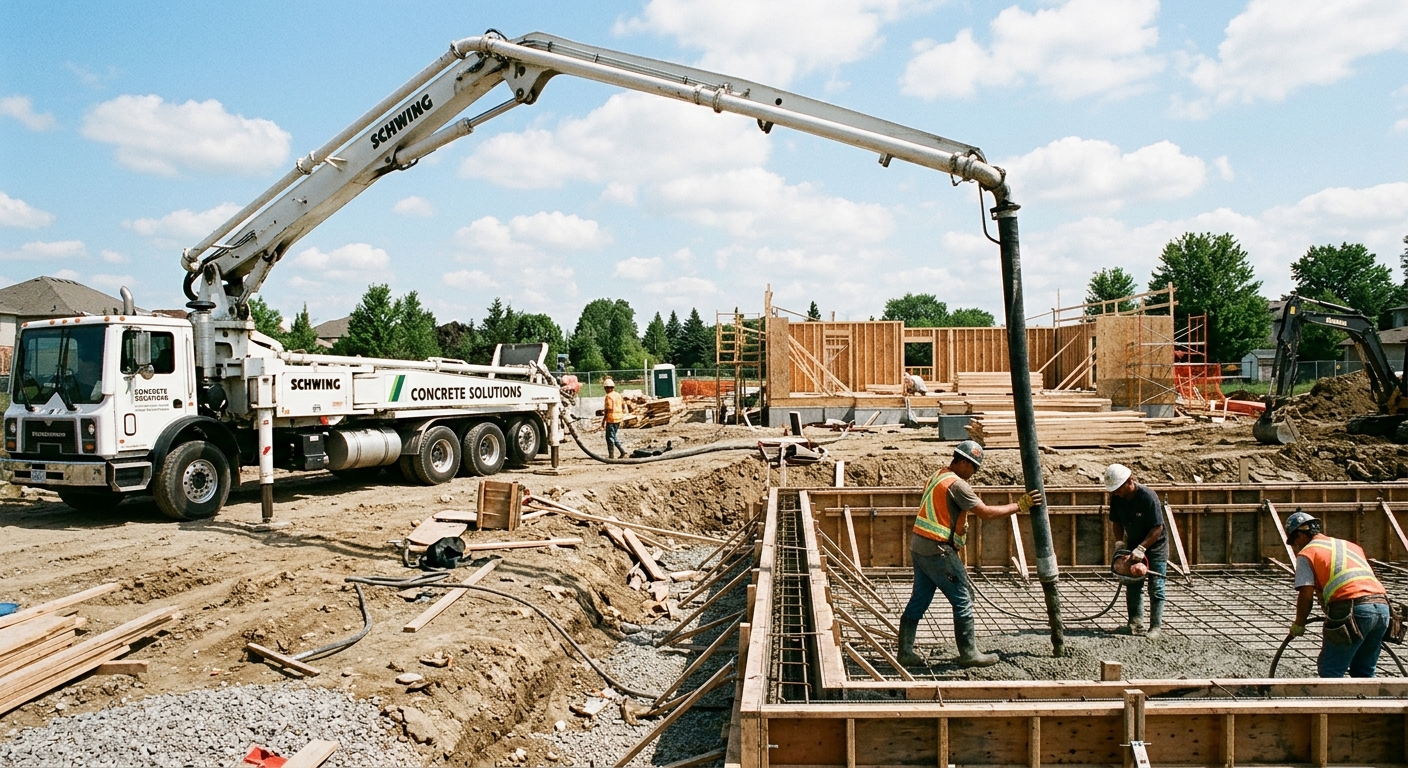
Concrete work options and costs in Turner Valley
Turner Valley is a small community in the Calgary region where concrete flatwork is common—especially for driveways, patios, and walkways on single-detached homes. In 2021, Turner Valley had 2,611 people and 925 homeowner households, with 86.0% of households owning their homes (Statistics Canada, 2021 Census). That homeowner mix matters because most concrete calls come from property upgrades: resurfacing an aging slab, adding a patio, or replacing front steps before freeze–thaw damage gets worse.
Pricing here reflects Calgary’s cold continental climate. With a design frost depth around 2.4 m in Alberta, footings and frost-protected foundation elements must extend well below the frost line to prevent frost heave. Driveway and patio slabs also face frequent freeze–thaw cycles, so contractors build the granular base correctly, use air-entrained mixes, and include control joints to reduce cracking and spalling. On top of that, the practical exterior pour season is shorter; when projects land in late fall or early spring, cold-weather curing precautions (insulation blankets and sometimes temporary heat) can add cost and affect scheduling. That’s one reason demand can be especially steady around established areas like the Turner Valley townsite and along main access corridors where homeowners are renewing driveways and front walkways.
Below are typical options and price ranges you’ll see from reputable local contractors. Use the table to compare finishes and scope, then we can tighten numbers once we know your size, access, soil conditions, and whether the job is tied to drainage or grading changes.
| Application |
Typical Size |
Key Spec |
Finish Option |
Price Range |
| Concrete driveway (standard broom finish) |
16 ft x 30 ft (480 sq. ft.) |
Air-entrained exterior mix, granular base with compaction, control joints |
Broom finish + light edging |
$12,000–$18,000 |
| Exposed aggregate driveway |
16 ft x 30 ft (480 sq. ft.) |
Proper curing + surface retarder plan for consistent exposure |
Exposed aggregate (light/dense stone) |
$16,500–$22,500 |
| Stamped concrete driveway or patio |
16 ft x 30 ft driveway or 12 ft x 16 ft patio (varies) |
Air-entrained exterior mix, reinforced slab design as required |
Stamped pattern with release agent + sealer |
$18,000–$26,000 |
| Plain concrete patio or walkway |
12 ft x 16 ft patio (192 sq. ft.) or 4 ft x 30 ft walkway (120 sq. ft.) |
Compacted granular base, control joints, broom finish for traction |
Plain broom finish |
$5,000–$9,000 |
| Garage floor (interior slab) |
20 ft x 22 ft (440 sq. ft.) |
Vapour barrier/insulation as needed, reinforced slab to spec |
Trowel-finish or light steel trowel |
$6,500–$11,500 |
| Foundation footings (structural, below frost) |
Typical house footing system (varies by plan) |
Engineered footing design, excavation to undisturbed soil below design frost depth |
Structural concrete + formwork |
$28,000–$45,000 |
Prices are estimates only and vary by project scope, site access and material selection.
What affects the price of concrete work in Turner Valley
In Turner Valley and the broader Calgary market, it’s not unusual to see concrete quotes for the “same” job swing by 30–50% once you factor in engineering, site conditions, mix design, and how much time the contractor has to protect the concrete during cold weather. A 480 sq. ft. driveway might sound straightforward, but the cost often comes down to how deep the frost-relevant excavation goes, how much base material is required, and whether reinforcement and finishing details are built to match Alberta’s freeze–thaw exposure.
Two drivers dominate the spread: frost depth and freeze–thaw. In Alberta, footings must extend below the design frost depth (often up to about 2.4 m) to prevent frost heave and seasonal movement. Exterior slabs need air-entrained concrete mixes to survive repeated cycles of freezing and thawing, and they rely on well-graded, compacted granular base prep. The colder region also has a shorter effective pour season; contractors may need winter-grade mixes, insulation blankets, and sometimes temporary heat to achieve proper curing. When that curing window isn’t respected, the slab’s surface can scale and spall faster, especially in salted areas, which is why sealing and correct mix design matter.
In practical terms, Turner Valley examples include: replacing old driveways where removal exposes unsuitable subsoil (more excavation and base) versus a straightforward overlay where the subgrade is solid; adding stamped patterns that require additional labour and finishing steps (you’ll often see stamped work move toward the $15,000–$26,000 range); and projects that arrive in shoulder season, where winter curing precautions push costs toward the upper end of exterior slab work like the $12,000–$18,000 driveway band. Homes built before 1981 are a sizable share of the housing stock here (33.0% built before 1981), so replacement and mitigation work is common, especially where drainage and frost exposure weren’t addressed to today’s expectations (Statistics Canada, 2021 Census).
| Price Factor |
Why It Matters |
Cost Impact |
| Frost line depth — determines footing depth and form height |
Footings must bear on undisturbed soil below the design frost depth |
Higher excavation/formwork volume (can add thousands) |
| Site preparation — excavation, grading, compacted granular base |
Proper base thickness and compaction control settlement and cracking |
More haul-away/import for soft or poor subgrade |
| Reinforcement — rebar or wire mesh requirement |
Reinforcement helps manage shrinkage and load cracking |
Material + labour for placement/chairs |
| Mix design — air-entrainment and compressive strength spec |
Air-entrainment reduces freeze–thaw damage; strength supports durability |
Premium mix and QC/testing |
| Finish type — broom vs. stamped vs. exposed aggregate |
Finish complexity drives extra labour and materials (forms, stamps, retarder, sealer) |
Stamped/exposed often costs substantially more |
| Pour size and concrete truck access to site |
Access affects how much of the pour can be placed efficiently |
Longer pump/placement time, extra crew time |
| Cold-weather curing precautions — heating and blankets |
Concrete must cure properly even when temps drop during the early set |
Heating blankets, labour, and sometimes schedule changes |
| Control joint pattern and sealing cost |
Joints manage shrinkage; sealing helps resist de-icing salt damage |
Additional saw-cut labour and sealer product |
Permits & regulations in Alberta
In Alberta, structural concrete work—think foundation footings, foundation walls, and grade beams—typically requires a building permit, and many projects need engineered drawings that the municipality reviews as part of permitting. Concrete flatwork (patios, walkways, and most standard driveways) usually does not require a permit by default, but there are common exceptions: if your work changes lot grading, alters drainage patterns, increases impervious surface coverage in a way that conflicts with municipal requirements, or affects municipal right-of-way/sidewalk conditions, you may need approvals. The safest approach is to ask the local authority before breaking ground, especially in areas where drainage and runoff control are part of the permitting review.
For contractor compliance, Turner Valley homeowners should verify three things before any forms go in: licence/eligibility to perform the work (where applicable), liability insurance, and worker coverage (WSIB/WCB). While exact registry pathways can vary by contractor type, you can usually confirm eligibility through Alberta’s online business and professional information pages, then request documents directly from the contractor. Ask for a current certificate of insurance showing liability limits and confirm the policy includes your project address. For WSIB/WCB, request the most current clearance letter or account verification that matches the contractor’s legal entity name. Finally, ask for references on similar footing or exterior flatwork projects in the Calgary region so you can gauge whether they build for frost depth and freeze–thaw exposure.
Practical tip: get the permit responsibility clear in writing—whether the contractor pulls it (where required) or you do.
Getting concrete right in Turner Valley's freeze-thaw climate
Concrete failures in Turner Valley are rarely “mystery concrete.” They’re usually traceable to predictable issues: weak base prep, poor mix design (especially insufficient air-entrainment), missing or mis-spaced control joints, and rushed curing during cold snaps. In a Calgary-area freeze–thaw cycle, the slab repeatedly expands and contracts as water in the pores freezes. If the concrete isn’t engineered to handle that—air-entrained properly and cured long enough—you can see surface scaling, spalling, and random cracking long before a slab should age out.
To spec the job correctly, start with the base: excavate and place a compacted granular sub-base to the correct depth for local soil and drainage. Next, require a properly air-entrained exterior mix—commonly about 5–7% air content for exterior flatwork—and a minimum compressive strength of 32 MPa so it meets structural and durability expectations. Add control joints with an intentional spacing plan to limit where cracks will form. Curing is next: plan for at least 7 days under proper conditions, and if you’re near cold-weather conditions, ensure the contractor uses curing protection (insulating blankets/heat) to keep the concrete developing strength. Finish durability needs sealing: apply a penetrating sealer after the cure—often around 28 days post-pour—so de-icing salts and water don’t concentrate at the surface.
Ask technical questions around frost and salt damage. For example, a driveway upgrade that adds proper granular base thickness and the right air-entrained mix may cost more upfront, but it’s often the difference between staying near the $12,000–$18,000 standard range and avoiding early replacement expenses. Meanwhile, choosing a stamped surface may justify the extra labour toward $15,000–$26,000 if you want the look—just don’t let decorative decisions replace the durability specs that matter for freeze–thaw.
| Spec |
Why It Matters in Turner Valley |
What to Ask For |
Impact if Skipped |
| Compacted granular base (depth?) |
Controls settlement and reduces water movement under the slab |
Base thickness and compaction method; disposal/import plan if subgrade is weak |
Premature cracking, uneven settling, early edge failure |
| Air-entrained concrete mix (target air %?) |
Protects against freeze–thaw damage in Turner Valley winters |
Target air content (commonly 5–7% for exterior flatwork) and confirmation of air-entraining admixture |
Surface scaling/spalling, faster deterioration from de-icing salt and freeze–thaw |
| Compressive strength (MPa rating) |
Strength supports durability and resists structural issues under freeze–thaw |
Minimum 32 MPa (or higher if engineered), plus mix design confirmation |
Wear, cracking, and reduced service life |
| Control joints (spacing per ACI guidelines) |
Manages shrinkage cracking where it won’t be damaging |
Planned joint layout and saw-cut timing to achieve intended crack control |
Random cracking across the slab and faster water infiltration |
| Minimum 7-day curing period |
Ensures strength gain before exposure to cold nights and snowmelt |
Concrete temperature/cure protection plan; blankets/heat if temps are borderline |
Weak surface, scaling risk, reduced long-term performance |
| Penetrating sealer (when applied after cure) |
Repels water and helps protect against salt-laden meltwater |
Penetrating sealer applied after full cure (commonly around 28 days post-pour) |
More rapid surface breakdown from salt and moisture cycles |
How to choose a concrete work contractor in Turner Valley
Choosing a concrete contractor in Turner Valley comes down to verifying compliance and quality before the pour. First, confirm Alberta eligibility where applicable and require proof of liability insurance for your project, then ask for worker coverage documentation (WSIB/WCB). The best way to check: (1) request a current certificate of insurance showing your address, coverage limits, and effective dates; (2) ask for a WSIB/WCB clearance letter or account verification tied to the contractor’s legal name; and (3) verify the contractor’s business details online to ensure the paperwork matches the company you’re hiring.
Next, get 2–3 itemised written quotes. You want labour and materials broken out—concrete supply, excavation, granular base, reinforcement, finishing labour, saw cutting, and sealer if included. Avoid lump-sum quotes that don’t show what’s excluded (for example: demolition, disposal, forms for curb edges, or whether permit fees are included where required). For warranty, ask for two things: a workmanship warranty length (how many years for settlement/cracking issues caused by workmanship) and whether there’s a product/manufacturer warranty for admixtures/sealer/finish systems. Also confirm if it’s transferable to future owners.
On payment, don’t pay large deposits: keep upfront spending around 10–15% max, then hold back until the job is complete and cleaned up. Finally, lock in timing: ask for a written start date, weather contingency plan, and a realistic completion estimate.
- Ask for a written scope that lists excavation, base thickness, compaction, and reinforcement.
- Confirm the concrete mix is air-entrained for exterior freeze–thaw exposure.
- Require joint locations and who will saw cut (timing affects crack control).
- Get a statement of cure protection for cold nights (blankets/heat when needed).
- Clarify disposal: haul-away included or extra?
- Confirm truck access plan: can they place the full load without overworking the mix?
- Request sealer details if it’s an exterior slab (product type and when applied).
- Ask whether existing concrete is removed entirely or partially (and how edges are formed).
- Verify liability insurance certificate before any work begins.
- Verify WSIB/WCB clearance letter tied to the correct legal entity.
- Insist on clear warranty wording and exclusions (including drainage-related issues).
- Keep receipts and make sure change orders are documented in writing.
Concrete contractor red flags in Turner Valley: vague or missing specs for air-entrainment and curing, refusal to provide insurance/WSIB documentation, quotes that don’t mention control joints or sealing for exterior slabs, “cheap” pricing that suggests minimal base prep, and contractors who can’t show comparable local project photos or references.
Frequently asked questions — concrete work in Turner Valley
Stamped vs broom-finish concrete — cost difference?
Stamped concrete costs more than broom-finish because it adds labour and materials: moulds/stamps, release agents, extra finishing time, and usually a higher-end sealer system. In Turner Valley, the price difference is real but still depends on size and site conditions. As a reference, standard concrete driveway work often lands around the $12,000–$18,000 band for broom-finish, while stamped driveway or patio projects commonly move toward $15,000–$26,000 depending on the pattern complexity and prep requirements. Both options should use air-entrained exterior concrete and have correctly spaced control joints for Alberta freeze–thaw. The key is to ensure the decorative option doesn’t replace the durability specs—especially curing and sealing on salt-exposed surfaces.
When is the best time to pour concrete in Turner Valley?
In Turner Valley, the best time is when you can maintain safe curing temperatures and avoid sudden cold nights in the first 7 days. Practically, contractors plan pours in late spring through summer, when daytime and nighttime temperatures are more predictable and the curing window is easier to protect. If you’re scheduling in early fall or spring shoulder periods, ask the contractor what winter-grade mix, insulation blankets, and/or temporary heat will be used to keep the concrete developing strength. Because Calgary-area freeze–thaw cycles are frequent, rushed cold-weather placement increases the risk of surface scaling and long-term durability issues. Even when the calendar says “soon,” the concrete’s early temperature control matters more than the exact date on your calendar.
How long does concrete take to cure?
Concrete curing has two parts: early strength gain and full cure. For exterior flatwork in Alberta, you should plan for at least a 7-day curing period under proper conditions before expecting normal loads and weather exposure. Full cure is typically referenced at 28 days for products like sealers and to confirm the concrete’s longer-term development. In Turner Valley’s cold continental climate, curing protection is critical during the first week—especially if night temperatures dip. That’s why good contractors will talk about blankets or heat if the forecast gets borderline. If curing is rushed or exposed too early, you may get a surface that looks fine initially but scales or spalls sooner under freeze–thaw and de-icing salts.
Do I need a permit for concrete work in Alberta?
Often, structural concrete work does require a permit in Alberta—particularly footings, foundation walls, and grade beams—usually backed by engineered drawings reviewed by the municipality. For concrete flatwork like typical patios, walkways, and many driveways, a permit is often not required unless the work affects lot grading, drainage, impervious surface coverage limits, or the municipal right-of-way. In Turner Valley, the safe approach is to confirm requirements with the local authority before you start. Also, make sure you’re hiring a contractor who can handle permitting responsibility correctly (where required). If you’re unsure, ask the contractor to state in writing whether permits are included, who pulls them, and what the approval timing means for your start date.
Concrete vs pavers for a patio in Turner Valley?
Both can work well, but the choice comes down to what you want to manage: settlement lines, joints, and maintenance. Concrete patios are typically more affordable for straightforward layouts and provide a monolithic surface with control joints that can be engineered to limit cracking. Pavers offer visual flexibility and are often easier to lift and replace individual damaged units, which can be useful if a future service repair is likely. In Turner Valley’s climate, both need proper base prep and drainage—if the base moves, everything suffers. Cost-wise, plain concrete patios/sidewalks often fall around $5,000–$9,000 depending on size and site conditions. Pavers can be competitive or higher depending on edging, base thickness, and pattern. If you want the lowest hassle and a clean finish, concrete usually wins; if you want modular repairability and a range of looks, pavers may be worth the extra attention to installation details.
How long does a concrete driveway last?
A well-built concrete driveway in the Turner Valley area commonly lasts decades—often 20–30 years or more—if it’s designed for freeze–thaw durability. The life span depends mostly on base preparation depth and compaction, air-entrained mix design, proper control joint placement, curing quality, and surface protection. Sealing (applied after the cure, often around 28 days post-pour) helps repel water and reduces the impact of de-icing salts that accelerate spalling. Driveways built on weak subgrade, poured in cold conditions without adequate protection, or without correct joints often show scaling and cracking much earlier. If yours is showing spalling or repeated patch failures, it may be a base/drainage issue rather than a simple surface defect. A site visit and check of base and edges is the fastest way to estimate true remaining service life.