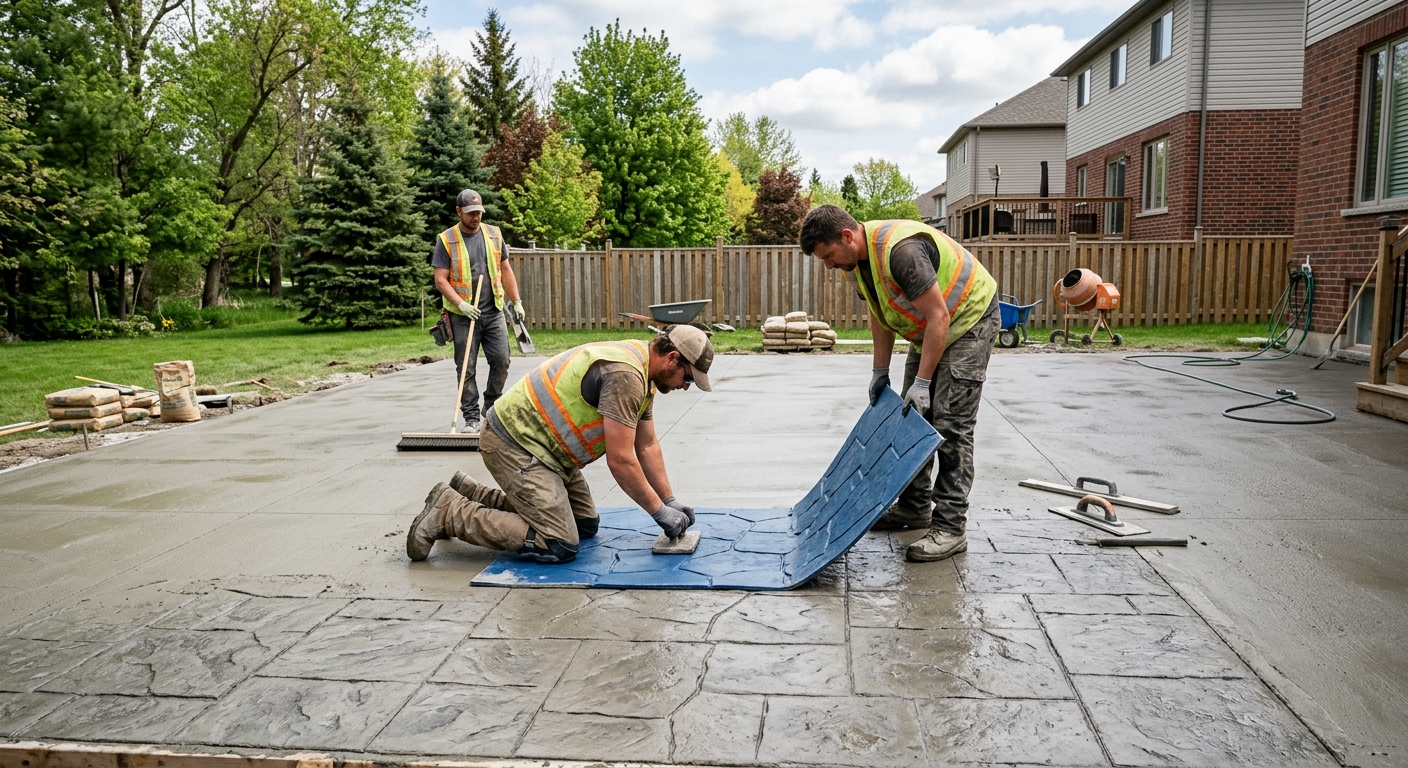
Concrete work options and costs in Strathmore
Strathmore is where a lot of Alberta homeowners start with practical flatwork—driveways, patios, and walkways—before they move on to bigger projects. In a town built around family neighbourhoods (and where single-detached homes make up 58.7% of dwellings), it’s common to see replacement slabs, expanded drive approaches, and new front steps tied to the homeowner’s timeline. With 4,260 homeowner households in the area (77.2% of households own), there’s steady demand for concrete work that looks good and holds up to daily use.
In the Lethbridge–Medicine Hat economic region, pricing reflects a deep frost line and aggressive freeze–thaw cycles. For structural work, footings generally need to sit below frost—often in the 5–6 ft range—so excavation and forming costs rise compared with milder climates. Exterior slabs also require air-entrained concrete and tight control joint planning to reduce cracking and spalling risk. Because the pour season can be shorter in cold and shoulder weather, contractors may need blankets, heaters, or accelerators to hit strength targets, which can move a job upward or downward depending on the calendar and access to site services.
In Strathmore, projects are especially common around newer subdivisions near the Downtown/West Main Street corridor and the surrounding growth areas where driveways are often upgraded from gravel to concrete. If you’re comparing options, the differences are usually clearer once you look at the finishes and the structural specs—see the cost ranges below.
| Application |
Typical Size |
Key Spec |
Finish Option |
Price Range |
| Concrete driveway (standard broom finish) |
12 ft x 22 ft (approx. 264 sq ft) |
Air-entrained mix for exterior, compacted granular base, control joints |
Broomed surface |
$14,000–$22,000 |
| Exposed aggregate driveway |
12 ft x 22 ft (approx. 264 sq ft) |
Air-entrained mix, proper curing, sealed or ready-to-seal surface |
Exposed aggregate (sandblast/wash) |
$18,000–$28,000 |
| Stamped concrete driveway or patio |
10 ft x 20 ft (approx. 200 sq ft) |
Air-entrained mix, integral colour, base preparation and joints |
Stamp + colour |
$20,000–$32,000 |
| Plain concrete patio or walkway |
10 ft x 12 ft (120 sq ft) |
Air-entrained mix, compacted base, joints where required |
Float/brush finish |
$1,500–$3,000 |
| Garage floor (interior slab) |
22 ft x 24 ft (approx. 528 sq ft) |
Interior mix, base grading, vapour control layer if required |
Steel trowel or broom-to-trowel finish |
$10,000–$18,000 |
| Foundation footings (structural, below frost) |
Typical single foundation system (allowance) |
Excavation below frost, reinforcement per engineer, air content where exterior exposure applies |
Formed/finished for structural placement |
$18,000–$35,000 |
Prices are estimates only and vary by project scope, site access and material selection.
What affects the price of concrete work in Strathmore
In Strathmore, it’s normal to see quotes for the “same” concrete project come in 30–50% apart once you compare the real specifications. The gap usually comes down to frost depth and freeze–thaw durability requirements, not just the concrete itself. In the Lethbridge–Medicine Hat region, contractors design for a deep frost line: exterior work needs proper granular base prep and structural elements often have to be placed below frost (commonly about 5–6 ft for footings), which drives excavation and forming costs up. In turn, that affects how crews schedule pours and how quickly they can move through a site—labour availability can become a cost driver during warmer windows.
Freeze–thaw cycles also dictate mix design. Exterior slabs typically require air-entrained concrete to handle internal expansion when water freezes. If a quote uses a non-air-entrained mix or doesn’t clearly state air targets, you might pay less upfront but you’re gambling with premature surface scaling and spalling. Cold-weather pours are another pricing lever: shoulder-season work may require insulated blankets, heaters, or accelerators so the concrete can reach strength before backfill or loading. Even in a drier part of Alberta, sealing matters because de-icing salts can accelerate surface deterioration on exposed edges and slabs.
In Strathmore, a driveway swap on firm, accessible ground can land near the lower end of the local slab bands (for example, concrete driveway pricing often targets the $14–$22 per sq ft range as a planning guide), while complicated access or poor drainage can push budgets closer to the higher end. For finishes, a basic patio often stays closer to the $12–$20 per sq ft band, but stamped or aggregate work adds labour and materials for forms, tools, and/or surface treatments—so it’s not unusual to see a difference of several thousand dollars for the look you want. Home age plays a role too: with 17.5% of homes built before 1981, it’s common to deal with older service runs, uneven approaches, or settlement that increases prep time and repair scope.
| Price Factor |
Why It Matters |
Cost Impact |
| Frost line depth |
Determines footing depth and form height |
Higher frost depth increases excavation and rebar/form time |
| Site preparation |
Excavation, grading, compacted granular base |
Poor soil or extra hauling can add significant labour and equipment costs |
| Reinforcement |
Rebar or wire mesh requirement |
Engineering, tying, and placement time can materially change total price |
| Mix design |
Air-entrainment and compressive strength spec |
Spec changes can raise material cost and impact pour logistics |
| Finish type |
Broom vs. stamped vs. exposed aggregate |
Stamped/aggregate generally requires more labour steps and curing control |
| Pour size and concrete truck access to site |
Distance, staging, and ability to place quickly |
Tighter access may require pumps, extra labour, or smaller pours |
| Cold-weather curing precautions |
Heating and blankets |
Adds fuel/equipment and can require longer protection time |
| Control joint pattern and sealing cost |
Manages cracking and protects against de-icing salt |
Proper joint layout and sealer add line-item cost but reduce failures |
Permits & regulations in Alberta
In Alberta, whether you need a permit depends on what concrete element you’re building and whether it affects structure or lot servicing. Structural concrete work—such as footings, foundation walls, grade beams, and other foundation-related elements—typically requires a building permit, and engineered drawings are often reviewed by the municipality as part of the permit process. For concrete flatwork (like driveways, patios, and walkways), permits are commonly not required unless the work affects lot grading, drainage, impervious surface coverage limits, or the municipal right-of-way. If your project includes curb ties, changes to municipal sidewalk areas, or major drainage rerouting, confirm requirements before breaking ground.
Before you sign anything in Strathmore, verify the contractor is properly insured and qualified. Here’s a simple step-by-step homeowner check:
- Check their business licensing/registration in Alberta (ask for their business number info and registration details).
- Request a current certificate of liability insurance. Confirm the coverage dates match the project window and that concrete-specific activities are covered.
- Request proof of WSIB/WCB coverage (or a clearance letter where applicable). Don’t rely on “we’re covered” without a document.
- Ask for references on similar-scope jobs in Alberta—driveways, patios, or foundation work depending on your project.
- Get the work scoped in writing: excavation limits, disposal, curing plan, and finishing details.
Getting concrete right in Strathmore's freeze-thaw climate
Concrete doesn’t fail in Strathmore because it’s “bad concrete”—it fails when the base, mix, joints, or curing don’t match the local freeze–thaw reality. The most common issues I see are spalling and premature scaling from inadequate air-entrainment, plus random cracking from missing or poorly spaced control joints. The fix starts before the first pour: build a properly compacted granular base to the right depth for your soil and frost considerations, then use an air-entrained mix and protect the placement through curing.
For exterior flatwork, specify air-entrained concrete with a typical target air content of 5–7% for freeze–thaw resistance, and a minimum 32 MPa compressive strength so it can reach durability strength reliably. Add control joints at spacing that’s appropriate for the slab dimensions and design (so cracking is controlled, not random). Curing should be at least 7 days under proper conditions; in colder shoulder periods, discuss blankets/heaters so the slab gains strength before it gets stressed by freeze cycles or early loading. Finally, plan for sealing after full cure (around 28 days) using a penetrating sealer to reduce salt and moisture penetration at the surface.
Here’s a concrete example of where prices can make sense: a standard broom driveway and a stamped option may differ by several thousand dollars. If you want stamp and colour, the premium is often justified because you’re paying for extra labour steps, a controlled finishing schedule, and more careful curing timing. But for durability, don’t “save” by skipping air entrainment or joint planning—even if that means staying closer to a standard broom finish budget. Those corners tend to cost more later.
| Spec |
Why It Matters in Strathmore |
What to Ask For |
Impact if Skipped |
| Compacted granular base (depth?) |
Base supports loads and helps manage frost movement |
Confirm granular type, thickness, and compaction test/standard used |
Settlement, voids, and higher cracking risk |
| Air-entrained concrete mix (target air %?) |
Relieves pressure from freeze–thaw cycles |
State target air content (typically 5–7% for exterior flatwork) |
Spalling/scaling and shortened service life |
| Compressive strength (MPa rating) |
Strength affects durability and load capacity |
Minimum 32 MPa specified for the pour |
Surface wear, poor performance under freeze stresses |
| Control joints (spacing per ACI guidelines) |
Controls where shrinkage cracks occur |
Ask for joint plan tied to slab size (with saw-cut timing) |
Random cracking through the finish |
| Minimum 7-day curing period |
Strength gain needs time, especially in cooler weather |
Confirm curing method and protection plan during cold/shoulder periods |
Lower final strength and increased surface deterioration |
| Penetrating sealer (when applied after cure) |
Helps repel moisture and de-icing salt intrusion |
Apply after full cure (around 28 days) with compatible product |
More salt scaling and faster edge breakdown |
How to choose a concrete work contractor in Strathmore
Choosing the right contractor in Strathmore is mostly about verifying three things: credentials, documentation, and workmanship details that match our freeze–thaw climate. Start by confirming Alberta business and safety coverage. Ask for their liability insurance certificate and verify it covers the work period. Then request proof of WSIB/WCB coverage (or a clearance letter where applicable). You should be able to see a document, not just be told “we’re covered.”
For quoting, insist on 2–3 itemised written quotes instead of one lump sum. The best quotes break down excavation and disposal, granular base and compaction, reinforcement, concrete supply and mix specification (including air-entrainment), formwork, finishing, curing/protection, saw cutting, sealing, and any reinstatement like topsoil and sod. Check what’s included and what’s excluded: permit pull included? traffic control? waste hauled away? saw cutting timing and joint sealing included? These details are where “cheap” quotes often hide costs.
Warranty matters too. Ask for the workmanship warranty length, whether there’s a separate manufacturer warranty for admixtures/finishes, and whether it’s transferable to future owners. On payment, don’t go beyond 10–15% upfront; hold a portion until cleanup and final inspection are complete. Finally, get a written timeline with a start date and an estimated completion window, including contingencies for weather.
- Proof of liability insurance with project dates and proper coverage limits
- WSIB/WCB clearance letter or coverage documentation
- Concrete mix specified for exterior durability (air-entrainment explicitly stated)
- Granular base type, thickness, and compaction expectations in writing
- Reinforcement plan stated (and why it’s needed)
- Control joint locations and timing (saw-cut schedule)
- Curing method and protection plan for cooler days
- Finishing process described (broom vs stamped vs exposed aggregate)
- Sealer type and when it’s applied (after full cure)
- Disposal and hauling details (included or extra)
- Surface prep and edge finishing scope (removal, forms, transitions)
- Clear warranty terms for workmanship and materials
Concrete red flags I’ve seen around Strathmore include: quotes that don’t clearly state air-entrainment, promises of “no joints needed,” missing saw-cut timing details, skipping base compaction documentation, and contractors who won’t put curing/protection measures in writing—especially when weather windows are tight.
Frequently asked questions — concrete work in Strathmore
How do I compare concrete quotes?
Start by comparing like-for-like, not just the total price. In Strathmore, the biggest quote differences often come from base prep depth, granular compaction, reinforcement requirements, and whether the exterior mix is truly air-entrained for freeze–thaw durability. Ask each contractor to itemise excavation/disposal, granular base, concrete supply with mix spec (including air content), finishing method, control joint layout, curing/protection, and sealing. If you’re comparing a driveway, confirm whether the quote aligns with local planning ranges (for example, concrete driveway pricing is often budgeted around the $14–$22 per sq ft band for standard broom work, before upgrades). Also check truck access—haul distance and placement time can change labour and concrete logistics. Finally, make sure warranty terms and payment schedule are written and consistent across bids.
Can concrete be poured in cold weather in Strathmore?
Yes, concrete can be poured in cold weather in Strathmore, but it must be managed correctly. When temperatures are low, concrete gains strength more slowly and is more vulnerable during the first days of curing—exactly when freeze–thaw cycles can cause surface problems. A reputable contractor will plan cold-weather procedures such as insulating blankets, heaters, curing blankets, and sometimes approved accelerators to help concrete reach strength before it’s exposed to severe cold. They should also confirm that placing and finishing are possible within the workable time window and that protection continues long enough. If you’re getting work done in shoulder months, ask what temperature thresholds trigger added protection. That’s also when itemised costs may move upward, since the equipment and extra labour days aren’t optional in southern Alberta’s climate.
How do I maintain concrete in Strathmore's freeze-thaw climate?
Maintenance is mostly about controlling moisture and salt exposure. In Alberta winters, de-icing salts and trapped water at edges can accelerate scaling or spalling, especially on driveways and patios. The practical steps start with sealing: after proper curing (typically around 28 days), apply a penetrating sealer to help repel moisture and reduce salt intrusion. Keep the surface clean of sand build-up and avoid overusing harsh de-icers—use sand for traction when possible. Promptly remove snow from edges rather than letting ice sit and undermine corners. Inspect control joints and edges each season; if you see widening joints or loose sealant, repairs are cheaper early. Because Strathmore has a strong single-detached homeowner market (and many homes built in older eras), routine touch-ups can be a smarter budget than full replacement.
What causes concrete to spall in Strathmore winters?
Spalling in Strathmore is most often tied to freeze–thaw pressure inside the concrete and moisture entering through the surface. The top cause is inadequate air-entrainment—without the right air content, water freezes and expands, breaking the surface layer over time. Poor curing or curing that’s insufficient in cold weather can also lower early strength, leaving the surface more vulnerable. Another contributor is inadequate base prep or drainage: if water sits under or around slab edges, freeze–thaw cycles repeat with more force. De-icing salts make it worse by adding chemical stress, which is why sealing after cure is important. If you’re choosing between options, don’t try to save money by dropping durability specs—spalling repairs later can be far more expensive than the difference between standard broom work and a properly protected slab.
What is rebar and when is it required in Alberta?
Rebar (reinforcing steel) is used to strengthen concrete where tensile forces occur—think foundation systems, grade beams, and certain structural slabs. In Alberta, structural concrete like footings and foundation walls typically requires engineered designs, so rebar placement and sizing aren’t guesswork; they’re specified based on soil conditions, loads, and frost considerations. For exterior flatwork like driveways, some projects use mesh or rebar, but the decision depends on slab thickness, soil support, and design requirements. The key is that a proper contractor explains the “why” and references the engineered or project spec. If you’re doing structural work that goes below frost, expect reinforcement requirements to be spelled out in the drawings and included in the permit scope. Always ask your contractor to list reinforcement grade/type and where it’s installed.
How long does a concrete project take in Strathmore?
The timeline depends on scope, weather, and how many pours are needed, but you can plan around the practical steps. For an exterior driveway or patio, demo and base prep can take a few days, then form/steel and the pour day itself happens when conditions are right. Drying isn’t the same as being ready for use: slabs typically require protection during curing and may be restricted for a period depending on temperature and strength gain. Sealing is usually scheduled after the slab has fully cured (commonly around 28 days), even if the work is “finished” sooner. Cold-weather pours add time because blankets/heating often extend the protection window. If your project includes structural footings below frost, excavation and inspections can further extend the schedule. When you request quotes, ask for a written start date and estimated completion window, including curing/protection days and sealing scheduling.