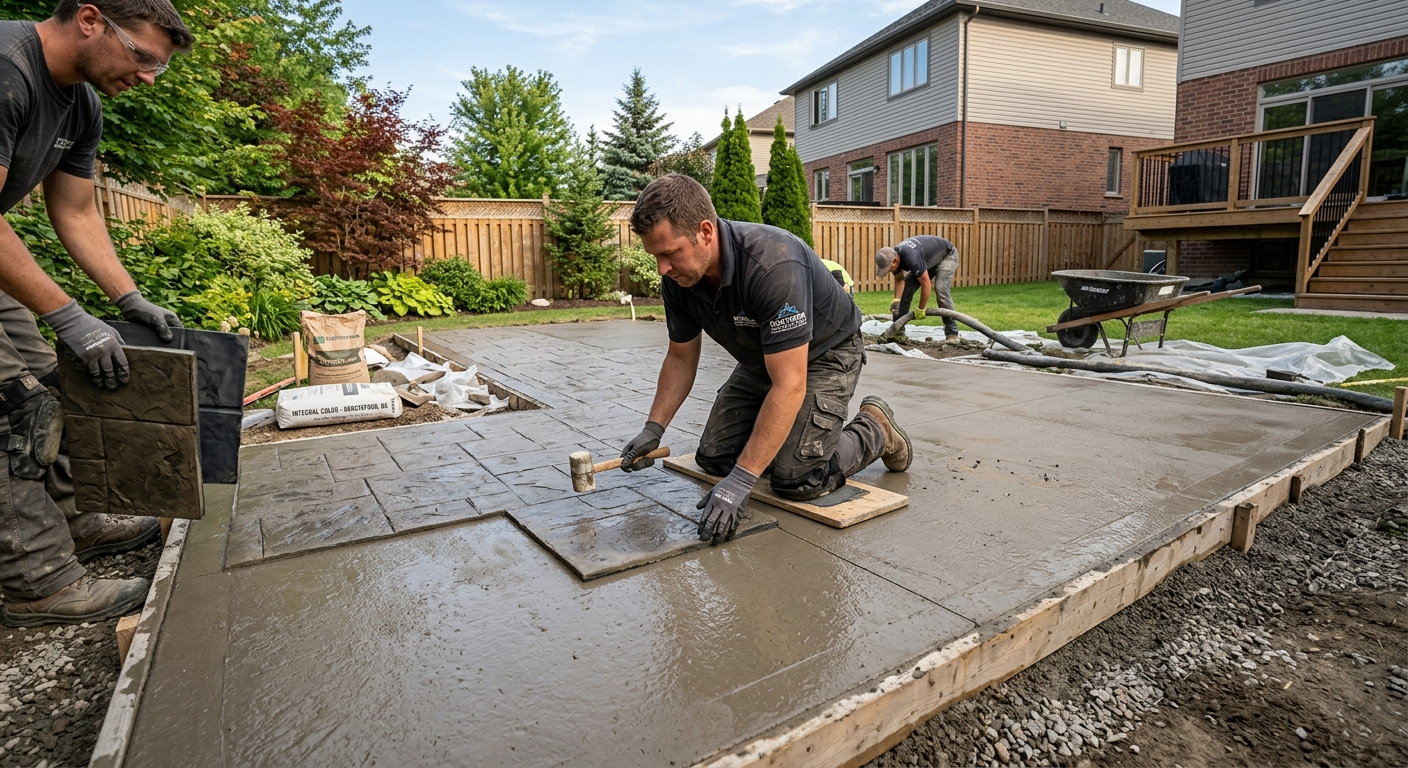
Concrete work options and costs in Sundre
Sundre homeowners rely on concrete for everything from driveways and garage floors to patios and walkways—especially because the area has a winter freeze–thaw pattern that punishes weak mixes and poor base prep. In a community of 2,672 people (Statistics Canada, 2021 Census), and with 76.5% of households owning (Statistics Canada, 2021 Census), it’s common to see long-term home improvements like replacing tired flatwork on older properties. That matters here because 51.7% of dwellings are single-detached homes (Statistics Canada, 2021 Census), which is the primary market for exterior slabs and garage pads.
Calgary-area concrete pricing is shaped by frost depth and the practical pour season. In Alberta, the design frost depth is roughly 1.2 m (about 4 ft), so footings and deeper structural pours require more excavation, more granular base, and higher concrete volumes than in milder climates. Freeze–thaw cycles also drive specs such as air-entrained mixes and more deliberate control joint patterns to reduce cracking and surface scaling. On top of that, cold-weather curing precautions—insulated blankets, sometimes heat, and tighter scheduling—can add cost, particularly when exterior work slips into late fall or early spring.
In Sundre, where contractors are especially in demand is the older core and infill areas around main residential streets, plus neighbourhood pockets where residents frequently upgrade driveways for better vehicle access. If you’re comparing contractor quotes, the fastest way to align expectations is to look at typical scope and finish choices side-by-side—see the comparison table below.
| Application |
Typical Size |
Key Spec |
Finish Option |
Price Range |
| Concrete driveway (standard broom finish) |
24 ft x 10 ft (240 sq ft) |
Air-entrained exterior mix, reinforced where required, control joints |
Broom finish, edges finished with trowel |
$12,000–$18,000 |
| Exposed aggregate driveway |
24 ft x 10 ft (240 sq ft) |
Air-entrained exterior mix, proper base compaction for frost |
Exposed stone (form-lined or wash/expose process) |
$14,500–$22,000 |
| Stamped concrete driveway or patio |
200–400 sq ft (project-dependent) |
Air-entrained exterior mix, reinforcement and release system |
Stamped pattern + coloured hardener |
$15,000–$26,000 |
| Plain concrete patio or walkway |
12 ft x 16 ft (192 sq ft) |
Air-entrained mix, compacted sub-base, control joints |
Broom or light trowel, clean edges |
$5,000–$9,000 |
| Garage floor (interior slab) |
24 ft x 24 ft (576 sq ft) |
Interior mix spec, vapour considerations, reinforcement |
Float + light broom/smooth finish |
$10,500–$16,500 |
| Foundation footings (structural, below frost) |
Typical small addition/garage |
Engineered excavation to below design frost; rebar/structural placement |
Structural formwork + reinforcement (no decorative finish) |
$28,000–$45,000 |
Prices are estimates only and vary by project scope, site access and material selection.
What affects the price of concrete work in Sundre
In Calgary and the surrounding area, it’s not unusual to see quotes for the “same” concrete job differ by 30–50%. The swing usually comes from what’s included in site prep, how the contractor deals with frost-depth requirements, and what quality/spec they’re actually placing—not just the finished colour or stamp. In Alberta, footings and grade-related concrete work must be engineered around freeze–thaw performance, and that starts with depth and base build-up. A design frost depth of about 1.2 m (roughly 4 ft) means deeper excavation and more granular base than many homeowners expect, which drives foundation and footing costs upward relative to regions with shallower frost penetration.
Freeze–thaw cycles also dictate mix and detailing. Exterior slabs and driveways need air-entrained concrete (commonly 5–7% air) so the slab can survive repeated expansion/contraction without spalling. Contractors also plan for a shorter exterior pour season, and when cold-weather placement is required they may add insulated blankets or temporary heating to protect curing. De-icing salt use accelerates surface scaling if the mix or finishing isn’t spec’d correctly—so sealing often becomes a practical requirement for longevity.
Two examples you’ll notice in Sundre: (1) removing topsoil and hauling in well-graded granular base for a driveway can add cost, but it often prevents premature edge failure; and (2) choosing a stamped driveway/ patio upgrade can move you from the plain flatwork range into the $15,000–$26,000 band, but the added value shows up in surface detail and curb appeal. Meanwhile, a straightforward broom-finished driveway tends to fall in the $12,000–$18,000 band when access and base conditions are normal.
Age of the housing stock is another influence. In Sundre, many homes are older (38.7% built before 1981 per Statistics Canada, 2021 Census), and older lots often have unknown fill history, deeper unsuitable material, or prior repairs—each can increase excavation and reinforcement requirements.
| Price Factor |
Why It Matters |
Cost Impact |
| Frost line depth — determines footing depth and form height |
Footings must bear below the design frost depth to prevent heave and seasonal movement |
Higher excavation depth raises concrete and labour; typically the biggest driver for foundations/footings |
| Site preparation — excavation, grading, compacted granular base |
Weak or poorly compacted base leads to settlement and cracking |
Can add thousands if unsuitable soils or extra haul-away/replacement is required |
| Reinforcement — rebar or wire mesh requirement |
Controls cracking and improves load performance under freeze–thaw cycles |
Mesh vs rebar, placement accuracy, and tying labour can shift costs |
| Mix design — air-entrainment and compressive strength spec |
Air-entrainment improves durability against spalling; strength targets affect mix and curing demands |
Upgrading spec adds material cost but can prevent long-term scaling and repairs |
| Finish type — broom vs. stamped vs. exposed aggregate |
Finishes add surface steps, finishing timing, and sometimes extra products |
Stamped/exposed typically cost more than plain broom finishes |
| Pour size and concrete truck access to site |
Long carries, tight access, or multiple truck runs increase labour and scheduling time |
May increase mobilization and placement cost significantly on constrained lots |
| Cold-weather curing precautions — heating and blankets |
Proper curing is critical in Calgary-area conditions to avoid scaling and weak surface durability |
Adds equipment and labour; may be needed in late fall/early spring pours |
| Control joint pattern and sealing cost |
Joints manage shrinkage cracking; sealing helps reduce de-icer salt damage |
More joints and sealing are small line-items compared with full slab replacement risk |
Permits & regulations in Alberta
In Alberta, structural concrete work typically requires a permit and often engineered drawings reviewed through the municipal process. This includes concrete footings, foundation walls, grade beams, and other below-grade structural elements. Concrete flatwork—patios, walkways, and driveways—usually does not require a permit if it stays within your property grade plan and doesn’t alter lot grading in a way that affects drainage, impervious surface limits, or any municipal right-of-way requirements. That said, the safe move in Sundre is to confirm what applies to your exact footprint and any grading/drainage changes before a saw ever touches concrete.
Here’s a practical step-by-step way a homeowner can verify a contractor in Alberta before starting:
- Ask for their liability insurance certificate (COI) and ensure the coverage period is current.
- Confirm WSIB/WCB coverage (as applicable) by requesting a clearance letter or proof of active coverage—don’t accept an expiry date.
- Request their business identification and any Alberta registration details they can provide for your project records.
- Verify they’ve completed similar work locally (recent driveways/footings) and ask for addresses you can drive by.
- Get your permit responsibilities clarified in writing: who applies, who pays, and what dates are required.
If a quote includes structural concrete like footings, insist on clear scope language and engineered requirements so you’re not surprised by permitting delays. For flatwork, still confirm drainage and grading impacts—those are the details that frequently trigger additional requirements.
Getting concrete right in Sundre's freeze-thaw climate
Concrete failures in Sundre are usually predictable: freeze–thaw expansion, inadequate base preparation, and poor curing lead to surface scaling, spalling, and random cracking. The fix is in the specification, not just the appearance. First, base preparation must reach the right depth for local soil conditions and frost behaviour—properly compacted granular sub-base is what keeps a slab from settling as the ground cycles through winter. Second, the mix design should include air-entrainment; for exterior flatwork, a typical target is 5–7% air, alongside a minimum 32 MPa compressive strength so the slab meets durability expectations in Alberta cold weather. Third, control joints should be planned with a spacing strategy that limits uncontrolled cracking and helps cracks land where they’re meant to.
Curing is the step homeowners can’t see, but it’s where costs and longevity diverge. In Calgary-area conditions, minimum 7-day curing under proper conditions is recommended; cold weather pours require protecting the slab with insulation blankets and, if needed, temporary heat. Finally, sealing should be planned after the cure period (commonly 28 days post-pour for many systems) to help repel de-icing salt and reduce surface deterioration.
If you’re deciding between finish options, make sure the fundamentals are right first. For example, a stamped concrete driveway/patio often sits in the $15,000–$26,000 band, while a broom-finished driveway is commonly in the $12,000–$18,000 band. The price difference can be justified when base prep, air-entrainment, and joint/seal detailing are identical and only the surface finish changes. If a contractor offers “cheap stamped” with unclear mix/spec, that’s where warranties usually get hard to enforce.
Use this as your checklist of technical questions: “What’s the base depth and compaction method?”, “What air content are you targeting?”, “How will you protect curing when temperatures drop?”, and “What joint spacing and sealer schedule are included?”
| Spec |
Why It Matters in Sundre |
What to Ask For |
Impact if Skipped |
| Compacted granular base (depth?) |
Controls settlement and movement during winter freeze–thaw cycles |
Minimum sub-base depth for your soil + proof of compaction (lift thickness method) |
Premature cracking, edge spalling, and uneven surface |
| Air-entrained concrete mix (target air %?) |
Improves durability against freeze–thaw and reduces spalling risk |
Target 5–7% air for exterior flatwork and confirm it in writing |
Surface scaling/spalling within a few winters |
| Compressive strength (MPa rating) |
Provides structural capacity and better long-term performance in cold conditions |
Minimum 32 MPa specified for the application |
Weaker slab; increased cracking and durability problems |
| Control joints (spacing per ACI guidelines) |
Manages shrinkage cracking so it doesn’t become random damage |
Joint layout plan with spacing guidance appropriate to slab thickness and dimensions |
Random cracking that can admit moisture and accelerate deterioration |
| Minimum 7-day curing period |
Ensures strength gain before cold stresses the surface |
How curing will be protected (insulation/heating if needed) to reach safe strength |
Weak surface, scaling, and reduced long-term performance |
| Penetrating sealer (when applied after cure) |
Helps protect against de-icing salts and moisture migration |
Sealer type and confirmation of timing (commonly after full cure, often ~28 days) |
Faster salt damage and surface breakdown |
How to choose a concrete work contractor in Sundre
Choosing the right concrete contractor in Sundre starts with verification and clarity. In Alberta, ask for (1) liability insurance, (2) WSIB/WCB clearance or proof of active coverage, and (3) references for similar-scale work. To check: request a certificate of insurance that lists your project address/location as appropriate and confirms coverage is current; obtain a WSIB/WCB clearance letter or proof documents with valid dates; and confirm their business information matches the quote documents you receive.
Next, get 2–3 itemised written quotes—not a single lump-sum with missing details. A good quote breaks down labour and materials (excavation/granular base, reinforcement, concrete supply, finishing, joints and sealing, disposal, and any heating/blanket line-items for cold weather). Read the scope carefully: what’s excluded (sidewalk/approach cuts, tie-ins to existing concrete, sawcutting, waste disposal, permits/locates if needed)? Who is responsible for sub-drainage considerations if your grade changes?
Warranty matters too. Ask for the workmanship warranty length and whether it’s tied to proper maintenance (like sealing) or limited to specific defects. Product/manufacturer warranty on sealers or admixtures may differ; confirm what’s transferable if you sell your home.
On payment schedule, don’t pay more than 10–15% upfront. Hold back a portion until the final finishing, joint sealing (if included), and cleanup are complete. Finally, insist on a written timeline with a start date and completion estimate, including how weather impacts scheduling in Alberta’s freeze–thaw season.
- Proof of liability insurance with current dates and coverage limits
- WSIB/WCB clearance letter (or proof of active coverage where applicable)
- 3 recent references for driveways/patios in the Calgary/Sundre area
- Itemised quote showing excavation, base, reinforcement, concrete, finishing, joints, sealing
- Stated concrete mix spec (air-entrainment target and strength) for exterior work
- Joint layout plan and whether joints are sawcut vs tooled
- Curing method described (especially if temps may drop during placement)
- Clear wording on disposal: what gets hauled away and what stays on site
- Site access notes: how many trucks/carry distance assumptions are included
- Permit responsibility stated (who pulls it, who pays, and typical timelines)
- Warranty terms in writing, including what’s excluded and maintenance requirements
- Payment schedule capped at 10–15% deposit; holdback until final walkthrough
Concrete contractor red flags in Sundre include: vague mix specs (“standard concrete” with no air content mentioned), no plan for frost-depth base requirements, skipping written joint spacing and sealing timelines, refusing to show insurance/WSIB/WCB documentation, and offering overly aggressive schedules that ignore cold-weather curing precautions.
Frequently asked questions — concrete work in Sundre
Concrete vs pavers for a patio in Sundre?
In Sundre, both can work, but concrete is usually the better fit when you want low maintenance and a strong, monolithic surface through Alberta’s freeze–thaw cycles. A properly built concrete patio with air-entrained mix and control joints tends to handle winter stresses well and resists shifting when the base is compacted to the right depth. Pavers can be excellent if you expect future adjustments or if your grade/drainage is tricky, because individual units can be replaced. Price-wise, a plain concrete patio often lands in the $5,000–$9,000 range for many typical residential sizes, while pavers can come out higher once you include excavation depth, edge restraints, and labour-intensive setting. If you’re choosing between them, focus first on base compaction and drainage design—finish choice matters only after the durability specs are correct.
How long does a concrete driveway last?
A well-built driveway in Sundre often lasts many years—commonly 20+ years—because the slab is designed for Alberta’s frost conditions and freeze–thaw cycle. Longevity depends less on whether the driveway is broom finished or stamped and more on the foundation of the job: compacted granular base, correct air-entrained exterior mix, reinforcement details (when required), and joints spaced to reduce random cracking. Also, cold weather curing protection and sealing can make a meaningful difference when de-icing salts are used. If a contractor skimped on air-entrainment or rushed curing during cold snaps, scaling and spalling can show up sooner, usually after a few winters. When you compare quotes, ask for the mix spec and curing plan; that’s where “same-looking” driveways can end up with very different service lives.
What is air-entrained concrete and why does it matter here?
Air-entrained concrete is formulated with tiny, evenly distributed air bubbles that give freezing water somewhere to expand without damaging the paste. In Sundre and the broader Calgary region, repeated freeze–thaw cycles are the main reason exterior slabs crack, spall, and scale when the mix is wrong. That’s why local concrete practice commonly targets about 5–7% air content for exterior flatwork and why you should expect air-entrainment to be included for driveways, patios, and walkways. Without it, de-icing salts and moisture migrate into small surface defects, and the freeze–thaw stress turns those defects into concrete loss. When comparing contractor quotes, don’t accept vague wording—ask directly what air content (and strength rating) they’re specifying in writing. That one line item often explains the difference between cheap bids and durable results.
How do I prepare the base for a concrete slab?
Base preparation is the foundation of durability in Sundre’s climate. A good concrete contractor should remove unsuitable topsoil and any soft/organic material, then place a compacted granular sub-base to a depth appropriate for local soil and the frost environment (Alberta practice is engineered around a design frost depth of roughly 1.2 m for deeper structural elements). They should compact in lifts with proper equipment so the base reaches the required density—not just “patted down.” A strong base reduces settlement and keeps the slab from cracking when soil moves during freeze–thaw cycles. Ask for details on the granular material (gradation/type), compaction approach, and whether reinforcement is placed correctly relative to the base. If disposal, hauling, or replacement of unsuitable soil is needed, it should be itemised in your quote so you know what you’re paying for.
How do I compare concrete quotes?
To compare concrete quotes fairly in Sundre, you need like-for-like scopes. Start by getting 2–3 itemised quotes that separate labour and materials, including excavation/grading, granular base, reinforcement, concrete supply, finishing, control joints, and any sealing. Confirm whether the quote includes cold-weather curing precautions (insulated blankets/heating) if the schedule crosses into colder temperatures. Pay attention to what’s excluded: disposal, tie-ins to existing concrete, sawcutting, permits (if required for structural work), and any adjustments for truck access. Then compare finish specs: broom vs stamped vs exposed aggregate. A broom driveway commonly sits around the $12,000–$18,000 band, while stamped upgrades are often in the $15,000–$26,000 range, but only if the durability specs (air-entrainment, joints, curing) are consistent. The lowest number isn’t always the best value if the mix and curing plan are unclear.
Can concrete be poured in cold weather in Sundre?
Yes, concrete can be poured in cold weather in Sundre, but it must be engineered and protected to achieve proper curing. The risk isn’t just “slower curing”—it’s surface scaling, weak strength gain, and long-term durability issues if temperatures drop too far during placement. Alberta contractors typically use cold-weather mixes when needed and add practical protection like insulated blankets and, in some cases, temporary heat to maintain curing conditions. This is especially important for exterior flatwork exposed to freeze–thaw cycles soon after the pour. A reputable contractor will explain their temperature thresholds, curing plan, and how they’ll protect the slab for the required curing period (minimum 7 days under proper conditions). When quotes mention winter work, ask whether heating/blankets are included and how the schedule accommodates curing—those details are where costs and quality either align or diverge.