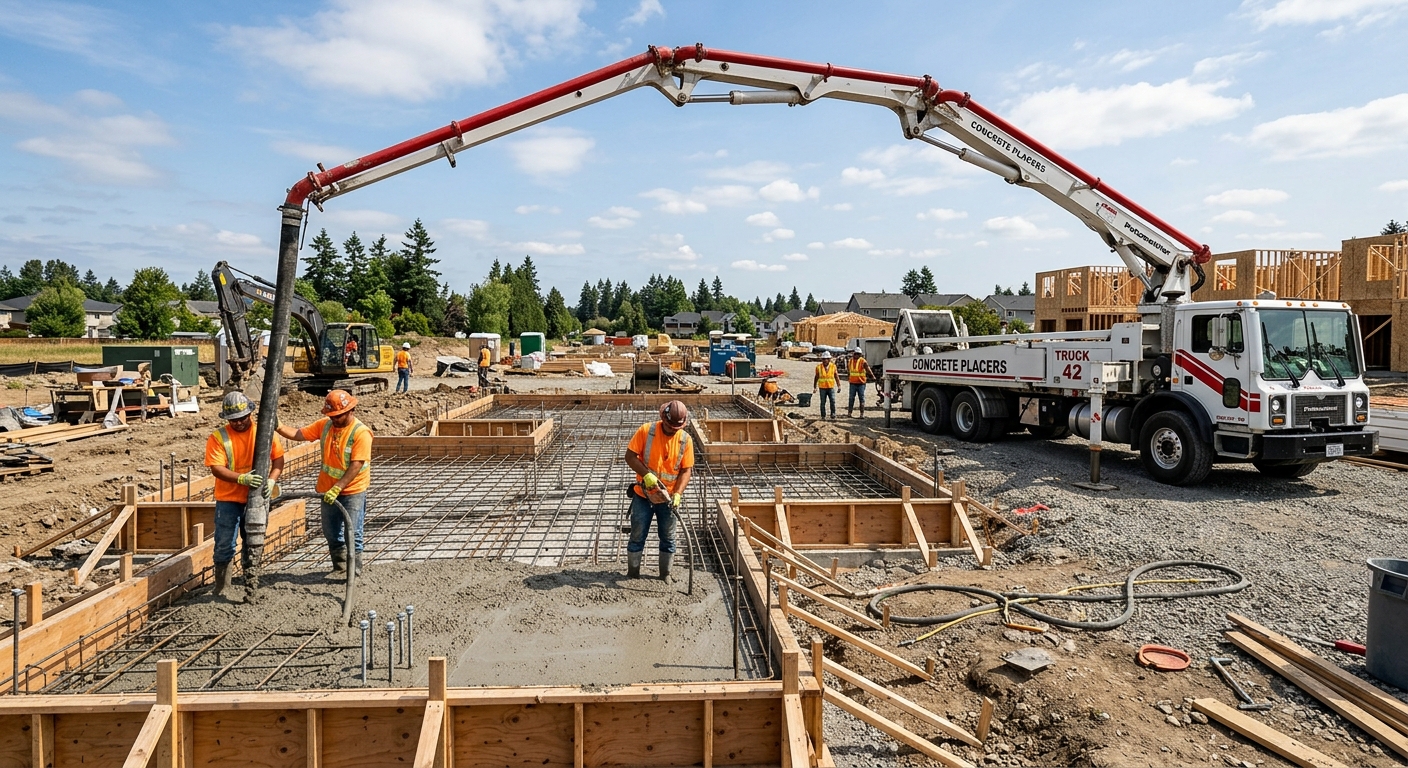
Concrete work options and costs in Rosslyn
Concrete work in Rosslyn, Alberta typically comes down to a few repeatable scopes: driveways, patios/walkways, garage floors, and foundation footings. With a population of 2,902 people (Statistics Canada, 2021 Census), Rosslyn is small enough that the same contractors often get rebooked season-to-season, especially in the areas where homeowners are actively upgrading exterior living space and entry approaches. Housing in and around the Calgary region is also dominated by single-family development patterns, which is why concrete flatwork—driveways, patios and walkways—is usually the most requested scope on new builds and “curb appeal” renovations. In practice, Rosslyn work is shaped by Calgary’s cold continental climate: frost protection is a cost driver, and freeze–thaw cycles require air-entrained mixes plus a layout that controls cracking and helps reduce spalling from de-icing salts. Because design frost depth in Alberta commonly lands around the 1.2 m (about 4 ft) range, footings for houses, garages and many retaining elements must bear below that depth on undisturbed soil, which increases excavation and structural concrete volume. Exterior slabs also have a shorter practical pour season, and late pours may need winter-grade materials, insulated blankets, or temporary heat to keep curing on track. That’s why two neighbours can receive quotes that differ meaningfully on similar scopes—one might be engineered with full granular prep and proper curing, while another may cut corners that show up as scaling and surface deterioration.
Below is a practical comparison of common Rosslyn concrete options so you can align your expectations before you request itemised quotes.
| Application |
Typical Size |
Key Spec |
Finish Option |
Price Range |
| Concrete driveway (standard broom finish) |
16 ft x 40 ft (640 sq ft) |
Air-entrained mix, compacted granular base |
Broom finish, basic seal |
$12,000–$18,000 |
| Exposed aggregate driveway |
16 ft x 40 ft (640 sq ft) |
Air-entrained mix, controlled wash/expose |
Exposed aggregate finish |
$14,500–$22,500 |
| Stamped concrete driveway or patio |
400–600 sq ft |
Air-entrained mix, hardened release system |
Stamped (pattern + colour) |
$15,000–$26,000 |
| Plain concrete patio or walkway |
12 ft x 20 ft (240 sq ft) |
Air-entrained mix, joints to reduce cracking |
Float + broom or light trowel |
$5,000–$9,000 |
| Garage floor (interior slab) |
20 ft x 22 ft (440 sq ft) |
Vapour barrier as required, fibre or mesh |
Broom finish, saw-cut joints |
$8,500–$14,000 |
| Foundation footings (structural, below frost) |
Typical house footprint and engineered sections |
Reinforced footings, excavation to frost depth |
Structural concrete (no decorative finish) |
$28,000–$45,000 |
Prices are estimates only and vary by project scope, site access and material selection.
What affects the price of concrete work in Rosslyn
In Rosslyn, Alberta, you can see the same “type” of job priced differently across Calgary and the surrounding region because concrete pricing isn’t only about the slab—it’s about how the slab is engineered for freeze–thaw, and how much labour is required to prep and protect it. A 30–50% spread is common when one quote includes full granular base prep, reinforcement where required, and cold-weather curing precautions, while another is priced more like a basic pour. The biggest drivers are local climate engineering choices: footings must extend below the design frost depth (around 1.2 m in many Alberta house designs) to prevent frost heave and seasonal movement, and exterior slabs typically require air-entrained mixes to survive repeated freezing and thawing. In colder seasons, the pour window tightens—contractors may need winter-grade mixes, insulated curing blankets and/or temporary heat to achieve proper cure, which adds direct material and labour costs. De-icing salt in winter accelerates surface wear and spalling if the concrete mix, air content and curing weren’t done correctly, so sealing later becomes an important part of lifecycle cost.
In Rosslyn specifically, site conditions can swing the price fast. For example, poor drainage or clay-heavy soils can require deeper excavation and thicker granular replacement to get the base firm, increasing costs above the typical plain patio range of $5,000–$9,000. Conversely, an uncomplicated, flat back yard with easy equipment access can keep walkway/patio projects near the low end. For driveways, the difference between a standard broom finish and higher-end finishes is usually real: stamped work typically lands in the $15,000–$26,000 band because it includes extra steps (release, stamping, and colour curing requirements), not just different aesthetics. Finally, housing age matters—older Rosslyn properties often have settled soils near existing edges, which can require careful saw-cut removal, haul-off, and regrading before you ever pour.
| Price Factor |
Why It Matters |
Cost Impact |
| Frost line depth |
Determines footing depth and form height to resist frost heave |
Higher excavation and more concrete volume (often one of the largest costs) |
| Site preparation |
Excavation, grading and compacted granular base protect against movement |
More labour and granular material if soils are unsuitable or drainage is poor |
| Reinforcement |
Rebar or mesh reduces cracking and improves structural performance |
Additional steel + labour; can be minor or major depending on design |
| Mix design |
Air-entrainment and specified compressive strength improve freeze–thaw durability |
Winter-grade mixes and stricter testing can add cost |
| Finish type |
Broom vs. stamped vs. exposed aggregate changes workmanship time and materials |
Stamped/exposed typically increases labour and product cost |
| Pour size and concrete truck access to site |
Small pours still need setup; difficult access can require pump/extra trips |
Truck time, pumping fees, and staging can raise the total |
| Cold-weather curing precautions |
Heating/blankets help achieve proper cure and reduce scaling |
Added materials and crew time, especially late fall/early spring |
| Control joint pattern and sealing cost |
Joints manage cracking; sealing helps limit salt-driven surface damage |
Higher quality detailing can add cost but reduces long-term repairs |
Permits & regulations in Alberta
In Alberta, the key rule of thumb is that structural concrete is treated more strictly than decorative flatwork. For Rosslyn homeowners, the work that typically DOES require a building permit includes structural concrete elements such as footings, foundation walls, grade beams, and any structural foundation-related modifications tied to the house or an engineered foundation design. Municipal review often relies on the engineered drawings, and inspection requirements usually follow once the permit is pulled. Concrete flatwork—driveways, patios and walkways—usually does NOT require a permit, provided it doesn’t materially affect lot grading, drainage patterns, or impervious surface coverage rules, and it stays within municipal right-of-way requirements. That said, even when a permit is often not required, you still need to verify lot drainage and any tie-in to existing services or weeping tile systems, because municipal expectations can vary.
To verify contractor compliance in Alberta step by step: (1) ask the contractor for their certificate of insurance and confirm liability coverage limits; (2) request proof of WSIB/WCB coverage—then verify it matches the contracting entity name; (3) confirm they carry the right licences/authorizations for the type of work they’re performing (and ask for the registration details they use when tendering/permits are required); and (4) check Alberta licensing/registry information online where applicable, then cross-reference it against the certificate of insurance and any clearance/coverage letter documents the contractor provides. A reputable crew should hand you this information before any work starts.
Getting concrete right in Rosslyn's freeze-thaw climate
Concrete failures in Rosslyn, Alberta usually aren’t “mystery problems”—they’re predictable consequences of base prep, mix design and curing that don’t match the region’s freeze–thaw pattern. The most common issue I see is spalling and surface scaling, often linked to inadequate air-entrainment and rushing cure. To spec the job correctly: (1) base preparation must reach the right depth and be compacted with proper granular material—if the base is underbuilt or poorly compacted, the slab moves and joints telegraph cracking; (2) the mix design should target exterior freeze–thaw durability, commonly with air-entrainment around 5–7% for outdoor flatwork and a minimum 32 MPa compressive strength (the exact design depends on exposure and engineering); (3) control joints must be planned and spaced to limit random cracking; (4) curing should be at least 7 days under suitable conditions—cold-weather pours may need insulated blankets or temporary heat to avoid premature surface cooling; and (5) sealing is typically a penetrating sealer applied after the concrete has cured (often around 28 days post-pour) to repel de-icing salt and reduce moisture ingress.
When you’re comparing options, pay attention to what you’re buying. For example, upgrading from a plain broom-finish patio to stamped concrete often moves you into the $15,000–$26,000 band for larger stamped areas. The extra cost can be justified if the contractor also includes the same freeze–thaw protections—air-entrainment, correct joints, and proper curing—rather than treating it as purely cosmetic. If they do those fundamentals, the higher finish price is a “visible upgrade” without increasing the risk of hidden durability problems.
| Spec |
Why It Matters in Rosslyn |
What to Ask For |
Impact if Skipped |
| Compacted granular base (depth?) |
Reduces settlement and frost-related movement under exterior slabs |
Confirm excavation depth, granular type, and compaction method |
Cracking, uneven surfaces, and accelerated joint breakdown |
| Air-entrained concrete mix (target air %?) |
Protects concrete from freeze–thaw damage and scaling |
Specify exterior air content around 5–7% (per design/exposure) |
Spalling and loss of surface durability in winter |
| Compressive strength (MPa rating) |
Ensures structural capacity and improves long-term performance |
Minimum 32 MPa (or higher if engineering requires) |
Premature wear and reduced impact resistance |
| Control joints (spacing per ACI guidelines) |
Manages shrinkage and movement so cracking happens where planned |
Ask for joint layout/spacing and saw-cut timing |
Random cracks and water pathways |
| Minimum 7-day curing period |
Cold nights can slow strength gain and increase surface vulnerability |
Ask how they protect curing (blankets/heat in cold weather) |
Scaling, weakened surface, and reduced durability |
| Penetrating sealer (when applied after cure) |
Limits moisture/salt intrusion that worsens freeze–thaw effects |
Sealer timing after cure, typically around 28 days post-pour |
Faster deterioration and more frequent maintenance |
How to choose a concrete work contractor in Rosslyn
Choosing the right contractor in Rosslyn, Alberta is mostly about documentation and clarity—not just the lowest number on the first quote. Start by verifying Alberta coverage basics: ask for their liability insurance certificate (make sure the insured name matches the contract), and request proof of WSIB/WCB coverage for their workers. If your contractor can’t provide those documents quickly, that’s a major red flag. Next, get 2–3 itemised written quotes. You want the breakdown to show labour and materials separately (concrete supply, reinforcement/mesh, excavation/granular base, rebar ties, finishing labour, formwork, curing blankets/heat if needed, and disposal/haul-off). A fair quote should also state what’s included in the scope: permit pull responsibility (if applicable), hoisting/pump allowances, and whether demolition and concrete disposal are covered.
Warranty matters too. Ask for the workmanship warranty length and whether it covers the specific failure modes you care about (cracking, spalling, settlement-related issues). Also ask about product/manufacturer warranty on sealer or admixtures, and whether any warranty transfers if you sell the home. Payment scheduling should be conservative: never pay more than 10–15% upfront, and hold back a reasonable portion until the job is complete and surfaces are inspected. Finally, insist on a written start date and completion estimate—especially in winter—so you know how they’ll protect curing and avoid scaling when temperatures drop.
- Provide certificates of liability insurance and WSIB/WCB coverage before contract signing.
- Confirm the exact scope is in writing (demo, excavation, base, steel/mesh, finishing, sealing).
- Ask whether the quote includes haul-off/disposal for removed concrete and spoil.
- Require air-entrainment and minimum compressive strength in the spec, not just “standard concrete.”
- Ask for the control joint plan (layout and timing of saw-cutting).
- Confirm curing protection in cold weather (blankets/heat) if pouring near shoulder season.
- Request a detailed breakdown of finish materials (stamps/release/colour hardener for stamped work).
- Verify forms, rebar/mesh grade and placement method (not just “we’ll reinforce”).
- Ask who handles sealing and when it’s applied after curing.
- Review the warranty in plain language and get it in writing.
- Ensure payment terms are staged (avoid large upfront deposits).
- Ask for references on similar Rosslyn climates and projects (driveways/patios/foundations).
Red flags I see in Rosslyn concrete projects: crews who won’t discuss air-entrainment and curing; quotes that treat excavation/granular base as “optional”; no written joint layout (or joints that are delayed); vague warranty language with no coverage specifics; and payment schedules asking for large upfront deposits.
Frequently asked questions — concrete work in Rosslyn
How do I seal concrete to protect it in Rosslyn?
In Rosslyn, Alberta, sealing is mainly about repelling moisture and de-icing salts that can drive freeze–thaw damage. The usual approach is to let the concrete cure properly first—often around 28 days—then apply a penetrating sealer designed for exterior use. Before sealing, the surface should be clean and dry (power-wash and allow drying time), and any stains should be addressed so the sealer can penetrate uniformly. If your patio or walkway is near a driveway where snow-melt salts splash, sealing becomes more important for long-term appearance and reduced scaling. For budgeting, sealing is typically a smaller line item compared with the slab itself, but skipping it can shorten the time before you see surface deterioration—especially in Calgary’s winter cycles (Statistics Canada, 2021 Census).
What is the difference between concrete and cement?
Cement and concrete are related but not the same. Cement is one component—usually Portland cement—that acts as the binder. Concrete is the finished building material made from cement plus water, aggregates (sand and gravel/crushed stone), and sometimes admixtures like air-entrainment and plasticizers. In Rosslyn, Alberta, the “concrete” you get on site matters because the mix design for exterior flatwork needs air-entrainment and durability for freeze–thaw exposure. Two mixes can both be called “concrete,” but one may meet a stronger or more durable specification, which affects scaling and spalling performance over winter. That’s why a good contractor should specify compressive strength and air content rather than just saying “standard mix.”
How much does concrete work cost in Rosslyn?
Concrete costs in Rosslyn usually track the broader Calgary regional bands, adjusted for your exact size, access, and how much base prep is needed. For a driveway using a standard broom finish, homeowners commonly budget around $12,000–$18,000 for a typical two-car layout, assuming proper excavation and granular base. For a plain patio or walkway, a realistic expectation is $5,000–$9,000 depending on square footage, thickness, joints, and whether it’s attached to existing hardscape. Stamped concrete tends to cost more because it’s labour-intensive and needs careful curing and materials—often landing around $15,000–$26,000 for driveway or larger patio scopes. Foundation footings are a separate category because frost depth protection drives excavation volume, often around $28,000–$45,000.
How deep must footings be for Rosslyn's frost line?
For Rosslyn, Alberta projects, footing depth is engineered to resist frost heave. In this region, design frost depth is commonly about 1.2 m (roughly 4 ft), meaning footings for houses, garages and retaining structures typically must bear below that depth on undisturbed soil. The exact required depth can vary based on soil conditions, loads, and how the engineered foundation is specified, so you should follow your structural drawings (or the municipality’s foundation requirements if applicable). In practice, deeper frost protection usually means more excavation and more concrete, which is why foundation work often sits around $28,000–$45,000 for typical footing scopes. If soil is poor or drainage is problematic, engineers may require additional granular replacement or changes to the design, further affecting cost.
Why does concrete crack in Rosslyn and how is it prevented?
Concrete cracking in Rosslyn is mostly about shrinkage, temperature changes, and movement under the slab—not “one mistake.” In a cold continental climate with freeze–thaw cycles, concrete also faces added durability stress; if the base isn’t properly compacted, settlement can cause cracks. Prevention starts with the right base prep and frost-engineered design, then a proper mix (including air-entrainment for exterior durability), and finally a control joint plan that tells the concrete where to crack. Joints need to be spaced and timed correctly (saw-cut at the right stage or formed as specified). Curing is just as important: cold-weather pours without insulating blankets or proper protection are more vulnerable to surface scaling that can lead to wider deterioration over time. A sealed, properly jointed slab also stands up better against winter salt exposure.
Stamped vs broom-finish concrete — cost difference?
Stamped concrete generally costs more than a broom-finish because it requires additional steps: stamping tools, release agents, colour hardeners or integral colour, careful finishing technique, and often more labour time to achieve consistent patterns. In Rosslyn, Alberta, broom-finish driveways commonly budget around $12,000–$18,000 depending on size and site access. Stamped concrete driveway or patio projects more often fall around $15,000–$26,000 for typical mid-to-large scopes. That doesn’t mean broom-finish is “cheap” or “worse”—proper air-entrainment, curing, base prep, and jointing are what protect both options. The right comparison is durability specs first, then finish aesthetics. If a contractor can’t clearly explain air content, joints, and curing for a stamped job, you should be cautious even if the quote is attractive.