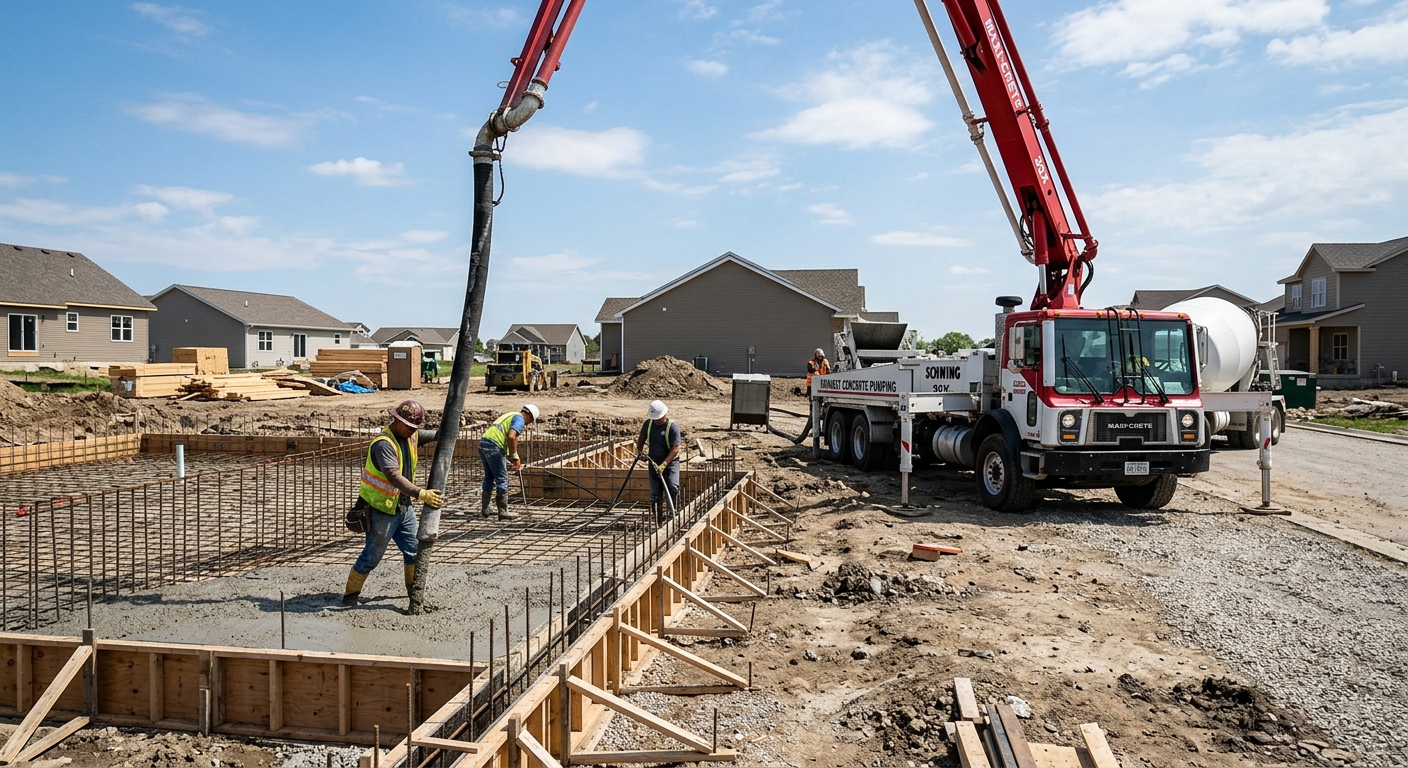
Concrete work options and costs in Eaux Claires
Eaux Claires is a small community (population 3,060 as of the 2021 Census, Statistics Canada), and in practice it’s served by Calgary-area crews for most foundation and flatwork concrete. In neighbourhoods like those along the main access routes into the Calgary economic orbit, homeowners typically prioritize concrete flatwork—driveways, patios, and walkways—because it performs well when it’s engineered for Alberta’s cold continental freeze–thaw cycles.
Prices in Eaux Claires land in the same reality as the wider Calgary market, but the climate does the heavy lifting: Calgary-area projects need deeper footing support (engineered around a design frost depth of about 1.2 m / roughly 4 ft) and properly air-entrained concrete to reduce cracking and surface scaling. That means higher excavation effort, larger footing volumes, and stricter curing plans than you’d see in milder provinces. When winter sets in, the pour window for exterior slabs tightens, and cold-weather placement often requires insulated blankets and/or temporary heat to achieve the early strength needed for durable curing.
Contractor availability also affects cost. In peak months, schedule pressure can raise labour premiums; in slower periods, you may find more flexibility, especially for standard broom-finish slabs. That’s why two homeowners can get quotes for “the same” driveway and still see differences.
Use the ranges below as a practical benchmark when you compare options and finishes, and then discuss the exact specs (base depth, air content, reinforcement, and curing plan) with your installer.
| Application |
Typical Size |
Key Spec |
Finish Option |
Price Range |
| Concrete driveway (standard broom finish) |
400–600 sq. ft. |
Air-entrained exterior mix, reinforced as needed |
Broom finish + control joints |
$12,000–$18,000 |
| Exposed aggregate driveway |
400–600 sq. ft. |
Air-entrained exterior mix + proper reveal curing |
Exposed aggregate with sealer |
$14,000–$20,500 |
| Stamped concrete driveway or patio |
300–500 sq. ft. |
Engineered base + joint plan to manage shrinkage |
Stamp pattern + colour hardener |
$15,000–$26,000 |
| Plain concrete patio or walkway |
150–300 sq. ft. |
Air-entrained exterior mix |
Light broom/float finish + joints |
$5,000–$9,000 |
| Garage floor (interior slab) |
400–600 sq. ft. |
Vapour barrier (as applicable), reinforcement based on design |
Broom or trowel finish |
$6,500–$12,500 |
| Foundation footings (structural, below frost) |
Per house/engineered perimeter |
Footings extend below design frost depth (engineered) |
Structural concrete + rebar placement accuracy |
$28,000–$45,000 |
Prices are estimates only and vary by project scope, site access and material selection.
What affects the price of concrete work in Eaux Claires
In Calgary and the broader Alberta market, quotes for the “same” concrete job can swing by 30–50% because contractors price the whole system, not just the cement. When you compare two estimates, look past the slab thickness and ask about base depth, compaction, reinforcement, mix design, trucking logistics, curing methods, and how joints and sealing are handled for Alberta’s freeze–thaw impacts.
Frost line depth is the first driver. Alberta practice typically assumes a deeper design frost depth than much of the country, and footings must be engineered to bear on undisturbed soil below that depth to avoid frost heave and seasonal movement. On top of that, frequent freeze–thaw cycles require air-entrained concrete mixes for exterior slabs, plus a joint layout that limits random cracking. In this cold continental climate, the pour season for exterior work is shorter, and cold-weather curing precautions (insulation blankets, sometimes temporary heating) can add both labour and material costs—especially if a schedule pushes the pour into colder weeks. Finally, de-icing salts accelerate spalling if the slab isn’t built and finished for durability, which is why sealing is commonly recommended after curing.
In Eaux Claires, these conditions show up in everyday scope changes. A driveway that needs heavy excavation (rock removal or deeper base to reach firm soil) will increase costs, while good access (close truck approach and clear crane/boom or chute path) can keep labour efficient. Decorative work also shifts the budget: a stamped concrete driveway or patio can fit the $15,000–$26,000 band when you’re paying for colour hardener, stamping labour, and careful curing; meanwhile, a standard broom-finish driveway tends to align with the $12,000–$18,000 range when the base and drainage are straightforward.
Even housing age and the condition of existing grades matter. If you’re retrofitting around an older home and the drainage is off, you may need regrading and improved base prep—those aren’t “extras,” they’re the difference between a slab that survives winters and one that heaves or cracks early.
| Price Factor |
Why It Matters |
Cost Impact |
| Frost line depth — determines footing depth and form height |
Footings must extend below design frost to prevent frost heave |
Higher excavation and concrete volume for foundations |
| Site preparation — excavation, grading, compacted granular base |
Proper base reduces settlement and limits water pathways |
Rock removal and regrading can add significant labour |
| Reinforcement — rebar or wire mesh requirement |
Controls cracking and improves slab durability |
Material + placement labour, especially for larger flatwork |
| Mix design — air-entrainment and compressive strength spec |
Air-entrainment improves freeze–thaw resistance |
Special mix and QC time can raise per-m3 pricing |
| Finish type — broom vs. stamped vs. exposed aggregate |
Finishing method affects labour and curing control |
Decorative finishes typically increase total cost |
| Pour size and concrete truck access to site |
Limits number of loads and affects timing and handling |
Pump/extra trucks and long carries add labour expense |
| Cold-weather curing precautions — heating and blankets |
Ensures early strength gain and reduces scaling risk |
Temporary heat and insulation increase both materials and time |
| Control joint pattern and sealing cost |
Joints manage shrinkage; sealing repels salt and moisture |
Cutting, joint hardware, and sealer can add a line item |
Permits & regulations in Alberta
In Alberta, structural concrete work—like foundation footings, foundation walls, and grade beams—normally requires a building permit and, in many cases, engineered drawings reviewed as part of the permit process. Concrete flatwork such as patios, walkways, and driveways usually does not require a permit by itself, unless it changes lot grading, impacts drainage, or affects municipal requirements around impervious surface coverage or right-of-way conditions. Because each site is different, confirm requirements with the local authority before you break ground.
Before work starts in Eaux Claires, also verify the contractor is set up to build safely and legally. Ask for proof of liability insurance and current coverage for workers (WSIB/WCB as applicable). Then check references on projects with similar scope—particularly exterior slabs in freeze–thaw climates—so you know they’re building to prevent spalling and random cracking.
Step-by-step for homeowners:
- Licence check: look up the contractor’s business information and any relevant trade registration through Alberta’s online resources (use the company name exactly as listed on the quote).
- Certificate of Insurance: request a current COI showing liability coverage; confirm it’s in the contractor’s name and includes your address as applicable (or that they will list you on request).
- WSIB/WCB clearance/coverage: ask for proof of clearance or current coverage documents.
- References: request 2–3 photos and addresses of similar Alberta exterior pours (driveways/patios) from the last 12–24 months.
- Permit clarity: ask in writing whether the permit pull is included for structural work and who submits it.
Getting concrete right in Eaux Claires's freeze-thaw climate
Concrete can fail in Eaux Claires when the system isn’t built for freeze–thaw movement and salt exposure. The most common issues we see are spalling (surface chipping), random cracking, and scaling—usually tied to base problems, inadequate air-entrainment, or rushed curing. To spec the job correctly for the Calgary-area cold continental climate, you want to address the full build-up: (1) base preparation with a compacted granular sub-base to the right depth for local soil and frost considerations, (2) mix design with air-entrainment and an appropriate minimum compressive strength, (3) a control joint pattern that limits random cracking, (4) curing for at least 7 days under proper conditions, and (5) penetrating sealer applied after cure to help repel de-icing salts.
For exterior flatwork, air-entrainment matters a lot. If the mix doesn’t have the right air content for freeze–thaw durability, water that penetrates the surface can expand as it freezes, breaking paste near the surface and leading to spalling. In a region where winters can be long and wet/dry cycling is frequent, that’s not a “maintenance later” issue—it’s a durability decision at the time of the pour.
Here’s a simple cost perspective: a plain patio or walkway typically sits around $5,000–$9,000, and that range can be protected when base prep, joints, and air-entrained mix are done properly. If a contractor tries to cut corners to save money (thin base, weak mix, or skipping curing precautions), you may spend less upfront but face earlier patching and resealing—often costing more than the original savings.
When you talk to contractors, ask technical questions directly: “What air content are you targeting?”, “How deep is the compacted granular base?”, “How are joints spaced for shrinkage?”, and “What curing method do you use when temperatures drop?”
| Spec |
Why It Matters in Eaux Claires |
What to Ask For |
Impact if Skipped |
| Compacted granular base (depth?) |
Supports the slab and reduces settlement/surface cracking under freeze–thaw |
“Show me the designed compacted base depth and compaction method.” |
Heaving, cracking, and early edge failure |
| Air-entrained concrete mix (target air %?) |
Improves freeze–thaw durability in Alberta winters |
“Confirm air-entrainment target (typically 5–7% for exterior flatwork) and mix type.” |
Spalling and scaling from freeze–thaw pressure |
| Compressive strength (MPa rating) |
Ensures structural performance and surface durability |
“Confirm minimum 32 MPa rating (or higher if engineered) and test/QA approach.” |
Higher risk of surface damage and reduced lifespan |
| Control joints (spacing per ACI guidelines) |
Controls shrinkage cracking so cracks form where you want them |
“What joint spacing will you use and when will you cut joints?” |
Random cracking across the slab |
| Minimum 7-day curing period |
Early strength gain protects durability in cold conditions |
“How do you protect the slab to meet a minimum 7-day curing period?” |
Scaling, reduced strength, and long-term performance loss |
| Penetrating sealer (when applied after cure) |
Repels de-icing salt and moisture to reduce surface deterioration |
“Will you apply penetrating sealer at about 28 days post-pour (after cure)?” |
Faster spalling and stain/track marks |
How to choose a concrete work contractor in Eaux Claires
Picking the right contractor matters as much as the concrete mix, especially in Alberta’s freeze–thaw climate. Start by verifying licensing/registration as applicable for the business and confirm liability insurance is active before anyone excavates. Next, ask for WSIB/WCB coverage proof for their workers. You can usually check these items by requesting documents directly (for insurance and coverage) and cross-referencing business details through Alberta online resources (for the company name and registration status). A contractor who can’t produce current paperwork is a red flag.
Then get 2–3 itemised written quotes. You want a labour + materials breakdown, not a single lump-sum number that hides the real differences. The quote should clearly list excavation and haul/disposal (if included), granular base and compaction, reinforcement requirements, concrete mix design (including air-entrainment), finish and sealer, and whether any permit pull is included for structural work.
Warranty is another practical differentiator. Ask for the workmanship warranty length, whether it covers cracking/spalling within a defined period, and whether product/manufacturer warranties (if any) transfer to you as the homeowner. For payment, avoid large upfront deposits; a common good practice is no more than 10–15% upfront, then hold back until key milestones (base inspection, prior to pour confirmation, and substantial completion). Get the schedule in writing with a stated start date and completion estimate.
- Ask for proof of liability insurance and current WSIB/WCB coverage before the first site visit.
- Confirm the contractor has completed similar Calgary-area exterior pours in the last 12–24 months.
- Require itemised quotes (labour, materials, disposal, base prep, reinforcement, finish, sealing).
- Check whether truck access/pumping is included and what happens if access is limited.
- Verify mix design: air-entrainment target and minimum compressive strength (e.g., 32 MPa minimum).
- Confirm control joint spacing and when joints will be cut.
- Ask how they handle cold-weather curing (blankets, heat, and curing duration).
- Clarify excavation depth and compacted granular base requirements.
- Confirm reinforcement placement (rebar/wire mesh) and supports/chairs used.
- Ask if sealer is included and when it will be applied after cure (around 28 days).
- Review exclusions: what’s not included (site drainage corrections, rock removal, snow removal, permit fees).
- Get a written schedule and payment milestones tied to inspections and completion.
Concrete red flags I watch for in Eaux Claires: quotes that ignore air-entrainment, “we always pour anytime” promises without cold-weather curing plans, vague joint/curing language, no written scope for base depth or reinforcement, and contractors who won’t provide insurance/WSIB/WCB documentation before starting.
Frequently asked questions — concrete work in Eaux Claires
When is the best time to pour concrete in Eaux Claires?
The best time in Eaux Claires is typically late spring through early fall, when air and slab temperatures stay within a workable curing range. Calgary-area conditions can turn quickly, and concrete placed too late in the season may not gain early strength properly—raising the risk of scaling and surface damage. If you’re scheduling an exterior driveway, patio, or walkway, ask your contractor what temperature thresholds they follow and what cold-weather curing method they use (insulated blankets, heat, and longer protection time). Interior slabs like garage floors are more flexible, but exterior work still needs careful planning around freeze–thaw cycles. For budgeting, keep in mind that a standard broom-finish driveway often lands around $12,000–$18,000, and late-season scheduling can push costs upward due to heating/curing precautions.
How long does concrete take to cure?
Concrete curing has two timelines homeowners feel: initial handling/strength gain and full durability development. As a practical minimum, many exterior pours are expected to cure for at least 7 days under proper conditions, with extra protection if temperatures drop at night. That’s the period when early surface damage risk is highest if curing is rushed. Full strength development continues beyond that; while concrete can reach significant strength within days, durability and readiness for sealing is typically handled closer to 28 days. That’s why many Alberta concrete crews schedule penetrating sealer about 28 days after the pour—so de-icing salt exposure doesn’t attack an insufficiently cured surface. If your quote doesn’t mention curing protection and timing, especially for Eaux Claires winters, ask directly.
Do I need a permit for concrete work in Alberta?
In Alberta, structural concrete work—think foundation footings, foundation walls, and grade beams—usually requires a building permit and often relies on engineered drawings reviewed through the municipal permit process. Concrete flatwork such as patios, walkways, and driveways typically doesn’t require a permit by itself unless the work affects lot grading, drainage, impervious surface requirements, or municipal right-of-way conditions. Because Eaux Claires-area lots vary (especially around older homes and drainage routes), confirm requirements with your local authority before breaking ground. Also confirm your contractor’s paperwork process in the quote: if permits are required, who pulls them and what’s included. If you’re doing foundation work, expect that permit/engineering steps can influence schedule and—indirectly—cost. Foundation/footings are commonly budgeted around $28,000–$45,000 in this region.
Concrete vs pavers for a patio in Eaux Claires?
Concrete and pavers can both work well in Eaux Claires, but concrete usually wins for long-term continuity when the base is built correctly for freeze–thaw. A plain concrete patio or walkway is often budgeted around $5,000–$9,000, and the advantages include fewer joints that can shift, straightforward sealing options, and a cleaner integration with the driveway drainage plan. Pavers can look great and can be easier to spot-repair if a section fails, but they still need a well-draining granular base and careful edging to prevent movement during Alberta freeze–thaw cycles. If de-icing salts and water management are an issue, sealed concrete generally provides a reliable barrier strategy when installed with air-entrained mix and control joints. The best choice comes down to your maintenance comfort and how your contractor handles base prep and joint/drainage detailing.
How long does a concrete driveway last?
A properly built concrete driveway in Alberta can last decades, but longevity depends heavily on how it’s engineered for freeze–thaw. The biggest durability levers are air-entrained mix for exterior exposure, correct base prep, reinforcement where required, and a control joint plan that manages shrinkage cracking. Sealing also helps with de-icing salts by reducing moisture and salt penetration into the surface. If a driveway was poured without adequate air content or rushed curing, you can start seeing scaling or spalling relatively early—especially after harsh winters and repeated melt cycles. In contrast, when the system is built correctly, homeowners often see long service lives that hold up through many Calgary-area seasons. Your contractor should be able to explain the mix spec and joint spacing—not just the finish.
What is air-entrained concrete and why does it matter here?
Air-entrained concrete is designed to include tiny, evenly distributed air bubbles in the mix. In Eaux Claires and the broader Calgary region, those bubbles provide pressure relief as water freezes and expands within the concrete, reducing the risk of spalling and scaling. For exterior flatwork, contractors typically target about 5–7% air content (for the right mix design) and ensure the project meets a minimum compressive strength requirement (commonly 32 MPa minimum for the spec). This matters because Alberta’s freeze–thaw cycles aren’t mild—they’re frequent, and de-icing salts add chemical stress on top of moisture exposure. If a contractor can’t talk through their air-entrainment target and how they’ll protect curing in cold weather, that’s a serious technical gap. It’s one of the main reasons properly built broom-finish driveways tend to hold up better than “cheaper” mixes.