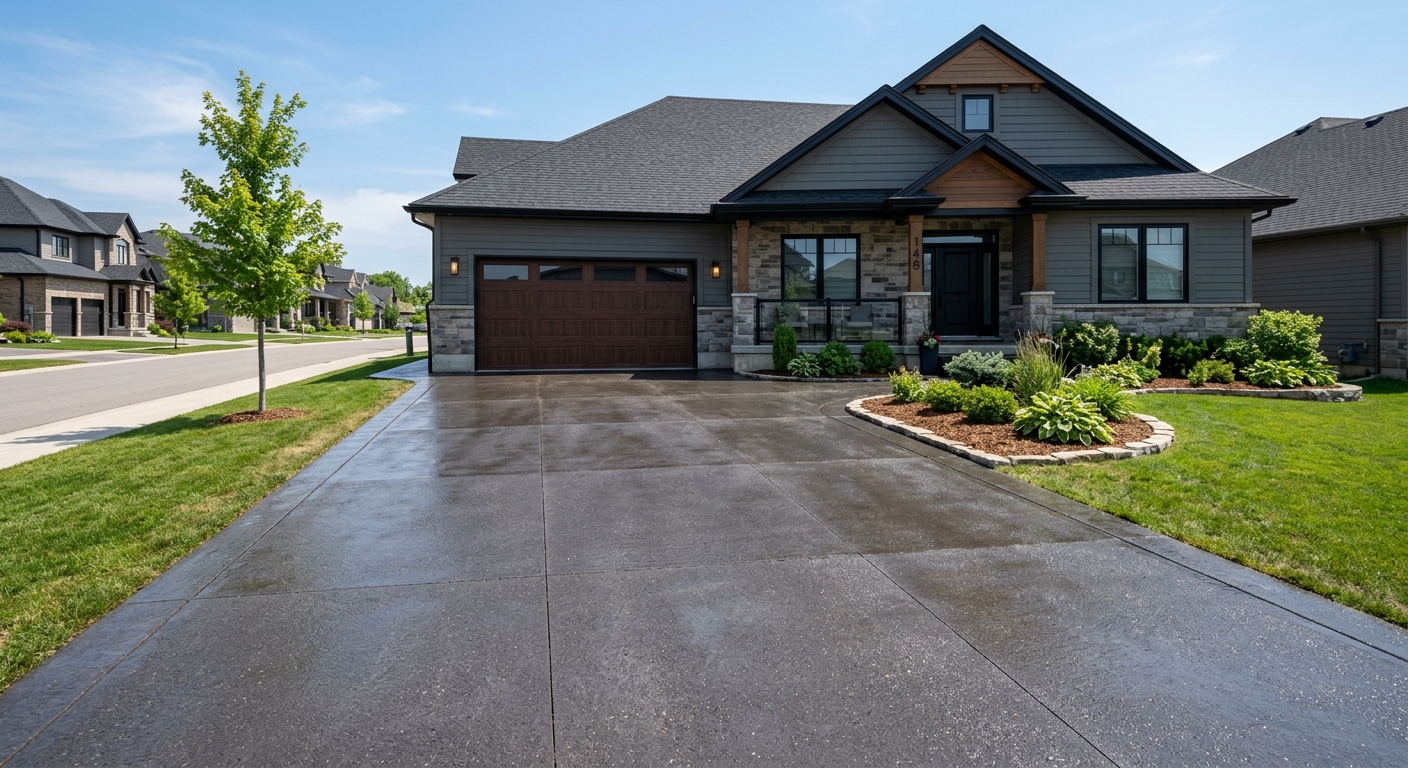
Concrete work options and costs in Beltline
Beltline, Alberta is where a lot of homeowners focus on concrete flatwork because it’s practical, low-maintenance, and fits the way people use their yards and garages year-round. In the Beltline housing mix, a large share of homes are single-detached houses (Statistics Canada, 2021 Census), which is exactly where you’ll see demand for driveways, patios, and walkways. A big part of the local spend is tied to how cold Calgary gets, how long the freeze–thaw cycle runs, and how deeper frost affects footing and slab design. In this area, the design frost depth is about 1.2 m, so structural concrete like footings has to be engineered to bear below frost to prevent seasonal movement and frost heave.
On the exterior side, repeated freeze–thaw cycles push every contractor toward air-entrained mixes, granular base prep, and well-spaced control joints—because cold weather and cycling can turn small cracks into spalling over time. The short practical pour season also affects costs: crews may need winter-grade placement practices (insulating blankets and sometimes temperature control) to protect curing. Finally, Beltline is busy—projects in and around high-traffic pockets like the Beltline core and nearby central Calgary routes tend to get scheduled sooner, and access constraints can change truck timing, labour, and disposal costs.
Below is a practical cost range comparison for the most common options homeowners consider in Beltline, so you can line up apples-to-apples when you request quotes.
| Application |
Typical Size |
Key Spec |
Finish Option |
Price Range |
| Concrete driveway (standard broom finish) |
24 ft x 12 ft (288 sq ft) |
Air-entrained exterior mix, compacted base, control joints |
Broomed surface, sealed after cure |
$12,000–$18,000 |
| Exposed aggregate driveway |
24 ft x 12 ft (288 sq ft) |
Air-entrained mix, proper base and jointing, consistent curing |
Exposed stone with sealer |
$14,000–$20,500 |
| Stamped concrete driveway or patio |
20 ft x 14 ft (280 sq ft) |
Air-entrained mix, reinforcement as required, texture release |
Stamped pattern with colouring |
$15,000–$26,000 |
| Plain concrete patio or walkway |
12 ft x 12 ft (144 sq ft) |
Air-entrained mix, compacted granular base, joints |
Screeded and lightly broomed |
$5,000–$9,000 |
| Garage floor (interior slab) |
22 ft x 22 ft (484 sq ft) |
Minimum 25–32 MPa mix, vapour barrier (as specified), wire mesh |
Float and trowel, optional densifier |
$9,500–$15,500 |
| Foundation footings (structural, below frost) |
Typical house perimeter (engineered) |
Engineered design, excavation, rebar, pour below frost depth |
Standard finished concrete for foundation elements |
$28,000–$45,000 |
Prices are estimates only and vary by project scope, site access and material selection.
What affects the price of concrete work in Beltline
In Beltline, it’s not unusual to see quotes for the “same” concrete job swing by 30–50% across Calgary, especially when one contractor accounts for full excavation to frost-bearing soils while another proposes shortcuts on base thickness, reinforcement, or curing protection. Concrete pricing also depends on crew availability during the short exterior pour window; when demand spikes, labour and scheduling costs rise. In a cold continental climate, engineering and materials aren’t optional—air-entrainment, control joints, and winter-grade curing practices drive real cost, and they show up line-by-line in quotes.
Two things dominate. First, frost line depth: footings must extend below the design frost depth (about 1.2 m in this region) to avoid frost heave and seasonal movement. Second, freeze–thaw cycles force exterior slabs and driveways to be built with air-entrained concrete and properly prepared granular bases so water can’t undermine the slab. Calgary also has a shorter pour season, and cold-weather placement can require insulated blankets and temporary heat to achieve proper curing—skipping or under-budgeting this increases the risk of scaling and spalling later. Because Beltline homeowners often de-ice drives through winter, sealing is also important; de-icing salts accelerate surface deterioration on inadequately protected concrete.
Real examples from Beltline: a broom-finished driveway might land closer to the lower end of the $12,000–$18,000 band if the site has easy truck access and the required base depth is straightforward. A driveway with exposed aggregate or a stamped finish typically moves toward the $15,000–$26,000 decorative band because the mix, placement timing, and finishing steps are more labour-intensive. On the foundation side, anything that increases excavation volume—soft soils, trench depth, or restricted access—can push foundation/footings toward the upper end of the $28,000–$45,000 range.
| Price Factor |
Why It Matters |
Cost Impact |
| Frost line depth — determines footing depth and form height |
Footings must bear below frost to prevent heave and seasonal movement |
Higher excavation and formwork can add significant cost; typically shifts structural work upward |
| Site preparation — excavation, grading, compacted granular base |
Proper base reduces settlement and helps manage drainage under the slab |
More haul-off and deeper base can move prices toward the top of the range |
| Reinforcement — rebar or wire mesh requirement |
Controls cracking and improves slab performance under loads |
Material and labour add cost; omission can cause early cracking |
| Mix design — air-entrainment and compressive strength spec |
Air-entrainment helps concrete survive freeze–thaw cycles |
Winter-grade/correct mix can raise costs but reduces long-term failure risk |
| Finish type — broom vs. stamped vs. exposed aggregate |
Finishes change labour time, equipment needs and timing accuracy |
Decorative finishes typically push projects into the higher concrete price band |
| Pour size and concrete truck access to site |
Placement efficiency affects labour and schedule |
Limited access can increase labour and placement time; can add to overall costs |
| Cold-weather curing precautions — heating and blankets |
Proper curing is critical in late fall/early spring for strength gain and durability |
May add several thousand dollars depending on temperature and duration |
| Control joint pattern and sealing cost |
Joints manage cracking locations; sealer helps resist de-icing salt scaling |
Better detailing costs more upfront but reduces maintenance and premature deterioration |
Permits & regulations in Alberta
In Alberta, structural concrete work—think foundation walls, grade beams, footings, and other structural elements—generally requires a building permit, and it often depends on having engineered drawings that the municipality reviews. For concrete flatwork (driveways, patios, sidewalks/walkways), permits are usually not required unless your project changes lot grading, affects drainage/impervious surface considerations, or ties into municipal right-of-way rules. Even when a permit isn’t required for the slab itself, you may still need approval if the work impacts how water is managed on your lot or changes how runoff reaches the curb line.
For Beltline homeowners, the practical approach is simple: confirm before you break ground. Start by asking the contractor directly whether a permit is required for your scope, and who is pulling it (often the contractor). Then verify the contractor is properly covered for liability and jobsite risk. Step-by-step, you can do this by (1) confirming they are registered for their trades and business through the relevant online provincial registries, (2) requesting a current certificate of insurance showing general liability with adequate limits and naming you where applicable, and (3) checking they have WSIB/WCB coverage (clearance letters or proof of account). Finally, request references on similar-scale projects in your area—structural scopes should match the size and complexity of what they’re proposing for your home.
If you’re unsure, ask your local municipal development authority what applies to concrete flatwork versus structural foundation work—getting that clarity early prevents delays and rework.
Getting concrete right in Beltline's freeze-thaw climate
Beltline’s freeze–thaw cycle is the main reason concrete can fail early here. The most common problems homeowners see are surface scaling, spalling, and random cracking—usually traced back to inadequate air-entrainment, weak or improperly prepared base, poor joint layout, and rushed curing. To spec the job correctly, build from the ground up. (1) Base preparation: excavate to the right depth for local soil conditions and frost-bearing requirements, then install a compacted granular base that drains correctly and supports the slab. (2) Mix design: require air-entrained exterior concrete—typically 5–7% air content for exterior flatwork—and a minimum 32 MPa compressive strength so the concrete can gain strength reliably. (3) Control joints: specify a joint pattern that limits random cracking; the goal is cracks where you planned them, not across visible areas. (4) Curing: insist on minimum 7-day curing under proper conditions, with cold-weather precautions when temps drop. (5) Sealing: apply a penetrating sealer at about 28 days post-pour (after cure) to help repel de-icing salts.
When you compare options, the “cheapest” quote often ignores one of these. For example, a plain broom-finished patio might land near the $5,000–$9,000 band, but a decorative stamped patio or driveway can be $15,000–$26,000 because the finishing steps, pattern work, and colour systems add labour and timing requirements. The right answer isn’t always to spend more—it’s to ensure the spec is correct first. A well-built broom finish with proper air-entrainment and joints can outperform a decorative finish that was rushed and under-cured.
Ask contractors how they’ll meet each spec below in writing, not just what finish they’ll apply on top.
| Spec |
Why It Matters in Beltline |
What to Ask For |
Impact if Skipped |
| Compacted granular base (depth?) |
Supports the slab and helps prevent settlement and water pumping during freeze–thaw |
Base thickness (inches/cm), soil type assumptions, and compaction method/proof |
Uneven settlement, cracking, and premature surface damage |
| Air-entrained concrete mix (target air %?) |
Improves freeze–thaw durability in Calgary-area winters |
Confirm air-entrainment target (typically 5–7% for exterior flatwork) and admixture use |
Higher risk of spalling/scaling under de-icing salt exposure |
| Compressive strength (MPa rating) |
Strength gain must be adequate despite cold placement and curing challenges |
Minimum 32 MPa rating (or project-specific spec from engineer/contract) |
Lower durability and higher likelihood of surface wear and cracking |
| Control joints (spacing per ACI guidelines) |
Controls crack locations to reduce random cracking and water intrusion |
Proposed joint spacing and layout plan before finishing |
Random cracking, unsightly repairs, and accelerated freeze–thaw damage |
| Minimum 7-day curing period |
Strength development is critical before exposure to freezing conditions |
How curing will be protected in cold weather (blankets/heating if needed) |
Weak surface layer, scaling, and long-term performance issues |
| Penetrating sealer (when applied after cure) |
Helps reduce water and salt penetration during winter de-icing |
Confirm application timing (about 28 days post-pour) and sealer type |
Faster scaling, staining, and more frequent maintenance |
How to choose a concrete work contractor in Beltline
Choosing the right concrete contractor in Beltline comes down to verifying coverage, getting detailed written scope, and making sure the spec matches Calgary’s freeze–thaw reality. In Alberta, you should confirm three things early: (1) licensing/registration as applicable for the contractor’s trade and business, (2) liability insurance with proof via a current certificate of insurance (ask for the COI directly), and (3) WSIB/WCB coverage where applicable. Your goal is to see documents dated within the last year and clear coverage for the work being done—if they won’t provide it, that’s a major red flag.
Then get 2–3 itemised written quotes that break out labour and materials (not just a single number). Look for line items like excavation/grading, granular base, reinforcement, concrete supply/mix design, finishing, control joints, curing protection, and sealing. Check what’s excluded: disposal/haul-away, site protection, saw-cutting timing, permit pulling, and any traffic or access limitations. Payment terms matter too—never pay more than 10–15% upfront, and hold back a final portion until the job is complete and clean. Finally, ask for the start date and estimated completion time in writing, along with how they’ll handle weather delays during Calgary’s colder stretches.
- Ask for and review the contractor’s certificate of insurance (liability) before signing.
- Request proof of WSIB/WCB clearance or equivalent coverage documentation.
- Confirm their registration status through provincial online resources.
- Require a detailed scope: excavation depth, base depth, reinforcement type and placement.
- Get the air-entrained exterior mix requirement stated in writing.
- Ask who supplies and installs control joints and verify the planned spacing.
- Confirm cold-weather curing plan (blankets/heating) if temps drop near pour/curing.
- Request curing protection and minimum cure timing (at least 7 days) in the contract.
- Clarify sealing: material type and the target application timing after cure (about 28 days).
- Check disposal/haul-away is included for removed soil and concrete waste.
- Verify warranties: workmanship duration, what’s covered, and whether exclusions apply.
- Use a staged payment schedule: small deposit, then progress payments, holdback at completion.
Red flags in Beltline: quotes that don’t mention air-entrainment for exterior work, vague base specs (“we’ll prep it properly”), skipping details on control joints, refusing to provide insurance/WSIB/WCB paperwork, and offering aggressive timelines that don’t allow for curing—especially for late-season pours.
Frequently asked questions — concrete work in Beltline
When is the best time to pour concrete in Beltline?
In Beltline, late spring through early fall is typically the safest window because concrete placement and curing are easier when temperatures stay consistently above the contractor’s cold-weather thresholds. That matters because Calgary-area freeze–thaw cycles can attack a surface that hasn’t reached adequate strength yet. If you need work done in colder shoulder months, reputable crews will plan winter-grade placement: heated enclosures or temporary heat, insulated blankets, and tighter monitoring to meet the curing requirement. Your quote should state how they’ll protect the slab during curing, not just the pour date. If you’re comparing options, remember that decorative and driveway projects often take longer to finish—so planning for schedule and curing is part of the cost you see in the $12,000–$18,000 driveway band or the $15,000–$26,000 decorative band.
How long does concrete take to cure?
Concrete strength gain starts immediately, but curing time is what protects it from early damage. For most exterior flatwork, you should plan for at least 7 days of curing under proper conditions before expecting it to perform normally. In Alberta’s cold snaps, the curing approach is just as important as the calendar—if temperatures drop right after the pour, contractors may need insulated blankets or temperature control to keep the concrete from freezing too early. Even after the slab is “cured” enough to stand on, sealing is usually not immediate; penetrating sealer is commonly applied at about 28 days post-pour so the surface has dried and matured properly. If a contractor rushes curing, you may see scaling or spalling later, particularly around edges where de-icing salts reach the most.
Do I need a permit for concrete work in Alberta?
In Alberta, structural concrete work like footings, foundation walls, and grade beams typically requires a building permit, and engineered drawings are often reviewed by the municipality. For concrete flatwork—driveways, patios, and walkways—permits usually aren’t required unless your project affects lot grading, drainage, impervious surface limits, or involves municipal right-of-way impacts. In Beltline, this is especially relevant if you’re changing elevations near a walkway, adjusting how water runs toward the curb, or expanding coverage in a way that changes runoff patterns. Best practice: ask the contractor whether a permit is required for your exact scope, confirm with the local authority before start, and ensure your written contract clarifies whether permits (if needed) are pulled and who is responsible.
Concrete vs pavers for a patio in Beltline?
Concrete and pavers both work well in Beltline, but the choice usually comes down to cost predictability, crack tolerance, and how you want the surface to look. A plain concrete patio often lands around the $5,000–$9,000 band depending on size and base preparation, and it’s a good fit when you want a straightforward, continuous slab with control joints. Pavers can be attractive if you want easier section-by-section replacement and a design look, but you still need proper base and drainage to avoid settling under freeze–thaw cycling. Concrete can be more economical for larger, simple rectangles, while pavers are often chosen for complex edges or patterns. If you expect heavy ploughing near the patio edges or lots of de-icing salt use, either material can last—what matters most is correct base prep and good drainage details.
How long does a concrete driveway last?
A properly built concrete driveway in Beltline can last many years—often 20+—but “service life” depends on how it was detailed for Calgary’s winters. The two biggest drivers are durability specs (air-entrainment for freeze–thaw resistance) and base preparation/compaction so the slab doesn’t settle or pump water during thaws. Control joints and proper saw-cut timing help keep cracking controlled. Sealing after cure helps reduce surface scaling from de-icing salts. In pricing terms, a standard broom-finished driveway near the $12,000–$18,000 band can perform very well when the contractor includes the right base depth, mix design, joints, and curing. If a quote is low but doesn’t clearly address those items, you may end up with early spalling or repeating repairs that cost more long-term.
What is air-entrained concrete and why does it matter here?
Air-entrained concrete is mixed with microscopic air bubbles that give ice somewhere to expand during freeze–thaw cycles. In Beltline and the Calgary region, that’s critical because repeated freezing and thawing can otherwise push water in the concrete to expand, breaking apart the surface over time. That’s why exterior flatwork generally requires air-entrained mixes, with typical targets around 5–7% air content for durable exterior performance, plus a minimum strength spec like 32 MPa (or project-specific requirements). If a contractor skips air-entrainment or can’t confirm the mix design, the risk of spalling and scaling increases—especially when de-icing salts are used. A good contractor should be able to state the mix requirements in writing and describe curing protection for cold weather placement.