Concrete work options and costs in Kirkness
Kirkness, Alberta is a small community on the Calgary side of the region, with a total population of 3,735 (Statistics Canada, 2021 Census). In day-to-day terms, that means most concrete demand centres on the same few staples: driveways, patios, walkways, garage floors, and the flatwork that supports everyday access around homes. Kirkness is largely a residential market, so contractors typically see steady work from homeowners upgrading aging slabs or replacing sections that have been hit by Alberta’s freeze–thaw cycles and de-icing salt.
In this cold continental climate, concrete pricing is shaped less by “decorative options” and more by engineering and durability requirements. Frost depth is a big driver: to reduce frost heave, footings generally need to extend below the design frost depth, which pushes excavation and footing volumes higher than in milder areas. For exterior slabs, crews also rely on air-entrained mixes, properly compacted granular base prep, and a control joint plan to limit random cracking and spalling.
Because Calgary’s pour season is shorter and cold-weather placement needs winter-grade curing measures (insulated blankets and sometimes temporary heat), you often get better pricing when the schedule is planned for workable temperatures. In Kirkness and nearby areas such as the newer pocket developments on the Calgary edge, demand tends to spike for driveway replacement and backyard patio work where access is being improved for families and renovations. Use the table below to compare common options and what you should budget before you ask for quotes.
| Application |
Typical Size |
Key Spec |
Finish Option |
Price Range |
| Concrete driveway (standard broom finish) |
20 ft x 10 ft (200 sq. ft.) |
Reinforcement (wire mesh or rebar as required), air-entrained mix, control joints |
Steel trowel edge + broom texture |
$12,000–$18,000 |
| Exposed aggregate driveway |
20 ft x 10 ft (200 sq. ft.) |
Durable air-entrained mix, proper base prep for freeze–thaw |
Exposed aggregate finish (controlled wash) |
$14,000–$20,500 |
| Stamped concrete driveway or patio |
200 sq. ft. (driveway segment or patio) |
Air-entrained mix, release agent, joint layout |
Stamp pattern + colour hardener/antiquing |
$15,000–$26,000 |
| Plain concrete patio or walkway |
12 ft x 12 ft (144 sq. ft.) |
Air-entrained concrete, compacted granular base |
Plain broom or light float |
$5,000–$9,000 |
| Garage floor (interior slab) |
22 ft x 20 ft (440 sq. ft.) |
Vapour barrier (as needed), reinforcement, appropriate mix design |
Trowel finish (light broom if specified) |
$10,500–$16,500 |
| Foundation footings (structural, below frost) |
Per typical house footprint (engineered) |
Excavate to undisturbed soil below frost depth, engineered rebar, formwork and concrete |
Structural concrete (not decorative) |
$28,000–$45,000 |
Prices are estimates only and vary by project scope, site access and material selection.
What affects the price of concrete work in Kirkness
In Kirkness and across the Calgary economic region, it’s common to see quotes for the “same” concrete job vary by 30–50%. The difference usually comes down to how each contractor handles the parts homeowners don’t always see: excavation depth, granular base thickness, reinforcement amount, and whether the mix is engineered for freeze–thaw exposure. Two contractors can both say “driveway replacement,” but one may be pricing for a basic slab while the other includes the frost-aware excavation and durability details that reduce future scaling and cracking.
Frost line depth is the key driver for structural work. In Alberta, footings must generally extend below the design frost depth (often around 1.2 m or more depending on the specific engineered requirement and local soil conditions) to limit frost heave. Exterior slabs also need air-entrained concrete mixes to withstand the region’s repeated freeze–thaw cycles. The colder pour conditions shorten the practical exterior schedule, so crews may use winter-grade mixes, insulated blankets, and sometimes temporary heat—especially in late fall or early spring—so concrete can reach proper early strength. Finally, de-icing salt accelerates surface wear, so sealing and joint maintenance matter for long-term performance.
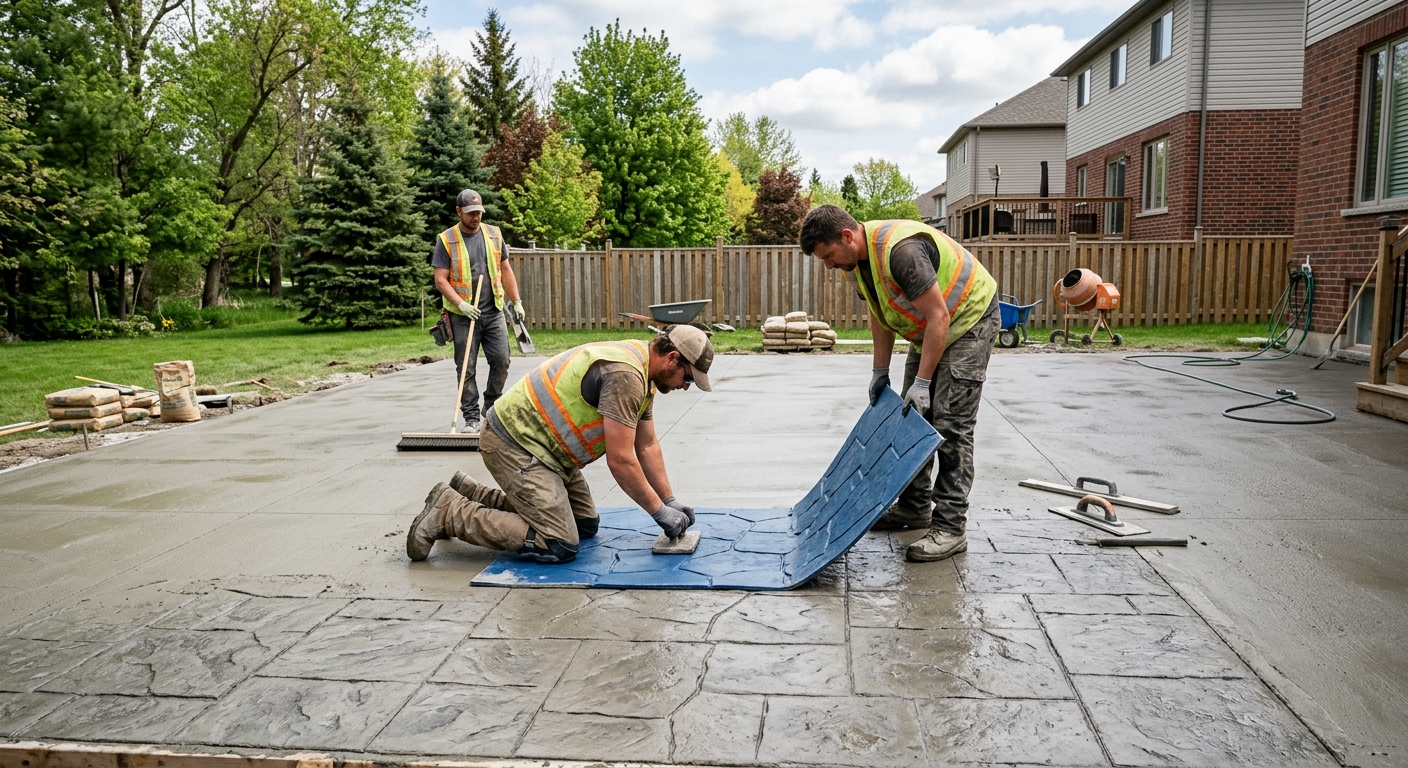
Here are a few Kirkness examples that move pricing: steep grade or limited access can raise excavation and truck time; clay-heavy soils may require deeper or wider base work; and a stamped driveway costs more than standard broom because it includes forming, stamping tools, and extra finishing labour. That’s why a plain patio may land in the $5,000–$9,000 band, while a stamped option is typically in the $15,000–$26,000 range once joints, colour system, and time are included.
| Price Factor |
Why It Matters |
Cost Impact |
| Frost line depth |
Determines footing depth and form height |
Higher excavation and concrete volume; can move structural pricing meaningfully |
| Site preparation |
Excavation, grading, compacted granular base |
More truck time and granular material; critical for avoiding settlement |
| Reinforcement |
Rebar or wire mesh requirement |
Labour and material cost increases, especially for driveways and footings |
| Mix design |
Air-entrainment and compressive strength spec |
Ensures freeze–thaw durability; winter placements may require winter-grade mix |
| Finish type |
Broom vs. stamped vs. exposed aggregate |
Decorative systems add labour, chemicals, and curing/sequence time |
| Pour size and concrete truck access to site |
Distance from truck and number of placements |
More staging time, pumping or extra labour if access is tight |
| Cold-weather curing precautions |
Heating and blankets |
Can add labour and equipment rental, especially outside the main pour window |
| Control joint pattern and sealing cost |
Limits cracking and protects against salt scaling |
Sealing and joint saw-cutting add line items; boosts long-term durability |
Permits & regulations in Alberta
In Alberta, permits and engineering reviews vary by the kind of concrete work you’re planning. Structural concrete work—think foundation elements such as footings, foundation walls, and grade beams—typically requires a building permit, and it’s common to have engineered drawings submitted for municipal review. That’s because these components affect structural safety and must be built to handle frost movement and local soil conditions.
Concrete flatwork (patios, walkways, and driveways) usually does not require a permit on its own. However, it can trigger requirements if it affects lot grading, changes drainage away from the home, or increases impervious surface coverage near limits set by the municipality. Also, if your project touches areas within municipal right-of-way or sidewalks, you may need approvals before work begins. The safe approach is to confirm what applies to your address before the first excavation.
Before signing, verify the contractor’s insurance and coverage. Ask for:
- A current certificate of liability insurance (include project address and dates).
- Proof of WCB coverage (often called WSIB/WCB depending on the wording used by the insurer).
- Clear references for similar-scale jobs in the Calgary area with dates and outcomes.
- Worker competence: ask who will be on site and what crew size will pour and finish your slab.
Step-by-step for Kirkness homeowners: request their certificate of insurance first, confirm the coverage names match the business on the quote, then ask for their WCB clearance documentation. For licences/registrations, check the Alberta registry relevant to the contractor’s business type and trades, and compare the name on the certificate to the name on your contract.
Getting concrete right in Kirkness's freeze-thaw climate
Concrete failure in Kirkness usually traces back to three things: poor base prep, inadequate freeze–thaw durability in the mix, and shortcuts on curing and joints. In a cold continental climate with frequent freeze–thaw cycles, the slab and underlying soil must be engineered to stay stable. That starts with compacted granular sub-base to the correct depth and level for your local soil and frost requirements. If the base isn’t built to spec, the slab can settle or pump fines, which then leads to cracks that allow moisture in.
Next is mix design. For exterior flatwork, you should expect air-entrainment—typically in the 5–7% range for freeze–thaw exposure—and a minimum compressive strength specification such as 32 MPa, so the concrete can resist scaling and spalling. Control joints also matter: spacing should be planned to limit random cracking into manageable lines. Curing is the silent make-or-break step: concrete should be protected and cured properly for at least 7 days under suitable conditions. In cold weather, crews may need insulated blankets and/or temporary heat so the concrete gains strength before it’s exposed to harsh conditions.
Finally, sealing after the cure window helps repel de-icing salts. It’s common to see homeowners skip this, then wonder why surface wear shows up faster in Alberta winters. For example, opting for standard broom vs. stamped concrete might cost less than the $15,000–$26,000 stamped band—but if you pay for decorative work without proper air-entrainment and joint detailing, the savings don’t hold up. You’ll get the appearance you want, but durability should be engineered first.
| Spec |
Why It Matters in Kirkness |
What to Ask For |
Impact if Skipped |
| Compacted granular base (depth?) |
In Kirkness, frost and moisture movement can amplify settlement if the base isn’t compacted to the right depth |
State target base thickness, granular type, and compaction proof |
Uneven slab, cracking, and joint failure over time |
| Air-entrained concrete mix (target air %?) |
Freeze–thaw cycles require entrained air to reduce damage from ice formation |
Request air content target (typically 5–7% for exterior flatwork) |
Spalling and surface scaling, especially with de-icing salts |
| Compressive strength (MPa rating) |
Higher strength helps the slab resist cracking and weathering in Alberta winters |
Minimum 32 MPa rating (confirm mix design) |
Lower durability and premature surface wear |
| Control joints (spacing per ACI guidelines) |
Kirkness concrete contracts and expands; joints control where cracks go |
Ask for joint spacing and saw-cut timing plan |
Random cracks, moisture ingress, and faster deterioration |
| Minimum 7-day curing period |
Proper curing is critical in cold weather so strength develops before freeze events |
Confirm curing method, protection plan, and how cold-weather placement is handled |
Weak surface and increased long-term cracking risk |
| Penetrating sealer (when applied after cure) |
Sealer helps repel salt and water that drive spalling on exterior slabs |
Apply after cure—commonly around 28 days post-pour—using a product suited to freeze–thaw |
Faster surface degradation and more staining |
How to choose a concrete work contractor in Kirkness
Choosing the right contractor in Kirkness comes down to verification, clarity, and accountability. Start with Alberta coverage: confirm the contractor carries liability insurance and WCB coverage before they mobilize. To check, ask for a certificate of insurance (COI) that lists the business name you’re hiring and the project dates; then verify the WCB coverage using the clearance documentation they provide. If their paperwork doesn’t line up with the quote name or the dates on the contract, that’s a red flag.
Next, don’t accept one vague number. Request 2–3 itemised written quotes that break out labour and materials—concrete supply, excavation/grading, reinforcement, formwork, finishing, saw-cut joints, and sealing (if included). Clarify what’s excluded: permit pulls, disposal of excess soil, drainage adjustments, and whether traffic control is required.
Warranty matters too. Ask for the workmanship warranty length (and what it covers) and whether product/manufacturer warranties apply to admixtures or decorative systems. Also ask if the warranty is transferable if you sell the house—many homeowner-friendly policies are.
Payment schedule should be conservative. Avoid large deposits; a common safe approach is no more than 10–15% upfront, with a holdback until completion and cleanup are confirmed. Finally, insist on a start date and a completion estimate in writing so winter curing requirements and delays are planned, not improvised.
- COI and WCB clearance documents reviewed before signing.
- Proof of experience with Calgary-area freeze–thaw details (air-entrainment, joints, curing).
- Itemised quote with concrete mix spec and reinforcement type.
- Clear scope for excavation depth and granular base thickness.
- Joint layout plan: spacing and saw-cut timing.
- Cold-weather plan (blankets/heating) if temperatures drop.
- Sealing included or explicitly excluded, with an application timing note.
- Permit responsibility stated (who pulls it, if required).
- Disposal of excess material included or priced separately.
- Truck access plan and whether pumping/extra labour is needed.
- Surface protection and site cleanup described.
- Warranty terms in writing, including what’s considered a defect.
Concrete contractor red flags in Kirkness: they won’t provide COI/WCB paperwork on request; they quote structural work without discussing engineered footing depth below frost; they promise decorative finishes but skip air-entrained mix and joint detailing; they start without a clear curing plan for cold weather; or their quote excludes sealing and then won’t explain how de-icing salt will be handled over time.
Frequently asked questions — concrete work in Kirkness
How long does concrete take to cure?
In Kirkness and across Alberta, curing time is more than a calendar date—it’s about temperature, protection, and whether the concrete is allowed to gain early strength before freeze events. For most placements, you can expect formwork removal and light trade access sooner, but the practical target for durability is still: proper curing for at least 7 days under suitable conditions. If you’re pouring in cooler weather, contractors may need insulating blankets and/or temporary heat to keep the slab from freezing before it reaches early strength.
For long-term performance—especially surface protection—sealing is commonly scheduled after the cure window, often around 28 days post-pour. That timing helps the sealer work properly against water and de-icing salts, which are tough on exterior slabs through Alberta winters. If someone tells you you can seal immediately or drive on it right away, ask how they’re managing curing, temperature, and protection.
Do I need a permit for concrete work in Alberta?
In Alberta, structural concrete work such as footings, foundation walls, and grade beams generally requires a building permit and often engineered drawings reviewed through municipal processes. For typical concrete flatwork—driveways, patios, and walkways—permits are usually not required by default. That said, you may need approvals if your concrete project affects lot grading, drainage, or impervious surface coverage, or if it involves work near municipal right-of-way (for example, sidewalks or curb transitions).
For Kirkness homeowners, the best approach is simple: confirm with the local authority before you break ground, especially if you’re raising a driveway or changing slopes for better drainage. Also make sure your contractor’s scope matches the permit responsibility—some quotes include permit handling (when required), while others explicitly don’t.
If you’re budgeting, remember that foundation/footings pricing commonly sits around $28,000–$45,000, so you don’t want surprises if permits or engineered requirements apply.
Concrete vs pavers for a patio in Kirkness?
For a patio in Kirkness, concrete and pavers can both perform well—what matters is how the base is built and how freeze–thaw is managed. Concrete patios typically come with cleaner drainage control and fewer individual units to shift, and air-entrained concrete with proper control joints helps it handle Alberta’s freeze–thaw cycles. Pavers can offer more design flexibility and easier spot repairs if one area heaves, but they depend heavily on a well-graded base, correct bedding sand, and edge restraint.
Cost-wise, plain concrete patios often land in the $5,000–$9,000 band depending on size and prep, while decorative systems (like stamped concrete) usually push higher. Pavers may be competitive once you include excavation, base, bedding, restraints, and labour—but the final price swings a lot based on pattern complexity and removal/replacement needs.
If your goal is longevity with fewer joints to maintain, and you want a smooth, uniform surface, concrete is often the straightforward choice. If you’re prioritizing easy section repairs or a highly customized look, pavers can make sense—just insist on freeze–thaw appropriate base engineering.
How long does a concrete driveway last?
In Alberta’s freeze–thaw climate, driveway lifespan depends heavily on base preparation, air-entrained mix design, joint spacing, curing practices, and ongoing surface care with de-icing habits. A well-built concrete driveway with proper granular base prep and a control joint plan can last for decades, but poor execution often shows up within a few winters as cracking, spalling, and surface scaling—especially at edges where salt and moisture accumulate.
Concrete driveways in Kirkness are engineered for frost movement, which is why footings and exterior flatworks should follow durability specs. Contractors should place air-entrained concrete and use appropriate finishing and curing to avoid weak surfaces. Sealing after curing can also help protect against salt-driven wear. If you’re replacing a driveway, it’s normal to budget within the local range for standard driveway work (often $12,000–$18,000 depending on size and site access), but the cheapest quote may be missing reinforcement, base thickness, or winter curing precautions.
The most important step is to ask for the mix and joint details—appearance is easy; durability details are what determine lifespan.
What is air-entrained concrete and why does it matter here?
Air-entrained concrete is mixed with microscopic air bubbles designed to give freeze–thaw ice expansion somewhere to go. In Kirkness, Alberta, that matters because winter conditions regularly cycle concrete through freezing and thawing. Without sufficient air entrainment, water inside the concrete can freeze, expand, and break down the surface. Over time, that shows up as spalling and surface scaling—especially where de-icing salts and moisture contact the slab.
For exterior flatwork, you should expect air-entrainment targets typically in the 5–7% range for freeze–thaw performance, along with a concrete strength specification such as a minimum 32 MPa rating. Contractors should also plan for proper curing time and protection, because cold-weather placement can interrupt strength gain if not managed with insulated blankets and/or heat.
Ask your contractor to state the air-entrainment and strength spec in writing. If they can’t, or if they treat air-entrainment as optional, that’s a major quality risk in the Calgary area climate.
How do I prepare the base for a concrete slab?
Base preparation is where concrete jobs in Alberta are won or lost. For a concrete slab in Kirkness, you need the right excavation depth, properly graded sub-grade, and a compacted granular sub-base built to support the slab through frost movement. The granular material should be compacted in lifts to the required standard (contractors should be able to describe their compaction approach), and the surface should be level and stable before placing reinforcement and concrete.
Because the design frost depth is deep in this region, crews often excavate more than homeowners expect—especially for structural work like footings. Even for exterior slabs like patios and walkways, good base prep prevents settlement and reduces cracking paths that water can exploit during freeze–thaw cycles.
In your pre-pour checklist, ask: what is the granular base depth, what type of granular material is used, how is drainage handled, and what reinforcement is installed? If you’re comparing quotes for a driveway around $12,000–$18,000, insist the base prep and reinforcement details are spelled out—not just “concrete and labour.”