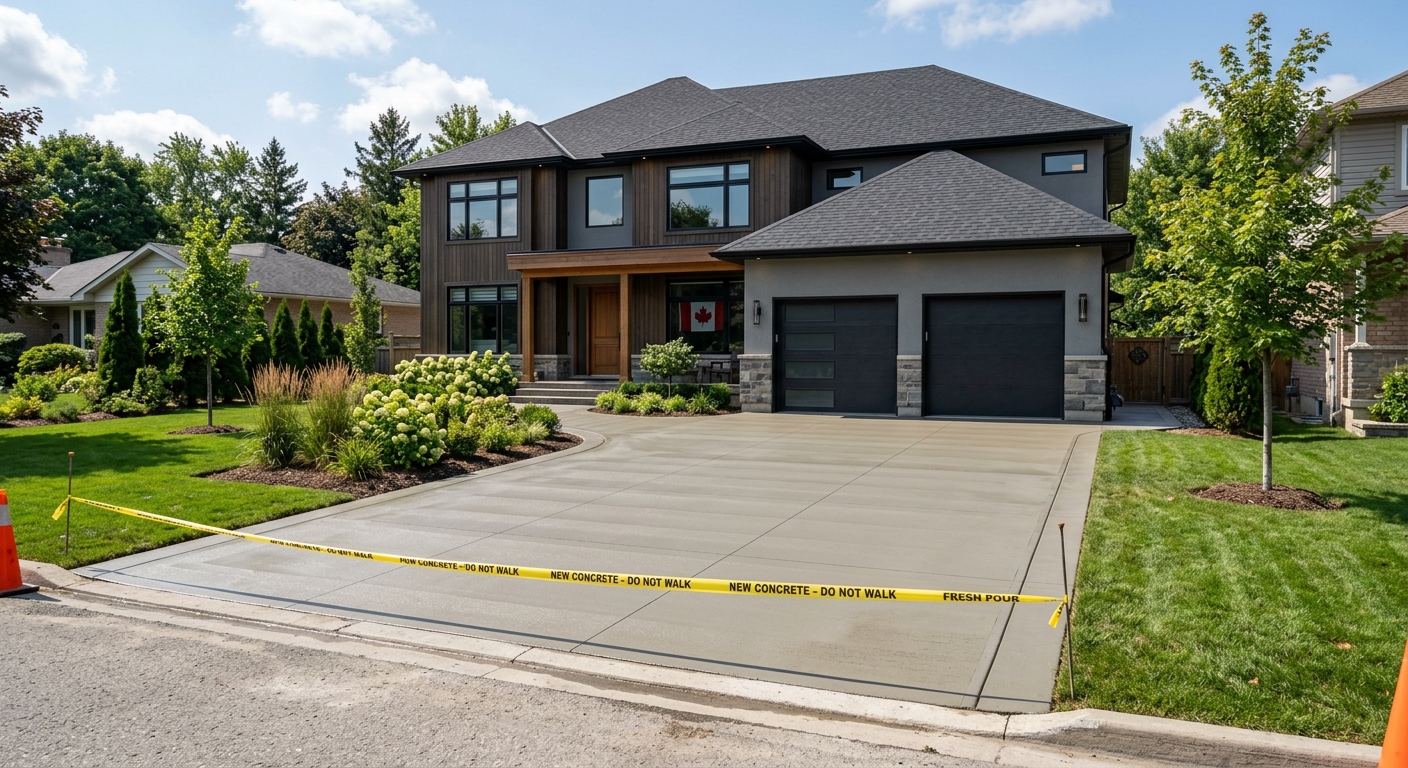
Concrete work options and costs in Brentwood
Brentwood, Alberta is a fast-growing community in the Calgary economic region, and that shows up in how busy the concrete crews are for driveways, patios and walkways. The area’s housing base is largely centred on single-family living—Statistics Canada (2021 Census) reported 31.9% of households are in single-detached homes—so homeowners commonly upgrade front entries with new concrete flatwork rather than swapping to masonry or full landscaping. With Brentwood’s population at 7,410 (Statistics Canada, 2021 Census), the demand is concentrated but the trade still has to staff projects around the same winter freeze–thaw challenges that affect all of Calgary and the surrounding counties.
In this cold continental climate, the cost of concrete is engineered around deeper frost considerations (with a design frost depth of about 1.2 m, roughly 4 ft) and frequent freeze–thaw cycles. That means more excavation, more compacted granular base, air-entrained mixes for exterior slabs, and better control joint planning. Exterior pours also have a shorter practical window, so cold-weather curing precautions (insulated blankets and, in some cases, temporary heat) can add labour and materials cost. If you’re in a spot like the Brentwood’s living corridors near major access routes where access and truck manoeuvring can be tight, you may also see higher labour costs because the crew has to protect lawns, sidewalks and existing services while staging the pour.
Use the table below to compare typical options and budget ranges, then we’ll break down what changes pricing the most for Brentwood projects.
| Application |
Typical Size |
Key Spec |
Finish Option |
Price Range |
| Concrete driveway (standard broom finish) |
16 ft x 30 ft (approx. 480 sq. ft.) |
Air-entrained mix; compacted granular base; control joints |
Broom finish |
$12,000–$18,000 |
| Exposed aggregate driveway |
16 ft x 30 ft (approx. 480 sq. ft.) |
Air-entrained mix; proper curing; base prep for freeze–thaw durability |
Exposed aggregate (light broom/brush texture) |
$14,500–$20,500 |
| Stamped concrete driveway or patio |
14 ft x 28 ft (approx. 392 sq. ft.) or similar |
Air-entrained mix; integral colouring; joint plan |
Stamped pattern + sealer |
$15,000–$26,000 |
| Plain concrete patio or walkway |
12 ft x 16 ft (approx. 192 sq. ft.) |
Air-entrained mix; compacted sub-base; edges and joints |
Float/steel trowel + light broom |
$5,000–$9,000 |
| Garage floor (interior slab) |
22 ft x 24 ft (approx. 528 sq. ft.) |
Vapour barrier; rebar or mesh (if specified); proper base |
Power trowel (finish varies) |
$9,500–$15,500 |
| Foundation footings (structural, below frost) |
Varies by home design; typical single-family excavation footprint |
Engineered reinforcement; excavation to below design frost depth |
Structural concrete |
$28,000–$45,000 |
Prices are estimates only and vary by project scope, site access and material selection.
What affects the price of concrete work in Brentwood
In Brentwood and across the Calgary region, it’s not unusual for two quotes for the “same” concrete project to differ by 30–50%. The reason is that the foundation for pricing isn’t just the concrete itself—it’s the engineered site prep, the concrete mix design for freeze–thaw durability, and the curing approach needed for cold conditions. When contractors price for risk (bad soil, limited access, or late-season pours), labour hours, excavation, and thermal protection requirements rise quickly.
First, frost depth and freeze–thaw cycles dictate every spec. In Alberta, footings and structural elements are designed to bear below the design frost depth (about 1.2 m, roughly 4 ft) to prevent frost heave and seasonal movement. Exterior slabs and flatwork need air-entrained concrete so the mix can tolerate repeated freezing and thawing without scaling or spalling. Second, the colder region means a shorter pour season for exterior work, plus a tighter curing window: late fall or early spring pours often require insulated blankets and sometimes temporary heating to keep the slab curing properly. That’s why a simple driveway may land nearer the lower end of the $12,000–$18,000 band when scheduled in-season, but can drift upward if winter protection is required. De-icing salt use also accelerates deterioration on unsealed or inadequately cured surfaces—so sealing, while sometimes optional in other regions, becomes more practical in Calgary-area winters.
Local conditions in Brentwood that commonly raise cost include clay-heavy or variable fill requiring deeper removal and better base preparation, narrow approach lanes that slow down concrete placement, and existing utility conflicts around garage pads. Your cost can also drop if you’re replacing like-for-like with good subgrade and clean access; a straightforward broom-finished driveway in an accessible lot may stay closer to the middle of the $12,000–$18,000 range rather than approaching the higher end seen with stamped work near the $15,000–$26,000 band.
| Price Factor |
Why It Matters |
Cost Impact |
| Frost line depth — determines footing depth and form height |
More excavation and concrete volume to reach undisturbed soil below frost |
Higher formwork and concrete cost; larger foundation “footprint” cost |
| Site preparation — excavation, grading, compacted granular base |
Weak sub-base leads to settlement, cracking and premature failure |
Can be the difference between a fast pour and an extended dig/rebuild |
| Reinforcement — rebar or wire mesh requirement |
Controls cracking and improves slab durability under loads |
Extra materials and labour; depends on design and slab thickness |
| Mix design — air-entrainment and compressive strength spec |
Air void system reduces freeze–thaw damage; strength impacts long-term performance |
Higher material spec cost; usually required for exterior durability |
| Finish type — broom vs. stamped vs. exposed aggregate |
Finishes add steps and tooling, and require tighter execution during curing |
Labour-intensive finishing raises costs (especially stamped work) |
| Pour size and concrete truck access to site |
Access limits can force smaller lifts, pumping, or extended staging |
Increased labour time and possible equipment charges |
| Cold-weather curing precautions — heating and blankets |
Proper temperature supports strength gain and reduces scaling risk |
Adds rentals, fuel/electricity, and skilled supervision time |
| Control joint pattern and sealing cost |
Joints manage shrinkage cracks; sealing helps resist de-icing salt exposure |
Better long-term protection adds modest cost versus premature rework |
Permits & regulations in Alberta
In Alberta, structural concrete work—like footing and foundation elements—generally needs a building permit. That includes foundation footings, foundation walls, and grade beams that are part of the engineered structural system. For these, municipalities typically expect engineered drawings (or engineered design confirmations) because the work must meet structural and frost-resistance requirements for our climate.
Concrete flatwork such as driveways, patios, and walkways usually does not require a permit on its own unless your project affects lot grading, drainage, impervious surface coverage limits, or the municipal right-of-way. Even when a permit isn’t routinely required, grading and drainage issues can still trigger compliance questions. The safest path is to confirm with your local authority before excavation.
To protect yourself in Brentwood, verify the contractor before they start:
- Request their liability insurance certificate (make sure your address or project is covered as applicable).
- Confirm they have WCB/WSIB coverage for the workers who will be on site.
- Ask for references and, if available, photos of similar Alberta exterior freeze–thaw projects.
- If the job involves structural elements, ensure the contractor is coordinating the permit/inspection requirements through the proper process and engineers.
Step-by-step: (1) ask for COI and clearance/coverage confirmation, (2) verify coverage dates and company name match the quote, (3) keep a copy for your records, and (4) confirm the scope in writing (what is and isn’t included) before signing. When you’re clear on permit needs up front, you avoid schedule delays and change-order surprises later.
Getting concrete right in Brentwood's freeze-thaw climate
Concrete failures in Brentwood typically start long before the first crack shows up. The two biggest drivers in our Calgary-region freeze–thaw climate are inadequate base preparation and the wrong concrete mix for exterior exposure. If compacted granular base is too shallow, poorly graded, or underspecified, the slab loses support and settles. If the mix isn’t air-entrained (and properly proportioned), freeze–thaw cycles will break down the paste over time, leading to surface scaling and spalling—especially where de-icing salt lands.
To spec the job correctly, focus on five controls. (1) Base preparation: excavate to the right depth and install a well-compacted granular sub-base suitable for our frost considerations and local soils. (2) Mix design: for exterior flatwork, air-entrainment is critical; a typical target is 5–7% air, with at least 32 MPa compressive strength so the slab gains durable capacity. (3) Control joints: place joints to manage shrinkage cracking and reduce random cracking across driveways and patios. (4) Curing: plan for at least 7 days curing under suitable conditions—cold weather can require blankets or heat so the slab actually gains strength. (5) Sealing: apply a penetrating sealer after cure (commonly at 28 days) to help repel de-icing salts and reduce surface deterioration.
A practical way to think about cost is this: spending a bit more on base prep and proper mix/curing often prevents expensive “band-aid” repairs. For example, a plain broom-finished driveway might sit in the $12,000–$18,000 range, but a poorly prepared job that later scales can cost far more than the initial premium you’d pay for a proper air-entrained mix and joint plan. If you’re choosing a decorative option like stamped concrete, budgeting near the $15,000–$26,000 band is only justified when the base and curing are done correctly—otherwise the finish won’t last.
Before the pour, ask technical questions: “What air content are you targeting?”, “How deep is the base and how are you compacting it?”, “What’s the joint spacing?”, and “What cold-weather curing method will you use if temperatures drop?” Those answers are usually where the durable jobs separate from the quick ones.
| Spec |
Why It Matters in Brentwood |
What to Ask For |
Impact if Skipped |
| Compacted granular base (depth?) |
Provides stable support and protects against frost-related movement |
Confirm excavation depth, granular type, and compacted lift method |
Settlement, uneven surface, and premature cracking |
| Air-entrained concrete mix (target air %?) |
Reduces freeze–thaw damage that causes scaling and spalling |
Ask the supplier’s target air content (typical exterior flatwork 5–7%) |
Surface scaling and spalling in a few winters |
| Compressive strength (MPa rating) |
Affects long-term durability and strength gain timing |
Minimum 32 MPa specified for the slab |
Weaker surface, increased wear and cracking |
| Control joints (spacing per ACI guidelines) |
Manages shrinkage cracking under Calgary-area temperature swings |
Joint layout and spacing plan in writing |
Random cracking patterns and water ingress |
| Minimum 7-day curing period |
Proper curing supports strength development despite cold snaps |
Minimum 7 days curing plan; what happens if it’s cold? |
Insufficient strength, scaling risk, and shorter service life |
| Penetrating sealer (when applied after cure) |
Helps repel de-icing salts and reduces salt-driven surface deterioration |
Sealer applied after cure (commonly 28 days post-pour) |
Faster spalling and roughening of the slab surface |
How to choose a concrete work contractor in Brentwood
Choosing the right concrete contractor in Brentwood comes down to proof and clarity, not just price. In Alberta, you’ll want to verify that the contractor carries liability insurance and has WCB/WSIB coverage for their workers. How to check: request a current certificate of insurance (COI) and confirm the policy is active during your project dates; for WCB/WSIB, ask for a clearance/coverage confirmation that matches the legal business name on the quote. Don’t rely on verbal assurances—get the paperwork up front before excavation starts.
Next, get 2–3 itemised written quotes rather than a single lump sum. A quality quote breaks down labour and materials (excavation, base, reinforcement, concrete supply, finishing, joints, sealer), and clearly lists what’s included for disposal, site protection, and any traffic-control or weekend access constraints. Scope clarity matters in Calgary-area jobs—excluded items like cold-weather curing blankets or removal/haul-off can turn a “mid-range” quote into an expensive change.
Pay attention to warranty too. Ask how long the workmanship warranty lasts, what it covers (cracking due to shrinkage control vs structural defects), and whether any product/manufacturer warranty is assignable. For payment scheduling, never pay more than 10–15% upfront; keep a holdback until the work is complete, cleaned up, and sealed/finished as specified. Also require a written start date and realistic completion estimate, because cold-weather constraints can shift timelines quickly.
- Request COI and WCB/WSIB clearance before signing.
- Confirm the quote is itemised (base, reinforcement, concrete, finishing, joints, curing, sealing).
- Ask who supplies and places the concrete and whether it’s air-entrained for exterior use.
- Verify the slab thickness and the joint spacing plan are stated in writing.
- Confirm excavation depth and compacted base thickness/lift method.
- Check what’s included for demolition and disposal of existing concrete.
- Ask whether perimeter edges, forms, and proper drainage tie-ins are included.
- Clarify if permit coordination is included when it’s required for structural work.
- Find out the cold-weather approach (blankets/heating) if temperatures drop.
- Request references for projects of similar scope and in Calgary-area climates.
- Review the warranty terms in plain language and get it in the contract.
- Use staged payments with a holdback until final cure/finishing is confirmed.
Concrete red flags we commonly see in Brentwood include: (1) quotes that don’t mention air-entrainment or joint layout, (2) “cheap” excavation that doesn’t specify compacted granular base, (3) contractors asking for most payment upfront, (4) no written curing plan for cold weather, and (5) vague warranty language that excludes typical slab issues instead of defining workmanship coverage.
Frequently asked questions — concrete work in Brentwood
Do I need a permit for concrete work in Alberta?
In Alberta, structural concrete work such as footings, foundation walls, and grade beams typically needs a building permit, often tied to engineered drawings and municipal review. Concrete flatwork like driveways, patios and walkways usually does not need a permit by itself unless your project impacts lot grading, drainage, impervious surface limits, or the municipal right-of-way—so it’s worth confirming before you excavate. For homeowners in Brentwood, a practical approach is to ask your contractor what portion of the work is structural versus flatwork, and then verify with the local authority whether a permit is required for the way the slab ties into grading and drainage. A reputable contractor should also carry liability insurance and WCB/WSIB coverage, and they should be comfortable explaining the permit pathway if it’s required.
Concrete vs pavers for a patio in Brentwood?
For patios in Brentwood, both concrete and pavers can look great, but concrete usually wins when you want long-term uniformity and easier maintenance. In our Calgary-region freeze–thaw climate, concrete that’s properly air-entrained (commonly targeting 5–7% air), placed on a compacted granular base, and fitted with a good joint plan tends to hold up well. Pavers can also perform, but they rely heavily on the base and drainage; any settling or weed intrusion can become an ongoing issue. On cost, plain concrete patio work typically falls in the $5,000–$9,000 range depending on size and site conditions. Decorative stamped finishes can move higher, but for a lot of homeowners the durability per dollar is strongest with correctly specified concrete, especially when de-icing salts are used during Alberta winters.
How long does a concrete driveway last?
A well-built concrete driveway in Brentwood often lasts decades, but “how long” depends on the details that fight freeze–thaw: air-entrained mix, proper base prep, reinforcement where required, control joints, correct curing, and sealing for salt resistance. Many driveways fail early due to inadequate excavation or poor granular base compaction, or because contractors rush cold-weather curing and the slab doesn’t reach the strength it needs. If your driveway is in the middle of the $12,000–$18,000 pricing band, it’s usually a sign the scope includes the essential durability specs—provided the quote explicitly mentions base compaction, joints, and air-entrainment for exterior placement. If you’re comparing quotes, ask how they’ll handle late fall pours, what they’ll do to protect curing, and whether a sealer is included after cure.
What is air-entrained concrete and why does it matter here?
Air-entrained concrete is designed with a small amount of microscopic air bubbles that give freezing water somewhere to expand inside the paste. In Alberta’s cold continental conditions, repeated freeze–thaw cycles can otherwise break down the concrete surface—leading to scaling and spalling, especially where de-icing salts hit. This is why exterior slabs in Brentwood should use an air-entrained mix and not a “standard” mix meant for interior use. When a contractor is quoting a driveway, patio, or walkway, you want them to specify the mix design and confirm it’s air-entrained. If they can’t tell you the target air content (often around 5–7% for exterior flatwork) and the minimum compressive strength (commonly at least 32 MPa), it’s a sign to ask more questions or consider another bid.
How do I prepare the base for a concrete slab?
Base prep is where good slabs are won in Brentwood’s freeze–thaw climate. A quality base starts with excavating to the required depth, removing unsuitable soil, then placing compacted granular sub-base in properly compacted lifts. The goal is to ensure stable support so the slab doesn’t settle or heave seasonally. Ask your contractor what granular material they use, how thick the compacted base will be, and how they compact it (including lift thickness and equipment). A concrete slab on a weak or poorly graded base can crack even if the finishing looks perfect. Also ask about drainage around edges and whether joints and reinforcement (as required) will be installed to control shrinkage cracking. For many driveway and patio budgets in Brentwood—like the $12,000–$18,000 driveway range—base prep is a major portion of why the best quotes aren’t the cheapest ones.
How do I compare concrete quotes?
Comparing concrete quotes in Brentwood is mostly about apples-to-apples scope. Start by requesting itemised quotes with labour and materials breakdown: demolition/disposal, excavation and compacted granular base depth, reinforcement, concrete supply (including air-entrainment for exterior work), finish type, joints, curing precautions, and whether sealing is included after cure. Don’t compare only the bottom-line number—two bids can land in the same $12,000–$18,000 driveway range while having very different specs for air content, base preparation, or cold-weather curing. Check payment terms too (a safe approach is keeping upfront payment around 10–15% and using a holdback). Finally, verify contractor compliance: liability insurance and WCB/WSIB coverage, and references for similar projects in Calgary-area conditions. If a quote lacks technical detail, treat it as incomplete.