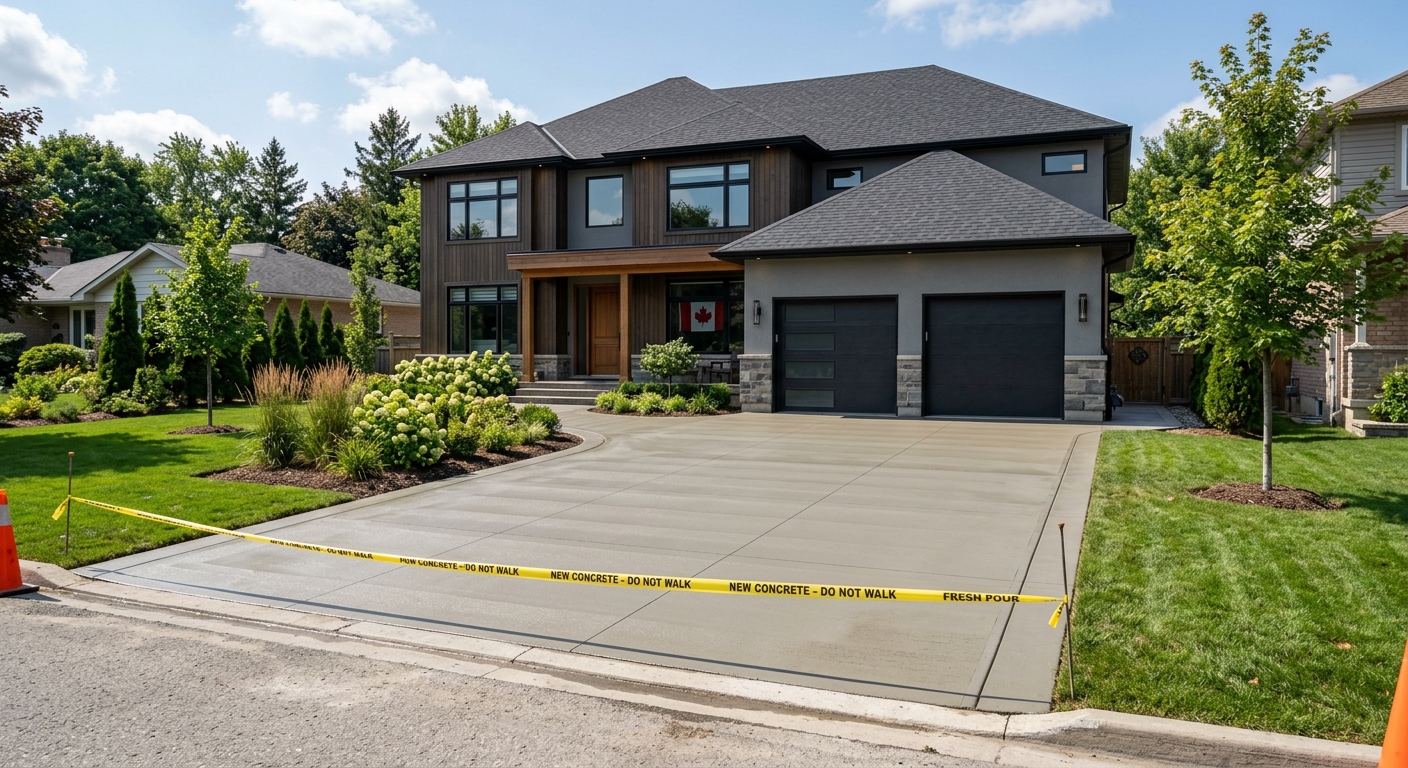
Concrete work options and costs in Beaumont
In Beaumont, Alberta, concrete work is a big part of how homeowners protect value—especially because the community is largely single-detached housing, with 80.0% of dwellings in that style (Statistics Canada, 2021 Census). With 6,060 homeowner households (87.2% of households own), you’ll see steady demand for driveways, patios, walkways, and garage slabs that stand up to Edmonton-area winter conditions (Statistics Canada, 2021 Census). The Edmonton economic region’s cold continental climate matters for your budget: frost depths are commonly designed around 1.5 m or more, so footings and foundation elements must extend below the design frost line to avoid frost heave. For exterior slabs, frequent freeze–thaw cycles mean air-entrained concrete, a properly compacted granular base, and correctly spaced control joints are non-negotiable—otherwise you can get cracking, scaling, and spalling much sooner.
Costs also respond to scheduling pressure. The flatwork pour season tends to be shorter in late fall/winter than in milder regions, and cold-weather curing can require insulated blankets or heated enclosures. That can create labour premiums when crews are booked. In established parts of Beaumont—commonly around residential growth corridors near downtown Beaumont and older neighbourhoods with more driveways needing replacement—contractors are often busiest for new or widened driveways, plus walkways tied into the front door and garage entry.
Below are practical, Beaumont-friendly cost ranges so you can compare contractor quotes apples-to-apples.
| Application |
Typical Size |
Key Spec |
Finish Option |
Price Range |
| Concrete driveway (standard broom finish) |
400–550 sq ft (typical single driveway) |
Air-entrained mix; reinforced if specified; compacted granular base |
Broom finish with control joints |
$9,000–$18,000 |
| Exposed aggregate driveway |
400–550 sq ft |
Air-entrained mix; correct retarder/washed surface timing |
Exposed aggregate (light brushing/wash) |
$12,500–$21,500 |
| Stamped concrete driveway or patio |
300–600 sq ft |
Stamped system; air-entrained exterior mix; joint layout planned |
Stamp + release + seal |
$12,000–$26,000 |
| Plain concrete patio or walkway |
150–300 sq ft |
Air-entrained exterior mix; compacted base; control joints |
Float/trowel with broom or light texture |
$3,500–$9,000 |
| Garage floor (interior slab) |
400–700 sq ft |
Vapour barrier if needed; thickness per design; jointing |
Standard trowel/finish |
$7,000–$14,000 |
| Foundation footings (structural, below frost) |
Per home design; often 1,000–2,500 sq ft of footing area |
Below-frost excavation; engineered reinforcement; correct concrete placement |
Structural concrete |
$25,000–$60,000 |
Prices are estimates only and vary by project scope, site access and material selection.
What affects the price of concrete work in Beaumont
In and around Beaumont, Alberta, it’s common to see quotes for the “same” concrete job vary by 30–50%—especially when the proposals aren’t describing the same specs. A driveway that looks identical on paper can actually include very different excavation depth, granular base thickness, reinforcement, and concrete mix requirements for freeze–thaw durability. In the Edmonton region, frost line design is the starting point: exterior footings must extend below the design frost depth (often up to 2.4 m in Alberta) to prevent frost heave. On top of that, exterior slabs should be built with air-entrained concrete so the freeze–thaw cycle doesn’t drive scaling and spalling. Cold weather also changes the economics: the pour season can compress into late spring through early fall, and when temperatures drop, contractors may need insulated blankets or heated curing enclosures—adding labour, materials, and fuel.
Local conditions can raise or lower costs quickly. For example, a replacement driveway on older lots (Beaumont has 11.9% of homes built before 1981) can require more removal of existing base material and regrading, which pushes labour and disposal. In contrast, a straightforward patio with good access and a stable subgrade can stay closer to the lower end of the $3,500–$9,000 patio/walkway range. Similarly, upgrading from broom finish to stamped work can be justified when you want a longer curb appeal lift—stamped concrete often lands in the $12,000–$26,000 band because of forms, stamp mat layout, and finishing discipline.
When you compare bids, always ask for concrete mix details, base depth, reinforcement callouts, joint spacing, and whether cold-weather curing is included.
| Price Factor |
Why It Matters |
Cost Impact |
| Frost line depth — determines footing depth and form height |
Footings must sit below the designed frost depth to stop heave and settlement. |
Higher excavation and concrete volume; can swing structural cost substantially |
| Site preparation — excavation, grading, compacted granular base |
Weak or poorly graded base leads to settlement cracks and surface failure. |
More labour and granular material; common reason for 30–50% quote gaps |
| Reinforcement — rebar or wire mesh requirement |
Controls cracking and improves load distribution, especially on driveways and slabs. |
Additional material and placement labour |
| Mix design — air-entrainment and compressive strength spec |
Exterior air entrainment helps the concrete survive freeze–thaw cycles. |
Small material premium that prevents costly premature failure |
| Finish type — broom vs. stamped vs. exposed aggregate |
Finish complexity changes labour time, tooling, and sealing steps. |
Typically increases cost for stamped/exposed finishes |
| Pour size and concrete truck access to site |
Smaller pours or difficult access can mean extra handling and truck coordination. |
May add crew time or pumping/placement costs |
| Cold-weather curing precautions — heating and blankets |
Proper cure is critical when temperatures fall; insulation protects hydration. |
Can noticeably increase labour and material costs |
| Control joint pattern and sealing cost |
Jointing reduces random cracking; sealing helps repel de-icing salts. |
Additional sawcut/finishing labour and sealer material |
Permits & regulations in Alberta
In Alberta, structural concrete work—such as foundation footings, foundation walls, and grade beams—typically requires a building permit, and it’s common for engineered drawings to be reviewed as part of the approval process. Concrete flatwork (driveways, patios, and walkways) usually does not require a permit unless it affects lot grading, triggers impervious surface coverage concerns, or impacts municipal right-of-way / drainage assumptions near the street. The safe approach in Beaumont is to confirm with the local authority before breaking ground, especially if you’re changing elevations, adding catch basins, or altering drainage patterns toward a curb or ditch.
As a homeowner, you can verify a contractor the right way, step-by-step:
- Licensing: check the contractor registration/labelling they provide and confirm the business is active in Alberta through the applicable online resources (ask the contractor for their current licence info).
- Liability insurance: request a certificate of insurance showing general liability coverage and the project name/address where possible.
- WSIB/WCB coverage: ask for proof of coverage for workers (or clearance/letter, depending on their account status).
- References: ask for 2–3 similar-scale pours in Edmonton-area conditions—exterior air entrainment and joint layouts are the giveaway for quality.
- Scope alignment: ensure their quote states base depth, mix/air entrainment, reinforcement, joints, and sealing/cold-weather provisions.
If a contractor can’t produce insurance/WCB proof or won’t clearly explain scope details, that’s your signal to pause and re-check the paperwork before you sign.
Getting concrete right in Beaumont's freeze-thaw climate
Concrete failures in Beaumont, Alberta usually come down to one of five things: poor base preparation, the wrong mix, missing or mis-spaced control joints, inadequate curing, or sealing that never happens. In the Edmonton market, the freeze–thaw cycle is relentless: water enters surface pores and around micro-cracks, freezes, expands, and then the surface flakes (spalls). To prevent that, your spec has to match the climate, not just the look.
(1) Base preparation: require a compacted granular sub-base to the depth your soil conditions demand for frost protection and drainage. If the base is too shallow or not compacted correctly, the slab settles and cracking accelerates. (2) Mix design: insist on air-entrained concrete for exterior work; a typical target is 5–7% air content and the mix should meet a minimum 32 MPa compressive strength for exterior durability. (3) Control joints: place them at a spacing that limits random cracking—then sawcut/cut cleanly at the right time. (4) Curing: plan for at least 7 days of proper curing conditions; cold weather requires protection (insulated blankets/heating) so hydration proceeds. (5) Sealing: apply a penetrating sealer after the recommended cure window—typically around 28 days—to help repel de-icing salt and reduce scaling.
These specs are why the right option costs more up front but costs less over time. For instance, going from a plain patio to stamped can add money for stamp labour and careful finishing, but if you’re replacing an aging surface in an exposed entry area, that upgrade can be worthwhile—provided the base, joints, air entrainment, and curing are still done properly. Skipping those items usually negates any aesthetic gains.
| Spec |
Why It Matters in Beaumont |
What to Ask For |
Impact if Skipped |
| Compacted granular base (depth?) |
Beaumont freeze–thaw + drainage needs a stable, well-compacted base to prevent settlement and cracking. |
Base thickness by design; compaction testing method; drainage plan if needed |
Uneven settlement, early cracking, rough surface heaving |
| Air-entrained concrete mix (target air %?) |
Proper air voids help concrete tolerate repeated freeze–thaw cycles. |
Air entrainment target (commonly 5–7% for exterior flatwork) stated in writing |
Spalling/scaling, especially after winter de-icing |
| Compressive strength (MPa rating) |
Enough strength supports durability under vehicle loads and seasonal movement. |
Minimum 32 MPa (or project-specified equivalent) confirmed |
Wear, surface deterioration, reduced service life |
| Control joints (spacing per ACI guidelines) |
Joints control where cracks form so they don’t become random structural damage. |
Joint spacing plan and finish sequence (sawcut timing) |
Random cracking, wider cracks, water intrusion |
| Minimum 7-day curing period |
Hydration needs time; cold weather slows curing and increases strength loss risk. |
Curing plan; cold-weather protection if temperatures are expected to drop |
Reduced strength, increased shrinkage cracking, weaker edges |
| Penetrating sealer (when applied after cure) |
De-icing salts and moisture cycling are harsher in Edmonton-area winters. |
Penetrating sealer applied after cure window (often ~28 days) + product details |
Faster scaling and surface wear |
How to choose a concrete work contractor in Beaumont
Choosing the right concrete contractor in Beaumont, Alberta comes down to proof, clarity, and a scope you can verify. Start with Alberta coverage checks: ask for their certificate of liability insurance (and confirm it covers the work at your address if possible) and proof of WSIB/WCB coverage for their workers. Many contractors can email these immediately; quality contractors don’t treat insurance as optional. If they refuse or provide outdated documents, that’s a major red flag. Then verify you receive itemised written quotes—not a vague lump sum—so you can compare concrete volume, base prep, reinforcement, finishing, and sealing/cold-weather curing provisions.
When reviewing the scope, read the exclusions. Is the permit pull included where required for structural work? Is disposal of old concrete included? Are excavation and regrading included to achieve the correct elevation and drainage? For warranty, ask for the workmanship warranty length in writing, whether any material/manufacturer warranty applies, and whether it is transferable if you sell your home. Payment terms should also be disciplined: don’t pay more than about 10–15% upfront, and insist on a holdback until the job is fully complete and any deficiencies are corrected.
Finally, get your timeline in writing: start date and a realistic completion estimate that accounts for curing time and weather protection needs. In Beaumont, weather can shift, but a good contractor plans for it instead of rushing.
- Request proof of Alberta liability insurance (certificate) before work begins.
- Request proof of WSIB/WCB coverage and confirm it covers their workers on your site.
- Get 2–3 itemised quotes with line items for excavation, base, concrete, reinforcement, finishing, and sealing.
- Ask for the concrete spec: air entrainment and minimum strength (e.g., minimum 32 MPa for exterior durability).
- Confirm reinforcement details (wire mesh vs rebar) for driveways and garage slabs.
- Verify control joint plan: spacing and sawcut timing.
- Confirm base depth and compaction requirements—not just “granular base.”
- Ask whether cold-weather curing protection (blankets/heating) is included when temperatures drop.
- Confirm disposal/recycling of old concrete and where it will be hauled.
- Ask how they handle drainage and slope to prevent ponding on patios and walkways.
- Get warranty details in writing: workmanship length, exclusions, and how claims are handled.
- Use a payment schedule with limited upfront deposit and holdback until complete.
Concrete red flags I see in Beaumont include: quotes that omit base depth or joint spacing, contractors who won’t confirm air-entrainment for exterior slabs, no willingness to provide insurance/WSIB/WCB documents, rushing finishing and skipping curing/blankets in cold snaps, and “final” costs that balloon because disposal, regrading, or reinforcement wasn’t included.
Frequently asked questions — concrete work in Beaumont
How deep must footings be for Beaumont's frost line?
In Beaumont (Edmonton-area conditions), footing depth is set to sit below the design frost depth so the soil under the foundation doesn’t heave during freeze–thaw cycles. In Alberta, that design frost depth is often up to 2.4 m for many areas, which is why properly engineered foundation drawings matter—your engineer/municipal requirements govern the exact depth for your lot and soil conditions. For homeowners, the practical takeaway is that your foundation quote should clearly state footing excavation depth and show engineered details, not just a “standard” depth. If you’re seeing a footing budget that looks too low (even relative to the $25,000–$60,000 foundation/footings band), it’s worth asking what depth and reinforcement are being assumed. Cold protection during placement and correct concrete placement also affect long-term performance in Alberta’s winter climate (Statistics Canada, 2021 Census).
Why does concrete crack in Beaumont and how is it prevented?
Concrete can crack in Beaumont because winter moisture expands and contracts with temperature swings, and because concrete naturally shrinks as it cures. In an exterior slab—driveway, patio, or walkway—those movements intensify if the base isn’t stable, if the concrete mix isn’t air-entrained, or if joints aren’t planned and cut correctly. The main prevention strategy is not “no cracks,” but “cracks where we planned them.” That means correct granular base preparation, air-entrained exterior mix (commonly 5–7% air content), and a control joint layout with proper sawcut timing. Then curing needs to be protected—minimum 7 days, and often additional attention in cooler weather—so strength development isn’t compromised. Finally, sealing after cure helps reduce de-icing salt damage that can widen and expose cracks faster.
Stamped vs broom-finish concrete — cost difference?
In Beaumont, stamped concrete costs more than broom-finish largely because the system involves extra labour and finishing steps: stamp mat work, release agents, more careful surface timing, and additional sealing discipline. Broom-finish driveway work is commonly quoted around the lower-to-mid range of the driveway band (for example, $9,000–$18,000 depending on size and site prep). Stamped driveways or patios typically land higher—often within the $12,000–$26,000 range—because the finishing time and materials are more intensive. That said, you don’t “buy” durability with stamping. The real durability comes from air-entrainment, a compacted base, reinforcement (when required), joint layout, and proper curing. If a contractor’s stamped quote doesn’t clearly cover those items, the cheaper broom-finish option may actually perform better long-term.
When is the best time to pour concrete in Beaumont?
The best time to pour concrete in Beaumont is generally late spring through early fall, when ambient temperatures support reliable curing and reduce the need for heated enclosures. Edmonton-area conditions can shift quickly, and cold snaps can slow hydration; that’s why contractors plan around temperatures and wind and bring cold-weather protection when needed (blankets, insulation, sometimes heaters). If you’re scheduling a driveway or patio, ask the contractor what minimum/expected temperatures they plan to pour in and what their curing plan is if temperatures drop overnight. For exterior work, scheduling matters because a rushed pour with insufficient curing protection can reduce strength and increase the likelihood of surface scaling over subsequent winters. While winter pours are sometimes possible with the right protection, they often cost more—so timing can directly affect your final budget within the typical bands (e.g., patio/walkway $3,500–$9,000 and driveway $9,000–$18,000).
How long does concrete take to cure?
Concrete curing has two different ideas: “set” and “strength development.” For a homeowner in Beaumont, the key practical timeline is that exterior durability depends on proper curing for at least 7 days under suitable conditions. Strength continues to build beyond that, and for sealing many systems want the slab to be cured before application—often around 28 days—so the sealer can penetrate effectively and reduce the effects of de-icing salt and moisture. In colder weather, curing can be slower, which is why reputable crews protect the pour with insulated blankets or heated enclosures. If you use your slab too early (driving on it prematurely, or allowing snow clearing too soon), you can increase surface damage and scaling risk. Ask your contractor how they will protect the concrete during the first week and when they recommend sealing for your specific weather window.
Do I need a permit for concrete work in Alberta?
In Alberta, many concrete flatwork projects—driveways, patios, and walkways—typically do not require a permit unless the work affects lot grading, impervious surface/drainage assumptions, or municipal right-of-way considerations. However, structural concrete work such as foundation footings, foundation walls, and grade beams generally requires a building permit and often engineered drawings reviewed through the municipal process. For Beaumont homeowners, the best approach is to confirm with the local authority before you start excavation, especially if you’re changing elevations, rerouting drainage, or adding hardscape close to the curb/ditch. Also verify the contractor’s insurance and WSIB/WCB coverage—because permits and inspections often go hand-in-hand with documented compliance. If your quote is strictly for flatwork around a driveway and patio, it may not need a permit, but the scope should still be written clearly so there are no surprises later.