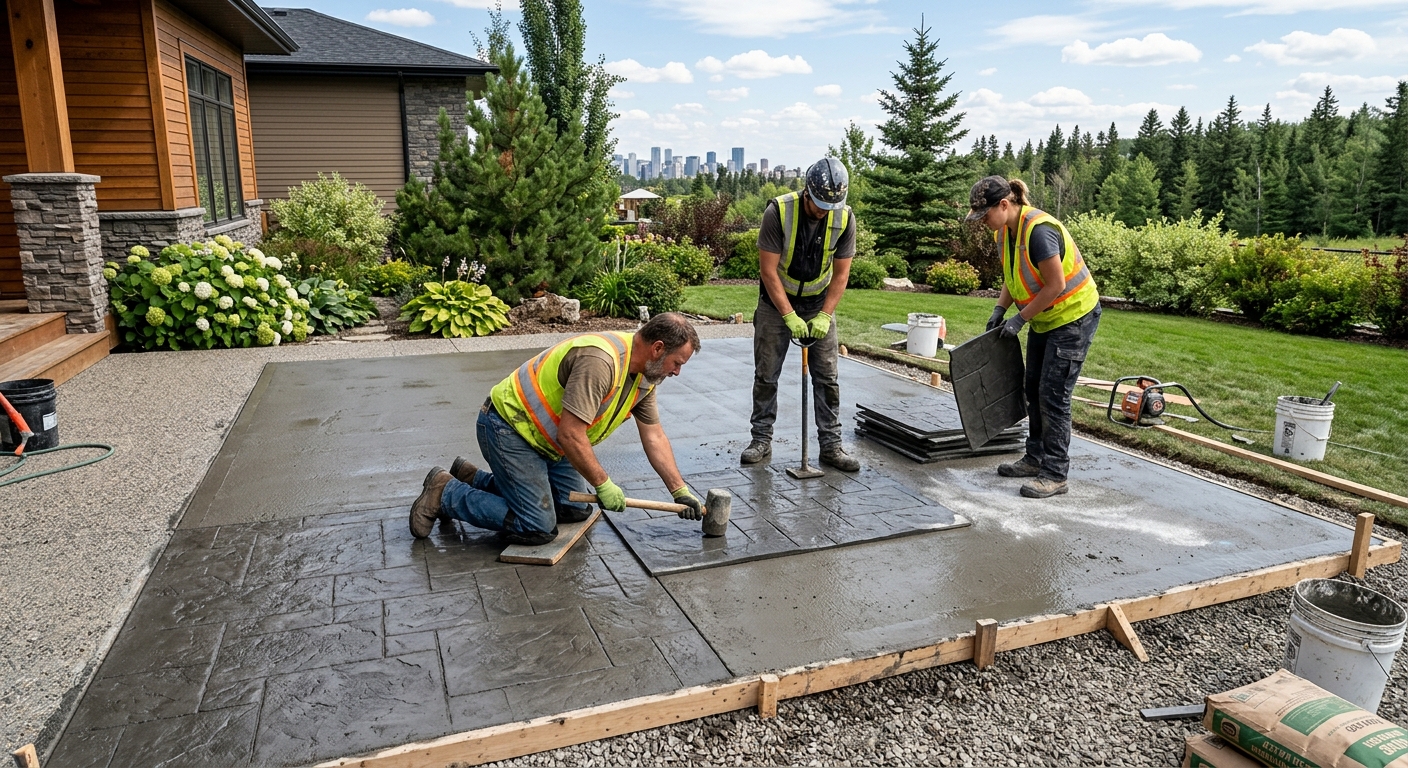
Concrete work options and costs in Fulton Place
Fulton Place is a compact community in the Calgary economic region, and it’s a great place to price concrete realistically because homeowners there tend to upgrade the “hard surfaces” all at once—driveways, patios, walkways and garage floors. With a population of 2,239 (Statistics Canada, 2021 Census), most concrete demand is driven by ongoing owner projects and repeat buyers looking for durable finishes that can handle Alberta winters. In this part of the Calgary area, the homes you’ll see most often are single-detached houses, which means driveway and patio work is a consistent need.
Concrete pricing in Fulton Place is shaped by the cold continental climate around Calgary: the design frost depth is about 1.2 m (roughly 4 ft), so footings for houses, garages and some retaining structures must bear on undisturbed soil below that depth. Add frequent freeze–thaw cycles and you’ll see every contractor budgeting for thicker granular base prep, air-entrained mixes, properly spaced control joints, and careful curing logistics. In practice, that makes the quote more dependent on excavation volume and subgrade conditions than on “just concrete” alone.
In neighbourhoods and close-in areas where access is tighter—back lanes and older established lots near transit routes—contractors often need more time for forming, staging and hauling spoils. That’s one reason you’ll notice stronger demand for concrete flatwork and foundations as homes age and yards get reworked.
Below is a side-by-side comparison of the most common concrete options and realistic price ranges for Fulton Place, so you can align your budget before you request itemized quotes.
| Application |
Typical Size |
Key Spec |
Finish Option |
Price Range |
| Concrete driveway (standard broom finish) |
12 ft x 20 ft (240 sq. ft.) |
Air-entrained exterior mix, compacted granular base, control joints |
Broom finish, edges formed |
$12,000–$18,000 |
| Exposed aggregate driveway |
12 ft x 20 ft (240 sq. ft.) |
Air-entrained mix, proper curing, aggregate exposure process |
Exposed aggregate with colour options |
$14,000–$21,000 |
| Stamped concrete driveway or patio |
10 ft x 20 ft (200 sq. ft.) |
Air-entrained mix, reinforcement as required, integral stamping process |
Stamped pattern + release + sealer |
$15,000–$26,000 |
| Plain concrete patio or walkway |
12 ft x 12 ft (144 sq. ft.) |
Air-entrained exterior mix, compacted base, slope away from house |
Float/trowel with light broom |
$5,000–$9,000 |
| Garage floor (interior slab) |
20 ft x 22 ft (440 sq. ft.) |
Smooth finish, thickness per design, vapour control as applicable |
Power trowel or broom finish |
$6,500–$12,500 |
| Foundation footings (structural, below frost) |
Typical house/garage footing system |
Excavation to frost depth, engineered steel, concrete below design frost |
Structural concrete (no decorative finish) |
$28,000–$45,000 |
Prices are estimates only and vary by project scope, site access and material selection.
What affects the price of concrete work in Fulton Place
In Fulton Place and across the Calgary market, two quotes for the “same” concrete job can land 30–50% apart because contractors price risk differently. The biggest drivers are excavation conditions, how deep they must go for proper frost protection, how much rebar or base is required, and whether the contractor is allowed to schedule around cold-weather curing needs. In Alberta, you’ll often pay more for dependable execution than for minimal materials—especially in exterior work where freeze–thaw exposure is constant.
The frost line depth is a core reason specs change. In much of Ontario, the frost depth can push to 1.5–2.4 m, and in Alberta it can be as high as roughly 2.4 m depending on engineering and soil—so footings and form height aren’t “standard” by guesswork. In our Calgary region, that design frost depth concept is why concrete foundations and structural footings typically sit in the $28,000–$45,000 band. For exterior slabs, air-entrained concrete is non-negotiable: it’s engineered to survive freeze–thaw cycles by managing internal stress from water movement in the concrete. If the job is poured late in the season, cold-weather precautions (insulated blankets, sometimes temporary heat, and protected curing) add labour and equipment costs.
Local conditions can swing the price either way. For example, good drainage and stable soil can reduce granular base and make excavation cleaner; poor bearing soil or buried debris increases truck counts and disposal. A stamped driveway that lands in the $15,000–$26,000 band is usually justified when access is good and the installer can keep consistent placement and finishing—otherwise, increased rework risk quickly erodes the savings. Even the age of the housing stock matters: older lots often need more foundation daylighting or grade adjustments before a slab can be built to the right height and slope.
| Price Factor |
Why It Matters |
Cost Impact |
| Frost line depth — determines footing depth and form height |
Exterior and structural concrete must bear below the design frost depth to prevent frost heave. |
Can add thousands in excavation, concrete volume and formwork; drives foundation pricing. |
| Site preparation — excavation, grading, compacted granular base |
Proper base thickness and compaction control settlement and reduce cracking. |
Unexpected soft spots, hauling, and grading can swing total cost 15–30%. |
| Reinforcement — rebar or wire mesh requirement |
Reinforcement resists cracking and controls shrinkage and load distribution. |
Material and placement labour; increases cost if footing/slab engineering demands it. |
| Mix design — air-entrainment and compressive strength spec |
Exterior durability in freeze–thaw depends on air-entrainment and proper strength. |
Upfront material cost, but it reduces long-term spalling/repairs. |
| Finish type — broom vs. stamped vs. exposed aggregate |
Decorative finishes require more labour, timing, and finishing discipline. |
Stamped/exposed options typically cost several thousand more per driveway/patio. |
| Pour size and concrete truck access to site |
More prep time and pump/short-haul needs increase labour. |
Tight access, long reach, or multiple loads adds cost quickly. |
| Cold-weather curing precautions — heating and blankets |
Concrete must cure properly to achieve strength and reduce scaling/spalling risk. |
Equipment and labour; can add a noticeable premium in late-season pours. |
| Control joint pattern and sealing cost |
Joints manage cracking; sealing helps protect against de-icing salts. |
More layout time and later materials; a common “hidden” line item. |
Permits & regulations in Alberta
In Alberta, structural concrete work—such as footings, foundation walls, and grade beams—almost always requires a building permit, and engineered drawings are commonly reviewed as part of the permit process by the municipality. For example, if you’re building new, underpinning, or modifying a foundation system, you should expect permitting and engineering involvement. Concrete flatwork like patios, walkways, and driveways usually does not require a permit on its own, but it can trigger review if it affects lot grading, drainage, or impervious surface and right-of-way considerations. In Fulton Place, the practical point is simple: confirm with the local authority before breaking ground, especially if you’re changing slopes near the foundation or altering how stormwater runs.
Before you hire anyone, verify three things step-by-step: (1) contractor registration/licensing where applicable, (2) liability insurance, and (3) WSIB/WCB coverage. Start by asking the contractor for their most recent certificate of insurance (COI) showing liability coverage for the specific work scope—if the COI can’t be provided, walk away. Next, request proof of WCB/WSIB coverage clearance (often provided as a clearance letter or confirmation number, depending on the contractor’s setup). Finally, check for references on similar-scale concrete projects in Calgary-area freeze–thaw conditions.
Getting concrete right in Fulton Place's freeze-thaw climate
Concrete fails in Fulton Place when water gets into the wrong places and then freezes, expands, and damages the paste. The two biggest culprits are inadequate base preparation and an exterior mix that isn’t properly air-entrained. Without air-entrainment, freeze–thaw cycles can drive spalling and surface scaling over time, especially where de-icing salts are applied. Another common issue is poor jointing and sealing—if cracks form randomly and water can reach the concrete edges, you’ll see deterioration sooner.
To spec the job correctly for the Calgary climate, insist on five fundamentals. First is base prep: compacted granular sub-base at the right depth for local soil and frost considerations, with proper slope away from the house. Second is mix design: a properly air-entrained exterior concrete mix—targeting 5–7% air content for many exterior flatwork applications—paired with minimum 32 MPa compressive strength. Third is control joints: spacing designed to limit random cracking. Fourth is curing: plan for at least 7 days of curing under appropriate conditions, and use insulated blankets or controlled heat when cold weather threatens early strength gain. Fifth is sealing: apply a penetrating sealer after the concrete has cured (commonly at 28 days) to repel de-icing salts.
Here’s a concrete budget reality check. If an exposed aggregate driveway is priced higher than a standard broom driveway, the difference is often justified by durability-oriented preparation and the extra finishing process. However, if you’re offered “cheap” decorative work without confirming air content, curing protection, and joint layout, you’re likely paying later—repairs and partial replacement in freeze–thaw climates can erase the initial savings fast.
| Spec |
Why It Matters in Fulton Place |
What to Ask For |
Impact if Skipped |
| Compacted granular base (depth?) |
Controls settlement and limits water movement under freeze–thaw exposure. |
Granular base thickness by engineered/approved section and proof of compaction testing method. |
More cracking, uneven slab movement, and faster surface deterioration. |
| Air-entrained concrete mix (target air %?) |
Air bubbles provide freeze–thaw resistance and reduce spalling risk. |
Exterior mix with target air content (commonly 5–7% for many exterior flatwork specs). |
Higher likelihood of scaling and spalling after winter cycles. |
| Compressive strength (MPa rating) |
Strength gain affects durability and ability to carry loads without early failure. |
Minimum 32 MPa (or higher if engineered for the slab type and loads). |
Surface wear, cracking, and reduced long-term performance. |
| Control joints (spacing per ACI guidelines) |
Guides where shrinkage cracks occur so water doesn’t find random paths. |
Joint layout plan with spacing and timing of saw-cut or formed joints. |
Random cracks, water intrusion, and accelerated freeze–thaw damage. |
| Minimum 7-day curing period |
Proper curing enables strength development before winter conditions stress the surface. |
Planned curing method and protection plan for cold snaps. |
Scaling, reduced strength, and higher risk of long-term surface defects. |
| Penetrating sealer (when applied after cure) |
Helps repel de-icing salt solutions that intensify freeze–thaw wear. |
Penetrating sealer applied after cure (commonly around 28 days). |
Faster salt-related surface deterioration and more frequent maintenance. |
How to choose a concrete work contractor in Fulton Place
Choosing a concrete contractor in Fulton Place is less about who has the lowest number on the page and more about who can execute in Calgary’s freeze–thaw environment. Start with Alberta coverage basics. Ask for a certificate of insurance (liability) that matches the job size and includes worksite coverage. Then confirm WCB/WSIB coverage: request proof/clearance documentation so you know they’re set up to protect their workers. Even if the job is “only” a driveway, proper coverage matters because excavation, truck movement, and concrete finishing are labour-heavy and risk-prone.
Next, collect 2–3 itemised written quotes. You want the breakdown separated into labour, materials, base/earthworks, concrete supply, finishing, reinforcement (if any), and disposal. Look for whether the permit (if required) is included, how drainage and slope are handled, and whether saw-cut joints and sealing are part of the scope. Avoid lump sums that don’t state thickness, air-entrainment intent, or curing/blanket provisions—those details drive durability.
Warranty should be specific: ask for the workmanship warranty length, whether it covers cracking, settlement, scaling, or only certain defects, and whether product/manufacturer warranty transfers to you. Payment schedules matter too: never pay more than 10–15% upfront. Use a holdback until substantial completion and curing-related steps are verified. Finally, require a start date and completion timeline in writing; in Alberta, winter scheduling can make or break cure quality.
- Ask for project photos in Calgary-area winter conditions, not just summer pours.
- Request evidence of liability insurance and confirm jobsite coverage limits.
- Provide WCB/WSIB clearance documentation (don’t accept verbal confirmation only).
- Get quotes that list thickness, base prep depth, and whether soil is over-excavated.
- Confirm exterior mix is air-entrained and specify target air content range.
- Ask for minimum strength (MPa) and curing method for cold weather.
- Require a joint plan: spacing, saw-cut timing, and how corners/edges are detailed.
- Clarify whether sealing is included and when it’s applied (after cure, often 28 days).
- Check if disposal, topsoil removal, and haul distance assumptions are stated.
- Ask who does subgrade verification and whether compaction is addressed.
- Review warranty terms for cracking, spalling/scaling, and settlement.
- Confirm payment schedule: 10–15% upfront max, with holdback until completion steps.
Concrete red flags in Fulton Place include: quotes that omit air-entrainment/curing details, missing proof of WCB/WSIB or liability coverage, “cheap” decorative work without a realistic scheduling window, no written joint or sealing scope for exterior slabs, and contractors who demand full payment upfront or won’t provide an itemised breakdown.
Frequently asked questions — concrete work in Fulton Place
Can concrete be poured in cold weather in Fulton Place?
Yes, concrete can be poured in Fulton Place during cold weather, but it must be handled as a cold-weather placement—not a standard summer pour. In Alberta’s freeze–thaw climate, contractors need to protect the slab until it reaches strength and to manage curing temperature so the concrete doesn’t scale or underperform. Practically, that means insulated blankets and/or temporary heat, plus careful scheduling to avoid letting the surface cool too quickly. If you’re comparing quotes, make sure they state their curing plan (blankets/heating) and protection timeline, not just the day they plan to pour. For context, exterior slabs and patios commonly fall within the $5,000 – $9,000 range for smaller jobs, while driveways are often $12,000 – $18,000; a proper cold-weather approach may push pricing toward the higher end because of labour, equipment, and materials.
How do I maintain concrete in Fulton Place's freeze-thaw climate?
Maintenance in Fulton Place is mostly about keeping water and salts from attacking the surface and preventing early spalling. Start with de-icing practices: use less aggressive products when possible and avoid leaving heavy salt piles on the same spots. Sweep away sand and grit rather than grinding them into the surface. If your driveway or walkway was sealed, re-seal according to the product schedule—often every few years depending on exposure—because de-icers can wear down surface protection. Visually inspect joints and edges each fall; if joints open up or sealant is missing, water can track into the slab and freeze–thaw damage accelerates. Finally, don’t ignore small cracks: address them early so the crack doesn’t become a pathway. In an Alberta context, good original specs—air-entrainment, jointing, and sealing—do most of the heavy lifting.
What causes concrete to spall in Fulton Place winters?
Concrete spalling is typically caused by freeze–thaw action combined with water and de-icing salt. If water gets into the concrete near the surface (or around edges), it expands as it freezes and can break off small pieces, especially during repeated temperature swings. The most common root cause in Fulton Place is inadequate air-entrainment for exterior exposure—without enough properly sized air voids, the internal freeze–thaw stresses build up faster. Poor curing and rushing the early strength gain can also contribute. Joint spacing and sealing matter too: if joints are too far apart or poorly detailed, cracks form randomly and create direct pathways for water. De-icing salt then intensifies surface deterioration. If you see spalling, it usually isn’t a “single bad winter” problem; it’s a sign the mix design, curing protection, and/or protective sealing likely weren’t aligned to Calgary-area freeze–thaw conditions.
What is rebar and when is it required in Alberta?
Rebar (reinforcing steel) is steel bars embedded in concrete to control cracking and improve tensile capacity, especially where loads or shrinkage stresses are expected. In Alberta, rebar requirements depend on engineering and the slab or structural element type—not a one-size-fits-all rule. For example, foundation systems (footings and walls) and some grade beams are typically engineered and may require rebar based on soil conditions, loads, and design frost depth considerations. For exterior flatwork like driveways and patios, reinforcement might be specified for thicker slabs, drive areas, or where soil or heavy loads demand it, but many broom-finished patios can still be adequate with the right thickness, base, joints, and air-entrainment. The best approach is to ask for the design thickness and whether reinforcement is included in the scope. Good contractors will explain the “why” tied to loads and freeze–thaw durability, not just “we always add mesh.”
How long does a concrete project take in Fulton Place?
Timelines in Fulton Place depend on the scope and whether the work is exterior or structural. A standard driveway pour is often a short on-site operation—placing and finishing is typically measured in hours—but the full project includes excavation, base prep, reinforcement (if required), forming, and curing protection. For exterior flatwork, the curing period still matters even after finishing day; contractors should maintain appropriate conditions for strength gain, particularly in Alberta cold snaps. Foundation/footings projects take longer because of excavation to below frost depth, inspections, forming, reinforcement placement, and staged pours. If you’re comparing options, understand that stamped or exposed aggregate work adds preparation and finishing discipline, which can extend the schedule within the same overall window. As a budget anchor: driveway projects often land in the $12,000 – $18,000 band for standard work, while decorative stamped jobs can go higher; higher complexity usually means a tighter, more controlled schedule, not just more cost.
What is a concrete overlay and is it suited to Fulton Place?
A concrete overlay is a new concrete layer placed over an existing slab after surface prep—typically used to refresh worn driveways without full removal. In Fulton Place, overlays can be suited to certain cases, but success depends on whether the existing concrete is still structurally sound and whether prep is done thoroughly. Overlays don’t fix problems like deep base failure, major settlement, or significant cracking that has already broken the slab’s performance. Freeze–thaw and de-icing salts can keep working their way through weak areas under an overlay if bonding and base conditions aren’t right. The contractor should show you how they will test bonding (and address drainage slope), what mix and thickness they plan, and how joints will be handled. If your existing driveway is in rough condition, a full replacement might be more durable over time—especially because Calgary-area freeze–thaw cycles can punish marginal foundations. When pricing overlays, get the same air-entrainment and curing assurances you’d demand on a new slab.