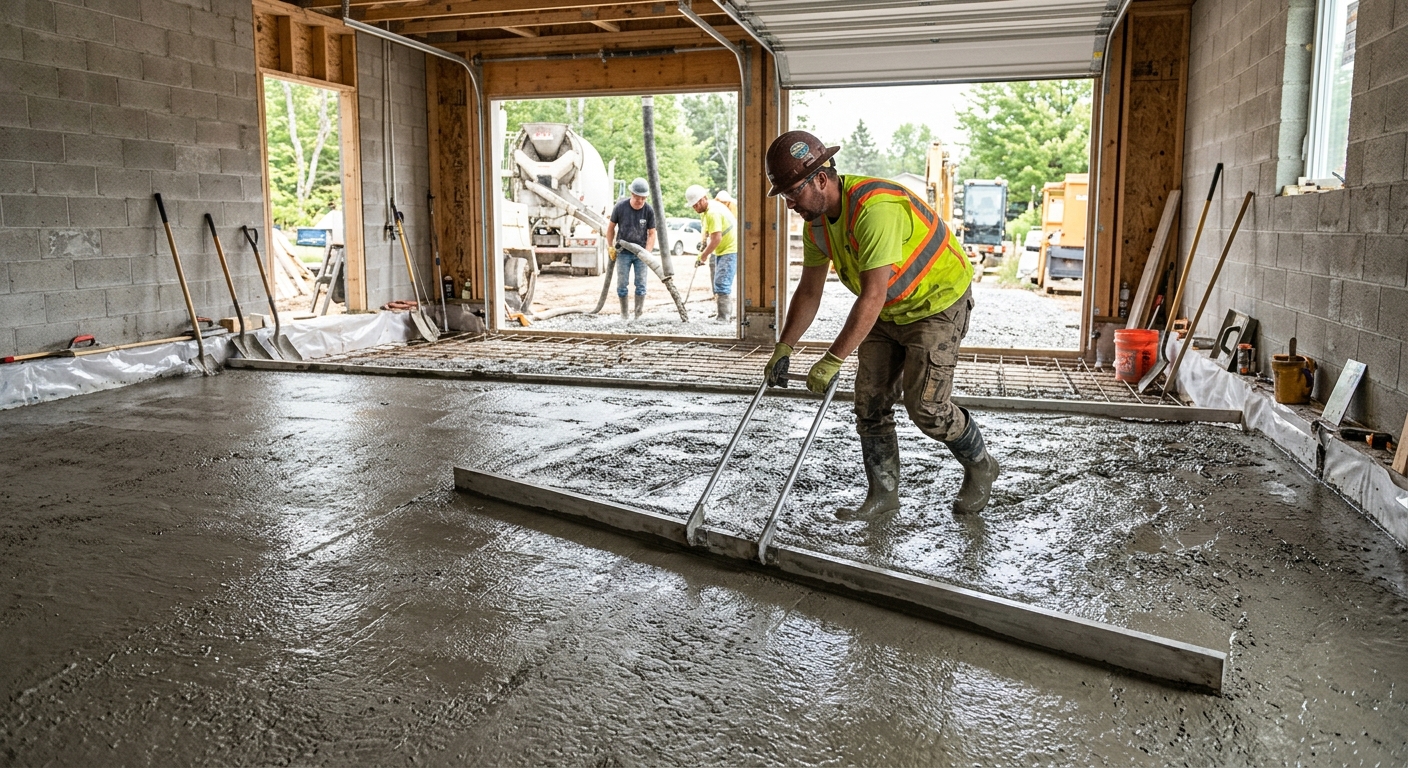
Concrete work options and costs in Athlone
Athlone is a growing community in the Calgary region, and for many homeowners the first “big-ticket” exterior upgrade is often new concrete flatwork—driveways, patios, walkways, and sometimes interior garage slabs. With a 2021 population of 3,116 (Statistics Canada, 2021 Census), Athlone tends to draw concrete work in waves as households expand and older properties get refreshed. In the area around Athlone, concrete contractors are especially busy when homes are renovated near established lanes and infill developments—where access and excavation logistics are tight and timelines matter.
In Calgary’s cold continental climate, concrete pricing reflects more than just material. The design frost depth is about 1.2 m (roughly 4 ft), so footings for structures like garages and retaining walls must bear below that level to reduce frost heave. Add frequent freeze–thaw cycles and you get engineered specs: air-entrained mixes, granular base preparation, and control joints for better crack control on exterior slabs. The practical pour season for exterior flatwork is shorter, and if you pour late fall or early spring, contractors often need cold-weather curing precautions (insulated blankets and sometimes temporary heat) to avoid surface scaling and longer-term durability issues.
Local demand is strong where homeowners typically add or expand parking and outdoor living—commonly around the residential pockets near the newer subdivisions and densification areas close to major commuter routes into Calgary. If you’re budgeting for a project in Athlone, the table below gives realistic ranges for common options, then you can match the spec to your site conditions.
| Application |
Typical Size |
Key Spec |
Finish Option |
Price Range |
| Concrete driveway (standard broom finish) |
400–600 sq ft (approx. 20’ x 20’) |
Air-entrained concrete, granular base, control joints |
Broom finish, light broom texture |
$12,000–$18,000 |
| Exposed aggregate driveway |
400–600 sq ft (approx. 20’ x 20’) |
Air-entrained mix, proper base compaction for freeze–thaw |
Exposed aggregate (salt-and-pepper or larger stone) |
$14,500–$21,000 |
| Stamped concrete driveway or patio |
300–500 sq ft |
Air-entrained mix, release agent, control joints |
Stamp patterns (slate/stone/wood look) |
$15,000–$26,000 |
| Plain concrete patio or walkway |
200–350 sq ft |
Air-entrained concrete, slope for drainage |
Broom or light trowel finish |
$5,000–$9,000 |
| Garage floor (interior slab) |
400–500 sq ft |
Vapour control as needed, reinforcement as specified |
Float/skim, smooth interior finish |
$9,500–$15,500 |
| Foundation footings (structural, below frost) |
Typical house/garage perimeter (engineered) |
Excavation to design frost depth, rebar + engineered specs |
Structural concrete for footings (no decorative finish) |
$28,000–$45,000 |
Prices are estimates only and vary by project scope, site access and material selection.
What affects the price of concrete work in Athlone
In Athlone and across the Calgary region, it’s common to see quote spread of 30–50% for “the same” concrete job. That gap usually isn’t because one contractor is guessing wildly; it’s because concrete pricing is driven by engineering and site conditions—frost depth requirements, sub-base preparation, reinforcement detailing, and how a crew manages curing in Alberta’s climate. Two bids can land at different totals because one includes full excavation and proper granular base to engineered depth, while the other assumes easier access or a thinner base.
Frost and freeze–thaw dictate the foundation and slab specs in Alberta. In Alberta, footings must extend below the design frost depth to prevent frost heave—about 1.2 m (roughly 4 ft) in practice—so excavation is deeper and footing volumes are higher. Exterior slabs also need air-entrained concrete to survive repeated freezing and thawing. On top of that, Athlone’s pour season can be more limited: in cold snaps, contractors must use cold-weather curing precautions (insulated blankets and sometimes heat) to reach the minimum strength and prevent scaling. If de-icing salt will be used on driveways and walkways, sealing becomes part of long-term cost control.
Here are a few concrete examples of what changes price in Athlone. A driveway with limited truck access or a tight turn usually costs more because concrete placement time and labour planning increase—often pushing projects toward the higher end of the $12,000–$18,000 driveway band. A stamped patio or driveway can be significantly higher when thicker structural sections and added finishing time are needed—often nearer $15,000–$26,000. Finally, if your existing base is poor (soft spots, organics, poor drainage), the “cheap” option isn’t cheaper—extra excavation and granular base rebuild will raise the scope fast, especially for exterior slabs exposed to freeze–thaw.
| Price Factor |
Why It Matters |
Cost Impact |
| Frost line depth — determines footing depth and form height |
Footings must bear below design frost to prevent heaving |
Higher excavation = more labour and concrete; can push foundation work toward the upper band |
| Site preparation — excavation, grading, compacted granular base |
Proper drainage and compaction prevent settlement and cracking |
Soft soils or poor drainage increase base depth and granular volume |
| Reinforcement — rebar or wire mesh requirement |
Controls cracking and supports structural loads |
Adds material cost and ties; may be required for garage slabs and thicker exterior pours |
| Mix design — air-entrainment and compressive strength spec |
Air-entrainment improves durability through freeze–thaw |
“Standard” mix may be cheaper, but engineered mixes reduce long-term failure risk |
| Finish type — broom vs. stamped vs. exposed aggregate |
Finishing complexity affects labour time and materials |
Stamped and exposed aggregate typically cost more than broom-finish flatwork |
| Pour size and concrete truck access to site |
Placement efficiency and labour planning depend on access |
Tight access can increase pump/placement planning or delays, raising labour costs |
| Cold-weather curing precautions — heating and blankets |
Concrete must achieve early strength without freezing |
Heating/blankets increase costs, especially in late fall/early spring |
| Control joint pattern and sealing cost |
Joints reduce random cracking; sealing repels de-icing salts |
Better joint layout and sealing add line items but reduce maintenance and spalling risk |
Permits & regulations in Alberta
In Alberta, structural concrete work generally needs proper permitting and often engineering review. If you’re building or changing structural elements—such as foundation footings, foundation walls, grade beams, or other load-bearing concrete—expect that a building permit will be required. Many projects also require engineered drawings that the municipality reviews as part of the permit process, particularly where excavation, structural loads, or soil conditions are involved.
Concrete flatwork like patios, walkways, and driveways usually does not require a permit by itself. However, you should still check before you pour if your plan affects lot grading, alters drainage patterns toward a neighbour’s property, or changes impervious surface coverage. Also verify requirements if your project impacts municipal right-of-way or sidewalks (for example, apron/approach changes).
For homeowners in Athlone, the practical checklist is: confirm whether your scope triggers a permit, then verify your contractor’s coverage before work starts. Ask for proof of liability insurance and WSIB/WCB coverage (or the appropriate clearance letter if applicable), and request references on similar footings/foundation or flatwork projects. Step-by-step, you can verify:
- Licence/registration status: check the contractor’s business credentials through the relevant Alberta online registry channel.
- Liability insurance: request a current Certificate of Insurance showing the policy limits and project details.
- WSIB/WCB coverage: ask for proof of account status and/or clearance letter before mobilisation.
- References: request photos and job addresses with similar slab thicknesses and winter scheduling.
Always confirm with the local authority before breaking ground.
Getting concrete right in Athlone's freeze-thaw climate
Concrete in Athlone fails in predictable ways when it’s not engineered for freeze–thaw. The biggest culprit I see is spalling and scaling from inadequate air-entrainment and rushed curing—especially when a pour happens in cold weather without proper blankets or heat. Another common failure is cracking that shows up early because the base wasn’t compacted to the correct depth or drainage slope wasn’t built-in, allowing water to sit under or near the slab. In a region where freeze–thaw cycles are frequent and the frost depth is about 1.2 m (roughly 4 ft), the “spec” is what keeps your concrete stable year after year.
To spec the job correctly in Athlone, focus on five areas. (1) Base preparation: build a compacted granular sub-base to engineered depth and ensure proper drainage and slope. (2) Mix design: for exterior flatwork, air-entrainment targets about 5–7% air content, with minimum 32 MPa compressive strength (engineered as needed for structural elements). (3) Control joints: plan joint spacing so shrinkage cracking happens in the joints, not randomly. (4) Curing: plan for at least 7 days of curing under suitable conditions; in cold weather, you may need insulated blankets and monitored curing temperatures. (5) Sealing: apply a penetrating sealer after full cure (typically 28 days) to help repel de-icing salts.
Ask technical questions early. For example, sealing a driveway is often a worthwhile add-on. If you choose a broom-finish driveway around $12,000–$18,000, the cost is relatively straightforward; sealing and correct air-entrainment protect that investment. In contrast, stamped concrete around $15,000–$26,000 pays you back only if the base and curing are right—otherwise the decorative surface can still spall under salt and freeze–thaw. In short: decorative options are “worth it” when durability specs are treated as non-negotiable.
| Spec |
Why It Matters in Athlone |
What to Ask For |
Impact if Skipped |
| Compacted granular base (depth?) |
Controls settlement and supports the slab through freeze–thaw cycles |
Base depth and compaction method matched to your soil and slab thickness |
Early cracking, pumping, and uneven surfaces |
| Air-entrained concrete mix (target air %?) |
Helps concrete resist freeze–thaw damage and reduces spalling risk |
Target air content for exterior flatwork (typically 5–7%) |
Scaling/spalling, surface deterioration and faster maintenance cycles |
| Compressive strength (MPa rating) |
Strength gain supports durability and load performance |
Minimum 32 MPa (or higher if engineered/structural) |
Lower strength can lead to premature wear and cracking |
| Control joints (spacing per ACI guidelines) |
Directs shrinkage cracking to planned lines |
Joint layout plan and saw-cut timing |
Random cracking and more difficult, less attractive repairs |
| Minimum 7-day curing period |
Ensures adequate early strength before exposure to cold/loads |
Curing plan, including cold-weather blankets/heat if needed |
Surface scaling and reduced long-term durability |
| Penetrating sealer (when applied after cure) |
Repels moisture and helps protect against de-icing salts |
Sealer type and timing (commonly after full cure, around 28 days) |
Faster salt-driven deterioration and more frequent re-sealing |
How to choose a concrete work contractor in Athlone
Choosing the right concrete contractor in Athlone comes down to verification, clarity, and jobsite discipline—especially in Calgary’s freeze–thaw conditions. Start by confirming Alberta licensing/registration where applicable, then verify liability insurance and WSIB/WCB coverage. You can check licences/registration through the appropriate Alberta online registry, request a current Certificate of Insurance showing the coverage limits, and ask for proof of WSIB/WCB account status or a clearance letter before the crew mobilises. Don’t accept vague assurances like “we’re covered”—get the documents in writing.
Next, ask for 2–3 itemised quotes, not one lump sum. A good quote breaks labour and materials: excavation/grading, granular base, reinforcement, concrete supply/mix design, forms, finishing, control joint cutting, curing protection (blankets/heat), and sealing (if included). Read the exclusions carefully: what’s not included (haul distance, disposal of excess soil, repairs to existing slabs, permit costs if needed, saw cutting, or sealing) can change the price more than finish selection.
Warranty matters. Ask for workmanship warranty length and whether there’s a separate product/manufacturer warranty for sealers or admixtures. Also confirm whether the warranty is transferable if you sell the home. For payment scheduling, never pay more than 10–15% upfront, and hold back a portion until the final inspection and finishing details are complete. Finally, get a written start date and completion estimate that accounts for cold-weather protection if winter conditions hit.
- Verify Alberta licensing/registration status before signing.
- Request liability insurance Certificate of Insurance (and confirm coverage is active for the project dates).
- Confirm WSIB/WCB coverage via clearance letter or proof of account status.
- Insist on itemised quotes: excavation, base, reinforcement, concrete mix, finishing, joints, curing, and sealing.
- Check whether disposal/hauling of excess soil is included.
- Confirm truck access plan (and whether pumping or additional handling is required).
- Ask what cold-weather curing steps are included if air temperatures drop.
- Require written reinforcement details (rebar size/spacing or mesh spec) for garage slabs and structural work.
- Confirm control joint spacing and saw-cut timing.
- Ask for curing method and minimum curing period (and who monitors temperature if blankets/heat are used).
- Ensure sealing is scheduled and specified if included (sealer type + application timing).
- Use a payment schedule with a holdback until finishing, cleanup, and documentation are complete.
Concrete red flags in Athlone: crews starting without confirming frost-depth excavation requirements, no documentation of air-entrainment or curing plans, skipping control joints or cutting them too late, weak cleanup (wet soil left to freeze under the slab), and vague warranties (“we’ll fix it” without timelines or scope in writing).
Frequently asked questions — concrete work in Athlone
What is rebar and when is it required in Alberta?
Rebar (reinforcing steel) is used in concrete to help control cracking and provide strength where concrete needs extra tensile support—especially in structural elements. In Alberta, whether rebar is required depends on the design and intended loads: foundation footings, foundation walls, grade beams, and many garage floors are commonly engineered with reinforcement, while some thin exterior patios may use mesh or fibre reinforcement depending on thickness and soil conditions. For Athlone homeowners, it’s important not to “guess” reinforcement based on a neighbour’s project—Alberta’s frost depth requirements and freeze–thaw exposure can make the engineered spec the difference between a durable slab and early cracking. Your contractor should provide drawings/specs for structural work and explain the reinforcement layout clearly before the pour. If you’re comparing quotes for foundation/footings, foundation work commonly sits in the $28,000–$45,000 band because excavation, engineering, and reinforcement are typically included.
How long does a concrete project take in Athlone?
In Athlone, the “clock” on concrete projects includes more than just the pour day. For flatwork like a driveway or patio, the schedule is often: site prep and formwork first (which can take several days depending on excavation and base rebuild), then placement and finishing, followed by curing and joint cutting. If it’s cold weather, crews must protect the pour with blankets/heat and monitor conditions—curing time can extend beyond normal expectations, and that’s why contractors schedule early. As a rough guide, a standard driveway may take about 1–2 working days for placement/finishing, but full curing and readiness for heavier use is longer; you should plan weeks, not days, for “fully settled” conditions. In Alberta’s climate, rushing curing can contribute to surface scaling. If you’re budgeting in the $12,000–$18,000 driveway range, timelines should include cold-weather precautions when air temperatures require it, not just the pour. Ask your contractor for a written timeline including curing and sealing (if specified).
What is a concrete overlay and is it suited to Athlone?
A concrete overlay is a new top layer placed over an existing concrete slab to improve appearance and extend service life—often used when the old concrete is still structurally sound but worn, spalled, or cracked at the surface. It can be suitable in Athlone if the existing slab is well-bonded, reasonably level, and has good drainage—because freeze–thaw cycles will continue to challenge any trapped moisture. Overlays are not a cure-all: if the base is failing, there is significant movement, or there’s ongoing settlement, the overlay can crack or debond. For homeowners in Alberta’s cold continental climate, the best candidates usually have stable slabs with manageable surface damage and properly prepared bonding surfaces. Compared to full replacement (often more disruptive), an overlay can be faster, but it depends heavily on inspection findings. If you’re considering overlay vs. new driveway work in the $12,000–$18,000 band, request an on-site assessment and a detailed scope showing how they handle patching, crack repair, bonding agent choice, and any sealing plan for de-icing salt exposure.
How do I seal concrete to protect it in Athlone?
Sealing helps protect against moisture and de-icing salts—both of which accelerate spalling risk in Athlone’s freeze–thaw conditions. The key is timing and product type. Typically, you apply a penetrating sealer after the concrete is fully cured, commonly around 28 days, so the concrete has released moisture and can accept the sealer. Before sealing, the slab should be clean and dry; contractors usually pressure wash or scrub to remove dirt and any curing compounds, then allow sufficient drying time. Ask your contractor for the sealer name/spec and whether it’s intended for exterior concrete in cold climates. If you use salt heavily in winter, sealing becomes more than cosmetic—it’s maintenance planning. Sealing is often offered as an add-on to driveway and walkway work, and it pairs best with correct air-entrainment, proper joints, and adequate curing. For reference, driveway projects often fall around $12,000–$18,000 depending on finish and site conditions; a well-timed sealing step helps protect that investment.
What is the difference between concrete and cement?
Cement is an ingredient, while concrete is the finished material. Cement is the binder (a powder) that, when mixed with water, sand, gravel (or crushed stone), and other admixtures, creates concrete. You can think of it like flour versus bread: cement is one component; concrete is the full engineered mix. In Athlone and throughout the Calgary region, the important homeowner-facing difference is the mix design—not just the name. Exterior flatwork must include air-entrainment (often 5–7% air content) to resist freeze–thaw damage and surface scaling. Concrete can also be specified for minimum compressive strength (commonly 32 MPa for many exterior slabs, with engineered exceptions). That’s why quotes may vary: a “cheaper” cement supply doesn’t help if the overall concrete mix doesn’t include the right durability specs for Alberta winters. If you’re getting quotes in the $15,000–$26,000 stamped concrete range, ask for the mix spec and confirm they’re using an exterior-grade, air-entrained concrete suitable for cold weather curing and de-icing salt exposure.
How much does concrete work cost in Athlone?
Concrete cost in Athlone depends on scope, excavation and access, how deep the foundation/frost-bearing work must go, reinforcement requirements, finishing complexity, and—very often in Alberta—cold-weather curing precautions. For budgeting, you can use the common local bands for Calgary-region projects. Driveways and exterior slabs often land around $12,000–$18,000 for standard driveway work, while stamped concrete projects typically run $15,000–$26,000 because of extra finishing labour and materials. Patios and walkways are commonly in the $5,000–$9,000 range depending on size and prep. Foundation/footings are usually the highest because excavation to below the design frost depth and engineering details drive volume and labour—often $28,000–$45,000 for typical residential scopes. Athlone also has a smaller local market (population 3,116 per Statistics Canada, 2021 Census), so demand can concentrate scheduling and availability. Ask for itemised quotes that include granular base prep, air-entrained mix spec, control joints, curing protection, and sealing options so you can compare apples to apples.