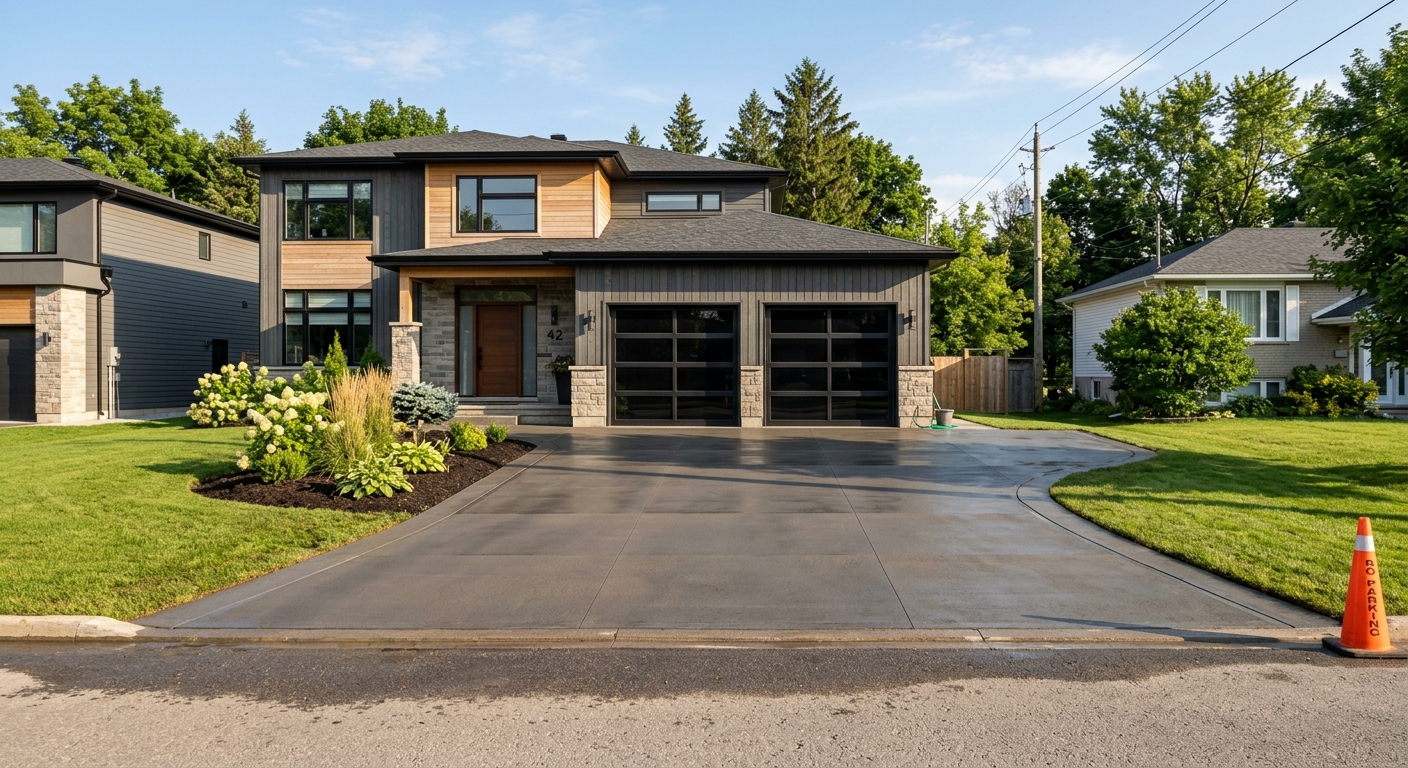
Concrete work options and costs in Pollard Meadows
Pollard Meadows, Alberta is a great community for concrete flatwork—driveways, patios, walkways and the slabs that connect homes to garages—but it’s also a place where concrete pricing reflects the reality of Calgary-area winters. With a 2021 population of 4,553 (Statistics Canada, 2021 Census), the market is big enough for healthy contractor availability, yet not so saturated that pricing is artificially low. Most homeowners here are working in an established residential fabric, and single-detached homes remain a common target for new driveways and backyard pours.
In the Calgary region, our cold continental climate means concrete is engineered around frost and freeze–thaw more than in milder provinces. The local design frost depth is about 1.2 m (roughly 4 ft), so foundation and some exterior work must be supported on undisturbed soil below that depth to reduce frost heave. Exterior slabs also need air-entrained concrete mixes and a smart joint layout to limit surface cracking and spalling over time. On top of that, our exterior pour season is shorter, so cold-weather placement often requires insulated blankets or temporary heat to protect curing—costs that show up in quotes.
Demand tends to spike in areas near active residential builds and frequent reno corridors around Pollard Meadows where homeowners want curb appeal without recurring maintenance. If you’re comparing options, the quickest way to understand value is to look at finish and scope side-by-side—starting with the table below.
| Application |
Typical Size |
Key Spec |
Finish Option |
Price Range |
| Concrete driveway (standard broom finish) |
24 ft x 10 ft (240 sq. ft.) |
Air-entrained mix, compacted granular base, saw cuts |
Broom finish |
$12,000–$18,000 |
| Exposed aggregate driveway |
24 ft x 10 ft (240 sq. ft.) |
Air-entrained mix, integrated aggregate, base + joints |
Exposed aggregate |
$14,000–$22,000 |
| Stamped concrete driveway or patio |
200 sq. ft. (e.g., 20 ft x 10 ft) |
Air-entrained mix, integral color, sealer-ready surface |
Stamp + color |
$15,000–$26,000 |
| Plain concrete patio or walkway |
120 sq. ft. (e.g., 12 ft x 10 ft) |
Air-entrained mix (exterior), compacted base |
Plain broom/trowel-light texture |
$5,000–$9,000 |
| Garage floor (interior slab) |
22 ft x 20 ft (440 sq. ft.) |
Vapour control where required, appropriate thickness, mesh |
Power trowel or light broom |
$7,500–$13,500 |
| Foundation footings (structural, below frost) |
Typical house perimeter (varies by plan) |
Below design frost depth, engineered reinforcement |
Structural concrete/typical form finish |
$28,000–$45,000 |
Prices are estimates only and vary by project scope, site access and material selection.
What affects the price of concrete work in Pollard Meadows
In Pollard Meadows, you can see the same basic concrete job priced 30–50% differently between quotes across Calgary and Alberta, and it usually isn’t “random.” It’s driven by frost engineering, the amount of excavation and granular base required, and how contractors plan for cold-weather curing. The deeper the required support (because of our frost depth and soil conditions), the more concrete volume, formwork and labour time show up in your invoice. In practice, that’s why a driveway can land anywhere within the region’s typical $12,000–$18,000 band if the base is straightforward, but climbs faster when there’s poor soil, regrading, or complicated access.
Calgary-area freeze–thaw also dictates mix specs. Exterior slabs generally need air-entrained concrete (to resist freeze-related scaling), proper curing, and deliberate control joints to limit random cracking. When temps drop, the pour season tightens—contractors may require winter-grade mixes, insulated blankets and sometimes staged pours to protect curing. De-icing salt later in the season can accelerate surface spalling if the air content and curing weren’t handled correctly, so sealing is commonly recommended.
Here are a few real examples from the Pollard Meadows market. If your driveway extension requires underpinning or additional excavation to reach competent soil, you’re paying for more haul-away, deeper forms and more compacted base. If your backyard patio sits on clay that needs significant base replacement, a “plain patio” that should fit the $5,000–$9,000 range can move upward once base depth and reinforcement are added. On the other hand, a straightforward interior garage slab with clean access often prices more predictably because there’s no frost-depth dependency and fewer weather constraints.
| Price Factor |
Why It Matters |
Cost Impact |
| Frost line depth — determines footing depth and form height |
Footings and some exterior support must bear below design frost depth to prevent heave |
Higher excavation and concrete volume; can raise structural costs significantly |
| Site preparation — excavation, grading, compacted granular base |
Correct base depth and compaction reduce settlement and help control cracking |
Unstable soil, haul-away, and grading add labour and trucking charges |
| Reinforcement — rebar or wire mesh requirement |
Helps control cracking and supports loads for driveways, patios and slabs |
Material cost plus placement labour; increases when spans or load demands are higher |
| Mix design — air-entrainment and compressive strength spec |
Air content and strength targets improve freeze–thaw durability |
Winter-grade mixes and tighter batching specs increase material costs |
| Finish type — broom vs. stamped vs. exposed aggregate |
Complexity changes labour time and material handling |
Stamped and exposed finishes typically cost more per square foot |
| Pour size and concrete truck access to site |
Access affects pumping distance, staging, and crew time |
Limited access can mean extra equipment or more mobilization charges |
| Cold-weather curing precautions — heating and blankets |
Protects the curing window to reduce scaling and surface defects |
Insulated blankets/temporary heat can add a noticeable line-item cost |
| Control joint pattern and sealing cost |
Joints control cracking; sealing helps resist de-icing salt damage |
More saw cuts, labour, and sealing materials increase total but reduce long-term issues |
Permits & regulations in Alberta
In Alberta, structural concrete work usually falls under building permit requirements and may need engineered drawings reviewed by the municipality. That includes footings, foundation walls, grade beams and other load-bearing structural elements. Concrete flatwork like patios, walkways and driveways typically does not require a permit by default, but you must check if your project changes lot grading, affects impervious surface coverage limits, or connects into municipal right-of-way concerns. When in doubt, confirm before you break ground—municipal review can affect your schedule.
Step-by-step, here’s how a homeowner in Pollard Meadows can verify a contractor properly. First, ask for their certificate of insurance and check that it covers the right type of work (general liability suitable for concrete placement). Second, verify workers’ compensation coverage (WSIB/WCB) so you’re not exposed if someone is injured on your property. Third, confirm they’re registered/licensed where required for the scope they’re doing—then ask for the insurer or registry details in writing.
For documentation, request a clear certificate of insurance that lists your address as an additional insured where available, and ask whether permits (if needed) are included in the quote. After that, request references on similar jobs (driveways, patios, and any foundation-related work) with photos of finished work and timelines. For Alberta-specific checks, you can verify contractor standing using online registry resources and review the certificate details for effective dates, coverage limits and endorsements.
Getting concrete right in Pollard Meadows's freeze-thaw climate
Concrete failure in Pollard Meadows usually comes down to one of five things: base problems, weak or improperly mixed concrete, lack of air entrainment, poor joint design, or rushed/insufficient curing. Our cold continental climate cycles—freeze, thaw, and refreeze—put extra stress on exterior surfaces. If the base isn’t prepared and compacted correctly to the right depth, slabs can settle or move, leading to cracking. If air content isn’t in the right range, water inside the concrete can expand during freeze, which causes scaling and spalling at the surface.
To spec the job correctly, focus on five items. (1) Base preparation: compacted granular sub-base to the right depth based on soil and drainage, not just “minimum thickness.” (2) Mix design: use air-entrained concrete for exterior work (targeting about 5–7% air content) and a minimum 32 MPa compressive strength for typical residential flatwork. (3) Control joints: spacing that limits random cracking—joints should be planned, not “whatever fits.” (4) Curing: protect the slab for at least 7 days under suitable conditions; in cold weather, contractors may need heating and insulated blankets to keep curing active. (5) Sealing: apply a penetrating sealer after the concrete has cured (commonly at/around 28 days) to help repel de-icing salts.
Ask direct questions to avoid the most common issue: spalling from inadequate air-entrainment. If one quote is lower by, say, $2,000–$4,000 on an exterior patio that should fall around the $5,000–$9,000 band, compare the mix spec, air content, curing method and joint pattern line-by-line. Often the “cheap” bid has shorter curing protection or a less durable mix design—those savings are usually paid back with repairs.
| Spec |
Why It Matters in Pollard Meadows |
What to Ask For |
Impact if Skipped |
| Compacted granular base (depth?) |
Reduces settlement and supports the slab through freeze–thaw |
Granular base depth based on soil and engineered frost support; confirm compaction method |
Cracking, unevenness, joint failure |
| Air-entrained concrete mix (target air %?) |
Improves freeze–thaw durability and reduces scaling/spalling risk |
Specify exterior air content around 5–7% (and confirm by batch documentation) |
Surface scaling, spalling, early deterioration |
| Compressive strength (MPa rating) |
Strength supports loads and reduces surface wear |
Minimum 32 MPa for typical exterior residential flatwork (confirm with mix design) |
Premature wear, cracking under load |
| Control joints (spacing per ACI guidelines) |
Controls where cracks form during drying and temperature swings |
Planned saw-cut timing and spacing that matches the slab dimensions |
Random cracking and water infiltration |
| Minimum 7-day curing period |
Ensures proper strength gain before harsh weather cycles |
Curing protection plan; blankets/heating in cold conditions |
Reduced strength, surface damage, curling or scaling |
| Penetrating sealer (when applied after cure) |
Helps repel de-icing chemicals and moisture |
Confirm sealer type and application timing (commonly after cure, e.g., around 28 days) |
Faster surface breakdown and staining |
How to choose a concrete work contractor in Pollard Meadows
Choosing the right concrete contractor in Pollard Meadows is less about flashy photos and more about documentation and workmanship practices. Start by verifying Alberta compliance: request proof of liability insurance (with coverage limits that make sense for your project) and confirm workers’ compensation coverage (WSIB/WCB). Ask for certificate details—effective dates, project/address coverage where applicable, and whether they list your address or home type on the policy endorsements. For licensing/registration, ask which specific scope they’re authorized to perform and check their standing through the appropriate online registry resources. Don’t accept “we’re covered” without a certificate you can review.
Next, get 2–3 itemised written quotes. You want a breakdown that separates labour, concrete supply, excavation/grading, reinforcement, finishing, disposal, and any permit-related items (if required). A quote that’s only a lump sum without specifying mix type (air-entrained) and finish method is harder to compare fairly. Read the exclusions too: Who is responsible for regrading? Is snow removal or winter protection included if the pour happens near cold weather? Is permit pulling included when structural permits are required?
For warranty, ask for both workmanship warranty length and manufacturer/product warranty terms. Clarify whether warranties are transferable if you sell the home. On payment, never put most of your money upfront—aim for a deposit around 10–15%, and hold back the remainder until completion and final walkthrough. Finally, insist on a written start date and a realistic completion estimate based on curing and weather window planning.
- Ask for air-entrained exterior mix confirmation (and target air content).
- Require joint layout details: where saw cuts happen and timing.
- Confirm base compaction method and granular base depth for your soil.
- Check they have liability insurance and WSIB/WCB coverage before signing.
- Get itemised pricing for excavation, forms, reinforcement and disposal.
- Verify whether heating/blankets are included for cold-weather curing.
- Ask who supplies and installs reinforcement (rebar/wire mesh) and how it’s placed (on chairs/spacers).
- Request photos of similar Pollard Meadows projects, not just generic gallery shots.
- Clarify curing and sealing schedule—especially sealer timing after full cure.
- Confirm warranty terms in writing, including workmanship coverage duration.
- Review the timeline including curing protection and access restrictions after pour.
- Make sure the scope states what’s excluded (repairs to adjacent surfaces, regrading, etc.).
Concrete red flags I see in Pollard Meadows include: a quote that avoids specifying air-entrainment and curing protection, contractors who can’t show insurance/WSIB/WCB documents, vague “we’ll figure it out” joint placement plans, and bids that are substantially cheaper while omitting base depth, reinforcement, or cold-weather measures.
Frequently asked questions — concrete work in Pollard Meadows
What is rebar and when is it required in Alberta?
Rebar (reinforcing steel) is steel bars placed inside concrete to improve its ability to handle tension and control cracking—especially in slabs and structural work. In Alberta, whether you need rebar depends on the engineered design and the load demands. For structural concrete like foundation footings, foundation walls and grade beams, reinforcement is commonly required and is typically specified by engineers and supported by building permit approvals where applicable. For exterior flatwork such as driveways and some patios in Pollard Meadows, reinforcement (rebar or welded wire mesh) is often used when loads, slab thickness, or slab size increase the risk of cracking. If your contractor can’t show the slab thickness, reinforcement plan and (for structural work) the engineered specs, that’s a major comparison problem. For pricing context, foundations/footings commonly land around $28,000–$45,000, and the reinforcement details are part of why.
How long does a concrete project take in Pollard Meadows?
Typical timelines in Pollard Meadows depend on scope and weather. For a standard driveway or patio, the on-site concrete work often takes only 1–3 days (excavation/prep, forming, pour, and initial finishing), but scheduling must include curing protection. Concrete should be kept in proper curing conditions; in colder periods, contractors may need insulated blankets or temporary heat, which adds time before normal use. A garage interior slab can usually proceed faster because it’s less exposed to freeze–thaw stress during curing, but surface finishing and curing still matter. Stamped work can also take longer due to formwork, timing between stages, and careful finishing to maintain crisp edges. Plan for a “whole project” window rather than a single-day pour—site access and truck coordination can stretch things, and concrete needs time before it’s loaded. If you’re comparing bids in the $12,000–$18,000 driveway range, ask how they protect curing and how long until you can drive or store materials on the slab.
What is a concrete overlay and is it suited to Pollard Meadows?
A concrete overlay is a new concrete layer placed on top of an existing slab to restore appearance and improve surface performance without fully removing the original. In Pollard Meadows (and across Calgary’s freeze–thaw climate), overlays can be suited to the right situation—typically when the existing slab is structurally sound with limited settlement, and the surface is properly prepared. The key risks in our climate are that moisture and movement can travel through cracks in the original slab, and de-icing salts can accelerate deterioration if the overlay isn’t properly sealed or if bond is poor. A proper overlay requires surface profiling/prep, careful patching of spalls and cracks, correct bonding details, and a mix designed for exterior durability. Overlays can be a cost-saving option versus complete replacement, but they’re not a solution for slabs with significant base failure or widespread structural cracking. In quotes, insist they explain surface prep, thickness, reinforcement (if any), and sealing. For homeowners comparing pricing, overlays won’t typically match a basic patio budget of $5,000–$9,000 unless scope is very limited.
How do I seal concrete to protect it in Pollard Meadows?
Sealing is one of the best practical defences in Alberta against moisture and de-icing salt damage. In Pollard Meadows, the goal is to repel water and resist chemical attack that can contribute to spalling over time—especially after freeze–thaw cycles. The most common approach is a penetrating sealer applied after the concrete has cured, commonly around 28 days post-pour. Don’t seal too early: if the slab is still releasing moisture, sealer can trap water and reduce performance. Before sealing, the surface needs to be clean, dry, and free of dust or construction residue. After application, follow the manufacturer’s cure and recoat instructions and avoid heavy traffic or washing too soon. Ask your contractor what product they use and whether it’s intended for exterior, de-icing salt exposure. If you selected a finish like stamped concrete in the $15,000–$26,000 range, sealing is especially important for keeping colour and reducing surface wear.
What is the difference between concrete and cement?
Concrete and cement are related, but they’re not the same. Cement is one ingredient—typically Portland cement—that acts as the binder in the mix. Concrete is the final engineered material made by combining cement with water, sand, gravel (or crushed stone), and sometimes additives like air-entrainment or plasticizers. In Pollard Meadows’ climate, what matters for performance is the full concrete mix design, not just the “cement” part. For exterior flatwork, air-entrainment helps resist freeze–thaw damage by improving how water and freezing expansion are managed inside the hardened concrete. Contractors in Calgary also specify compressive strength targets (commonly a minimum 32 MPa for many residential exterior flatwork applications) and the curing plan, because curing conditions strongly affect final strength and durability. When reviewing quotes, look for wording that specifies the concrete mix (air-entrained, strength target, and cold-weather handling), not just “concrete with cement.” That’s also why two driveway bids can differ even when the finish looks similar.
How much does concrete work cost in Pollard Meadows?
Concrete costs in Pollard Meadows generally align with Calgary-area pricing bands, but your final total depends heavily on excavation, base prep, reinforcement, finish complexity, and whether cold-weather curing measures are required. For a typical residential concrete driveway or slab, many projects land in the $12,000–$18,000 range, assuming reasonable site access and properly engineered granular base support. Plain patios and walkways commonly fall around $5,000–$9,000 depending on square footage and site prep. If you’re doing stamped or decorative concrete, the budget is usually higher—often $15,000–$26,000 for driveway or patio-style projects with integral colour and stamp labour. Foundations and structural footings tend to be the most expensive and can sit around $28,000–$45,000 depending on plan size and engineered reinforcement. If you want the most accurate number, ask for an itemised quote that shows base depth, mix spec, air-entrainment, reinforcement, joints, and curing protection.