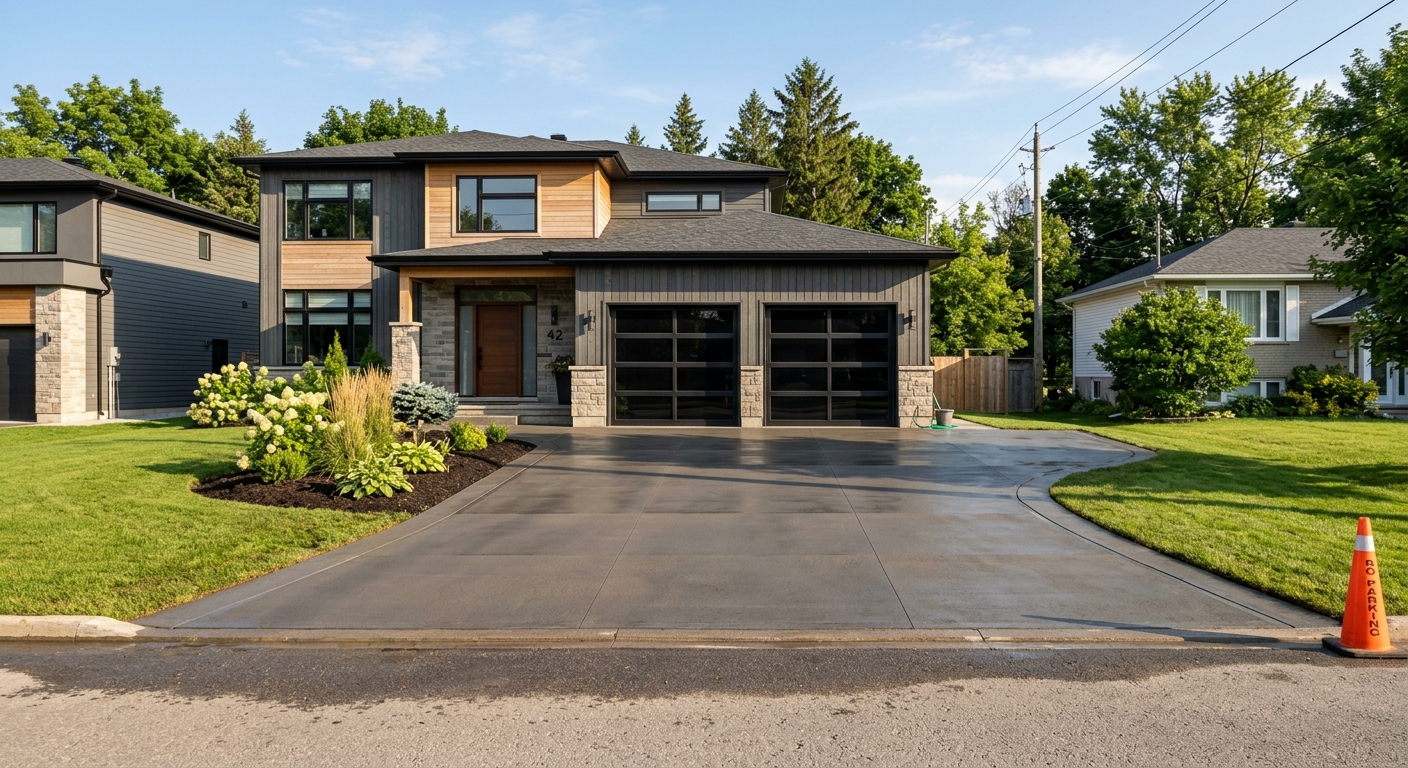
Concrete work options and costs in Haysboro
Haysboro, Alberta is a neighbourhood where concrete flatwork gets a real workout every winter. With a population of 6,960 (Statistics Canada, 2021 Census), the local market is dominated by typical Calgary-area suburban homes, which means homeowners regularly update driveways, patios, walkways and garage floors rather than changing larger structural elements. If your property is in the older pockets of Haysboro, or you’ve got a driveway that’s been through several seasons of snow-ploughing and de-icing, you’ll often be weighing replacement sooner than you expect.
In Calgary’s cold continental climate, pricing is shaped by frost depth and freeze–thaw cycling more than in milder provinces. The region uses a design frost depth of about 1.2 m (roughly 4 ft), so foundation and frost-protected elements must bear on undisturbed soil below that level. On exterior slabs like driveways and patios, contractors also rely on air-entrained mixes, a properly compacted granular base, and well-spaced control joints to reduce cracking and surface scaling. There’s also a shorter practical pour season for exterior work, and late-fall or early-spring placements may require winter-grade mixes and curing protection (insulated blankets and sometimes temporary heat) to prevent scaling and weak surface strength.
Demand is especially steady around the residential corridors connecting to 85 Street S.E. and the nearby arterial routes, where turnover and renovations drive new driveway and patio installs. Use the table below as a starting point for comparing common options before you request itemised quotes.
| Application |
Typical Size |
Key Spec |
Finish Option |
Price Range |
| Concrete driveway (standard broom finish) |
20 ft x 10 ft (200 sq. ft.) |
Air-entrained concrete, compacted granular base, control joints |
Broom finish, light saw cuts |
$12,000–$18,000 |
| Exposed aggregate driveway |
20 ft x 10 ft (200 sq. ft.) |
Air-entrained mix, base prep and curing control |
Exposed aggregate with sealer |
$15,000–$21,000 |
| Stamped concrete driveway or patio |
15 ft x 12 ft (180 sq. ft.) |
Air-entrained concrete, integral color, proper curing |
Stamp pattern and color |
$15,000–$26,000 |
| Plain concrete patio or walkway |
12 ft x 10 ft (120 sq. ft.) |
Air-entrained concrete, compacted base, joints |
Broom or smooth finish |
$5,000–$9,000 |
| Garage floor (interior slab) |
22 ft x 20 ft (440 sq. ft.) |
4 in. slab typically, reinforcement as specified |
Broom finish or troweled finish |
$9,500–$15,500 |
| Foundation footings (structural, below frost) |
Typical single-detached footing system |
Engineered footings below frost depth, reinforcement and inspection |
Structural (not decorative) |
$28,000–$45,000 |
Prices are estimates only and vary by project scope, site access and material selection.
What affects the price of concrete work in Haysboro
In Haysboro and the broader Calgary region, you can see the same basic “replace a slab” project priced 30–50% differently between contractors because the quote is really a bundle of site prep, specs, and risk management. A low number often assumes easier access, minimal excavation, standard reinforcement, and average curing conditions. A higher number typically includes deeper excavation to meet frost requirements, more base thickness and compaction, stronger mix specs, and the cold-weather steps needed to keep concrete strong through Calgary’s freeze–thaw cycles.
Frost depth is the biggest driver. In Alberta, footings and frost-critical elements must extend below the design frost depth (commonly about 1.2 m for local planning), otherwise seasonal movement can damage foundations and raise slab edges. For exterior flatwork—driveways, patios, and walkways—freezing and thawing also demand air-entrained concrete mixes so the paste can survive repeated expansion and contraction. Because Calgary’s exterior pour season is shorter, contractors may need winter-grade placement procedures and additional curing precautions like insulating blankets and controlled heating, especially when temperatures dip. If de-icing salts hit a poorly sealed surface, you can get accelerated spalling and surface breakdown, which later turns a “good enough” job into a costly redo—often pushing a driveway from the $12,000–$18,000 band into the reality of replacement-level work.
Two common Haysboro examples: (1) a driveway that requires hauling and regrading due to soft subgrade can add excavation, disposal, and granular base costs quickly; (2) a stamped or exposed-aggregate option can raise material and labour time, but it’s justified when you’re also budgeting for correct curing and sealing, not just the stamp texture. For homeowners comparing options, a basic broom-finish replacement in the $12,000–$18,000 range is often the best value when the goal is long service life—while stamped concrete in the $15,000–$26,000 range becomes smart when you want durability plus curb appeal and are willing to pay for the extra finishing and quality control.
| Price Factor |
Why It Matters |
Cost Impact |
| Frost line depth |
Determines footing depth and form height to prevent frost heave |
Higher excavation and concrete volume; major swing for foundations |
| Site preparation |
Excavation, grading, and compacted granular base control settlement |
Can add significant cost on soft soils or uneven lots |
| Reinforcement |
Rebar or mesh helps control cracking and supports loading |
Material + labour increases; required more often on driveways |
| Mix design |
Air-entrainment and strength spec for freeze–thaw resistance |
Winter-grade or higher-spec mix can raise per-yard costs |
| Finish type |
Broom vs. stamped vs. exposed aggregate affects labour and materials |
Stamped/exposed adds finishing time, tools, and sealing |
| Pour size and concrete truck access to site |
Smaller pours may cost more per sq. ft.; access affects truck placement |
Truck scheduling, pumping, or long carry distance increases labour |
| Cold-weather curing precautions |
Heating/insulation protects strength gain and reduces scaling risk |
Blankets/heaters add direct costs and scheduling complexity |
| Control joint pattern and sealing cost |
Joints manage cracking; sealing helps resist salt and water intrusion |
Skipping or underdoing increases failure risk and future repairs |
Permits & regulations in Alberta
In Alberta, structural concrete work generally needs municipal oversight. That means if you’re building or altering structural elements like foundation footings, foundation walls, grade beams, or other load-bearing concrete, you should expect a building permit and, in many cases, engineered drawings that the municipality reviews as part of the permit process. For concrete flatwork—patios, walkways, and typical residential driveways—permits are usually not required unless the work affects lot grading, drainage, impervious surface coverage limits, or involves municipal right-of-way considerations. Because rules can vary by location and by how the project ties into drainage, curb cuts, or property servicing, it’s smart to confirm with your local authority before demolition or forms go in.
For contractor accountability in Haysboro (and anywhere in Alberta), don’t rely on a verbal statement. Step-by-step: (1) ask for their Alberta licence or trade registration details if applicable and verify through the appropriate online registry; (2) request a current Certificate of Insurance and confirm it includes general liability coverage for the project scope; (3) ask for WSIB/WCB clearance or proof of coverage status—then check that it matches the contractor’s legal name; and (4) call references on similar-scale jobs (for example, a driveway replacement with winter curing procedures, or footing work for a similar footing footprint). This is the fastest way to avoid surprises and protect your investment.
Getting concrete right in Haysboro's freeze-thaw climate
Concrete problems in Haysboro usually start before the pour is even finished. The most common failure we see locally is spalling and scaling—surface damage that comes from freeze–thaw movement, water entry, and de-icing salt exposure. If the base isn’t built to the right depth and compacted properly, the slab can settle slightly; water then sits in micro-cracks, expands when temperatures drop, and starts breaking the surface. If the mix isn’t air-entrained for Alberta conditions, the concrete’s freeze–thaw durability can be compromised even if it looks fine in summer.
To spec the job correctly, focus on five fundamentals. (1) Base prep: compacted granular sub-base to meet local design requirements and frost considerations, so the slab bears on stable material. (2) Mix design: an air-entrained mix for exterior flatwork (target air content commonly in the 5–7% range) and a minimum 32 MPa compressive strength unless engineered otherwise. (3) Control joints: install and space them to limit random cracking in driveways, patios, and walkways. (4) Curing: plan for proper curing conditions; in cold weather, the minimum cure period must be protected—heating and insulated blankets are often the difference between durable strength and weak surface scaling. (5) Sealing: apply a penetrating sealer after the concrete is fully cured (typically 28 days) to repel salt and reduce water uptake.
Here’s a practical dollar example: if you’re deciding between a basic broom-finish driveway and stamped concrete, the stamped option may sit in the $15,000–$26,000 band. That extra cost can be justified only if the contractor also nails base prep, joints, air-entrainment, and curing. If the mix and curing are weak, paying more for a stamp doesn’t prevent spalling—so the “best-looking” driveway is still the one at risk.
| Spec |
Why It Matters in Haysboro |
What to Ask For |
Impact if Skipped |
| Compacted granular base (depth?) |
Stable support prevents settlement and water pooling through freeze–thaw |
Granular base thickness to match design + proof of compaction |
Cracks, edge heaving, and accelerated surface breakdown |
| Air-entrained concrete mix (target air %?) |
Durability against repeated freezing and thawing |
5–7% air for exterior flatwork (as applicable) documented on spec |
Higher risk of spalling and scaling in winter |
| Compressive strength (MPa rating) |
Strength gain supports long-term durability and resistance to abrasion |
Minimum 32 MPa unless engineered otherwise |
Weak surface and faster deterioration under snow removal and loads |
| Control joints (spacing per ACI guidelines) |
Limits random cracking so joints become the “planned” failure line |
Joint spacing schedule and saw-cut timing |
Random cracking and wider gaps that let water in |
| Minimum 7-day curing period |
Proper strength development is critical during Calgary’s temperature swings |
Protected curing plan; cold-weather procedures if needed |
Scaling risk increases, surface may crumble even if it looks cured |
| Penetrating sealer (when applied after cure) |
Reduces water and salt penetration through freeze–thaw cycles |
Penetrating sealer after cure (commonly around 28 days) and surface prep steps |
Faster salt-driven spalling and less long-term performance |
How to choose a concrete work contractor in Haysboro
Start by verifying Alberta coverage and responsibility. For licensing, ask for the contractor’s applicable Alberta registration details and confirm they’re valid through the relevant online registry. Next, request a Certificate of Insurance and make sure the policy covers the type of work you’re hiring them for (flatwork, excavation, structural concrete, etc.). Then ask for WSIB/WCB proof and clearance (where applicable): the cleaner the paper trail, the fewer delays you’ll face if an incident occurs on site. Finally, look at experience specifically tied to Calgary’s winter reality—contractors who consistently place exterior concrete with cold-weather procedures are usually better priced in the long run, not because they cut corners, but because they plan curing properly.
Get 2–3 itemised written quotes. You want line items that separate excavation/grading, granular base, reinforcement, concrete supply, finishing, curing protection, and sealing (if included). Avoid comparing quotes that are only a lump sum without specifying mix strength, air entrainment, and joint plan. Read scope exclusions too: is permit work included (when required), is disposal included, and who manages haul time and trucking access? A solid workmanship warranty matters—ask for the warranty length, what it covers (usually defects in workmanship, not misuse), and whether the warranty can be transferred if you sell the home.
Payment schedule: don’t agree to more than about 10–15% upfront. Hold back funds until you confirm forms, finishing, and cure protection were completed as specified. Timeline should be in writing with a start date and completion estimate, and it should reference weather constraints typical to Haysboro.
- Ask for documented mix strength and air-entrainment targets for exterior pours.
- Confirm control joint spacing and the saw-cut timing plan.
- Require a compaction method for granular base (proof or documentation).
- Verify insurance limits and that the certificate lists the correct project address.
- Request WSIB/WCB clearance/proof and check the contractor’s legal name matches.
- Get excavation and disposal details in writing (what’s included, what’s extra).
- Ensure truck access and pump/placement method is addressed for your lot.
- Ask whether winter-grade procedures will be used if temperatures drop.
- Confirm sealing is included (and whether it’s applied after proper cure time).
- Use itemised pricing for labour vs materials (avoid “mystery” line items).
- Clarify warranty term, what’s covered, and any exclusions tied to de-icing practices.
- Require the payment schedule and holdback terms in the contract.
Red flags in Haysboro: contractors who won’t discuss air entrainment or joints, quotes that don’t mention curing protection in cold weather, lack of WSIB/WCB clearance or an insurance certificate that doesn’t match the contractor’s name, “lowball” pricing that assumes minimal excavation or base thickness, and refusal to provide itemised scope (especially on demo, haul-off, and sealing).
Frequently asked questions — concrete work in Haysboro
How do I maintain concrete in Haysboro's freeze-thaw climate?
In Haysboro and across Alberta, maintenance is mostly about keeping water and salt from getting into the concrete’s surface. First, use a penetrating sealer applied after the concrete has cured (often around 28 days) and reapply per the manufacturer’s schedule. During winter, avoid aggressive scraping that can chip the surface and choose de-icing products thoughtfully—some salts are harsher than others. Sweep regularly to remove grit that abrades the surface under tire traffic. For driveways and walkways, check the edges and joints each spring; if joints are opening or failing, plan joint maintenance early rather than waiting for water to wedge into cracks. Well-constructed driveways in Calgary are durable, but freeze–thaw punishes neglected seams.
What causes concrete to spall in Haysboro winters?
Concrete spalls when the surface loses its ability to resist freeze–thaw pressure and when water plus de-icing salts get into the slab. The biggest technical reasons are inadequate air entrainment, poor base preparation that allows settlement and water pooling, and rushing curing so the surface doesn’t develop adequate strength. Calgary’s winter cycles are hard on exterior flatwork, and in Haysboro the combination of meltwater and salt accelerates scaling. If your driveway was built around a “cheap mix” or without control joints, cracks can develop and become pathways for water. That’s why durable exterior concrete may land in the $12,000–$18,000 range for standard replacement, while cheaper approaches can lead to earlier repairs—or full replacement—within a few seasons.
What is rebar and when is it required in Alberta?
Rebar is steel reinforcement embedded in concrete to help control cracking and improve load capacity, especially where the slab experiences bending or tensile stress. In Alberta, whether rebar is required depends on the structure and design—engineered foundation footings typically include reinforcement as specified by drawings, because frost movement and soil conditions demand structural capacity. For typical interior slabs like garage floors, reinforcement may be specified based on thickness, soil conditions, and use loads. For exterior slabs such as driveways and some patios, many projects use either rebar or welded wire mesh depending on slab thickness, design loads, and contractor/engineer approach. The key is that reinforcement decisions should be documented in your quote and based on the engineering or applicable design standard, not guesswork.
How long does a concrete project take in Haysboro?
For most residential concrete projects in Haysboro, the timeline has two parts: preparation and cure/protection. Demo and excavation can take a day or more depending on access and how much material needs hauling. Base preparation and reinforcement are often another 1–3 days. The actual pour and finishing usually happens in a single day, but it’s followed by curing requirements. Standard finishing work is generally done immediately after the pour, yet cold-weather protection may extend the “don’t disturb” window. In warm stretches, curing and rebound to usable strength can be quicker, but in Calgary’s colder periods, winter-grade procedures and insulated blankets may be needed. As an example, a driveway in the $12,000–$18,000 band might take about a week end-to-end for a typical residential replacement, including preparation, pour day, and curing time before normal use.
What is a concrete overlay and is it suited to Haysboro?
A concrete overlay is an additional layer of cementitious material placed over an existing slab, typically to improve appearance or level minor surface defects without full demolition. In Haysboro, overlays can be suitable when the original slab is structurally sound—meaning it isn’t significantly cracked through, lifted, or failing at joints. If the existing concrete has major settlement, widespread deterioration, or active moisture pathways, an overlay can trap problems underneath and accelerate failure. Overlays can also limit the ability to correct drainage slopes, which matters in freeze–thaw cycles. If your driveway has surface scaling but the slab is solid, an overlay may be a cost-effective option. However, if you’re seeing spalling or movement, replacement is usually the more durable path and aligns better with local exterior concrete durability expectations.
How do I seal concrete to protect it in Haysboro?
Sealing is one of the most effective steps you can take in Haysboro to slow salt-driven surface damage, but timing matters. Wait until the concrete is fully cured—commonly around 28 days—before applying a penetrating sealer. The surface must be clean and dry, and any existing contaminants (oil, dust, sealers that interfere with adhesion) should be removed using the right cleaning method. Penetrating sealers work by reducing how much water and salt can absorb into the concrete. For driveways and patios, sealing typically goes a long way when combined with correct joints and air-entrained concrete—sealer alone can’t fix a weak mix. If your contractor quotes sealing as part of a driveway project in the $12,000–$18,000 or stamped $15,000–$26,000 ranges, confirm the product type, application timing, and whether surface prep is included.