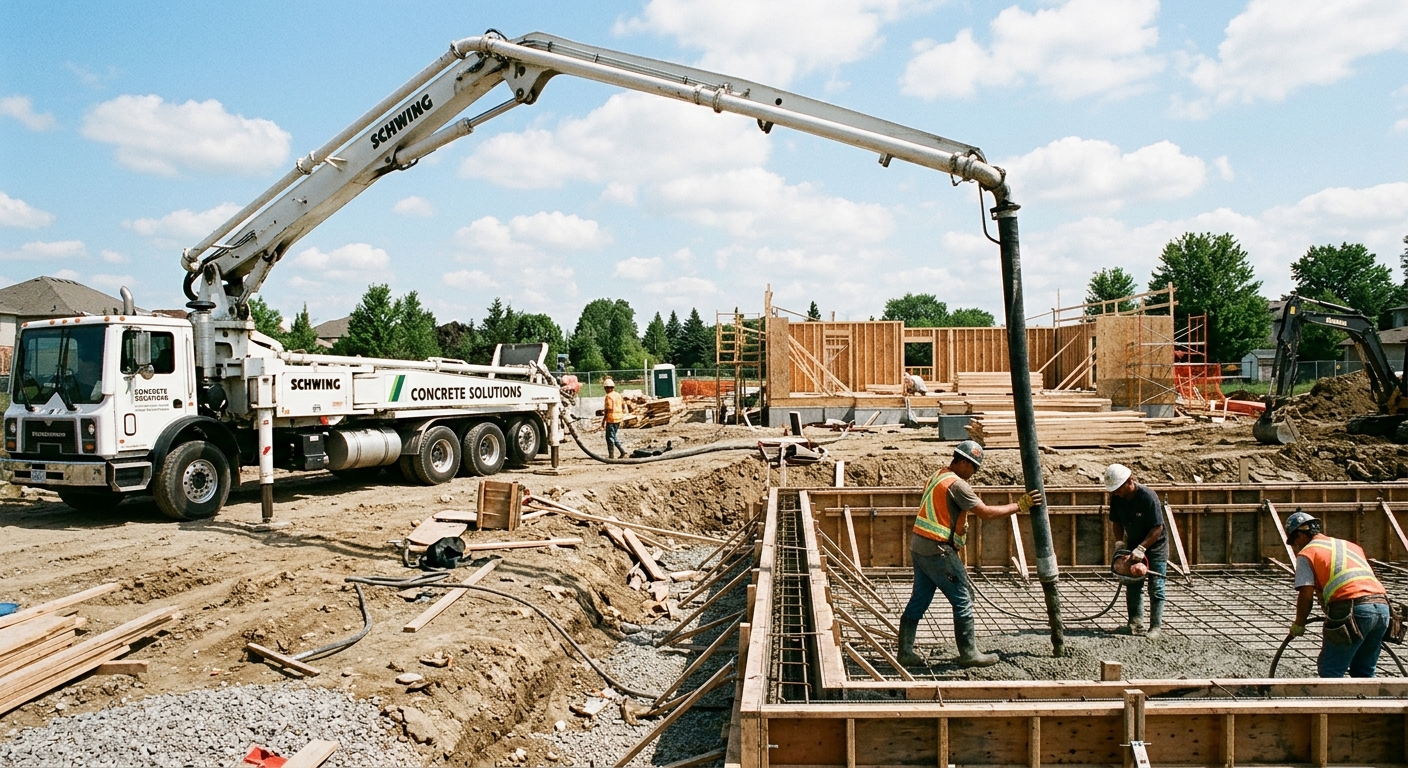
Concrete work options and costs in Callingwood North
Concrete work in Callingwood North is driven as much by Calgary’s freeze–thaw winters as it is by homeowner preferences. In a neighbourhood of about 2,376 people (Statistics Canada, 2021 Census), most concrete demand is tied to single-family living—especially driveways, patios, walkways, and garage slabs that get heavy seasonal loading from snow clearing and de-icing. Because the economic region is Calgary, you’ll also see more competition for concrete crews than in smaller towns, but winter scheduling can still tighten availability and affect pricing.
In cold continental Alberta conditions, local engineering practice designs footings around a frost depth of roughly 1.2 m (about 4 ft) and often goes deeper based on soil and foundation type. That means foundation and footing scope isn’t “just digging”—it’s more excavation, more granular base, more rebar, and more formwork height, so foundation quotes commonly land higher than in milder provinces. Exterior flatwork is also engineered for survival: air-entrained mixes, proper base prep, and control joints are non-negotiable if you want fewer issues like scaling and spalling. Calgary’s shorter pour season adds another cost lever—if cold weather placement requires winter-grade curing blankets or temporary heat, the crew must plan and protect the pour for proper strength gain.
Demand is especially strong around family-oriented pockets such as the callingwood-area lanes near shopping and schools where homeowners keep expanding or renewing driveways and backyard walkways. With that in mind, here’s a realistic comparison of typical options and price bands you can expect in Callingwood North, Edmonton-area style not required—this is Calgary-market pricing and cold-weather execution.
| Application |
Typical Size |
Key Spec |
Finish Option |
Price Range |
| Concrete driveway (standard broom finish) |
24 ft x 12 ft (288 sq ft) |
Air-entrained exterior mix; compacted granular base; control joints |
Broom finish |
$12,000–$18,000 |
| Exposed aggregate driveway |
24 ft x 12 ft (288 sq ft) |
Air-entrained exterior mix; two-step aggregate exposure; cured and sealed |
Exposed aggregate |
$14,500–$21,500 |
| Stamped concrete driveway or patio |
18 ft x 12 ft (216 sq ft) |
Colour hardener; air-entrained mix; stamped texture; sealing |
Stamped & coloured |
$15,000–$26,000 |
| Plain concrete patio or walkway |
16 ft x 8 ft (128 sq ft) |
Air-entrained exterior mix; compacted base; slope to drain |
Plain (light broom) |
$5,000–$9,000 |
| Garage floor (interior slab) |
20 ft x 22 ft (440 sq ft) |
Vapour barrier; fibre or mesh; proper curing and joints |
Float finish |
$9,500–$15,500 |
| Foundation footings (structural, below frost) |
Typical single-detached: 1,000–1,600 sq ft footprint |
Excavate below design frost; rebar; formwork; engineered dimensions |
Structural concrete |
$28,000–$45,000 |
Prices are estimates only and vary by project scope, site access and material selection.
What affects the price of concrete work in Callingwood North
In Callingwood North and across Calgary, quotes for the “same” concrete project can vary by 30–50% because the real scope isn’t the visible slab—it’s everything that happens underneath and around it. Two contractors can price a driveway using the same broom finish, yet one includes deeper frost-suitable excavation, a properly compacted granular base, correct air-entrainment, and joint layout, while the other trims those line items to reach a lower number.
Frost depth and freeze–thaw cycles dictate specs in Alberta: footings and structural foundations must extend below the design frost depth (about 1.2 m in Calgary-area engineering practice, sometimes deeper depending on soil and foundation details) to prevent frost heave. Exterior slabs—driveways, patios, and walkways—need air-entrained concrete mixes to survive repeated wetting and freezing. Calgary also has a shorter practical pour season, so cold-weather placement can require winter-grade curing measures: insulated blankets, timing changes, and sometimes temporary heat to keep concrete strength development on track. Finally, de-icing salts accelerate surface scaling and spalling, so sealing is often recommended after the cure window.
Here are a few concrete examples where local conditions raise or lower cost in Callingwood North. If your driveway ties into an older entrance with poor drainage, expect more base removal and regrading—often pushing the project toward the higher end of driveway pricing (for many projects that’s within the $12,000–$18,000 band). A stamped driveway can look “just decorative,” but it requires extra labour for colour, stamping, and finishing, so it commonly moves into the $15,000–$26,000 range. If your site is flat with easy truck access, you may stay closer to the lower ranges because mobilization and excavation are simpler. If the job happens late fall, winter curing measures can add cost even when the slab area stays the same—because protecting the pour is part of the engineering outcome.
| Price Factor |
Why It Matters |
Cost Impact |
| Frost line depth — determines footing depth and form height |
Deeper excavation/formwork increases concrete volume and labour. |
Major: can change foundation/footings pricing by thousands. |
| Site preparation — excavation, grading, compacted granular base |
Proper base prevents settlement and reduces cracking risk. |
Major: poor access or extra removal adds cost quickly. |
| Reinforcement — rebar or wire mesh requirement |
Distribution and structural capacity depend on reinforcement choice. |
Moderate: mesh vs rebar and placement depth affect price. |
| Mix design — air-entrainment and compressive strength spec |
Air entrainment and strength control durability through freeze–thaw. |
Moderate: winter-grade and higher specs add material cost. |
| Finish type — broom vs. stamped vs. exposed aggregate |
Labour-intensive finishing increases crew time and material handling. |
Moderate to major: stamped/exposed often shifts to higher bands. |
| Pour size and concrete truck access to site |
Long wheelbase carries add labour; limited access may require extra equipment. |
Moderate: access constraints can raise total labour and mobilization. |
| Cold-weather curing precautions — heating and blankets |
Ensures strength gain and reduces scaling/spalling risk. |
Moderate to major in late-season work. |
| Control joint pattern and sealing cost |
Joints manage shrinkage cracking; sealing repels de-icing salt attack. |
Minor to moderate: critical for long-term durability. |
Permits & regulations in Alberta
In Alberta, the permit picture depends on whether you’re doing structural concrete or simple flatwork. Structural concrete work—footings, foundation walls, grade beams, and any element that supports the building—typically requires a building permit, and municipalities often expect engineered drawings or design confirmation for part of the structural scope. For Callingwood North homeowners, that usually means you’ll be coordinating permit steps with your builder or designer before any excavation starts, especially for new foundations or major structural modifications.
Concrete flatwork (patios, walkways, driveways, and garage slabs) usually does not require a permit when it’s limited to the surface and stays within typical grading and lot coverage expectations. However, you should still confirm if your plan affects lot grading, changes stormwater flow, increases impervious surface coverage near limits, or touches municipal right-of-way or boulevard areas. When in doubt, ask before you break ground—rework in winter is expensive and delays curing.
Step-by-step, here’s how you verify contractor readiness in Callingwood North:
- Check the contractor’s Alberta licence/registration status through the appropriate provincial online tools (use the business name and legal entity).
- Request a certificate of liability insurance showing adequate coverage; confirm it lists your address/project as applicable or provides project coverage language.
- Ask for WSIB/WCB clearance or coverage documentation appropriate to the work and trades the contractor employs.
- Get references on similar foundation or slab projects in the Calgary area (cold-weather scheduling matters).
- Confirm who pulls permits (if required) and whether it’s included in the written quote scope.
Getting concrete right in Callingwood North's freeze-thaw climate
Concrete failure in Callingwood North is usually predictable: water gets in, temperatures cycle through freezing and thawing, and the surface or subgrade loses its ability to resist expansion. The big culprits are inadequate base compaction, incorrect mix design (especially missing air entrainment), poor joint planning, and rushing curing in cold weather. To spec the job correctly in Calgary-area practice, you need a layered approach. First, base preparation: build a compacted granular sub-base to the right depth for your soil conditions and frost requirements, and ensure correct slope/drainage so water doesn’t pond under the slab. Second, mix design: exterior flatwork should use air-entrained concrete with target air content generally in the 5% to 7% range, and a minimum compressive strength specification of 32 MPa for typical residential exterior durability requirements.
Third, control joints: plan them to limit random cracking and guide where shrinkage cracks will form. Fourth, curing: aim for at least 7 days of proper curing conditions, and in cold weather use insulated blankets or temporary heat so strength gain continues. Fifth, sealing: apply a penetrating sealer after the concrete has fully cured (often around 28 days) to help repel de-icing salts and reduce surface deterioration.
When homeowners choose between options, it can be justified—or not. For example, upgrading from a broom-finish driveway to stamped concrete may add several thousand dollars, often pushing projects toward the $15,000–$26,000 stamped range depending on area and features. That difference is worth it for appearance and long-term surface protection when the contractor still follows the same freeze–thaw durability specs (air entrainment, base, joints, curing). The cheaper-looking win is usually false economy if the contractor cuts the base or skips the correct mix—those shortcuts show up later as scaling and spalling.
| Spec |
Why It Matters in Callingwood North |
What to Ask For |
Impact if Skipped |
| Compacted granular base (depth?) |
Supports the slab and reduces movement during freeze–thaw cycles. |
Confirm base depth and compaction requirements for your soil and frost design. |
Settlement and cracking; faster deterioration of slab edges. |
| Air-entrained concrete mix (target air %?) |
Helps concrete resist scaling from repeated freezing and thawing. |
Ask for target air content typically 5%–7% for exterior flatwork. |
Higher risk of spalling/scaling, especially with de-icing salts. |
| Compressive strength (MPa rating) |
Strength gain supports long-term durability under loading. |
Confirm minimum 32 MPa (or higher if engineered). |
Surface weakness; increased cracking and abrasion damage. |
| Control joints (spacing per ACI guidelines) |
Manages shrinkage cracks so they don’t become random breaks. |
Request joint spacing and sawcut timing plan. |
Random cracking; more frequent repairs and water intrusion. |
| Minimum 7-day curing period |
Durability depends on proper early strength development in cold weather. |
Ask how they cure during late fall/early spring (blankets/heat if needed). |
Scaling, weaker surface, and premature wear. |
| Penetrating sealer (when applied after cure) |
Reduces salt and moisture attack during long winters. |
Confirm sealer type and timing—typically after cure, around 28 days. |
Faster surface breakdown and more frequent maintenance. |
How to choose a concrete work contractor in Callingwood North
Choosing the right concrete contractor in Callingwood North comes down to verification and scope clarity—because in Calgary’s freeze–thaw climate, “we pour concrete” is not a complete scope. Start by verifying Alberta credentials and coverage. Ask for the contractor’s Alberta licence/registration information, then confirm liability insurance limits on their certificate of insurance. For labour protection and compliance, request WSIB/WCB clearance or documentation that aligns with the company’s staffing and subcontractors. A legitimate contractor won’t hesitate to provide this paperwork before you sign.
Next, get 2–3 itemised written quotes. The best quotes break down labour and materials (excavation/grading, granular base, reinforcement, concrete mix type, finishing, joints, sawcutting, sealing), and they identify what’s included in disposal, forms, and cold-weather protection. Read exclusions carefully: Is permit pulling included if required? Is rebar included for your engineered foundation scope? Does the price include concrete access equipment or extra time for limited truck reach?
Warranty should be clear and specific. Ask for workmanship warranty length, whether there’s a product/manufacturer warranty for any specialty items, and if it’s transferable when you sell your home. For payment, don’t frontload the full job—never pay more than about 10–15% upfront and hold back a portion until completion and cleanup. Finally, ask for a start date and completion estimate in writing, especially if you’re near the cold-weather pour window.
- Request proof of Alberta licence/registration and confirm the legal company name matches the quote.
- Verify liability insurance certificate and coverage limits match the project size.
- Ask for WSIB/WCB coverage documentation or clearance letter.
- Get itemised quotes (materials + labour) rather than a single lump sum.
- Confirm whether frost-depth excavation and engineered footing depth are included.
- Ask for the air-entrainment specification for exterior concrete.
- Confirm reinforcement details: mesh/rebar type and placement location.
- Ask how control joints will be spaced and when they’ll be sawcut.
- Require a curing plan for cold weather (blankets/heat if needed).
- Ask whether sealing is included and the timing after the pour (often around 28 days).
- Clarify disposal, hauling, and any waste management charges.
- Use a payment schedule with holdback until final inspection and finish acceptance.
Concrete red flags I commonly see in Callingwood North include: missing or vague joint/sawcut timelines, quotes that don’t mention air-entrainment for exterior work, “bottom-of-the-truck” mix choices without specs, promises to pour in cold weather without blankets or heat, and vague warranties that only cover “materials” but not workmanship.
Frequently asked questions — concrete work in Callingwood North
Why does concrete crack in Callingwood North and how is it prevented?
Concrete cracks are common in Calgary-area freeze–thaw conditions, and in Callingwood North the cause is usually shrinkage plus restraint from the base, not “bad concrete.” When concrete dries, it shrinks; if there aren’t control joints planned to guide where cracking happens, cracks will form randomly. Freeze–thaw adds another stressor when water gets into micro spaces, especially if the base wasn’t compacted properly or if drainage is off. Prevention is spec-based: ensure a properly compacted granular base, use the correct air-entrained exterior mix, install a rational control joint pattern, and cure for at least 7 days (more importance if you’re pouring near shoulder season). A reputable contractor will also recommend sealing around 28 days post-pour to help resist de-icing salt attack. If you’re budgeting, this is why a plain patio in the $5,000–$9,000 band may cost more when it includes joints, sealing, and proper base prep.
Stamped vs broom-finish concrete — cost difference?
Stamped concrete typically costs more than broom-finished concrete because the process is labour-intensive and uses extra materials like colour hardeners, release agents, and stamp mats. In Callingwood North, contractors also still need to meet the same freeze–thaw durability specs—air entrainment, proper base preparation, and joint planning—so you’re paying for the decorative system on top of the engineering. That’s why stamped driveway or patio work commonly lands in the $15,000–$26,000 range, while standard broom-finish driveways often sit in the $12,000–$18,000 band for comparable areas. If your contractor offers “cheap stamping,” ask what’s included for curing blankets (if cold), joint spacing, and sealer—those omissions are where long-term performance gets compromised.
When is the best time to pour concrete in Callingwood North?
The best time in Callingwood North is when temperatures allow proper strength gain without excessive winter protection costs. In Calgary, that usually means late spring through early fall for many exterior pours. Late fall or early spring can work, but only if the contractor plans for cold-weather curing: winter-grade mix, insulated blankets, and sometimes temporary heat to protect the pour for the required early curing period. The practical reason is simple—rushing curing in a freeze–thaw climate increases scaling risk and can lead to weak surface durability under snow clearing and de-icing. If you’re comparing quotes, ask whether the stated price assumes summer conditions or includes cold-weather precautions. That’s often one reason why a similar driveway can swing within the $12,000–$18,000 range.
How long does concrete take to cure?
Concrete cure time depends on what you mean by “cure.” In Callingwood North, contractors generally plan for at least 7 days of proper curing for strength development before expecting early service, and they protect the surface during that window—especially if it’s cold outside. Full strength development continues after that; that’s why many specs and sealers refer to a 28-day period. Penetrating sealers are typically applied after the concrete is fully cured (commonly around 28 days) so the product can do its job repelling moisture and de-icing salts. For homeowners, the key is not to confuse “it looks dry” with “it’s cured.” If a contractor schedules work too quickly—without a cold-weather curing plan—durability suffers later, even if the initial finish looks good.
Do I need a permit for concrete work in Alberta?
In Alberta, you generally need a permit for structural concrete work such as footings, foundation walls, and grade beams because it impacts building structure and is typically reviewed with engineering requirements. For concrete flatwork—driveways, patios, and walkways—you usually do not need a permit unless the work affects lot grading, impervious surface coverage rules, or involves municipal right-of-way considerations. Because Callingwood North is part of the Calgary area, local expectations can still vary with how your work ties into drainage and property lines. The safest approach is to ask the contractor to confirm whether a permit is required for your specific scope and, if needed, who pulls it. Always verify the contractor carries proper liability insurance and WSIB/WCB coverage before work begins.
Concrete vs pavers for a patio in Callingwood North?
Both concrete and pavers can work in Callingwood North, but the best choice depends on your priorities. Concrete patios (plain) are typically in the $5,000–$9,000 band for common residential sizes and are straightforward: one continuous slab with planned joints and a slope to drain. Pavers give you a more “patchable” approach later—if a section fails, it’s often easier to remove and replace—though the base prep must still be excellent to prevent movement and weed growth in freeze–thaw cycles. If you use de-icing salt heavily, concrete durability depends on air-entrainment, curing, and sealing, while pavers depend on correct bedding and jointing material. Ask both contractors how they handle drainage, base compaction, and jointing details—those specs matter more than whether the top surface is stamped concrete or interlocking units.