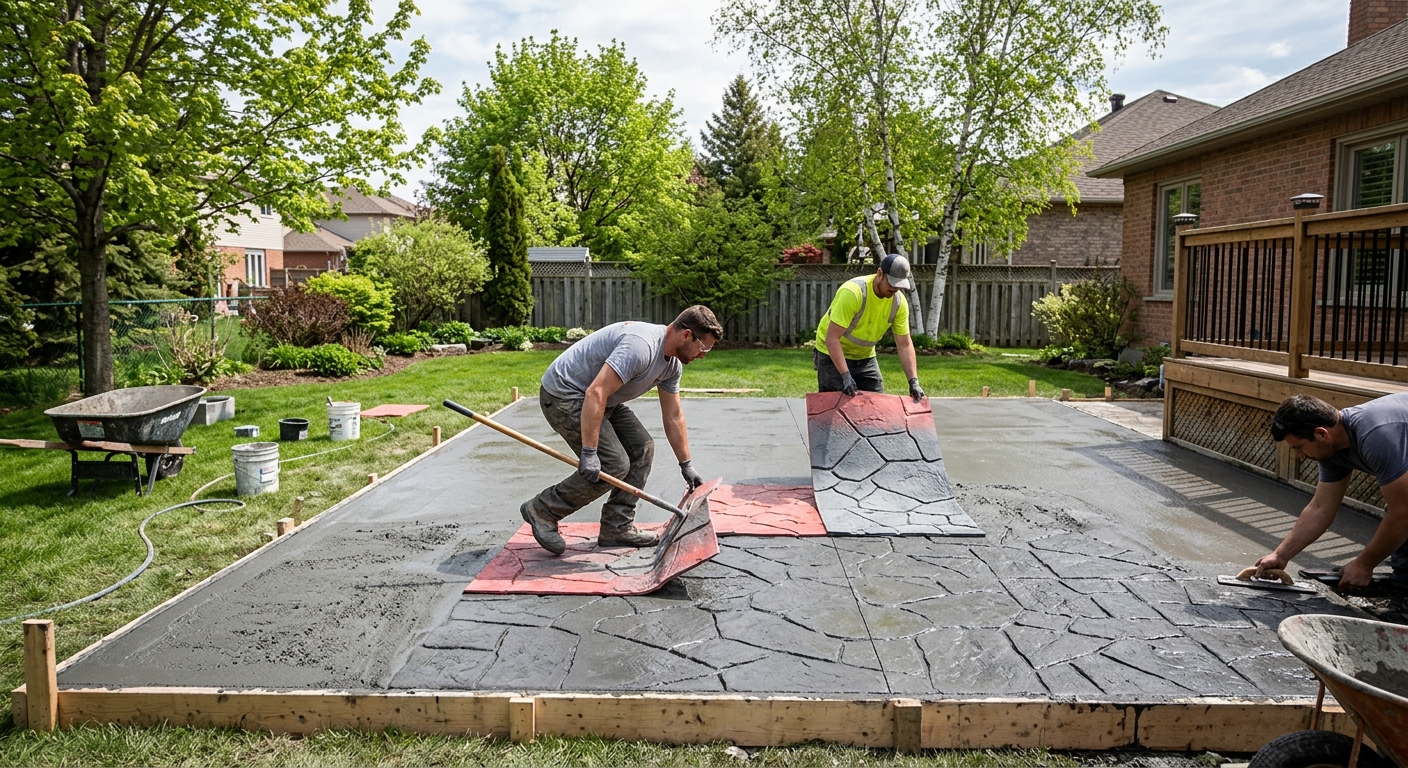
Concrete work options and costs in Canora
Concrete work in Canora is a practical necessity for homeowners, especially when you’re planning a new driveway, extending a patio, or upgrading a garage floor. Canora’s population is 3,309 (Statistics Canada, 2021 Census), and most concrete flatwork is tied to residential property improvements—think parking pads, backyard living spaces, and front approaches. Many local properties also reflect long-term homeownership and ongoing replacement cycles, so you’ll often see repeat demand from established areas such as near the central Canora streets and typical main-corridor lots where access for concrete trucks is easiest.
In the Calgary economic region, concrete pricing is heavily influenced by cold continental conditions. The design frost depth is about 1.2 m (roughly 4 ft), which means structural work—like foundation footings—must bear below that zone on undisturbed soil to reduce frost heave and seasonal movement. Driveways and exterior slabs face frequent freeze–thaw cycles, so costs rise for air-entrained mixes, proper granular base prep, and careful control joint placement. The practical pour season for exterior flatwork is shorter, and curing is engineered around that window using winter-grade placement methods when needed. Because of this, even “similar” projects can land in different price bands depending on excavation depth, rebar needs, and access constraints for the pour.
Below is a realistic comparison of common options homeowners request in Canora, including what usually drives the price.
| Application |
Typical Size |
Key Spec |
Finish Option |
Price Range |
| Concrete driveway (standard broom finish) |
24 ft x 10 ft (240 sq ft) |
Air-entrained exterior mix; compacted granular base; jointing |
Broom finish |
$12,000–$18,000 |
| Exposed aggregate driveway |
24 ft x 10 ft (240 sq ft) |
Air-entrained mix; proper retarder timing; base prep for frost resistance |
Exposed aggregate |
$16,000–$22,000 |
| Stamped concrete driveway or patio |
20 ft x 12 ft (240 sq ft) |
Air-entrained mix; reinforcement sized for local load; release agent/colour |
Stamped patterns |
$15,000–$26,000 |
| Plain concrete patio or walkway |
12 ft x 12 ft (144 sq ft) |
Minimum 32 MPa; air-entrained; control joints |
Plain broom or trowel-light |
$5,000–$9,000 |
| Garage floor (interior slab) |
22 ft x 22 ft (484 sq ft) |
Vapour control layer (as needed); reinforcement; proper curing |
Standard broom or lightly trowelled finish |
$11,000–$20,000 |
| Foundation footings (structural, below frost) |
Typical single-family footprint |
Excavation to frost depth zone; rebar; engineered sizing |
Below-grade structural concrete |
$28,000–$45,000 |
Prices are estimates only and vary by project scope, site access and material selection.
What affects the price of concrete work in Canora
If you’re getting quotes in Canora, it’s common to see the same general project come in 30–50% apart once you compare excavation, reinforcement, mix specs, and finish options. In the Calgary area, the cold continental climate means contractors engineer every exterior slab around frost and freeze–thaw—not just “pour and go.” A design frost depth of about 1.2 m (roughly 4 ft) for housing-related foundation work drives deeper digs, more granular base, and higher concrete volumes. That’s why foundation/footing work commonly sits in the $28,000–$45,000 range, while exterior flatwork is usually priced by square footage and can shift quickly based on base depth and joint layout.
Freeze–thaw cycles also require air-entrained concrete mixes to help resist surface scaling and spalling. When temperatures drop, the pour season tightens and cold-weather curing precautions—insulated blankets, sometimes temporary heat, and longer protection time—add labour and material costs. De-icing salt in winter accelerates deterioration if the mix and curing aren’t specified correctly, so sealing becomes a smart add-on for driveways and patios.
Here are a few real-world Canora examples that swing cost up or down. First, if your driveway ties into a slope or has unstable topsoil, excavation and replacement with compacted granular base increases volumes and labour (often pushing you toward the higher end of $12,000–$18,000 for driveways). Second, a stamped driveway needs colour, release, and extra finishing labour; it can justify landing in the $15,000–$26,000 band. Finally, older homes with existing concrete that needs removal typically add disposal and prep—especially if the existing base is poorly compacted.
| Price Factor |
Why It Matters |
Cost Impact |
| Frost line depth |
Determines footing depth and form height |
More excavation and concrete; higher materials and labour |
| Site preparation |
Excavation, grading, compacted granular base |
Unstable soil increases base thickness and replacement costs |
| Reinforcement |
Rebar or wire mesh requirement |
Improves structural capacity; adds labour for tying/placing |
| Mix design |
Air-entrainment and compressive strength spec |
Exterior durability costs more up front but reduces failures |
| Finish type |
Broom vs. stamped vs. exposed aggregate |
Stamped/exposed requires specialized labour and materials |
| Pour size and concrete truck access to site |
Impacts setup time and delivery method |
Limited access may require pumps/extra crews |
| Cold-weather curing precautions |
Heating and blankets |
Needed to achieve proper strength gain in shorter season |
| Control joint pattern and sealing cost |
Manages cracking and repels de-icing salt |
Better jointing reduces random cracking; sealing adds a material line |
Permits & regulations in Alberta
In Alberta, structural concrete work typically requires more formal oversight than simple patio or driveway flatwork. For most home projects in Canora and across Alberta, building permits are generally required for concrete that forms part of the structure—especially foundation footings, foundation walls, and grade beams. These elements affect load transfer and building performance, so municipalities often expect engineered drawings and inspections at key stages (for example, before concrete placement).
Concrete flatwork—driveways, patios, walkways, and garage floor slabs—usually does not require a permit unless the work changes lot grading, increases impervious surface beyond municipal limits, or affects drainage and the municipal right-of-way. Even when a permit isn’t usually required, it’s smart to confirm with the local authority before breaking ground to avoid rework.
To verify a contractor in Alberta, start with an itemized quote that clearly states what they will do: excavation, forms, reinforcement, concrete supply, finishing, and disposal. Then check three things before you sign: (1) Alberta licence or applicable trade registration for the contractor (use the online registry for the business/contractor details); (2) liability insurance—ask for a current certificate of insurance showing your project and adequate coverage; and (3) WCB/WSIB coverage (or WCB clearance where applicable). A reputable contractor can provide these documents quickly, along with references for similar-scale footing and flatwork projects.
Getting concrete right in Canora's freeze-thaw climate
Concrete fails in Canora when the base isn’t prepared correctly, the mix isn’t engineered for freeze–thaw, or curing and joints are skipped. In a cold continental climate like the Calgary region, water migrates into the slab/edges during winter cycles. If the concrete doesn’t have the right air-entrainment, that freeze action can lead to surface scaling and spalling over time—often the first visible problem after a winter or two.
To spec the job correctly, focus on five core items. (1) Base preparation: compacted granular sub-base must be built to the right depth and properly compacted for local soil conditions so the slab sits on stable support below the frost-affected zone. (2) Mix design: exterior flatwork should use air-entrained concrete (commonly 5–7% air content) and a minimum compressive strength such as 32 MPa for typical residential applications. (3) Control joints: cut or form joints to guide cracking and limit random fractures—spacing matters. (4) Curing: plan for at least 7 days of proper curing conditions; in cold weather this may require blankets/temporary heat to avoid early freezing. (5) Sealing: apply a penetrating sealer after full cure (often 28 days) to help repel de-icing salt and reduce deterioration.
When homeowners choose higher-spec solutions, the price difference can be justified. For instance, a standard broom-finish driveway might land in the $12,000–$18,000 band, while an exposed aggregate or heavier reinforcement approach could push closer to the top end because base prep and finishing labour are more involved. But the goal is the same: reduce freeze–thaw damage now and avoid expensive removal and replacement later.
| Spec |
Why It Matters in Canora |
What to Ask For |
Impact if Skipped |
| Compacted granular base (depth?) |
Stable support prevents frost-related movement |
State planned base thickness and compaction method |
Settlement, cracking, and edge breakdown over winters |
| Air-entrained concrete mix (target air %?) |
Protects against freeze–thaw scaling and spalling |
Confirm target air content (commonly 5–7% for exterior flatwork) |
Surface deterioration and flaking in 1–3 seasons |
| Compressive strength (MPa rating) |
Ensures strength gain for durability |
Confirm minimum 32 MPa and curing plan |
Higher risk of weakness, surface damage, and premature wear |
| Control joints (spacing per ACI guidelines) |
Controls cracking pattern under temperature swings |
Ask for the joint layout and cutting schedule |
Random wide cracks and water intrusion |
| Minimum 7-day curing period |
Achieves early strength before weather stress |
Ask how they protect the slab in cold weather |
Early freezing leads to scaling and long-term performance issues |
| Penetrating sealer (when applied after cure) |
Repels salts and reduces moisture absorption |
Confirm type of sealer and timing (often after full cure, ~28 days) |
Faster salt-related surface damage |
How to choose a concrete work contractor in Canora
Choosing the right contractor in Canora starts with verifying the basics—because concrete is unforgiving once it’s placed. First, confirm Alberta coverage and credentials. Ask for proof of liability insurance (certificate of insurance), proof of WCB/WCB clearance or equivalent coverage documentation, and the contractor’s applicable Alberta business/contractor registration details. When you request documents, look for dates that are current and project-specific details that align with your address and scope.
Next, get 2–3 itemised written quotes. You want labour and materials broken out (concrete supply, excavation/grading, forms, reinforcement, finishing, and disposal). Avoid quotes that only show a final total with no detail—you can’t compare like-for-like. Carefully read the exclusions: Is permit work included if needed? Is old concrete removal and disposal included? Are you paying separately for rebar, wire mesh, pump costs, or additional base depth for poor soils?
Then evaluate warranty and payment terms. A workmanship warranty should be written down with a clear start and scope, and you should understand whether any product/manufacturer warranty is assigned to you or only applies through the contractor. On payment schedule, don’t fund the job with a large upfront amount—aim for no more than 10–15% deposit and use a holdback until completion and cleanup. Finally, require a written timeline with a realistic start date and completion estimate; in Calgary-area freeze–thaw conditions, scheduling affects curing quality.
- Requests your soil/grade information or performs a site check before pricing.
- States the concrete mix design (air-entrainment and strength) rather than “standard mix.”
- Provides joint layout and finishing method in writing.
- Details base thickness, compaction method, and disposal/replacement plan if topsoil is unsuitable.
- Includes reinforcement scope (rebar size/spacing or mesh) for exterior load conditions.
- Explains cold-weather curing: blankets, heating, and protection time.
- Shows whether sealing is included, and when it will be applied post-cure.
- Lists concrete delivery logistics and who coordinates pump/short-transport needs (if required).
- Includes start date, pour date window, and completion estimate.
- Provides a workmanship warranty length and what it covers.
- Uses a reasonable payment schedule (limit upfront; holdback until complete).
- Communicates clearly about exclusions: permits, grading tie-ins, and utility locates.
Concrete red flags in Canora include: “too-good-to-be-true” pricing that omits base depth or reinforcement, refusing to provide a certificate of insurance or WCB/WCB clearance, vague cure protection plans for late-season pours, no written joint plan (or cutting done too late), and payment requests that ask for most funds upfront.
Frequently asked questions — concrete work in Canora
What is the difference between concrete and cement?
In Canora and across Alberta, cement is one ingredient in concrete—not the whole product. Cement is the binder (the powder) that reacts with water to create strength. Concrete is cement plus water, aggregates (sand and gravel), and sometimes admixtures. For exterior flatwork and driveways in the Calgary region’s freeze–thaw climate, the “admixtures” part matters: air-entrainment helps the concrete handle repeated freezing and thawing without spalling. That’s why two quotes can vary even when the driveway size is the same—one contractor may specify an exterior-rated mix with the right air content and curing precautions, while another may use a less durable approach.
How much does concrete work cost in Canora?
Concrete costs in Canora generally follow the local pricing bands tied to frost depth and exterior freeze–thaw durability requirements. For example, a typical concrete driveway commonly falls in the $12,000–$18,000 range depending on excavation, base prep, reinforcement, and access for the pour. Plain patios and walkways are often in the $5,000–$9,000 range depending on square footage and site complexity. For structural work like foundation footings below the frost-affected zone, pricing often sits in the $28,000–$45,000 band because excavation is deeper and the volumes and reinforcement requirements are higher. If you want stamped work, costs typically increase into the $15,000–$26,000 band due to specialized finishing labour and materials.
How deep must footings be for Canora's frost line?
For Canora-area residential foundations, footing depth is governed by design frost depth and engineered foundation requirements. In the Calgary region, the design frost depth is about 1.2 m (roughly 4 ft), and footings for houses, garages, decks, and retaining structures must bear on undisturbed soil below that zone to reduce frost heave and seasonal movement. Exact depth can vary based on soil conditions, drainage, and how the engineer/inspector interprets your site. The key point for homeowners is that footing depth shouldn’t be “guessed”—your contractor should follow the approved drawings and local inspection requirements, then place concrete and reinforcement as specified. If you see a quote that doesn’t discuss excavation depth or engineered specs, ask directly.
Why does concrete crack in Canora and how is it prevented?
Concrete cracks in Canora mainly because of temperature swings, shrinkage as it cures, and movement caused by freeze–thaw cycles—especially when slabs aren’t properly supported by a well-compacted granular base. In the Calgary area, those movements are repeated season after season, so control joints and air-entrained mix design are essential. Prevention starts with a stable base, correct mix (including air-entrainment for durability), and a planned joint pattern that directs cracking into predictable lines. Proper curing is also critical: if the concrete freezes too early, you can get surface scaling and long-term performance problems even if it “looks fine” at first. Finally, sealing helps limit moisture and salt intrusion at the surface. If you want a long-lasting driveway, choose a contractor who will specify joint spacing and cold-weather curing protection, not just the finish.
Stamped vs broom-finish concrete — cost difference?
Stamped concrete costs more than broom-finish because it requires additional materials and labour: colour hardeners, release agents, special finishing steps, and time-consuming patterning. In Canora, a basic broom-finish driveway often lands in the $12,000–$18,000 range depending on excavation and base prep, while stamped driveway or patio projects commonly fall in the $15,000–$26,000 band. That extra cost is usually justified when you want a decorative look with controlled crack locations and consistent finishing quality. The trap is comparing stamped pricing without verifying specs—ask that the contractor still includes exterior air-entrainment, correct curing protection, and proper control joints. Decorative finishes won’t make poor base preparation durable in freeze–thaw conditions.
When is the best time to pour concrete in Canora?
The best time to pour concrete in Canora is when you can achieve proper curing before freezing temperatures stress the slab. Because Calgary-area freeze–thaw conditions tighten the pour season, exterior work often goes best in late spring through early fall. If you need a late fall or early spring pour, ask the contractor about cold-weather curing precautions: insulated blankets, temporary heat (when needed), and how they’ll keep the concrete at a safe curing temperature during the critical early days. Proper curing is one reason concrete quotes differ—winter-grade logistics and protection time add cost. For homeowners, the practical takeaway is to plan your schedule so the contractor can protect the slab long enough for strength gain, rather than rushing the pour and risking scaling or weakened surfaces.