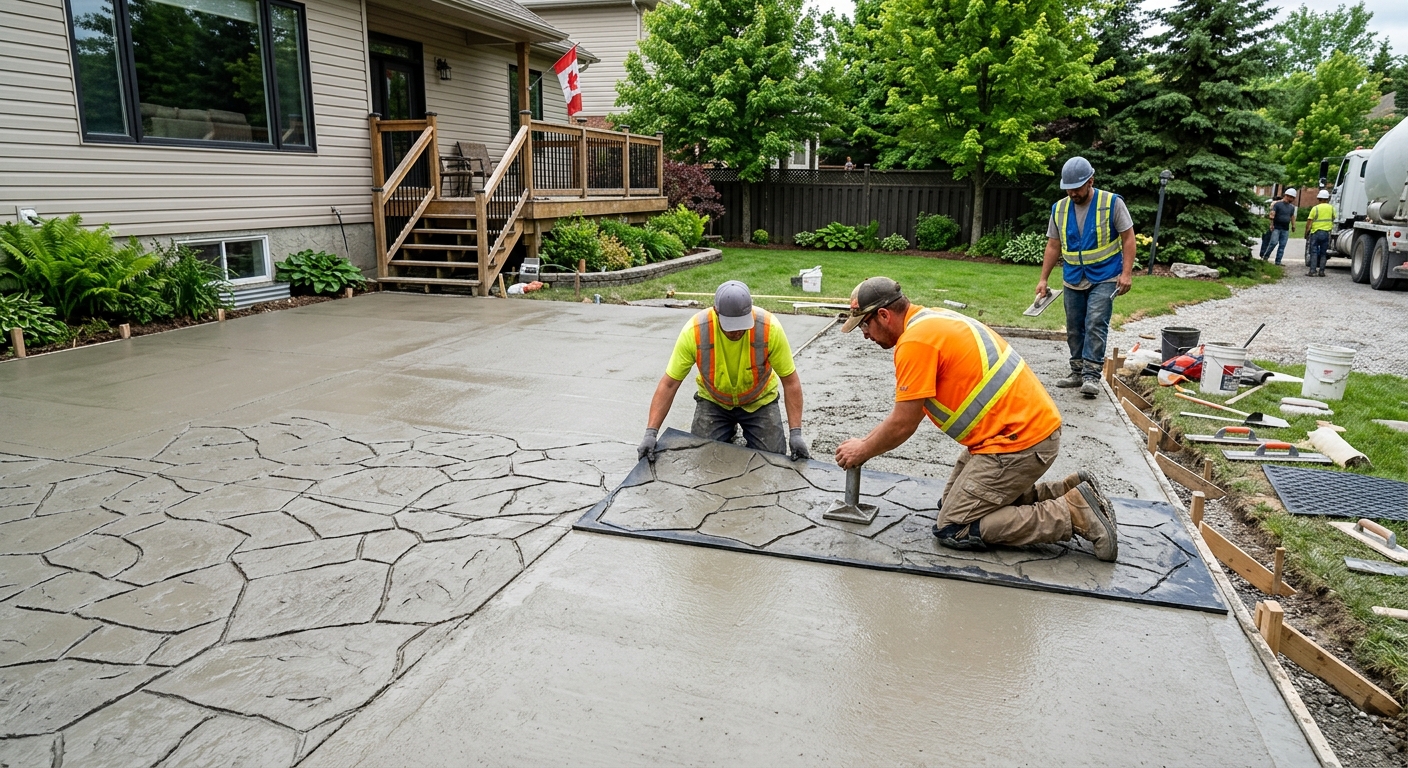
Concrete work options and costs in Overlanders
Concrete work in Overlanders is in constant demand because homeowners and builders want durable surfaces that can handle Alberta’s winter. Overlanders has a population of 2,867 (Statistics Canada, 2021 Census), and that local growth supports steady work for driveways, patios, walkways and foundations—especially in established pockets near newer residential builds and infill. While the exact mix of housing types changes by block, Overlanders’ owner-occupied homes and attached/garage-focused layouts typically translate into frequent requests for driveway expansions, backyard slabs, and garage floor pours.
In the Calgary economic region, pricing is shaped heavily by cold continental weather and freeze–thaw cycles. The design frost depth is about 1.2 m (roughly 4 ft), which means excavating deeper and building footings on undisturbed soil below that level. Exterior slabs also need air-entrained mixes, a properly graded granular base, and control joints to reduce cracking and surface scaling. Because the practical exterior pour season is shorter than in milder provinces, contractors plan around curing conditions, sometimes using insulated blankets or heaters—costs that show up in quotes.
In Overlanders, trade activity is especially strong where lots have older driveway approaches, changing grades, or where homeowners are adding rear parking pads and backyard living areas after winter freeze concerns show up. If your goal is to compare options side-by-side, the table below gives typical sizes, specs and price bands commonly used in this market.
| Application |
Typical Size |
Key Spec |
Finish Option |
Price Range |
| Concrete driveway (standard broom finish) |
24 ft x 10 ft (240 sq. ft.) |
Air-entrained concrete, reinforced edges, control joints |
Broom finish |
$12,000–$18,000 |
| Exposed aggregate driveway |
24 ft x 10 ft (240 sq. ft.) |
Higher-performing mix, careful finishing schedule |
Exposed aggregate (surface wash) |
$16,000–$22,500 |
| Stamped concrete driveway or patio |
20 ft x 14 ft (280 sq. ft.) |
Air-entrained base mix, integral color, release timing |
Stamped pattern + sealant |
$15,000–$26,000 |
| Plain concrete patio or walkway |
12 ft x 12 ft (144 sq. ft.) |
Compact granular base, thickness per design, joints |
Broom or smooth trowel (non-slip as needed) |
$5,000–$9,000 |
| Garage floor (interior slab) |
20 ft x 22 ft (440 sq. ft.) |
Vapour barrier, reinforcement, flatness focus |
Float + broom or light texture |
$10,500–$16,000 |
| Foundation footings (structural, below frost) |
Perimeter/isolated footings for typical house |
Excavate to undisturbed soil below frost depth, rebar + concrete volume |
Structural concrete (engineered) |
$28,000–$45,000 |
Prices are estimates only and vary by project scope, site access and material selection.
What affects the price of concrete work in Overlanders
In Overlanders and the broader Calgary area, it’s common to see quotes for the “same” concrete job land 30–50% apart. The reason usually isn’t the concrete itself—it’s the engineering and labour behind making it last in a freeze–thaw climate. In Alberta, frost and freeze–thaw cycles dictate every spec: footings must extend below the design frost depth (about 1.2 m here) to prevent frost heave and seasonal movement. Exterior slabs also require air-entrained concrete to survive repeated freezing and thawing, and cold-weather placement often means a shorter pour season plus winter-grade curing precautions (insulated blankets and/or temporary heat) to reach proper set and strength.
De-icing salt is another cost driver. Where homeowners salt driveways frequently, better sealing and correct mix design reduce the risk of surface scaling and spalling over time—skimping there may look cheaper today but costs more later. Two examples you’ll feel in Overlanders: (1) a driveway that needs deeper excavation and a properly compacted granular base will price closer to the upper end of the $12,000–$18,000 band; (2) a stamped or decorative patio often moves into the $15,000–$26,000 range because of extra labour, integral colour/release materials and strict timing for stamping and finishing.
Finally, housing age affects what’s under the slab. Older properties often have variable subgrade and drainage issues, so excavation and base prep can add thousands. In practical terms, that’s why a “simple” walkway can end up costing like a driveway when the foundation of the slab isn’t ready.
| Price Factor |
Why It Matters |
Cost Impact |
| Frost line depth |
Determines footing depth and form height |
Higher excavation and concrete volume; often adds major cost to foundations/retaining work |
| Site preparation |
Excavation, grading, compacted granular base |
Soft spots, unsuitable soil or poor drainage can push costs toward the top of the driveway/slab band |
| Reinforcement |
Rebar or wire mesh requirement |
Steel, labour tying/placing, and correct coverage can add a noticeable premium |
| Mix design |
Air-entrainment and compressive strength spec |
Winter-grade mix and certified spec control increase material cost but protect against spalling |
| Finish type |
Broom vs. stamped vs. exposed aggregate |
Decorative finishes require more labour and precise finishing windows |
| Pour size and concrete truck access to site |
Impacts number of pours and placement time |
Access limits may require smaller loads and extra labour to place/finish consistently |
| Cold-weather curing precautions |
Heating and blankets |
Can add direct heat/blanket costs and extend scheduling/crew time |
| Control joint pattern and sealing cost |
Controls cracking and protects against de-icing salts |
Proper joint layout and sealing add cost now, but reduce long-term surface damage |
Permits & regulations in Alberta
In Alberta, structural concrete work typically needs municipal review and a building permit—especially for items that carry load or change structural systems. For Overlanders homeowners, that usually includes foundation footings, foundation walls, and grade beams (and any concrete work that is part of engineered structural support). In many cases, engineered drawings are required and reviewed during permitting, particularly when soils, foundation design, or load paths are involved.
Concrete flatwork—like patios, walkways, driveway slabs and garage floors—often does not require a separate permit by default. However, permits can become relevant if the project affects lot grading, drainage, or compliance around impervious surface coverage, or if work is within or near municipal right-of-way requirements (for example, changes affecting boulevard drainage and curb interface). The safe approach is to confirm with the municipality before you break ground.
Before you hire anyone for concrete in Overlanders, verify the contractor is properly insured and compliant. Step-by-step:
- Check the contractor’s Alberta business registration and any required construction licensing/eligibility through the relevant provincial sources (use the contractor name exactly as listed).
- Request a Certificate of Insurance (COI) showing general liability coverage with adequate limits for concrete work.
- Ask for WSIB/WCB clearance or proof of coverage (as applicable) and confirm the certificate is current.
- Verify the scope aligns with the permit/engineering needs: structural jobs should be supported by appropriate drawings.
- Confirm the contractor provides references for similar-scale work (driveways, footings, and exterior slabs in cold-weather conditions).
This verification protects you from workmanship and liability issues—especially important when freeze–thaw performance depends on correct base prep and curing.
Getting concrete right in Overlanders's freeze-thaw climate
Concrete failure in Overlanders is rarely just “bad luck.” Most performance problems come from one of five steps: weak base prep, incorrect mix design, inadequate air entrainment, missing or poorly spaced control joints, and rushed curing—then compounded by winter de-icing salt. In our freeze–thaw climate, the slab’s first line of defence is a compacted granular sub-base placed to the correct depth and prepared for the local subgrade. Next is the concrete itself: exterior flatwork should use air-entrained concrete (commonly 5–7% air content) with a minimum 32 MPa compressive strength spec to withstand repeated freezing and thawing.
Control joints matter because they limit where cracking occurs. Skipping the right joint pattern or spacing can lead to random cracks that allow water intrusion. Curing is also time-critical: in Alberta, you should plan for a minimum 7-day curing period under proper conditions, and if you’re near colder weather, crews may use insulated blankets or heat to protect the set and early strength gain. Finally, sealing should be done after the cure window—often at 28 days post-pour—so de-icing salts don’t accelerate surface spalling.
Here’s a practical cost example: a basic broom-finished patio might fit the $5,000–$9,000 band when base prep and joints are done correctly. If someone under-specs air entrainment to cut costs, you may save a few hundred dollars upfront, but the odds of scaling and spalling rise—turning a “cheap patio” into a re-pour several seasons sooner. Sticking to correct specs is usually the cheaper long-term decision.
| Spec |
Why It Matters in Overlanders |
What to Ask For |
Impact if Skipped |
| Compacted granular base (depth?) |
Prevents settlement and reduces frost-related movement |
Granular sub-base to engineered depth for your subgrade; confirm compaction testing/targets |
Uneven support, cracking, and premature surface deterioration |
| Air-entrained concrete mix (target air %?) |
Improves freeze–thaw durability for exterior exposure |
Target 5–7% air for exterior flatwork (per mix design) |
Higher risk of scaling and spalling in winter |
| Compressive strength (MPa rating) |
Ensures strength gain and long-term structural performance |
Minimum 32 MPa compressive strength spec |
Surface wear, reduced durability, and cracking under loads |
| Control joints (spacing per ACI guidelines) |
Controls cracking to predictable locations |
Joint layout and spacing plan; saw-cut timing schedule |
Random cracks that allow water ingress and freeze damage |
| Minimum 7-day curing period |
Builds early strength before exposure to cold cycles |
Protect set with proper conditions; discuss cold-weather plan if late season |
Weakened surface and higher chance of scaling/spalling |
| Penetrating sealer (when applied after cure) |
Repels moisture and de-icing salts |
Apply after cure—commonly at 28 days post-pour; confirm product type |
Faster surface breakdown and staining in salted winters |
How to choose a concrete work contractor in Overlanders
Choosing the right concrete contractor in Overlanders is less about a low number and more about proof they’ll execute the freeze–thaw specs that matter here. Start with verification. Request the contractor’s liability insurance certificate (COI) and confirm coverage is active for the job. Then ask for WSIB/WCB clearance or proof of coverage (as required) and check that it’s current—expired coverage is a common issue when someone’s subcontractors change mid-project.
Get 2–3 itemised written quotes. You want labour and materials broken out rather than a single lump sum—especially for items like removal/disposal, excavation and granular base, reinforcement, concrete mix type, curing method, and finishing/sealing. Scope details should state what’s included and what’s excluded: permit pull included or not, disposal included, saw-cut timing, thickness and reinforcement, and whether truck access means extra labour.
Warranty matters too. Ask for: the workmanship warranty length, any product/manufacturer warranty for decorative sealers or coatings, and whether coverage is transferable if you sell the property. For payment, keep it sensible: never pay more than 10–15% upfront; hold back a portion until surfaces are sealed (where specified) and the final punch list is complete. Finally, demand a schedule in writing—start date and a completion estimate—so crews can pour and cure within realistic weather windows for Calgary-area winters.
- Ask for a project-specific concrete mix design (air-entrainment and strength) and confirm it meets exterior freeze–thaw durability needs.
- Confirm base prep scope: excavation depth, granular material type, and compaction approach.
- Verify reinforcement details (wire mesh vs rebar, edge support, and coverage).
- Check whether control joints will be saw-cut (and when) or formed, and confirm spacing.
- Ask about cold-weather procedures (blankets/heaters) if pours happen near shoulder season.
- Confirm whether removal and disposal of old concrete are included and how haul distances are handled.
- Request finish details: broom vs smooth vs exposed aggregate vs stamped—plus what non-slip approach is used for walkways.
- Get sealing included in writing if your quote is exterior and you’re in a salted winter area.
- Review the scope for drainage and grade transitions at garage aprons and driveway approaches.
- Confirm truck access plan: where the chute/setup will be and how placement time affects finishing quality.
- Make sure the quote specifies thickness (and any engineered changes for slopes or loads).
- Set a clear payment schedule tied to milestones, with holdback for final inspection.
Red flags to watch for in Overlanders: contractors who won’t specify air-entrained concrete, vague wording like “standard base” with no depth/compaction plan, no mention of control joints or sealing on exterior slabs, promises to pour in cold weather without a winter curing plan, and quotes that don’t include disposal/removal details when existing concrete must be broken out.
Frequently asked questions — concrete work in Overlanders
Concrete vs pavers for a patio in Overlanders?
For patios in Overlanders, concrete is often the better “whole-cost” choice when you want a long-lasting surface that handles Calgary freeze–thaw. A plain broom-finished patio typically lands around $5,000–$9,000 for common backyard sizes, and the price is easier to predict if base prep and joints are done correctly. Pavers can be excellent, but they shift with movement if the base isn’t engineered for frost and drainage—then you can end up with weed growth, uneven sections, or re-levelling. Concrete also gives you a monolithic surface with joints you can plan, plus optional sealing for de-icing salt exposure if your patio sits closer to driveway traffic. If you love the look of pavers, stamped concrete is the compromise many homeowners choose: design flexibility with a slab engineered for winter performance.
How long does a concrete driveway last?
A well-built driveway in the Calgary area commonly lasts 20–30 years, sometimes longer, but that timeline depends on whether the contractor engineered it for frost and winter maintenance. In Overlanders, the big performance drivers are footings/base prep for stability, air-entrained concrete for freeze–thaw durability, and correct control joints to reduce random cracking. Many homeowners also salt heavily in winter—sealing after proper curing helps slow surface breakdown and staining. If a driveway is placed in a rush during late fall without cold-weather curing precautions, the early strength gain can be compromised and scaling may show up sooner. On the other hand, a driveway priced toward the middle of the $12,000–$18,000 band with proper specs and finishing tends to hold up best because the “invisible” base and curing steps were done right.
What is air-entrained concrete and why does it matter here?
Air-entrained concrete is a mix designed with tiny, evenly distributed air bubbles. Those microscopic bubbles provide space for water to expand when it freezes, which greatly reduces scaling and spalling on exterior slabs exposed to Alberta’s winter cycles. In Overlanders and across the Calgary economic region, freeze–thaw happens frequently enough that air entrainment isn’t optional if you want long-term performance. Without the right air content, water trapped near the surface expands during freezing and can break the concrete’s surface layer over time. That’s why your quote should specify exterior-grade mix design (often targeting 5–7% air for flatwork) and include proper curing protection. This is also one reason “cheaper” bids sometimes don’t last—they may use generic mix wording and skip the air-entrainment and curing details that protect against winter damage.
How do I prepare the base for a concrete slab?
Base prep for a slab in Overlanders is mainly about excavation, grading, and compacted granular sub-base to support the concrete and manage frost movement. Start with the right scope: removal of unsuitable soil, proper slope/drainage, and installation of granular layers to the engineered depth for your site conditions. The contractor should compact each layer to achieve stable support rather than dumping crushed rock and hoping it holds. For exterior work, base prep is paired with correct thickness, reinforcement, and joints so the slab can tolerate movement without random cracking. If your project involves existing soil fill or older drainage issues, expect more prep time and sometimes deeper excavation. Ask the contractor how they’ll confirm compaction, what granular material they’ll use, and how they’ll tie into existing grades (garage aprons and driveway transitions are common problem areas).
How do I compare concrete quotes?
To compare concrete quotes in Overlanders, insist on line-item clarity and technical specs—not just a total price. Ask each bidder to provide an itemised breakdown for excavation/removal and disposal, granular base (depth and type), reinforcement (mesh vs rebar and placement), concrete mix design (air-entrainment and compressive strength), thickness, and finishing method. For exterior slabs, confirm control joint spacing and sealing details, including when sealing will be applied. Also check whether cold-weather measures are included if the pour is near shoulder season. A lower bid may use a lower-spec mix, reduce base prep depth, or omit sealing and joint execution, which can lead to premature surface scaling. When comparing driveway bids, benchmark the overall range—most standard driveways typically fall in the $12,000–$18,000 band, while stamped/decorative options commonly run higher. The “best” quote is usually the one with the most complete scope, not necessarily the lowest number.
Can concrete be poured in cold weather in Overlanders?
Yes, concrete can be poured in cold weather in Overlanders, but it shouldn’t be treated like a summer pour. The key is protecting the concrete during set and early curing so it reaches the required strength before freeze cycles attack the surface. Contractors typically plan for winter-grade mixes, insulated blankets and/or temporary heat, and they monitor temperatures closely to manage curing. If the job is delayed into colder weeks, the curing precautions can add cost and labour time, but skipping them can lead to surface scaling, reduced durability and cracking. When you’re getting quotes, ask whether cold-weather curing precautions are included and what plan they use if temperatures drop overnight. If the quote is silent on curing protection, that’s a risk—especially in a region where the frost depth is around 1.2 m and freeze–thaw cycles drive how engineered the base and slab must be for long-term performance.