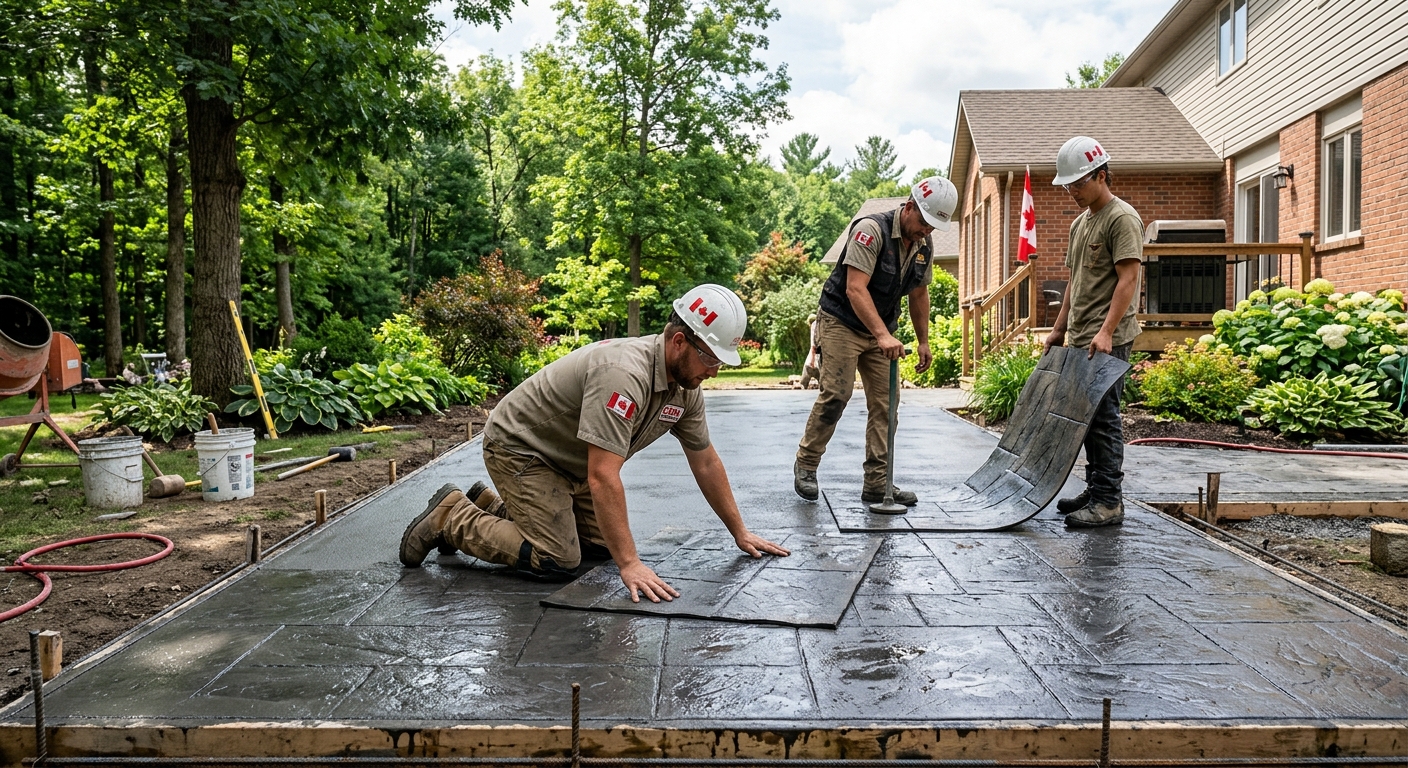
Concrete work options and costs in Richmond
In Richmond, Alberta, homeowners typically look at concrete because it holds up well on driveways, patios and walkways—especially with the right mix and detailing for Calgary’s cold continental freeze–thaw cycles. Richmond is a small community (population 5,250 per the Statistics Canada, 2021 Census), so the most active concrete work tends to cluster around the same household upgrades year after year: new flatwork for family homes, replacements on older slabs, and foundation-related pours for infill-style builds. Concrete flatwork also fits the way people use their lots—backyard patios and front walkways are common, and garages are often at the centre of the property layout.
Cost pressure in this market is real. In a region where the design frost depth is about 1.2 m (roughly 4 ft), footings for houses, garages, decks and retaining structures must bear on undisturbed soil below that depth. That means deeper excavation and larger foundation volumes than in milder areas. Add frequent freeze–thaw cycles and you get engineered specs like air‑entrained concrete, more granular base prep, and a deliberate control joint plan to reduce cracking and spalling. The practical pour season for exterior slabs is shorter, and when crews need to place concrete near cold-weather edges, winter-grade mixes and curing precautions (insulated blankets and sometimes temporary heat) can increase labour and material costs.
You’ll see the trade especially busy around established residential pockets where front-lot access and vehicle traffic are consistent, such as the core neighbourhoods near the main roads. The same homeowner who’s offered a low price for a driveway sometimes gets a higher number after engineering and cold-weather curing details are included. That’s why it helps to compare options side-by-side before you request final quotes.
| Application |
Typical Size |
Key Spec |
Finish Option |
Price Range |
| Concrete driveway (standard broom finish) |
400 sq. ft. (about 20' x 20') |
Reinforced slab on compacted granular base; air‑entrained mix |
Broom finish + light sealer |
$12,000–$18,000 |
| Exposed aggregate driveway |
400 sq. ft. (about 20' x 20') |
Exposed finish system; air‑entrained mix; good drainage plan |
Exposed aggregate + curing/finishing protection |
$15,000–$22,000 |
| Stamped concrete driveway or patio |
300 sq. ft. (about 15' x 20') |
Integral colour or hardener; air‑entrained mix |
Stamped pattern + release + sealer |
$15,000–$26,000 |
| Plain concrete patio or walkway |
200 sq. ft. (about 10' x 20') |
Compact sub-base; air‑entrained mix; control joints |
Broom finish or smooth trowel (slight texture) |
$5,000–$9,000 |
| Garage floor (interior slab) |
480 sq. ft. (about 20' x 24') |
Vapour control + insulation where required; fibre or mesh as specified |
Standard trowel + hardener option |
$11,000–$17,000 |
| Foundation footings (structural, below frost) |
Typical house/garage footing system |
Excavation to undisturbed soil; rebar; engineered dimensions below design frost depth |
Structural concrete only (no decorative finish) |
$28,000–$45,000 |
Prices are estimates only and vary by project scope, site access and material selection.
What affects the price of concrete work in Richmond
In Richmond and across the Calgary economic region, quotes for the “same” concrete job can swing by 30–50% because the cold-climate details that keep concrete performing long-term are easy to under-estimate. A driveway might be priced as a basic slab, but once a contractor accounts for deeper frost-related excavation, granular base upgrades, reinforcement requirements, and winter curing precautions, the scope changes. Labour availability also tightens in late fall, which can further influence pricing.
Frost depth is the big driver. Local engineering practice uses a design frost depth of about 1.2 m (roughly 4 ft), and footings must extend below that depth to prevent frost heave and seasonal movement. Even for flatwork, exterior slabs are engineered around freeze–thaw cycles: exterior concrete should be air‑entrained, bases must be properly graded and compacted, and control joints must be planned to manage shrinkage and reduce random cracking. Cold-season placement adds cost when cold-weather requirements trigger winter-grade mixes and curing protection (insulated blankets and, in some cases, temporary heat).
De-icing salt is another reality. In Richmond winters, salt is hard on poorly finished and poorly sealed concrete; inadequate sealing can accelerate surface scaling and spalling. On an older driveway that’s already showing pitting, a more complete prep and sealing plan often costs more up front but prevents a full replacement sooner. For example, moving from a standard broom-finish driveway to a higher-spec exposed aggregate system might increase the project from a typical $12,000–$18,000 band into the $15,000–$22,000 range, which is usually justified by the added finishing system and more protective curing/finishing steps. Similarly, stamped options can land in the $15,000–$26,000 range when integral colour, release workflow, and pattern labour are included—those costs are real, not a markup.
Two common Richmond examples: (1) poor drainage toward the driveway can raise costs because the base and grading need correction before any concrete is poured; (2) limited access for a concrete truck can add crew time and material handling costs, even if the slab area is small. When you’re comparing quotes, focus on the specs—not just the square footage.
| Price Factor |
Why It Matters |
Cost Impact |
| Frost line depth |
Determines footing depth and how high forms and excavation go on your lot |
Can significantly increase foundation costs; deeper excavation means more labour and concrete |
| Site preparation |
Excavation, grading, and compacted granular base reduce settlement and frost-related movement |
Upgrades to base depth/compaction often add cost but extend slab life |
| Reinforcement |
Rebar or mesh controls cracking; placement depth and chairing matter |
Material and labour increases can raise a job price even when the slab area is the same |
| Mix design |
Air‑entrainment and specified strength help concrete survive freeze–thaw cycles |
Winter-grade mixes and air targets can add to material and batching costs |
| Finish type |
Broom vs. stamped vs. exposed aggregate changes labour, curing, and sealing requirements |
Decorative systems typically add the most labour and finishing time |
| Pour size and concrete truck access to site |
Shorter pours are harder to stage; distance affects placement efficiency and labour |
Extra crew time, pumping, or multiple loads can increase cost |
| Cold-weather curing precautions |
Heated/insulated curing protects strength gain and reduces scaling |
Blankets, heaters, and monitoring can add material + labour overhead |
| Control joint pattern and sealing cost |
Proper joint spacing limits random cracks; sealing helps repel salt and moisture |
Skipping or under-spec’ing joints/sealer can reduce short-term cost but increases long-term failures |
Permits & regulations in Alberta
In Alberta, structural concrete work typically falls under building permitting. That includes footings, foundation walls, and grade beams, especially when the foundation is engineered and impacts structural loads. In many cases, engineered drawings are required and reviewed through the municipal permitting process. Concrete flatwork—like patios, walkways, and standard driveways—often does not require a permit, unless the work affects lot grading, drainage, impervious surface coverage rules, or the municipal right-of-way (for example, work that touches curb/sidewalk areas). Because rules can differ by lot situation, confirm with your municipality before breaking ground.
For your Richmond home project, verify contractor credentials step-by-step:
- Ask for the contractor’s Alberta licence details (where applicable) and company profile information.
- Request an active certificate of liability insurance; confirm the coverage is current and matches the scope (flatwork vs. structural work).
- Confirm workers’ coverage: ask for WSIB/WCB status documentation before work begins.
- Request references for similar-scale projects locally (driveways, slab-on-grade, or footing pours depending on your scope).
- Get written confirmation of schedule, exclusions, and cleanup/disposal responsibilities.
If the quote is for structural elements like footings, don’t accept verbal assurances—make sure the contractor states exactly how permits and engineered drawings are handled. A clean permit trail and proper insurance are part of doing concrete right in Alberta’s freeze–thaw climate, not optional paperwork.
Getting concrete right in Richmond's freeze-thaw climate
Concrete fails in Richmond winters mostly because water and salt get into the surface or through poorly prepared bases, then freeze–thaw expands microcracks. The result is spalling (surface scaling and flaking), which is especially common when air‑entrainment isn’t correct, joints aren’t installed to a planned pattern, or curing is rushed. On a cold-climate project, “finish day” is not the finish line—what happens after the pour determines durability.
To spec the job correctly in Richmond, focus on five items. First, base preparation: compacted granular sub-base must be placed to the right depth and support grade to minimize settlement. Second, mix design: exterior flatwork should use air‑entrained concrete, commonly targeting about 5–7% air content, and a minimum 32 MPa compressive strength for reliable performance. Third, control joints: spacing should limit random cracking—then you seal the joints or seal the surface as specified. Fourth, curing: plan for at least 7 days of curing under proper conditions; in cold weather, curing blankets or temporary heat help the concrete reach strength before it’s exposed to harsh freeze–thaw cycles. Fifth, sealing: apply a penetrating sealer after the cure (typically around 28 days post-pour) to repel de-icing salts.
When you compare options, you can see why the price difference is sometimes justified. For instance, a simple broom-finished patio in the $5,000–$9,000 range may cost less than a stamped patio in the $15,000–$26,000 range—but skipping air‑entrainment, joints, or proper curing is where owners lose value. Decorative finishing costs more because pattern work and colour systems require longer, more careful finishing workflows. The durability specs still matter either way; that’s what prevents the stamped surface from becoming a “pretty” failure later.
| Spec |
Why It Matters in Richmond |
What to Ask For |
Impact if Skipped |
| Compacted granular base (depth?) |
Supports the slab against settlement and improves drainage so water doesn’t stay under/within the slab |
State the base depth and compaction standard, plus how grading directs runoff |
More cracking, uneven surface, and faster deterioration in freeze–thaw cycles |
| Air-entrained concrete mix (target air %?) |
Air voids provide space for freezing water expansion, reducing spalling and scaling |
Ask for target air content (commonly 5–7% for exterior flatwork) and mix source/testing approach |
Higher risk of surface scaling/spalling during winter freeze–thaw |
| Compressive strength (MPa rating) |
Ensures adequate strength gain to resist early-age damage |
Confirm minimum 32 MPa and curing plan to achieve it under local conditions |
Weaker surface, higher chance of raveling and premature cracking |
| Control joints (spacing per ACI guidelines) |
Guides cracking to planned locations, protecting the rest of the slab |
Request joint layout drawings or a written joint spacing plan |
Random cracking that can open pathways for salt and moisture |
| Minimum 7-day curing period |
Strength development during the cold season is critical to long-term durability |
Ask how curing is protected if temperatures drop (blankets/heating if needed) |
Scaling and weakness from inadequate early-age curing |
| Penetrating sealer (when applied after cure) |
Helps repel de-icing salts and reduces water uptake |
Confirm sealer type and that it’s applied after cure (commonly around 28 days) |
Faster surface wear and increased spalling risk |
How to choose a concrete work contractor in Richmond
Choosing the right contractor matters in Richmond because the “right spec” for Alberta’s freeze–thaw climate is what protects your slab. Start by verifying Alberta compliance. Ask the contractor for a current certificate of liability insurance and confirm the policy is active before work begins. Then request proof of WSIB/WCB coverage for their workers—this protects you if an injury happens on site. If the contractor is doing structural work (footings/foundation-related), demand clarity on the permitting path and engineered requirements, not just a promise to “handle the rest.”
Next, request 2–3 itemised written quotes. You want the breakdown to show labour, materials, excavation/granular base, reinforcement, concrete mix type/air-entrainment, finishing, and disposal. Avoid quotes that only provide a lump sum without stating how they’ll build the base and joints. Read the scope carefully: what’s excluded (existing concrete removal, haul-away, regrading, steps/forms, drainage corrections)? Is permit work included where needed? Who pays for concrete truck wait time if access causes delays?
For warranty, ask for two pieces: the workmanship warranty length and the product/manufacturer warranty details. Clarify whether coverage is transferable if you sell the home. On payment schedule, don’t move more than 10–15% upfront—then hold back money until key milestones (base prep inspection, reinforcement placement check, finishing completion) and final cleanup are done. Get a start date and completion estimate in writing, especially because exterior pours can be delayed by cold nights.
- Confirm liability insurance is current and covers the specific scope.
- Verify WSIB/WCB coverage for all workers involved.
- Ask for local references on projects similar in size and finish.
- Require itemised quotes (labour + materials + excavation/base).
- Ensure quotes state air‑entrainment and minimum compressive strength for exterior work.
- Check that reinforcement details are included (rebar/mats, chairs, placement).
- Confirm control joint layout and whether joints will be sealed/managed.
- Ask how they handle cold-weather curing (blankets/heating monitoring).
- Make sure disposal/hauling is included if they remove existing concrete.
- Review access assumptions (truck placement, chute/pump needs, staging).
- Get a written payment schedule with a holdback until completion.
- Clarify warranty terms, duration, and what triggers a warranty call-back.
Concrete red flags in Richmond: (1) quotes that don’t mention air‑entrainment or winter curing; (2) no written joint plan or “we’ll do it when we can”; (3) base depth and compaction left vague; (4) large upfront deposits beyond 10–15%; (5) contractors who can’t explain how they’ll keep water out of edges and joints—especially important with de-icing salt.
Frequently asked questions — concrete work in Richmond
How do I maintain concrete in Richmond's freeze-thaw climate?
In Richmond, the maintenance goal is to keep water and salt from attacking the surface during freeze–thaw cycles. Sweep off grit and salt when possible, and avoid using abrasive ice-melting products that are harsher than needed. Keep joints clean—debris in joints can hold moisture and accelerate spalling. If your driveway or patio was sealed, plan to re-check it as the sealer wears; a penetrating sealer applied after proper cure (often around 28 days) helps repel de-icing salts. For older slabs, address minor surface scaling early rather than waiting for full cracking. If you’re choosing new concrete, ensure the mix is air‑entrained and control joints are installed; that reduces the maintenance burden. In Richmond projects, even a standard broom-finish driveway in the typical $12,000–$18,000 range lasts longer when the contractor includes sealing and correct drainage grading.
What causes concrete to spall in Richmond winters?
Concrete spalls when water gets into the surface or along microcracks, then freezes and expands. In a cold Alberta winter like Richmond experiences within the Calgary region, frequent freeze–thaw cycles make inadequate mix design and curing show up faster. The most common causes are: missing or incorrect air‑entrainment (no protective air void system), poor base preparation that traps water, and weak early-age curing where concrete doesn’t gain strength before cold snaps. Salt compounds the problem by increasing moisture movement into the surface layer. Finish and sealing also matter: unsealed or under-sealed concrete exposed to de-icing salt can scale, and repeated cycles peel the surface. If your job is in the $5,000–$9,000 patio/walkway band, you still want the same durability specs—skipping air content or joint planning can turn a cheaper installation into a costly replacement.
What is rebar and when is it required in Alberta?
Rebar is steel reinforcement used to control cracking and increase durability by helping concrete resist tensile stresses. Whether it’s required depends on your slab type, thickness, soil conditions, and engineering design—especially in Alberta where frost depth and freeze–thaw behaviour affect how slabs move. For structural foundation elements like footings and grade beams, reinforcement is typically required and usually engineered. For flatwork such as driveways and patios, contractors may specify rebar or wire mesh depending on design load and slab thickness; many driveways are reinforced because vehicles create higher flexing loads. The key is that reinforcement must be placed at the correct depth (supported on chairs/spacers) so it sits in the concrete—not on the ground. In Richmond, a contractor should tell you exactly what reinforcement they’re using and why. If they can’t explain their rebar or mesh plan, ask how they’ll prevent cracking under winter cycling.
How long does a concrete project take in Richmond?
The timeline depends on the project scope, weather conditions, and curing requirements in Richmond’s Alberta freeze–thaw climate. For most exterior flatwork, you’re typically looking at: site prep and forms (often 1–3 days), reinforcement and final grading (one more day depending on complexity), and then the pour day itself (usually a single day). After the pour, curing and protection continue—minimum 7 days of proper curing is important, but full strength and finishing readiness for sealing generally aligns with longer curing windows (often around 28 days for sealing). Cold nights can extend the schedule because winter-grade mixes and curing blankets/heating may be required to reach strength safely. If your project is a decorative stamped pad, finishing and timing for pattern stamping can also add hours on pour day. Budget for weather buffers—especially in late fall or early spring—so you don’t rush curing and create future scaling risk.
What is a concrete overlay and is it suited to Richmond?
A concrete overlay is a thin new layer poured over an existing slab to restore surface appearance and level the area without full demolition. In Richmond, it can be a good option when the original slab is still structurally sound—meaning it isn’t lifting significantly, and major settlement isn’t happening. Overlays are typically considered when the surface is worn, stained, or slightly cracked, and you can properly prepare the base (usually by removing weak surface material and ensuring good bonding). However, if the existing concrete has widespread delamination or active movement from frost-related issues, an overlay can fail early because the new layer can’t “fix” the underlying movement. Overlay projects also depend on proper drainage, joint management, and sealing strategy, since de-icing salt and freeze–thaw cycles drive deterioration. If you’re weighing an overlay versus a new pour, ask your contractor to assess slab movement and explain how they’ll ensure adhesion. If replacement is needed, you’ll see typical driveway replacement budgets in the $12,000–$18,000 range, while overlays and repairs can be less but only when the base is truly ready.
How do I seal concrete to protect it in Richmond?
Sealing protects concrete by reducing how much water and de-icing salt can penetrate the surface—important in Richmond winters with repeated freeze–thaw cycles. Use a penetrating sealer rather than a film-forming coating for many driveway and walkway applications because it helps repel moisture while still allowing the concrete to breathe. The critical timing point is cure: seal after the concrete has cured properly, commonly around 28 days post-pour (or as recommended by the product). Before sealing, the surface must be clean and dry—pressure washing is often part of prep, and you should let it dry fully before application. Apply sealer evenly and avoid puddling. Also, don’t think sealing replaces good specs: air‑entrainment, correct joints, and proper curing are what prevent spalling at the source. If you’re planning a new patio or walkway in the $5,000–$9,000 band, make sure your contractor includes sealing in the plan and provides the sealer type and timing, not just “we’ll seal it.”