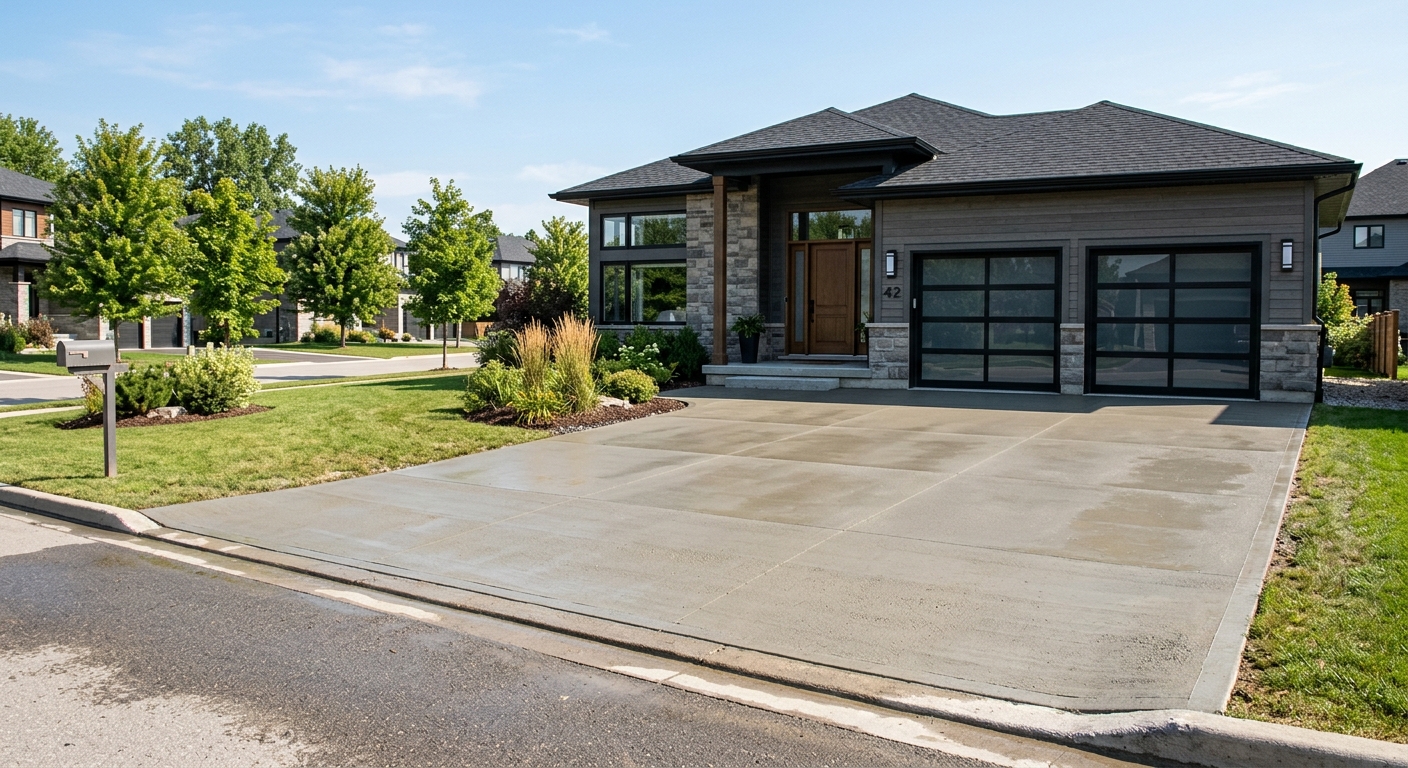
Concrete work options and costs in Pump Hill
Pump Hill, Alberta is a small community, but the demand for concrete flatwork keeps pace with the Calgary market—especially around the more established pockets of NE Calgary influence where homeowners update driveways, add patios, and rework entrances. With a population of 1,455 (Statistics Canada, 2021 Census), most concrete demand comes from resident upgrades tied to the area’s housing mix, including a steady baseline of single-detached homes that typically need new drive approaches, slab repairs, and backyard walkways. (Statistics Canada, 2021 Census)
In Calgary’s cold continental climate, your cost depends heavily on frost protection, freeze–thaw durability specs, and how long the contractor can pour and cure exterior work safely. With a design frost depth of about 1.2 m (roughly 4 ft), footings for garages, decks, and foundation elements must bear on undisturbed soil below that level. Exterior slabs then need air-entrained concrete, proper base prep, and a controlled approach to curing so you don’t end up with surface scaling or early spalling. That means excavation and granular base work are more intensive than in milder regions, and cold-weather precautions can add labour and materials.
If you’re comparing options, stamped and exposed aggregate driveways usually cost more but can be a good value when you want curb appeal that holds up to de-icing salt and winter abrasion. Below is a practical cost comparison by common application, before site conditions and finish selections are finalized.
| Application |
Typical Size |
Key Spec |
Finish Option |
Price Range |
| Concrete driveway (standard broom finish) |
24 ft x 10 ft (240 sq ft) |
Air-entrained concrete; reinforced where required; compacted base |
Broom finish with light saw-cut joints |
$12,500–$17,500 |
| Exposed aggregate driveway |
24 ft x 10 ft (240 sq ft) |
Air-entrained concrete; higher cement paste quality; curing control |
Exposed aggregate with sealer |
$15,000–$21,000 |
| Stamped concrete driveway or patio |
300 sq ft (e.g., 22 ft x 14 ft) |
Air-entrained mix; integral colour; engineered joint layout |
Stamp pattern + colour hardener; sealed surface |
$18,000–$27,500 |
| Plain concrete patio or walkway |
160 sq ft (e.g., 16 ft x 10 ft) |
Air-entrained; compacted base; control joints |
Smooth trowel or broom-touch finish |
$5,500–$9,000 |
| Garage floor (interior slab) |
22 ft x 20 ft (440 sq ft) |
Minimum 32 MPa mix; vapour barrier where applicable |
Broom finish |
$13,000–$19,500 |
| Foundation footings (structural, below frost) |
~1,200 sq ft of footing plan (varies by plan) |
Engineer-designed rebar and footing sizes; below 1.2 m design frost depth |
Structural concrete only (no decorative finish) |
$30,000–$48,000 |
Prices are estimates only and vary by project scope, site access and material selection.
What affects the price of concrete work in Pump Hill
In Calgary and the surrounding region, you can see the same concrete project swing by 30–50% between quotes because pricing is driven by engineering specs (frost protection and reinforcement), site conditions (how much you must dig and haul), and whether the contractor schedules for cold-weather curing. Two crews can pour “the same” driveway width and thickness, yet one may include a deeper granular base, air-entrained mix targets, reinforcement where needed, and proper jointing—while another may price tighter scope. That’s why homeowners often find that a driveway that lands near the lower end of the market still has the right specs, but a “cheap” option can skip the elements that prevent freeze–thaw damage.
In this climate, frost line depth and freeze–thaw cycles dictate almost everything. Footings must extend below the design frost depth of about 1.2 m to help prevent frost heave. For exterior slabs—driveways, patios, and walkways—air-entrained concrete is essential to survive the repeated cycles. Calgary also has a shorter effective pour season, so winter-grade placement, insulated blankets, and sometimes temporary heat can add cost. Finally, de-icing salts accelerate surface deterioration, which is why sealing and surface finishing choices matter for longevity.
In Pump Hill, one common cost driver is soil and access: if excavation is deeper or there’s rocky fill, excavation and disposal can push a project toward the higher end of the concrete driveway / slab band (roughly $12,000–$18,000). On the flip side, a small patio with straightforward access can land closer to the patio / walkway band (about $5,000–$9,000) because the base prep and reinforcement scope are simpler. For foundation work, older builds or complex layouts can add rebar and engineered changes, commonly pushing foundation / footings closer to $28,000–$45,000 or beyond once site constraints are factored.
| Price Factor |
Why It Matters |
Cost Impact |
| Frost line depth — determines footing depth and form height |
Footings must bear below the design frost depth to reduce frost heave risk |
Can add major excavation and concrete volume; shifts foundation pricing upward |
| Site preparation — excavation, grading, compacted granular base |
Uneven base or insufficient depth leads to settlement and cracking |
Higher disposal/haul-off and granular supply pushes totals up |
| Reinforcement — rebar or wire mesh requirement |
Controls cracking and supports loads (especially driveways and garage slabs) |
Adds material and labour; omission can reduce cost but shorten service life |
| Mix design — air-entrainment and compressive strength spec |
Air-entrainment supports freeze–thaw durability; strength supports structural demands |
Better mix selection increases material costs but reduces long-term spalling |
| Finish type — broom vs. stamped vs. exposed aggregate |
Finish affects labour time, materials (integral colour/aggregate), and surface prep |
Stamped/exposed typically adds cost compared to broom finish |
| Pour size and concrete truck access to site |
Smaller pours or tight access may require more labour for placement and finishing |
May require additional crews/handling; can raise cost significantly |
| Cold-weather curing precautions — heating and blankets |
Concrete must reach adequate early strength to reduce scaling and surface damage |
Winter heating/insulation can add line-item costs and scheduling delays |
| Control joint pattern and sealing cost |
Joints manage shrinkage cracks; sealing helps protect from de-icing salts |
Proper jointing and sealing add materials/labour but improve durability |
Permits & regulations in Alberta
In Alberta, most structural concrete work—things that support a building—requires a building permit and commonly engineered drawings reviewed by the municipality. That typically includes: footings, foundation walls, grade beams, and any concrete that forms part of the primary structural system. Concrete flatwork like driveways, patios, and walkways usually does not require a permit, unless it triggers other approvals tied to lot grading, drainage, impervious surface/coverage limits, or work affecting the municipal right-of-way. In Pump Hill, it’s especially smart to confirm if your driveway ties into curb, sidewalk, or drainage swales that the municipality monitors.
To verify a contractor before you sign, do this step-by-step:
- Check the contractor’s insurance by requesting a certificate of insurance: you want proof of general liability that covers concrete work and the worksite.
- Confirm workplace coverage (WSIB/WCB). In Alberta, you’ll typically see registration/coverage information on documentation—ask directly and request proof.
- Look for an online registry entry where applicable for Alberta businesses, then match the licence/business name to the quote and invoice.
- Ask for references on similar-size concrete jobs (driveways, patio/sidewalk pours, or footing subtrades) and confirm they were completed in winter/late-fall conditions where relevant.
- Verify whether permit pull is included if your scope includes structural elements. Don’t assume—confirm in writing.
Getting concrete right in Pump Hill's freeze-thaw climate
The most common concrete failures I see in Pump Hill are not “mystery defects”—they’re predictable results of base issues, weak or improperly specified mix design, and rushed curing during Calgary-area freeze–thaw cycles. To spec the job correctly, start with five fundamentals. First, base preparation: the sub-base must be compacted to the right thickness and profile so frost doesn’t lift the slab or cause settlement. Second, mix design: exterior flatwork should use an air-entrained concrete (typically 5–7% air) and a minimum 32 MPa compressive strength. Third, control joints: they need a disciplined spacing and saw-cut timing to limit random cracking. Fourth, curing: plan for minimum 7 days under proper conditions; in cold snaps, heating and insulated blankets can be the difference between durable finish and early scaling. Fifth, sealing: a penetrating sealer applied after cure (commonly around 28 days) helps repel de-icing salt intrusion that otherwise accelerates surface breakdown.
When homeowners choose decorative finishes, it’s worth understanding what you’re paying for. For example, upgrading from a broom-finished driveway to stamped concrete can move you from the basic driveway range (around $12,000–$18,000) into the stamped band (often $15,000–$26,000 and beyond depending on size). That premium is usually justified because stamped work includes integral colour materials, additional finishing labour, and often tighter joint planning and sealing—features that protect the surface in winter. The cheapest option is rarely the one with the right air-entrainment and curing plan.
| Spec |
Why It Matters in Pump Hill |
What to Ask For |
Impact if Skipped |
| Compacted granular base (depth?) |
Proper base depth and compaction reduce settlement and frost-related movement |
Base type and compacted depth (engineer/geo based) + compaction method/proof |
Cracking, uneven slab, premature edge failure |
| Air-entrained concrete mix (target air %?) |
Air voids protect against freeze–thaw damage and spalling |
Target air content (typically 5–7% for exterior flatwork) and mix documentation |
Surface scaling and spalling within seasons |
| Compressive strength (MPa rating) |
Strength helps the slab resist loads and stresses after freeze–thaw cycling |
Minimum 32 MPa and confirmation it matches the exposure condition |
Greater risk of cracking and deterioration under traffic/salt |
| Control joints (spacing per ACI guidelines) |
Joints manage shrinkage so cracking happens where you can control it |
Planned joint spacing, saw-cut timing, and how edges/corners are treated |
Random cracking that can widen and allow water intrusion |
| Minimum 7-day curing period |
Early strength development reduces scaling and surface weakness |
Minimum cure approach and winter curing plan (blankets/heating if needed) |
Scaling, dusting, weakened surface layer |
| Penetrating sealer (when applied after cure) |
Repels de-icing salt and moisture that drive freeze–thaw deterioration |
Confirm product type and application timing (commonly around 28 days post-pour) |
Faster surface breakdown and more maintenance over time |
How to choose a concrete work contractor in Pump Hill
Choosing the right contractor in Pump Hill is mostly about verification and documentation. In Alberta, you should confirm the contractor’s liability insurance (request a current certificate) and that they have appropriate WSIB/WCB coverage for their workers. Ask for proof before work starts and make sure the insured name and address match the company on your quote. Then ask how they handle cold-weather concrete: if they can’t explain their curing approach (blankets/heating and scheduling), that’s a red flag in Calgary’s freeze–thaw environment.
Get 2–3 itemised written quotes with a labour + materials breakdown. For example, ask whether the base prep includes specific excavation depth, granular type, compacted thickness, and disposal/haul-off. Clarify whether the quote includes saw-cut joints, reinforcement (rebar or mesh), and whether sealing is included for exterior flatwork. Also ask what’s excluded: tree roots removal, unknown subsoil conditions, sidewalk/curb tie-ins, permit fees (for structural work), and patching/disposal.
For warranty, demand the workmanship warranty length in writing and whether the concrete is installed under a manufacturer system that includes product warranty details. Confirm transferability if you sell your home. On payment, never pay more than 10–15% upfront; hold back until key milestones are complete and the surface has cured to the agreed standard. Finally, insist on a written timeline: start date, pour date, weather contingency, and completion estimate.
- Insist on itemised scope: excavation depth, base material, thickness, compaction.
- Confirm reinforcement plan: rebar/mesh placement and spacing where required.
- Ask for mix specs: air-entrainment target and minimum compressive strength (MPa).
- Verify cold-weather plan: insulated blankets/heating and curing schedule.
- Check joint plan: spacing, saw-cut timing, and edge treatment.
- Confirm sealing: product type and application timing after cure.
- Get disposal/haul-off stated—rock/soil removal can be the hidden cost.
- Ask about truck access and staging (where concrete is placed and finished).
- Require photos of completed similar jobs in Calgary area conditions.
- Request proof of general liability insurance before any demo starts.
- Confirm WSIB/WCB coverage for their crew (not just subcontractors).
- Put warranty and payment schedule in the contract, including holdback terms.
In Pump Hill, common concrete contractor red flags include: offering a price without base prep specs (no granular depth or compaction details), refusing to state mix targets for air-entrainment, pushing late-fall pours without winter curing measures, skipping reinforcement “to save money,” and not including sealing/joint details when the project is exposed to de-icing salts.
Frequently asked questions — concrete work in Pump Hill
Stamped vs broom-finish concrete — cost difference?
In Pump Hill and the wider Calgary market, stamped concrete usually costs noticeably more than broom-finish because it includes colour hardeners/integral colouring, extra labour for stamping, and often a more detailed joint and sealing plan to protect the decorative surface in freeze–thaw conditions. A broom-finished driveway typically sits around the $12,000–$18,000 band (depending on size and base prep), while stamped driveway or patio work commonly lands in the $15,000–$26,000 range. If your decorative upgrade is small (like a short walkway), the relative difference can feel smaller; if you’re doing a full driveway, stamped costs are more obvious. Always compare quotes with the same thickness and base scope—some “cheap” stamped jobs cut corners on the substrate, which can backfire quickly in Alberta winters.
When is the best time to pour concrete in Pump Hill?
The best time is generally late spring through summer when temperatures stay stable enough for proper curing without heavy heating or blanket measures. In Calgary-area freeze–thaw conditions, cold snaps can compromise early strength development, increasing the risk of scaling. If you must pour in shoulder season, ask the contractor what winter-grade mix they use and whether they’ll provide insulated blankets and temporary heat to protect the curing window. For exterior slabs like driveways and patios, scheduling matters as much as mix design—rushing cure is where we see performance problems. For foundation footings/structural elements, engineering and inspection timing can also drive schedule, but curing protection still matters because Alberta winters are unforgiving on fresh concrete.
How long does concrete take to cure?
Concrete cure is a process, not a single day. For practical purposes, you’ll typically see crews planning for at least 7 days of adequate curing before expecting early load or full surface hardening. However, concrete reaches closer to design properties over a longer period, commonly around 28 days for many performance targets. That’s also the usual timeframe to schedule penetrating sealer for exterior work to help repel de-icing salt intrusion. If your project is poured during cold weather, proper curing becomes more critical and may require heating or insulation to hold temperatures in a safe range. Ask your contractor to explain the curing steps they’ll take and how they’ll protect the concrete through the first week.
Do I need a permit for concrete work in Alberta?
Often, no permit is required for simple concrete flatwork like patios, walkways, and driveways, unless the work affects lot grading, drainage, impervious surface coverage limits, or impacts the municipal right-of-way. That said, structural concrete typically requires a building permit—think footings, foundation walls, and grade beams—because engineered drawings and municipal review are commonly involved. In Pump Hill, the safest approach is to confirm with the local authority before breaking ground, especially if your driveway ties into curb/sidewalk drainage patterns or your project includes foundation-related work. Also verify your contractor is properly insured and covered under WSIB/WCB; a permit or inspection process is only part of protecting your project.
Concrete vs pavers for a patio in Pump Hill?
Concrete and pavers can both work well in Alberta freeze–thaw climates, but the durability story differs. Concrete patios perform best when they’re built on a properly compacted base with air-entrained mix, correct jointing, and curing protection; they’re also generally faster to install and easier to maintain long-term when sealed. Pavers can be a strong choice if you want easy localized repairs and a more granular look, but they require meticulous base preparation and edge restraint to prevent movement over time. Cost-wise, a plain concrete patio often aligns with the $5,000–$9,000 band depending on size and access. Decorative concrete can move upward, while paver pricing typically depends heavily on the product system and labour complexity. If you’re unsure, ask for comparable scope: same finished thickness, base depth, drainage approach, and whether joints are engineered.
How long does a concrete driveway last?
A well-built concrete driveway in the Pump Hill/Calgary area can last for decades, but longevity depends on whether the job was engineered for frost and freeze–thaw, not just poured on a “standard” thickness. With proper sub-base preparation, air-entrained concrete, reinforced design where required, disciplined control joints, and sealing to resist de-icing salt, many driveways hold up to the region’s winter exposure for a long time. If these details are skipped—especially air-entrainment or curing protection—you may see early scaling or spalling, sometimes within a few winters. The difference between a driveway around $12,000–$18,000 and a higher-spec install is often the included base and curing practices that protect the slab during the harshest temperature swings. Ask your contractor what durability steps are included in their quote.