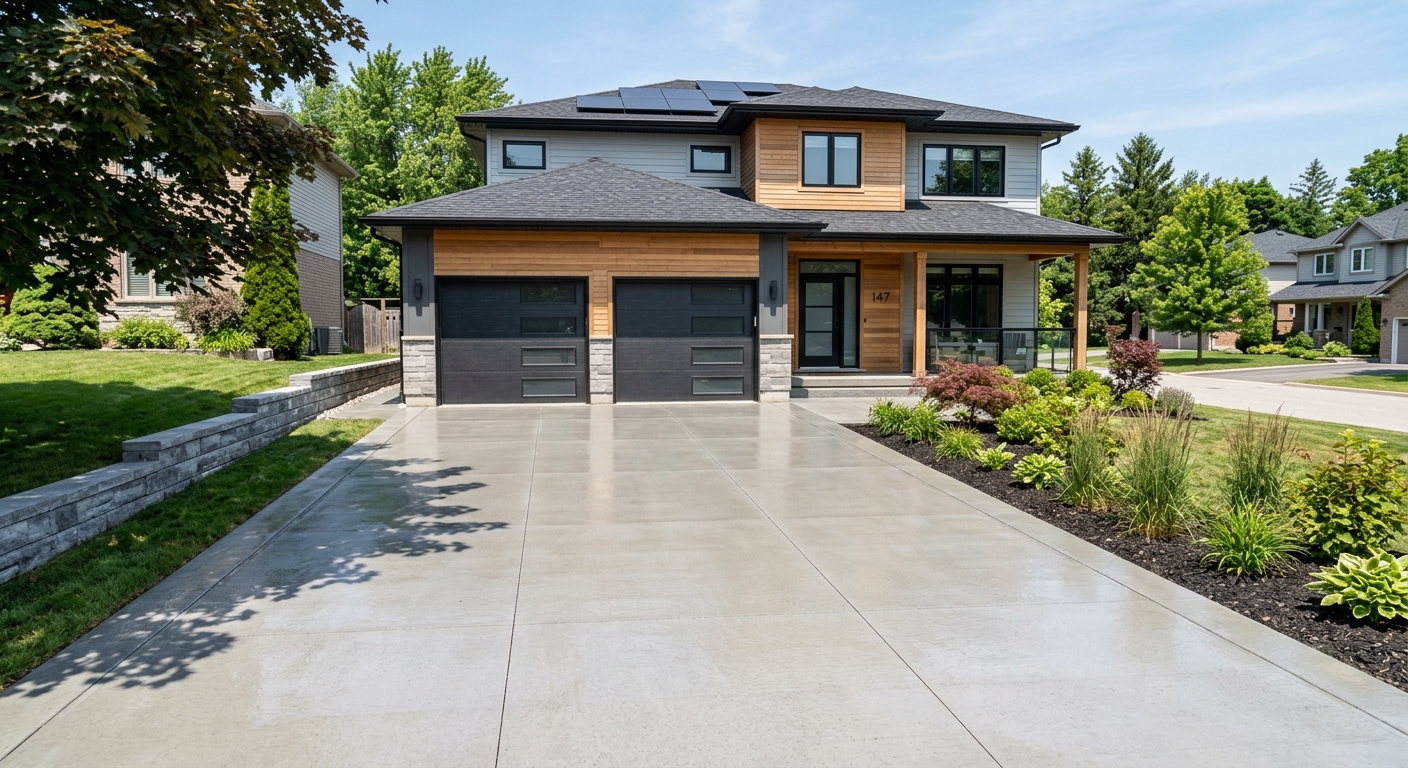
Concrete work options and costs in Sherbrooke
Concrete work in Sherbrooke is usually tied to three homeowner priorities: driveways, patios/walkways, and foundations. While Sherbrooke’s population is small at 2,438 (Statistics Canada, 2021 Census), the surrounding Calgary economic pull means contractors and material deliveries often follow Calgary scheduling, which can tighten availability in peak season. That matters for planning because exterior pours are engineered around the cold continental climate and freeze–thaw cycles—so the “fastest” crew isn’t always the cheapest option if the curing window gets compromised.
In practical terms, you’ll see the biggest demand for flatwork in established residential pockets, where aging driveways and walkways are due for replacement before winter road salt and slush accelerate surface deterioration. In Sherbrooke, demand is especially common in the older, mature neighbourhoods with more frequent vehicle and foot traffic routes, where spalling and scaling show up sooner. The Calgary-area frost-depth design approach is a major driver of foundation and footing pricing: footings for houses, garages, decks, and retaining structures are typically set below the design frost depth (about 1.2 m in Alberta planning practice), and that translates into more excavation, more formwork, and larger concrete volumes than homeowners expect.
For exterior slabs, costs also reflect air-entrained mix specs and cold-weather curing precautions. Calgary’s shorter pour season can compress scheduling, and winter-grade placement may require insulated blankets or temporary heat—cost adders that show up clearly in quotes. Use the table below to compare typical price ranges for common options in Sherbrooke, then we’ll break down the factors that push projects toward the higher end.
| Application |
Typical Size |
Key Spec |
Finish Option |
Price Range |
| Concrete driveway (standard broom finish) |
24 ft x 12 ft (288 sq ft) |
Air-entrained mix; compacted granular base |
Broom finish + control joints |
$12,000–$18,000 |
| Exposed aggregate driveway |
24 ft x 12 ft (288 sq ft) |
Air-entrained mix; exposed stone process |
Exposed aggregate finish + sealer |
$14,000–$20,500 |
| Stamped concrete driveway or patio |
20 ft x 20 ft (400 sq ft) |
Air-entrained mix; colour hardener/sealer system |
Stamp pattern + release + sealer |
$15,000–$26,000 |
| Plain concrete patio or walkway |
12 ft x 16 ft (192 sq ft) |
Air-entrained mix; proper slope & base |
Steel-trowel float + broom edge |
$5,000–$9,000 |
| Garage floor (interior slab) |
22 ft x 22 ft (484 sq ft) |
Vapour barrier; proper mix & reinforcement per design |
Plain finish; light broom/straight trowel |
$7,500–$13,500 |
| Foundation footings (structural, below frost) |
Typical two-storey house (engineered) |
Excavation below design frost depth; reinforced footings |
N/A (structural) |
$28,000–$45,000 |
Prices are estimates only and vary by project scope, site access and material selection.
What affects the price of concrete work in Sherbrooke
It’s common in the Calgary region to see the same concrete scope quoted 30–50% apart, even when the concrete style sounds simple. The difference is usually in the engineered items that protect the slab in a cold continental climate: excavation depth, granular base prep, reinforcement, mix design (especially air-entrainment), and how cold-weather curing is handled. In practice, two contractors can both say “driveway,” but one may include the right base build-up and the proper air-entrained mix, while another tries to hold price by trimming those line items.
Frost-line depth and freeze–thaw cycles dictate every major spec here. Footings must typically extend below the design frost depth (about 1.2 m in Alberta planning practice) to avoid frost heave and seasonal movement. For exterior flatwork, that same exposure to repeated freezing and thawing requires air-entrained concrete so the slab can tolerate expansion/contraction without scaling and spalling. Because the effective pour season is shorter, contractors may need cold-weather curing precautions—insulated blankets, protection during placement, and sometimes temporary heat—when work starts late fall or early spring. Finally, de-icing salt accelerates surface breakdown, so sealing and maintenance become part of the long-term cost picture; a poorly sealed slab often ends up being “repaired” sooner.
In Sherbrooke, a backyard patio in a well-drained area can land closer to the $5,000–$9,000 band, while a driveway on heavier clay soil with additional excavation and higher base depth can push toward the $12,000–$18,000 end. As homes age, replacement work also frequently includes saw-cutting, hauling, and disposal of old concrete, which can move a “mid-range” estimate up by thousands. With foundation work, engineered drawings and rebar schedules can swing costs depending on footing width and reinforcement requirements, which is why quotes for foundation/footings commonly land in the $28,000–$45,000 range.
| Price Factor |
Why It Matters |
Cost Impact |
| Frost line depth |
Determines footing depth and form height |
More excavation and concrete volume; can add significant cost on frost-protected designs |
| Site preparation |
Excavation, grading, compacted granular base |
Pushing toward higher base depth and better compaction increases labour and materials |
| Reinforcement |
Rebar or wire mesh requirement |
Extra steel and placement labour; worth it for crack control and structural capacity |
| Mix design |
Air-entrainment and compressive strength spec |
Air-entrained/winter-grade mixes cost more; reducing it can create long-term failures |
| Finish type |
Broom vs. stamped vs. exposed aggregate |
Stamped/exposed requires additional crew time, colour system, and finishing materials |
| Pour size and concrete truck access to site |
How much you can place per truck and how far it must be pumped/placed |
Limited access may require pumping, extra labour, and more staging time |
| Cold-weather curing precautions |
Heating and blankets |
Protection costs rise quickly if temperatures drop during the critical early cure window |
| Control joint pattern and sealing cost |
Limits random cracking and protects against salt intrusion |
Proper joint layout and sealer add upfront cost but reduce early deterioration |
Permits & regulations in Alberta
In Alberta, concrete that is part of the structure typically triggers permitting. If you’re planning structural concrete such as footings, foundation walls, grade beams, or other engineered foundation elements, you should expect a building permit and, in many cases, engineered drawings reviewed through the municipal process. For concrete flatwork—driveways, patios, and walkways—permits are often not required unless the work affects lot grading, drainage, impervious surface coverage, or the municipal right-of-way. Even when a permit isn’t automatically required, it’s smart to confirm before breaking ground, especially where slopes, downspouts, or egress routes change.
To protect yourself as a homeowner in Sherbrooke, verify the contractor’s credentials step-by-step:
- Ask for their Alberta business licence details (and the company’s legal name) and confirm it matches their quote and invoices.
- Request a certificate of liability insurance showing coverage amount and effective dates; ensure it lists your property address or at least the policy holder correctly.
- Confirm WSIB/WCB coverage for workers (ask for clearance documentation if applicable, or proof of registration/coverage).
- Request references for similar-scale projects (same type of slab, comparable site access, and comparable winter timing).
Good contractors won’t treat this as “too much paperwork.” Clear proof up front usually signals that crews work to spec—including frost-aware excavation and air-entrained mixes—rather than trying to rush around winter constraints.
Getting concrete right in Sherbrooke's freeze-thaw climate
Concrete fails in Sherbrooke’s climate most often because of one or more missing layers of protection: insufficient base preparation, the wrong mix for freeze–thaw exposure, poor jointing, or curing that doesn’t get a proper early-age temperature window. The fix is to specify a system, not just “some concrete.” Start with base preparation: place and compact a granular sub-base to the designed depth for local soil conditions and frost exposure, then grade the surface for proper drainage. Next, use an air-entrained concrete mix engineered for exterior exposure—typically targeting about 5–7% air content for exterior slabs—plus a minimum 32 MPa compressive strength spec (or higher if your engineer requires it). Then lay out control joints to limit random cracking, and commit to curing: minimum 7 days under appropriate conditions, with cold-weather precautions such as insulated blankets and/or temporary heat when temperatures fall. Finally, apply a penetrating sealer after the slab is fully cured—commonly 28 days—to help repel de-icing salts.
Here’s where you can see the value in paying for the right option. If you’re choosing between standard broom finish and stamped concrete for a patio, stamped work typically sits closer to the $15,000–$26,000 band for driveways/patios (size and design dependent), while plain patios usually fall around $5,000–$9,000. The price difference is justified when stamped systems are paired with the correct air-entrained mix, base prep, and seal schedule. If those “invisible” specs are cut, even a stamped patio won’t resist spalling and scaling the way it should in Calgary-area freeze–thaw.
Use this checklist as you talk to contractors: ask about air-entrainment verification, joint spacing, curing protection plans, and the sealer timeline. Those details are what prevent the most common Sherbrooke winter problem—surface spalling from inadequate air content and salt intrusion.
| Spec |
Why It Matters in Sherbrooke |
What to Ask For |
Impact if Skipped |
| Compacted granular base (depth?) |
Stabilizes the slab and reduces frost-related movement |
Documented base depth and compaction method for your soil |
Settlement and cracking; higher risk of joint failure and uneven slabs |
| Air-entrained concrete mix (target air %?) |
Protects against freeze–thaw scaling and spalling |
Target air content about 5–7% for exterior flatwork |
Surface scaling, spalling, and faster deterioration with salt exposure |
| Compressive strength (MPa rating) |
Ensures durability under loads and temperature cycling |
Minimum 32 MPa (or higher per engineered needs) |
Reduced long-term strength; potential cracking and premature wear |
| Control joints (spacing per ACI guidelines) |
Controls where cracks form instead of random cracking |
Joint layout with spacing appropriate for slab thickness and dimensions |
Random cracks; water intrusion that accelerates freeze damage |
| Minimum 7-day curing period |
Develops strength and reduces early-age defects |
What curing plan is used when temperatures drop |
Surface weakness, scaling, and poor bond in cold placement windows |
| Penetrating sealer (when applied after cure) |
Repels de-icing salt and reduces water absorption |
Schedule sealer application around 28 days post-pour |
Salt-driven deterioration; higher maintenance and earlier replacement costs |
How to choose a concrete work contractor in Sherbrooke
When you’re picking a concrete contractor in Sherbrooke, verify credentials before you ever compare final pricing. In Alberta, start with business licensing details (company legal name, not just a marketing name). Next, ask for a certificate of liability insurance and confirm it covers the type of work being quoted—foundation and flatwork both create liability exposures. For workers, confirm WSIB/WCB coverage and ask for proof/clearance documentation if offered. If they can’t provide current insurance and coverage information, treat it as a red flag—especially when winter scheduling can increase risk and the job requires tight curing management.
Then get 2–3 itemised written quotes. You want a breakdown that separates excavation and granular base, reinforcement (if applicable), concrete supply and air-entrainment/winter mix selection, finishing labour (broom vs. stamped vs. exposed aggregate), formwork, and curing protection. A quote that only states a lump sum for “concrete and finishing” makes it hard to compare apples to apples. Also ask whether a permit is included (when required), whether old concrete disposal is included, and who handles traffic control/safety around your driveway approach.
Warranty matters too: ask for workmanship warranty length, whether product/manufacturer warranties apply (for sealers/colour systems on decorative jobs), and whether coverage is transferable if you sell the property. For payment, never accept more than about 10–15% upfront; hold back a portion until the slab is complete and finished to spec. Finally, insist on a timeline in writing: start date, pour date expectations, and completion estimate, since cold-weather curing in the Calgary region can shift schedules.
- Verify Alberta licensing details match the invoice name.
- Request certificate of liability insurance and check effective dates.
- Confirm WSIB/WCB coverage for workers (ask for proof/clearance).
- Get itemised quotes (labour, materials, base prep, reinforcement, finishing).
- Confirm whether air-entrained and/or winter-grade mix is included for exterior work.
- Ask for curing plan during cold snaps (insulated blankets/heating if needed).
- Require joint layout details and sealing schedule for driveways/patios.
- Clarify exclusions: disposal, permits, saw cutting, pump charges, haul distances.
- Ensure site access plan is included (truck access and any pumping).
- Ask what happens if weather drops before the pour—who reschedules and how.
- Review warranty terms: workmanship, product/finishing systems, transferability.
- Set payment schedule with progress milestones; keep holdback until cleanup and final finish are confirmed.
Red flags I commonly see in concrete contractor problems in Sherbrooke: vague scopes with no base depth or mix spec, quotes that don’t mention air-entrainment for exterior slabs, refusing to provide insurance/WSIB/WCB proof, “cheap” stamped work that skips a compatible seal system, and crews that treat curing as optional rather than engineered protection during early-age development.
Frequently asked questions — concrete work in Sherbrooke
How do I compare concrete quotes?
To compare concrete quotes in Sherbrooke, insist on itemised line items—not just a total price. Look for what’s included in the base prep (excavation depth and compacted granular base), reinforcement details (wire mesh vs. rebar where required), and concrete specs (air-entrainment for exterior slabs, and winter-grade or cold-weather curing measures if the schedule is tight). Ask about curing protection plans and the joint layout method, because those directly affect cracking in freeze–thaw. A driveway quote near the middle of the $12,000–$18,000 band can still be a bad deal if it cuts base depth or air content. Similarly, a patio quote in the $5,000–$9,000 range should still include proper drainage, compaction, and sealing timing, not “concrete and leave.”
Can concrete be poured in cold weather in Sherbrooke?
Yes, concrete can be poured in cold weather in Sherbrooke, but it must be engineered for it. In the Calgary region’s freeze–thaw climate, the early-age cure is the most sensitive stage; if temperatures fall and curing isn’t protected, you can get weak surfaces, scaling, or durability issues later. A competent crew will plan for cold-weather curing: insulated blankets, wind protection, temporary heat if needed, and a winter-grade mix suited to placement conditions. Ask the contractor what their plan is if a cold snap hits within 24–48 hours of your pour date, and whether they will delay or protect the work. If your job is priced as a standard summer pour with no mention of heating/blankets, be careful—those measures are often part of why winter placement costs more.
How do I maintain concrete in Sherbrooke's freeze-thaw climate?
Maintenance in Sherbrooke is mainly about controlling water and protecting the surface from de-icing salt. After a new driveway or patio cures, have it sealed with a penetrating sealer (often about 28 days post-pour), then re-evaluate after seasons depending on traffic and weather exposure. Keep the slab clean by removing sand/salt build-up regularly, because trapped grit accelerates abrasion and can speed up scaling. Watch control joints: if sealant is damaged or missing, water can enter and freeze, enlarging cracks over time. Avoid using sharp metal scrapers that gouge the surface—use plastic scrapers or foam-based ice melt where appropriate. For any lifting or drainage issues, fix them early; base and drainage problems usually won’t “self-correct” in a freeze–thaw cycle.
What causes concrete to spall in Sherbrooke winters?
Spalling in Sherbrooke winters is usually linked to freeze–thaw damage plus salt exposure. The most common root cause is inadequate air-entrainment in the concrete mix, which means the freeze cycle can’t release pressure safely within the paste. When water enters the surface through microcracks or poor joint sealing, it freezes, expands, and breaks off small pieces—scaling first, then spalling. High salt and de-icing abrasion make it worse by increasing chemical attack and surface wear. The risk also rises when curing is rushed or temperatures drop during early age without protection, because you end up with a weaker, more porous surface. That’s why reputable contractors price exterior work with proper air-entrained mix specs and curing protection as part of the job—not as an optional add-on.
What is rebar and when is it required in Alberta?
Rebar (reinforcing steel bars) is used to add tensile strength and help control cracking in structural elements where concrete alone isn’t enough. In Alberta, whether rebar is required depends on the engineered design and the type of concrete work. For typical house foundation footings, grade beams, and foundation walls, engineered drawings often specify reinforcement size, spacing, and placement details, so rebar is commonly required. For exterior slabs like some driveways and patios, reinforcement may be specified based on thickness, sub-base support, and loading conditions—sometimes contractors use wire mesh or fibres, but many designs still call for rebar in areas of higher stress or when slab thickness is limited. If your quote doesn’t clearly state what reinforcement is included for your specific design, ask for the thickness and reinforcement plan before you sign.
How long does a concrete project take in Sherbrooke?
Timelines in Sherbrooke depend on size, access, and weather. For small flatwork like a patio or walkway, you might see a fast on-site schedule: excavation and forming in a day or two, then the pour and finishing on a scheduled day. Decorative work (stamped or exposed aggregate) takes longer because it includes extra finishing steps and timing considerations for colour/stamp processes. A driveway often takes longer due to base prep, saw cutting, and forming to match the approach and drainage. However, the full “safe use” timeline depends on curing: many crews schedule work, then wait a minimum curing period before heavy loads. Even if the surface looks ready, don’t treat it as fully cured. Foundation work is slower because it involves excavation below frost depth, inspections, and forming/reinforcement coordination. If you’re budgeting, plan for curing and potential cold-weather protection—those steps protect durability in freeze–thaw conditions.