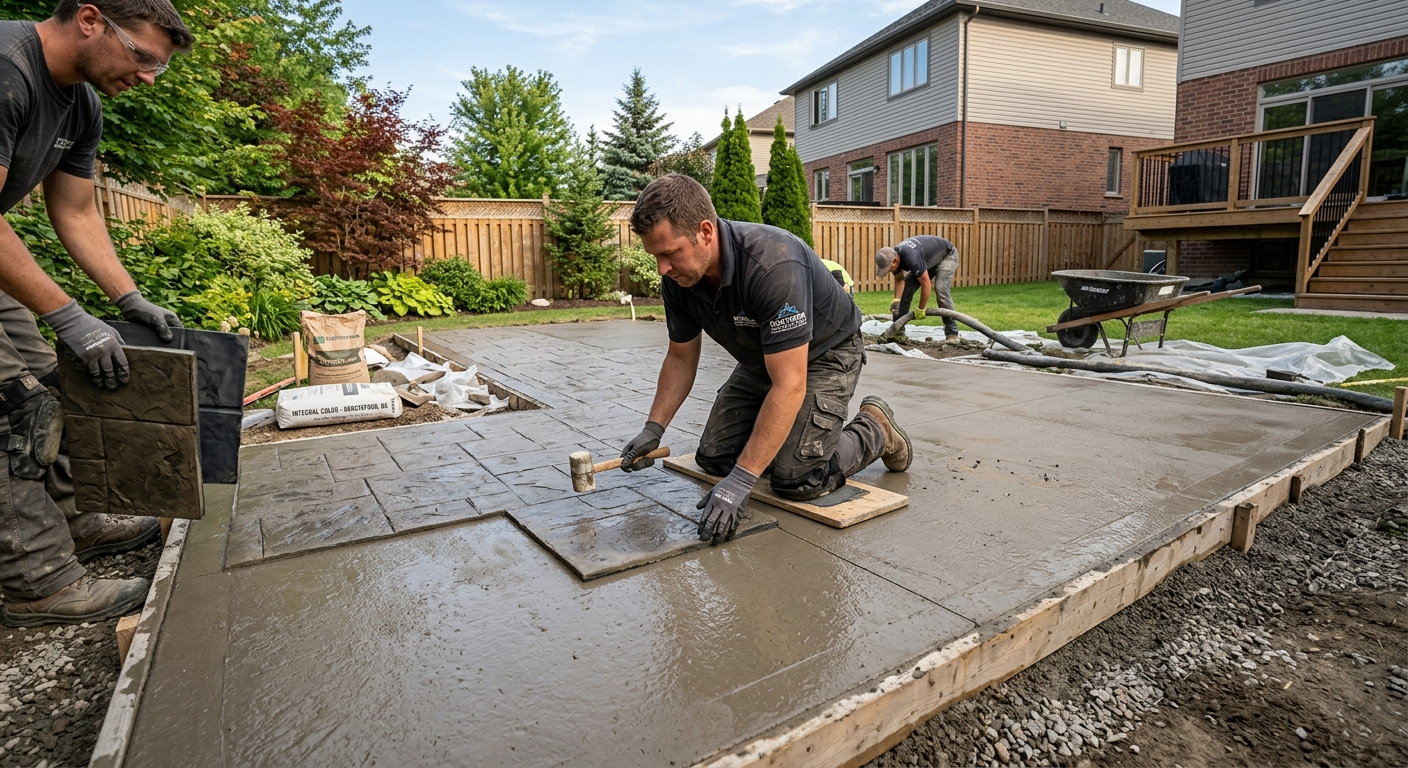
Concrete work options and costs in Hairsine
Hairsine, Alberta is a small community (population 2,465 per the Statistics Canada, 2021 Census), but the concrete needs are very real—driveways, patios, garage floors, and foundations for the kind of family housing that fills the area around Calgary’s growth. If you’re planning new flatwork or upgrading existing surfaces, the most common projects are concrete driveways and patios/walkways, because they’re the fastest way to improve curb appeal and usable outdoor space.
In this Calgary-area market, cost varies with both engineering requirements and the weather window. The region’s cold continental climate means frost and freeze–thaw cycles are planned for in every spec. Footings for houses, garages, decks, and retaining structures must typically bear on undisturbed soil below the design frost depth (about 1.2 m, roughly 4 ft). Exterior slabs also need air-entrained concrete mixes and deliberate control joint spacing to reduce cracking and spalling over time.
Hairsine properties also tend to see seasonal surface challenges like standing meltwater and rapid temperature swings. Add in the shorter pour season for exterior work and the need for winter-grade curing practices—insulating blankets, temperature monitoring, and sometimes heat—and you’ll understand why two “similar” quotes can differ. Availability of crews and concrete trucks can tighten around the shoulder seasons, especially when multiple contractors are stacking pours to beat cold snaps.
In practice, demand is often strongest on the newer infill and service-road areas where homeowners are building or upgrading drive access—so if your lot is in a busier construction pocket around the Hairsine–Calgary commuter corridor, expect more scheduling pressure and more value in getting detailed scopes early. Use the table below to compare typical options and ranges, then we’ll break down what drives the numbers.
| Application |
Typical Size |
Key Spec |
Finish Option |
Price Range |
| Concrete driveway (standard broom finish) |
400–500 sq. ft. |
4 in slab, air-entrained, control joints |
Broom finish |
$12,000–$18,000 |
| Exposed aggregate driveway |
400–500 sq. ft. |
Air-entrained mix, proper base prep |
Surface retarder/exposed stone |
$14,000–$20,500 |
| Stamped concrete driveway or patio |
300–450 sq. ft. |
Air-entrained mix, integral color, joints |
Stamp + release + stain/sealer |
$15,000–$26,000 |
| Plain concrete patio or walkway |
200–350 sq. ft. |
4 in slab, air-entrained, joints |
Broom or light trowel |
$5,000–$9,000 |
| Garage floor (interior slab) |
500–600 sq. ft. |
4 in slab, reinforced where needed |
Float/trowel finish (optional sealer) |
$10,500–$16,000 |
| Foundation footings (structural, below frost) |
Typical single house: 1,000–1,600 lineal ft. total perimeter/attachments |
Engineered excavation, rebar, concrete below design frost depth |
Structural pour (formwork and rebar) |
$28,000–$45,000 |
Prices are estimates only and vary by project scope, site access and material selection.
What affects the price of concrete work in Hairsine
In Hairsine, Alberta, it’s common to see quotes for the “same” concrete job come in 30–50% apart once you look past the surface. The spread usually comes from differences in engineering depth, excavation scope, reinforcement approach, and whether the contractor is pricing for Calgary’s real freeze–thaw conditions—not a generic template. When you’re comparing bids, you’re often really comparing base prep quality, mix design, curing planning, and how much risk the contractor is carrying.
Here are the big drivers. First, frost line depth and freeze–thaw cycles dictate every spec. Footings need to extend below the design frost depth (about 1.2 m in this region, roughly 4 ft) to prevent frost heave and seasonal movement. Exterior slabs also require air-entrained concrete mixes to survive repeated freezing and thawing, especially if de-icing salts will be used. Second, the cold-weather pour season is shorter around Calgary, and winter-grade placement (insulated blankets, heat, and temperature control) can add cost even when the slab size is unchanged. Third, de-icing salt accelerates surface spalling on under-specified mixes—so sealing becomes part of a durable plan.
Concrete examples that show how costs rise or fall in Hairsine: a driveway with poor drainage or shallow base may need extra granular excavation and re-compaction, pushing the job upward toward the higher end of the $12,000–$18,000 driveway band. A stamped patio can cost more than a plain walkway because of formwork, stamping labour, and curing coordination—often justified when you want long-term appearance and you’re already budgeting in the $15,000–$26,000 decorative range. Also, if you’re retrofitting an older lot with mature shrubs or uneven grades, haul-away and regrading can add real dollars fast; if you’re working on newer, simpler access, you may land closer to the lower end.
| Price Factor |
Why It Matters |
Cost Impact |
| Frost line depth — determines footing depth and form height |
Footings must bear below design frost depth to prevent heave and movement |
Higher excavation volume can push foundation costs up significantly |
| Site preparation — excavation, grading, compacted granular base |
Concrete performance relies on stable, well-compacted support |
Rock, soft spots, and drainage corrections add labour and materials |
| Reinforcement — rebar or wire mesh requirement |
Controls cracking and improves slab durability under load |
More steel and additional placement labour increases price |
| Mix design — air-entrainment and compressive strength spec |
Air-entrainment resists freeze–thaw damage; strength supports loads |
Higher-spec mixes cost more and require stricter placement conditions |
| Finish type — broom vs. stamped vs. exposed aggregate |
Labour intensity and material steps differ widely |
Decorative finishes add time, tools, and sealer systems |
| Pour size and concrete truck access to site |
Truck distance affects pumping/chute time and schedule |
Pump or extra logistics can add $ and compress crew availability |
| Cold-weather curing precautions — heating and blankets |
Proper curing prevents scaling and structural problems in late season |
Insulation, temperature monitoring, and heat can increase labour and fuel costs |
| Control joint pattern and sealing cost |
Joints manage cracking; sealer reduces salt-driven surface wear |
Better joint layout and penetrating sealer add modest cost, but reduce callbacks |
Permits & regulations in Alberta
In Alberta, structural concrete work needs the right approvals. In Hairsine, that means if you’re building or modifying the structural portion of a foundation—footings, foundation walls, grade beams, and similar load-bearing elements—you’ll typically need a building permit, and you’ll often be working from engineered drawings that are reviewed as part of the permit process. Concrete flatwork like a driveway, patio, or walkway usually does not require a permit by default, but it can trigger requirements if it affects lot grading, stormwater drainage, or municipal impervious surface coverage rules, or if it intersects municipal right-of-way concerns (like approaches, culverts, or sidewalk tie-ins). Always confirm with the local authority before breaking ground.
Step-by-step, here’s how a homeowner in Hairsine can verify a contractor is properly set up in Alberta:
- Ask for their Alberta business licence number or trade registration (if applicable) and confirm it in the relevant online listings.
- Request a current Certificate of Insurance and check that it includes liability coverage appropriate to the project scope.
- Ask about WSIB/WCB coverage (and whether they have clearance/active status). If they can’t provide documentation, treat it as a risk flag.
- Request references from similar foundation/flatwork projects in the Calgary region and confirm completion dates.
- Confirm who pulls permits (if required) and ensure the scope clearly states permit responsibility.
Taking these steps up front is the simplest way to protect yourself from schedule delays, workmanship disputes, and coverage gaps when winter weather hits and concrete must be placed and cured correctly.
Getting concrete right in Hairsine's freeze-thaw climate
Concrete fails in Hairsine most often for predictable reasons: weak or poorly prepared base support, inadequate frost resistance, insufficient air-entrainment, and rushed curing. In a cold continental climate with freeze–thaw cycles, water migrates in and around the slab. If the concrete isn’t designed to handle that movement, you’ll see early surface scaling, scaling over rebar areas, and eventually spalling—especially where de-icing salts are used.
To spec the job correctly, build the plan around five pillars. (1) Base preparation: excavate to the proper depth and install a compacted granular sub-base that matches the intended slab design. In Alberta, you can’t “eyeball” it—compaction and thickness determine whether the slab stays stable through winter. (2) Mix design: exterior slabs should use air-entrained concrete (commonly targeted around 5–7% air for exterior flatwork depending on aggregate and exposure) and a minimum compressive strength of about 32 MPa for typical residential applications. (3) Control joints: create a joint pattern that limits random cracking to predetermined lines. (4) Curing: plan for at least 7 days of proper curing conditions; when temperatures drop, cold-weather measures may be required to keep the concrete from early freeze. (5) Sealing: apply a penetrating sealer after the slab has fully cured (often around 28 days) to repel salt and slow surface breakdown.
Here’s a practical dollar example: if a standard broom-finished driveway lands around the middle of the $12,000–$18,000 band, upgrading to a stamped driveway can add cost (often toward the $15,000–$26,000 band). That price difference is justified when the contractor also increases attention to joint layout, curing coordination, and sealer system selection—not just stamping the surface. If the base and air content are under-specified, the stamp won’t prevent spalling; it can even mask early cracking until it’s expensive to repair.
When you talk to a contractor, ask direct questions about air content targets, base thickness/compaction methods, curing temperature plan, and the proposed joint spacing. Those answers are where durable concrete is won or lost in the Calgary/Hairsine freeze–thaw environment.
| Spec |
Why It Matters in Hairsine |
What to Ask For |
Impact if Skipped |
| Compacted granular base (depth?) |
Stable support prevents movement and cracking during freeze–thaw |
Base thickness, granular type, and compaction method with inspection checkpoints |
Uneven settlement, cracked slab, and faster surface deterioration |
| Air-entrained concrete mix (target air %?) |
Air void system helps resist freeze–thaw damage |
Air target (commonly 5–7% for exterior flatwork) and documentation of mix design |
Surface scaling and spalling, especially with de-icing salts |
| Compressive strength (MPa rating) |
Strength supports load and durability in winter conditions |
Minimum 32 MPa (or higher where specified) and how it’s verified |
Premature wear, cracking, and reduced structural reliability |
| Control joints (spacing per ACI guidelines) |
Controls where cracking happens during contraction/expansion |
Planned joint spacing, depth, and layout tied to slab dimensions |
Random cracks and potential joint failure pathways for water |
| Minimum 7-day curing period |
Proper hydration strength gain prevents early freeze damage |
Curing method and cold-weather plan if temps fall (blankets/heating where required) |
Scaling, loss of surface integrity, and weaker long-term performance |
| Penetrating sealer (when applied after cure) |
Salt and moisture exposure are harsher in winter cycles |
Sealer type and timing—typically after curing (often around 28 days post-pour) |
Faster spalling and staining, higher maintenance frequency |
How to choose a concrete work contractor in Hairsine
Choosing the right concrete contractor in Hairsine is mostly about proof: proof they understand frost and curing, proof they’re insured for the work, and proof their quotes are detailed enough that you can compare them apples-to-apples.
Start with Alberta licensing and coverage. Ask for:
- Insurance: request a current Certificate of Insurance showing liability coverage appropriate to your project size and scope.
- WSIB/WCB clearance/coverage: confirm they carry coverage and can provide documentation (clearance letter or proof of active status, as applicable).
- References: at least a few comparable jobs in the Calgary region, ideally in similar winter conditions.
Next, get 2–3 written, itemised quotes. For concrete work, the most useful quotes separate labour and materials (concrete supply, rebar/wire mesh, base/granular, excavation, forms, joints, finishing, and sealing). Avoid “one lump number” quotes—if you can’t see what’s included, you can’t judge value. Also ask whether the contractor is handling permits (when required), disposal, and any protection measures for landscaping or existing services.
Finally, check the warranty and payment schedule. A workmanship warranty should be clear (length, what’s covered, and for how long). Product/manufacturer warranty matters too, especially for sealers and admixtures. Payment should be controlled: typically no more than 10–15% upfront, with a holdback until the job is complete and inspected. Get the start date and completion estimate in writing—concrete doesn’t care about your calendar when temperatures drop, so schedule planning is part of quality.
- Confirm the quote includes air-entrained mix for exterior flatwork and a specified curing plan for cold weather.
- Ask for base thickness and compaction requirements (not just “we’ll prep the base”).
- Verify joint spacing and whether joints are cut/timed correctly for the slab type.
- Check if rebar or mesh is specified where needed (driveways and slabs-on-grade may require reinforcement depending on loads/design).
- Request a concrete mix design summary (strength and air target) for your project.
- Confirm who disposes of excess soil and whether haul-away is included.
- Ask about truck access and whether pumping is included if placement distance is long.
- Review the sealer scope: type, timing after cure, and whether it’s included or optional.
- Make sure the quote states weather limits and winter procedures (blankets/heating/temperature control).
- Get cleanup expectations in writing (edges, forms removal, grading touch-ups).
- Confirm start date and pour-day timing so the contractor can cure properly.
- Ask for warranty terms in writing before signing.
If you see these red flags in Hairsine—no mention of air-entrainment, a vague “we’ll pour when it warms up” plan, no joint layout details, no discussion of curing/blankets for late-season pours, or a quote that omits sealing for salt exposure—pause and request revisions before you sign.
Frequently asked questions — concrete work in Hairsine
How do I prepare the base for a concrete slab?
Base prep is the foundation of the foundation, especially in Hairsine’s Alberta freeze–thaw climate. A good slab starts with excavation to the designed depth, then grading so you get proper drainage and level support. Contractors should install a compacted granular sub-base of the right thickness for the slab type, using equipment that can achieve consistent compaction—not light raking. Because frost heave risk is managed by bearing below the effective frost zone, the footing depth and sub-base thickness matter more here than in milder provinces. For flatwork, also plan for well-drained granular layers and a stable transition around edges. When you compare quotes, ask the contractor to state base depth, granular type, compaction method, and whether they’ll proof-grade and inspect before pouring.
How do I compare concrete quotes?
In Hairsine and the broader Calgary region, you compare quotes by scope and specifications, not just the total number. Look for differences that commonly swing pricing by 30–50%: excavation volume, granular base depth/compaction, whether the concrete is air-entrained, rebar/mesh inclusion, joint spacing and sealing, and whether cold-weather curing precautions are planned. For example, a driveway bid that lands near $12,000–$18,000 can still be poor value if it assumes minimal base prep or lacks a winter curing plan. Likewise, a stamped patio near $15,000–$26,000 is only worth it if the contractor provides control joint details, proper cure timing, and a sealer system that accounts for de-icing salts. Ask for itemised labour + materials and confirm what’s included: disposal, permit handling (when required), and sealing timing.
Can concrete be poured in cold weather in Hairsine?
Yes, concrete can be poured in cold weather in Hairsine, but it has to be engineered for it. The risk in Calgary-area winters is early temperature drop that can interrupt curing—leading to scaling, weak surface durability, and long-term performance issues. A reputable Alberta contractor will plan for cold-weather placement: winter-grade mixes if needed, insulated curing blankets, and sometimes temporary heat to keep the concrete within the curing temperature range. They should also monitor temperatures and adjust timing for finishing. If a contractor promises “we’ll be fine” without talking about heating/blankets and curing duration, that’s a concern. When the schedule is tight in late fall or early spring, demand and crew availability can rise, but quality still depends on curing—at minimum, you should expect proper curing for at least 7 days under appropriate conditions.
How do I maintain concrete in Hairsine's freeze-thaw climate?
Maintenance is mostly about controlling moisture and salt exposure. In Hairsine, regular inspection after winter helps you catch early scaling or minor spalling before it spreads. Keep gutters and downspouts directing water away from the slab edges and joints, since trapped water accelerates freeze–thaw damage. Use de-icing methods carefully: calcium chloride and rock salt are common, but the more aggressive the salt and the more often it’s used, the faster surfaces can degrade. Sealing makes a difference—penetrating sealers applied after proper cure (often around 28 days post-pour) help repel moisture and slow salt-driven surface breakdown. If you have a driveway or patio, reapply sealing based on the sealer manufacturer’s recommendations and observe traffic/vehicle loads; heavy impacts can create micro-cracks that become pathways for water during thaw cycles.
What causes concrete to spall in Hairsine winters?
Spalling in Hairsine is usually tied to freeze–thaw stress meeting weak or under-specified concrete. The most common causes are inadequate air-entrainment (the concrete doesn’t have the air void structure needed to manage freezing water), insufficient curing (concrete doesn’t gain enough strength before temperatures drop), and poor drainage/base support that allows water to collect. De-icing salts intensify the problem: once salts are present, moisture exchange at the surface becomes more aggressive, and damaged areas expand over cycles. Another contributor is skipping or mismanaging control joints; cracks open pathways for water into the slab layers. When reviewing your project, make sure the contractor specifies air-entrained concrete for exterior flatwork and includes a curing/temperature plan. That’s the difference between a driveway that ages well in Alberta and one that looks worse after a couple of seasons.
What is rebar and when is it required in Alberta?
Rebar (reinforcing bar) is steel reinforcement that helps concrete handle tensile forces and controls cracking. It’s typically required where design loads, structural demands, or slab-on-grade conditions justify reinforcement—commonly in foundation elements like footings and foundation walls, and often in engineered slabs depending on thickness, soil support, and loading. In Alberta, the “when” comes down to engineered design and applicable construction details: structural concrete work like footings and grade beams generally follows engineering requirements and typically needs rebar as part of the reinforcement system. For flatwork like driveways, some designs use reinforcement (rebar or mesh) but whether it’s necessary depends on slab thickness, sub-base, load expectations, and the contractor’s/specifications. When getting a quote in Hairsine, ask the contractor to state what reinforcement they’re including, where it will be placed, and how it ties into durability under freeze–thaw cycles.