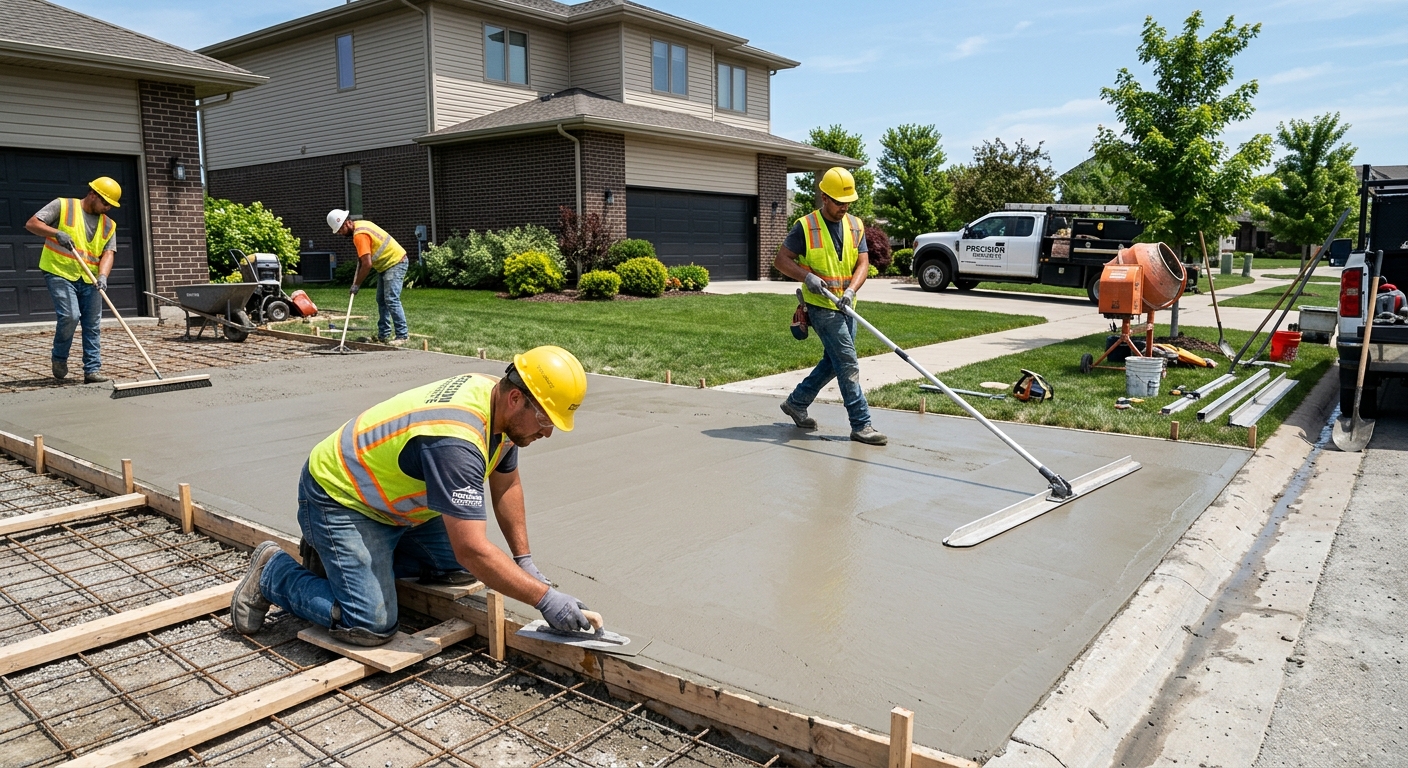
Concrete work options and costs in Silver Springs
Concrete work in Silver Springs, Alberta is typically driven by the same two realities homeowners feel every year: winter freeze–thaw and deeper frost requirements across the Calgary region. With a population of 8,570 (Statistics Canada, 2021 Census), the market is smaller than Calgary itself, so the best crews often book out quicker—especially for exterior flatwork near higher-demand pockets like the newer residential areas close to Range Road and the roadway corridors connecting toward Calgary. In this area, concrete flatwork is a common fit for the type of housing stock that dominates the local suburban build-out, where driveways, patios, and walkways are frequently added or replaced as homes age and garages get updated.
Calgary’s cold continental climate also changes what you pay for. Local engineering practice commonly assumes a design frost depth of about 1.2 m (roughly 4 ft) for typical residential supports, meaning more excavation and larger footing volumes than you’d see in milder provinces. Add freeze–thaw cycling—plus short practical pour seasons for exterior slabs—and pricing shifts. Exterior pours need air-entrained mixes, careful temperature management, and sometimes winter-grade practices like insulated blankets or temporary heat. That’s why one contractor’s “driveway price” can’t be compared to another’s without verifying base prep, concrete mix specs, and joint/sealer details.
Below is a practical way to compare options—from broom-finished driveways to stamped work and structural foundation footings—before you request itemised quotes.
| Application |
Typical Size |
Key Spec |
Finish Option |
Price Range |
| Concrete driveway (standard broom finish) |
24 ft x 10 ft (240 sq. ft.) |
Air-entrained mix, compacted granular base, control joints |
Broom finish with light edging |
$12,000–$18,000 |
| Exposed aggregate driveway |
24 ft x 10 ft (240 sq. ft.) |
Air-entrained mix, retarder/wash timing, sealed after cure |
Exposed aggregate (durable, textured surface) |
$14,000–$20,500 |
| Stamped concrete driveway or patio |
18 ft x 12 ft (216 sq. ft.) |
Air-entrained mix, reinforcement as required, color hardener/release |
Stamp pattern + integral color (optional border) |
$15,000–$26,000 |
| Plain concrete patio or walkway |
12 ft x 10 ft (120 sq. ft.) |
Air-entrained mix, compacted base, joints |
Float + broom or light broom texture |
$5,000–$9,000 |
| Garage floor (interior slab) |
22 ft x 20 ft (440 sq. ft.) |
Vapour barrier (if required), reinforced slab, proper curing |
Broom finish or light trowel + broom |
$8,500–$14,500 |
| Foundation footings (structural, below frost) |
Typical single-family footprint |
Engineered sizing, below design frost depth, rebar per design |
Structural concrete (no decorative finish) |
$28,000–$45,000 |
Prices are estimates only and vary by project scope, site access and material selection.
What affects the price of concrete work in Silver Springs
In Silver Springs and the wider Calgary region, it’s common to see quotes for the “same” concrete project come in 30–50% apart. The reason usually isn’t the finish—it’s what’s hidden below the surface: how deep the excavation goes, what your base thickness is, whether reinforcement is specified correctly, and how the contractor protects the pour during cold weather curing.
The biggest driver is frost design and freeze–thaw cycles. Local practice engineers footings and supports to bear on undisturbed soil below the design frost depth (about 1.2 m in this region, roughly 4 ft). That means bigger excavation and more concrete for foundations, garages, and any grade-supported exterior structures. Next, exterior slabs need air-entrained concrete to resist freeze–thaw damage. If air content or mix design is under-specified, you’re buying lower costs now and paying for scaling or spalling later.
Cold-weather placement also tightens timelines. When temperatures drop, achieving proper curing can require winter-grade mix, insulated blankets, and sometimes temporary heat—costs that show up in labour and materials. Finally, de-icing salt used in Alberta accelerates surface deterioration on unsealed or poorly finished concrete, so sealing is often essential.
Here are examples of how local conditions push pricing up or down in Silver Springs. A driveway that needs removal of a thick old slab and deep trenching for drainage can move you toward the $12,000–$18,000 driveway band rather than the low end. A stamped patio with tight access and more formwork often climbs into the $15,000–$26,000 stamped range because the labour is specialized and the schedule must be protected for curing.
Even housing-stock age matters: older yards often have irregular fill, weaker topsoil, or poor drainage, so base preparation can become the largest “variable” line item—sometimes by thousands of dollars.
| Price Factor |
Why It Matters |
Cost Impact |
| Frost line depth — determines footing depth and form height |
Footings must extend below design frost to prevent frost heave |
More excavation and concrete can add significant cost on foundations |
| Site preparation — excavation, grading, compacted granular base |
Bad base leads to settlement, cracking, and premature failure |
Thicker base and proper compaction increase labour and material |
| Reinforcement — rebar or wire mesh requirement |
Rebar controls cracking in structural and higher-load slabs |
Adding steel increases material cost and placement labour |
| Mix design — air-entrainment and compressive strength spec |
Freeze–thaw resistance depends on correct air content and strength |
Proper air-entrained mixes and specified strength add cost but reduce spalling |
| Finish type — broom vs. stamped vs. exposed aggregate |
Complex finishes take more labour and tighter timing |
Stamped/exposed often requires specialized crews and added materials |
| Pour size and concrete truck access to site |
Large pours need more manpower; access limits affect methods |
Long carry distances, limited access, or extra equipment raises cost |
| Cold-weather curing precautions — heating and blankets |
Low temperatures can stop proper curing and increase surface defects |
Winter-grade practices can add labour and rental/consumables |
| Control joint pattern and sealing cost |
Joints manage shrinkage cracking; sealing protects from salt scaling |
Better joint layout and sealer increase upfront scope but extend lifespan |
Permits & regulations in Alberta
In Alberta, structural concrete work usually triggers permitting and engineered design review. For homeowners in Silver Springs, the work that typically DO require a building permit includes: foundation footings, foundation walls, grade beams, and any other load-bearing structural concrete tied to the structural system. These elements affect the building’s safety and must match approved drawings.
Concrete flatwork—patios, sidewalks, and driveways—often does not require a building permit on its own. However, it may become regulated if it affects lot drainage, changes grading, introduces or alters impervious surface coverage, or impacts municipal right-of-way conditions. The safe approach is to confirm with the local authority before breaking ground, especially if your driveway tie-in changes runoff patterns or elevation.
To verify a contractor is legit in Alberta, do it step-by-step: first, ask for their liability insurance certificate (it should name you/your property as additional insured where applicable). Second, confirm their WCB/WSIB coverage—contractors should be able to provide proof and/or a clearance-style document. Third, verify any required business licensing or registrations through Alberta’s online resources and the contractor’s own documentation. Finally, request references on projects similar in scale to your driveway, patio, or foundation pour, and ask to see photos taken through winter conditions.
Getting concrete right in Silver Springs's freeze-thaw climate
Concrete failures in Silver Springs are usually predictable: inadequate base preparation, poor mix design, weak curing, and missing protection against de-icing salts. In a cold continental climate with frequent freeze–thaw cycles, the concrete has to be engineered to handle expanding and contracting moisture in the slab. If it isn’t, you’ll see scaling, surface dusting, and eventually spalling.
To spec the job correctly, focus on five areas. (1) Base preparation: require a compacted granular sub-base at the depth needed for your site and to support slabs below and around frost-impacted zones. (2) Mix design: require air-entrainment for exterior flatwork; a typical target is 5–7% air to improve freeze–thaw durability, and the slab should meet a minimum 32 MPa compressive strength rating. (3) Control joints: spacing should be planned to limit random cracking—joints are cheaper than repairs. (4) Curing: insist on at least 7 days of curing under proper conditions; in cold weather, crews may need insulated blankets or temporary heat to keep the curing process on track. (5) Sealing: for salt exposure, plan for a penetrating sealer applied after the concrete has cured—commonly at 28 days post-pour—so moisture and salts repel rather than soak in.
Ask direct questions to avoid spalling caused by inadequate air-entrainment. For example, a standard broom-finished driveway that lands near the low end of the $12,000–$18,000 band can be a good value if base prep and air content are verified. But if a lower bid skips proper winter curing measures, you might pay again for patching within a few seasons—often more than the price difference.
| Spec |
Why It Matters in Silver Springs |
What to Ask For |
Impact if Skipped |
| Compacted granular base (depth?) |
Prevents settlement and reduces freeze-related movement |
Documented excavation depth and granular base thickness + compaction testing method |
Cracking, uneven slab, and faster edge deterioration |
| Air-entrained concrete mix (target air %?) |
Resists freeze–thaw damage and reduces risk of scaling/spalling |
Confirm target air content (typically 5–7% for exterior flatwork) and mix design printout |
Surface scaling and spalling within winters |
| Compressive strength (MPa rating) |
Strength supports loads and improves long-term durability |
Minimum 32 MPa compressive strength rating for the specified mix |
Wear, cracking, and reduced lifespan under traffic and cold stress |
| Control joints (spacing per ACI guidelines) |
Controls shrinkage cracking location |
Joint layout plan with spacing and saw-cut timing |
Random cracking and wider, harder-to-repair damage |
| Minimum 7-day curing period |
Enables proper strength gain in Alberta’s temperature swings |
How curing is protected when nights are cold (blankets/heat plan if needed) |
Reduced strength and higher risk of surface defects |
| Penetrating sealer (when applied after cure) |
Helps repel moisture and de-icing salt exposure |
Sealer application timing—commonly at 28 days post-pour after cure |
Salt-driven scaling and accelerated surface wear |
How to choose a concrete work contractor in Silver Springs
Choosing the right concrete contractor in Silver Springs is mostly about verifying paperwork, then verifying the scope. Start with Alberta compliance: ask for their liability insurance certificate and proof of WCB/WSIB coverage. You should be able to see documentation with coverage details and dates. Next, request their business licensing/registrations if applicable and confirm they’re operating as a real contractor (not just a crew showing up). A reputable company will also provide references for similar work—driveways with air-entrained mixes and proper joints, or foundations where below-frost excavation is handled correctly.
For pricing, don’t accept only a lump sum. Get 2–3 itemised written quotes showing labour and materials: excavation and haul, base prep, reinforcement, concrete mix spec, finish labour, and curing/sealing allowances. Read the scope for exclusions like permit pull responsibility, topsoil restoration, rebar/wire mesh inclusion, and whether concrete disposal is included. If a quote is “cheap,” it often removes something small but critical—like winter curing protection or proper joint timing.
Warranty matters too. Ask for the length of workmanship warranty, the existence of any product/manufacturer warranty, and whether the warranty is transferable to a new homeowner. Payment should be controlled: never pay more than 10–15% upfront, and hold back funds until the job is complete and cleaned. Finally, insist on a written start date and completion estimate, especially because exterior pours in late fall can require scheduling around temperature and curing needs.
- Request concrete mix details (air content, strength rating) in writing.
- Confirm base excavation depth and granular base thickness, not just “we prep the base.”
- Ask about reinforcement plan (rebar vs mesh, tied where required).
- Verify control joint layout and who saw-cuts (timing matters).
- Confirm cold-weather curing plan: blankets, heaters, and set protection.
- Get a written scope for sealing (type and timing, typically after 28 days).
- Ask whether removal/disposal of old concrete is included.
- Clarify grading tie-ins and drainage direction to prevent water pooling.
- Make sure traffic management and protection of landscaping is addressed.
- Confirm permit responsibility (if the project affects grading/structures).
- Require itemised quotes: labour, materials, equipment, and contingency.
- Use a payment schedule with a holdback until acceptance and cleanup.
Concrete contractor red flags in Silver Springs include: refusing to provide mix specs or air-entrainment details, quoting without base thickness/compaction info, no proof of WCB/WSIB or liability insurance, starting exterior pours in freezing conditions without curing protection, and offering a very low price while excluding sealing or reinforcement language from the scope.
Frequently asked questions — concrete work in Silver Springs
How do I compare concrete quotes?
To compare quotes in Silver Springs, Alberta, line up the scope item-by-item instead of comparing only the total. Ask each contractor to specify concrete mix (including air-entrainment and a compressive strength rating like 32 MPa for typical exterior work), base prep depth and compaction approach, and whether reinforcement is included. For finish work, compare finish details too—broom vs stamped vs exposed aggregate often changes labour and curing time. Then check schedule and curing: Calgary-area winters mean cold-weather protection can add cost, and you want it included if temperatures are near freezing. A practical benchmark: driveways in this region often land in the $12,000–$18,000 band for broom-finished work, while stamped projects frequently fall closer to $15,000–$26,000. If a quote is far outside those ranges, ask exactly what was removed.
Can concrete be poured in cold weather in Silver Springs?
Yes, concrete can be poured in cold weather in Silver Springs, but it has to be done with the right cold-weather practices. The issue isn’t just “snow”—it’s curing performance. If temperatures drop too quickly, concrete may not gain strength properly, which increases the risk of surface scaling and long-term cracking during freeze–thaw cycles common in the Calgary region. Reputable contractors plan for this with winter-grade mixes, protective measures like insulated blankets and/or temporary heat, and set-protection scheduling. They also protect against freezing during the early strength-gain window. When you get quotes, ask: what temperature triggers your cold-weather plan, what protection is included, and for how many days will curing be maintained? A contractor that treats winter pours like standard summer work is taking shortcuts you’ll pay for later.
How do I maintain concrete in Silver Springs's freeze-thaw climate?
Maintenance in Alberta is about reducing moisture and salt exposure—both of which drive freeze–thaw damage. Start with timing: plan for a penetrating sealer applied after full cure (commonly at 28 days post-pour) so de-icing salts don’t soak into the surface. Keep an eye on small cracks: filling them early helps stop water migration into deeper layers. For cleaning, avoid aggressive methods that can damage the surface. During winter, use de-icing products carefully—salts accelerate deterioration, especially on unsealed or under-cured slabs. Also manage drainage: if your driveway or patio slopes toward the house or toward low spots, water will pool and freeze. That kind of site issue often costs more than routine maintenance, so it’s worth addressing during installation.
What causes concrete to spall in Silver Springs winters?
Spalling usually comes from a combination of freeze–thaw cycling and poor durability protection. In Silver Springs, the most common technical cause is inadequate air-entrainment. When concrete doesn’t have enough air content (typically 5–7% for exterior flatwork), water that enters pores can freeze and expand, breaking the surface layer off over repeated winters. Other contributors include insufficient or rushed curing, weak base prep that allows movement, and lack of sealing that leaves surfaces vulnerable to de-icing salt. If a slab wasn’t protected during early cold-weather curing, it can also have reduced strength at the surface and be more prone to scaling and spalling. When reviewing your contract or future bids, insist on written mix design specs, curing protection plans, and sealer timing—not just “we use proper concrete.”
What is rebar and when is it required in Alberta?
Rebar is steel reinforcing bar used to strengthen concrete and help control cracking—especially in structural members and slabs that see tension or heavier loads. In Alberta, whether rebar (or wire mesh) is required depends on engineering design, slab thickness, soil conditions, and the type of work (driveway, garage floor, foundation footings, or walls). For exterior slabs, some projects use mesh or dowels; structural foundation work typically uses rebar per engineered drawings and below-frost excavation requirements. For foundation footings in Silver Springs, permits and engineered plans are commonly involved, and steel placement is part of that structural package. When comparing quotes, ask directly: “Is rebar included? What size, how it’s supported, and how it’s tied?” If they won’t specify reinforcement, you can’t verify that the concrete will perform through Alberta winters.
How long does a concrete project take in Silver Springs?
Timelines in Silver Springs depend on scope and weather, especially because curing needs to be protected through cold snaps. A driveway pour typically takes about a day for excavation/base prep to complete and a subsequent day (or part of a day) for finishing and curing setup—though the full project stretches longer due to cure protection and joint work. Patios and walkways are often quicker, while stamped work can take additional time for formwork, layout, coloring, and proper timing during placement. Foundation footing timelines vary more, because below-frost excavation and coordination with inspections can extend the schedule. Regardless of the project, you should plan for curing: minimum 7 days before normal traffic for many applications (and longer for full strength depending on spec), plus sealer typically after 28 days. If a contractor can’t provide a written start date and completion estimate, that’s a risk in a climate where the pour season window can be short.