Concrete work options and costs in Duggan
Duggan, Alberta is a compact community within Calgary where homeowners rely on durable concrete for driveways, patios and walkways. With a population of 4,530 (Statistics Canada, 2021 Census), you’ll often see repeat bidders and crews who know local soil conditions and truck routes—especially around busy residential streets in and near Silverado/South Calgary-area access corridors. Most concrete flatwork demand comes from typical detached-home lots; in these neighbourhoods, a properly built slab can be the difference between a long-lived surface and one that heaves, scales or starts spalling after a few freeze–thaw seasons.
In the Calgary economic region, concrete pricing is shaped more by engineering and curing logistics than by labour alone. Alberta’s cold continental climate includes frequent freeze–thaw cycles, and local practice is engineered around a design frost depth of about 1.2 m (roughly 4 ft). That means exterior footings and foundation elements must sit on undisturbed soil below the frost line to prevent frost heave. For slabs, crews typically use air-entrained mixes, granular base prep and control joints to reduce random cracking. If you’re pouring closer to winter, cold-weather placement can require winter-grade materials, insulated blankets, and sometimes temporary heat to protect curing—costing more, but usually preventing premature surface damage.
If you’re comparing options for your property in Duggan, start by matching finish and structural needs to the right budget band. Below is a practical snapshot to help you read estimates consistently, then we’ll break down what drives the biggest swings in the next section.
| Application |
Typical Size |
Key Spec |
Finish Option |
Price Range |
| Concrete driveway (standard broom finish) |
20 ft x 10 ft (200 sq ft) |
Air-entrained exterior mix, control joints |
Broomed finish |
$12,000–$18,000 |
| Exposed aggregate driveway |
20 ft x 10 ft (200 sq ft) |
Retarder/exposure process, air-entrained mix |
Exposed aggregate |
$14,000–$22,000 |
| Stamped concrete driveway or patio |
15 ft x 20 ft (300 sq ft) |
Air-entrained mix, base prep for freeze–thaw durability |
Stamped pattern + release color |
$15,000–$26,000 |
| Plain concrete patio or walkway |
10 ft x 12 ft (120 sq ft) |
Air-entrained mix, compacted granular base |
Float + light broom |
$5,000–$9,000 |
| Garage floor (interior slab) |
22 ft x 20 ft (440 sq ft) |
Vapour control + reinforcement as required |
Plain trowel or broom-light |
$7,000–$14,000 |
| Foundation footings (structural, below frost) |
Typical house footprint (engineered) |
Excavation to frost depth, reinforced concrete |
Structural concrete only |
$28,000–$45,000 |
Prices are estimates only and vary by project scope, site access and material selection.
What affects the price of concrete work in Duggan
In Duggan and across the Calgary region, two quotes for the “same” concrete job can differ by 30–50% because the biggest line items aren’t the finish—they’re the engineering and site prep required to survive Alberta’s freeze–thaw cycle. Frost depth also plays a major role. Local practice is engineered around a design frost depth of about 1.2 m (roughly 4 ft), so footings and foundation elements must be placed below that depth on undisturbed soil. Excavation and footing volume are therefore larger than in milder regions, and that directly pushes foundation costs into the $28,000–$45,000 band.
Exterior slabs also need air-entrained concrete and careful control joint spacing to resist cracking and spalling. Calgary-area cold weather shortens the practical pour season for driveways, patios and walkways; if you’re scheduling late fall or early spring, contractors may add winter-grade mix, insulated blankets and/or temporary heat to protect curing. That curing window matters: improper curing is one reason surfaces scale, and once de-icing salts start, weak surfaces can deteriorate faster. Because of these requirements, “cheap concrete” pricing is often a red flag when it skips granular base depth, air content, or proper curing.
Concrete examples that commonly raise or lower cost in Duggan:
- More excavation: deeper frost bearing and removal of unsuitable soil can increase footing and prep costs.
- Hard access: narrow lanes or limited truck access add time for formwork and material handling.
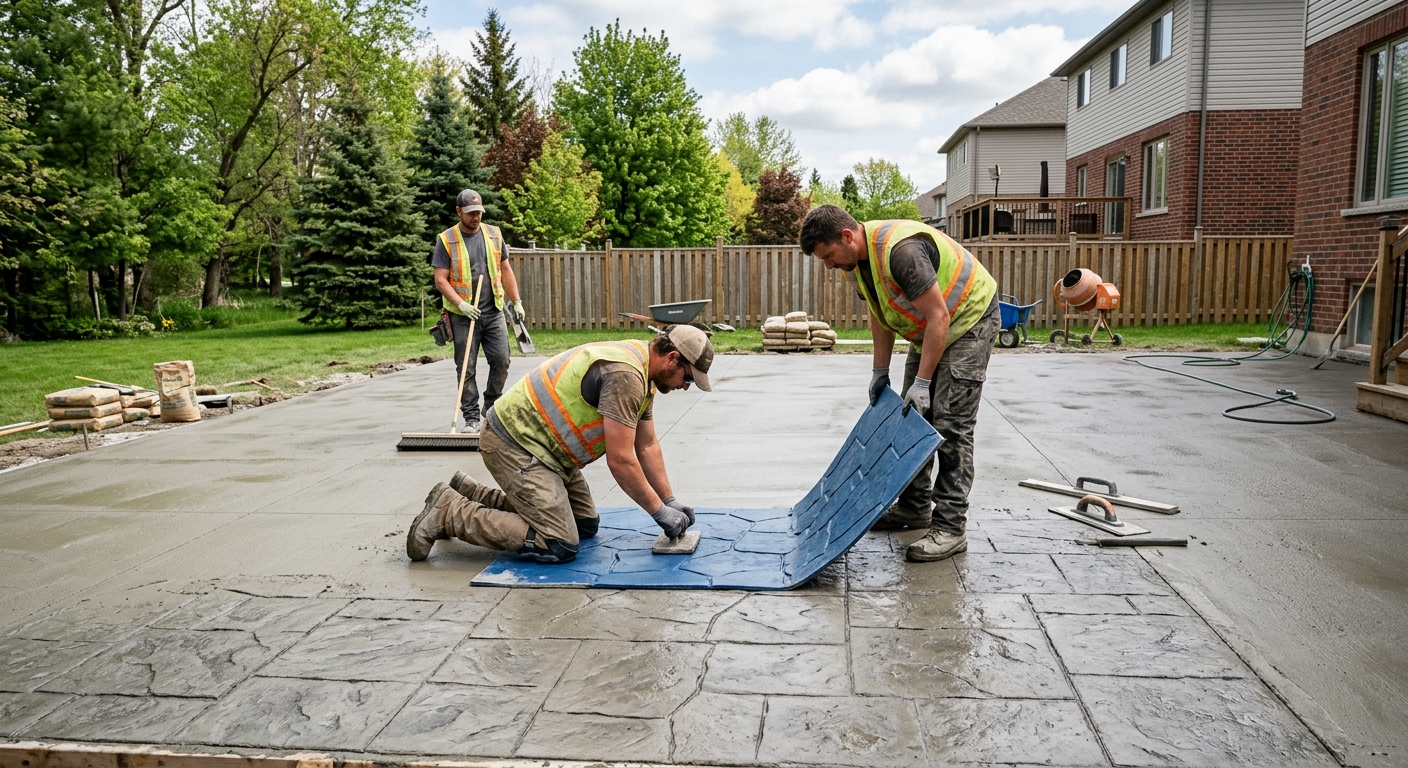
- Finish choice: a stamped job can move you from a $12,000–$18,000 broom driveway mindset into the $15,000–$26,000 range once pattern work, release materials and extra surface prep are included.
Even with similar lot sizes, older housing stock and established grading can mean additional re-shaping and drainage work, which shows up in the quote with dollar-for-dollar impact.
| Price Factor |
Why It Matters |
Cost Impact |
| Frost line depth — determines footing depth and form height |
Footings must bear below design frost to prevent frost heave |
Higher excavation increases foundation budgets by thousands |
| Site preparation — excavation, grading, compacted granular base |
Proper base prevents settlement and reduces slab movement |
Bad soil or poor drainage can add significant labour and material |
| Reinforcement — rebar or wire mesh requirement |
Controls cracking and supports loads in freeze–thaw conditions |
More steel/tighter placement adds material and install labour |
| Mix design — air-entrainment and compressive strength spec |
Air content protects against freeze–thaw damage and scaling |
Winter-grade or higher specs increase material cost |
| Finish type — broom vs. stamped vs. exposed aggregate |
Surface systems require added steps and materials |
Stamped/exposed work often adds the biggest non-structural premium |
| Pour size and concrete truck access to site |
Large pours need scheduling; access affects pour efficiency |
Access limits can trigger extra handling and labour hours |
| Cold-weather curing precautions — heating and blankets |
Protects hydration and early strength gain during curing |
Can raise exterior slab cost when conditions require it |
| Control joint pattern and sealing cost |
Joints manage shrinkage cracking; sealing helps resist salt damage |
Added saw cuts and sealer are small per m² but can add up |
Permits & regulations in Alberta
In Alberta, structural concrete work typically needs municipal oversight. For example, building permit approval is usually required for work such as foundation footings, foundation walls, and grade beams because these elements are part of the structural system and must meet building code requirements. Engineered drawings are often required (or at least strongly expected) so the footings, rebar placement, and bearing conditions are properly designed for your specific lot. By contrast, concrete flatwork like driveways, patios and walkways often does not require a permit on its own—unless your scope impacts grading, drainage, or impervious surface/lot grading considerations, or changes work within a municipal right-of-way.
For Duggan homeowners, the practical step-by-step is:
- Confirm the permit requirement with your municipality or the inspector/permit office before excavation begins.
- Ask the contractor for their liability insurance certificate and verify limits are adequate for your project value.
- Verify WSIB/WCB coverage (workers’ compensation) is active—do not rely on a verbal “yes.”
- Request a copy of their clearance letter or proof of account status where applicable.
- Check for a valid business presence and contact information, and ask for references on similar-scale Calgary-area jobs.
Also confirm who is responsible for utility locating and any street/sidewalk coordination if your driveway ties into curbs or sidewalks.
Getting concrete right in Duggan's freeze-thaw climate
Concrete failures in Duggan usually come from one of five places: inadequate base, poor mix design (especially air), wrong joint planning, rushed curing, or weak surface protection once de-icing salts start. To spec the job correctly for Calgary-area freeze–thaw, begin with base preparation. Exterior slabs and walkways should be on a compacted granular sub-base designed for the site and local frost behaviour; the goal is stable support with minimal movement at the time the slab cures and throughout winter.
Next is the mix design. For exterior flatwork, request air-entrained concrete with a target air content of 5–7% and a minimum compressive strength of 32 MPa. That air entrainment is what helps resist internal ice expansion that leads to scaling and spalling. Control joints matter too: spacing should limit random cracking into manageable lines, particularly where water can sit and freeze. Curing is the make-or-break step—plan for at least 7 days under proper conditions, and if temperatures are near freezing, contractors should use winter-grade placement precautions such as insulated blankets or controlled heat to keep curing temperatures in range.
Finally, sealing: use a penetrating sealer applied after cure (commonly 28 days post-pour) to help repel water and reduce salt intrusion. For a budget example, many homeowners choose a plain patio in the $5,000–$9,000 band; spending more on a stamped finish in the $15,000–$26,000 band is only justified if the base, air content and curing are already locked in—otherwise you’re paying premium dollars for a surface system that can still fail from inadequate mix/spec.
| Spec |
Why It Matters in Duggan |
What to Ask For |
Impact if Skipped |
| Compacted granular base (depth?) |
Stable support reduces settlement and movement during freeze–thaw |
Confirm base thickness and compaction method for your subsoil |
Cracking, uneven slab, and shortened service life |
| Air-entrained concrete mix (target air %?) |
Protects against freeze–thaw damage and surface scaling in cold winters |
Target 5–7% air for exterior flatwork |
Higher risk of spalling and scaling within a few seasons |
| Compressive strength (MPa rating) |
Strength gain supports durability under snow loads, tires and freeze pressure |
Minimum 32 MPa (verify with your mix/FOC) |
Lower durability and increased cracking risk |
| Control joints (spacing per ACI guidelines) |
Manages shrinkage cracking so cracks don’t run wild |
Ask for joint layout/spacing and sealing plan |
Random cracking, water intrusion, and freeze expansion damage |
| Minimum 7-day curing period |
Allows proper hydration and early strength development in cold weather |
Confirm curing protection plan when temperatures drop |
Surface weakness, scaling and loss of long-term strength |
| Penetrating sealer (when applied after cure) |
Repels water and helps reduce de-icer salt penetration |
Apply after cure, commonly 28 days post-pour |
Faster deterioration from salts and moisture cycling |
How to choose a concrete work contractor in Duggan
Choosing the right contractor in Duggan starts with proof, not promises. In Alberta, verify three things: (1) the contractor’s Alberta business licensing/registration (and whether any trade authorizations apply to their scope), (2) liability insurance with a current certificate of insurance, and (3) WSIB/WCB coverage status. When you ask, request the certificate and clearance documentation directly. If they can’t provide it quickly, that’s a risk you don’t want near excavation and structural concrete.
Then get 2–3 itemised written quotes that break down labour and materials—not just a lump sum. A good quote separates things like excavation and haul-away, compacted base material, forms, reinforcement, concrete supply, finishing, and (for exterior work) curing and sealing timing. Read what’s excluded: Who removes unsuitable soil? Is disposal included? Is permit pulling included for any structural scope? Also confirm whether winter protection (blankets/heat) is included if temperatures fall within your scheduled pour window.
For warranty, ask for two pieces: the workmanship warranty length and the product/manufacturer warranty (especially for sealers and any proprietary admixtures). Ask if anything is transferable to the next homeowner if you sell. On payment, never pay more than 10–15% upfront; hold back a portion until completion and clean-up are verified. Finally, insist on a written timeline with a start date and an estimated completion date so you’re not guessing during a short Calgary-season window.
- Provide proof of liability insurance and active WSIB/WCB clearance on request
- Use a contract with scope, start date, and completion estimate in writing
- Get itemised pricing: excavation/base, reinforcement, concrete supply, finishing, curing protection
- Confirm air-entrainment and target strength in the quote details
- Ask for joint layout and whether joints are sealed after cure
- Verify the schedule includes winter-grade curing precautions if temperatures drop
- Confirm who handles utility locating and any municipal coordination
- Require disposal/haul-away of unsuitable soil to be clearly stated
- Clarify access: how concrete trucks reach your lot and staging area limits
- Check warranty terms: workmanship duration, exclusions, and response timeframe
- Avoid large deposits; keep holdback until surface acceptance and clean-up
Concrete contractor red flags in Duggan: quoting a “low air content” or not stating air-entrainment at all; skipping cold-weather curing protection even when your pour date nears freezing; offering a finishing-only quote without detailed base depth and reinforcement scope; asking for most payment upfront without a signed schedule; and avoiding written joint/curing/sealing details—because those omissions are where freeze–thaw damage usually starts.
Frequently asked questions — concrete work in Duggan
How do I seal concrete to protect it in Duggan?
In Duggan and across the Calgary region, sealing is mainly about reducing water and de-icer salt intrusion—water is what turns into ice during freeze–thaw and expands inside tiny pores and micro-cracks. For most exterior slabs (driveways, patios and walkways), use a penetrating sealer applied after the concrete has cured—commonly around 28 days post-pour—so the slab is dry enough for the sealer to absorb properly. Before sealing, the surface should be clean and dry (power-washing is common), and any curing residue should be removed. Ask your contractor to specify the sealer type and coverage rate, and confirm whether joints are planned for sealing after saw cuts. If you’re spending budget money in the $12,000–$18,000 driveway band, sealing is one of the cheaper steps that helps protect that investment through Calgary winters.
What is the difference between concrete and cement?
In Alberta, people often use “cement” and “concrete” interchangeably, but they’re not the same. Cement is the binding ingredient (the fine powder) that reacts with water to create paste that hardens. Concrete is the full engineered mixture: cement plus water plus sand and gravel (aggregate), and often admixtures like air-entrainment for freeze–thaw durability. That distinction matters for quoting and quality control. When contractors specify exterior concrete for Duggan, you want the quote to reference air-entrainment and the performance strength (commonly a minimum 32 MPa), not just “cement” volume. The freeze–thaw environment in Calgary makes air-entrainment critical; if a supplier changes the mix or skips air, you can see scaling and spalling even if the cement brand sounded “premium” on paper.
How much does concrete work cost in Duggan?
Typical concrete pricing in Duggan lines up with Calgary-region price bands because excavation depth, frost protection details and curing requirements are similar. For a driveway slab in the $12,000–$18,000 range, you’re usually getting proper granular base prep, air-entrained exterior mix and an exterior-finish system (often broom finish). If you go to a stamped driveway or higher-end decorative option, budgets often move into the $15,000–$26,000 range due to extra surface steps and materials. Plain patios and walkways commonly land around $5,000–$9,000 depending on size and access. For structural foundation footings, costs often fall within $28,000–$45,000 because excavation to frost depth and reinforcement drive the labour and material volume. If your site needs extra grading or has limited truck access, you can expect upward pressure on those numbers.
How deep must footings be for Duggan's frost line?
Duggan sits in a cold continental climate where frost penetration is significant. Local engineering practice uses a design frost depth of about 1.2 m (roughly 4 ft). Practically, that means foundation footings for houses, garages and retaining structures must bear on undisturbed soil below that depth to avoid frost heave and seasonal movement. The exact footing depth can still vary based on your soil conditions, engineering requirements, and the structural design for your foundation system, but the frost line is the guiding requirement. When you’re comparing foundation quotes, ask whether they’re excavating to the engineered bearing elevation and whether the design account includes frost protection and any necessary reinforcement details. Skipping depth or reducing excavation “to save money” is one of the fastest ways to create problems that show up after winter freeze–thaw cycles.
Why does concrete crack in Duggan and how is it prevented?
Concrete cracking in Duggan is usually a freeze–thaw and shrinkage management issue, not a “mystery material flaw.” When concrete cures, it shrinks as moisture leaves; then temperatures swing during Calgary winters, and water in the surface can freeze and expand. Cracks can be harmless if they’re controlled, but random cracking is where water gets in and spalling can start. Prevention comes from three core specs: (1) correct compacted base so the slab doesn’t move, (2) air-entrained exterior mix to reduce freeze–thaw damage, and (3) a planned control joint pattern so cracking happens where it’s intended. Also make sure curing isn’t rushed—minimum 7-day curing under proper conditions is critical. Finally, sealing after the cure helps reduce salt and moisture intrusion. If a contractor can’t describe their joint spacing or air-entrainment approach, ask more questions before signing.
Stamped vs broom-finish concrete — cost difference?
Stamped concrete generally costs more than broom-finish because it’s a multi-step surface system, not just a different brush. For a driveway, a standard broom-finish option often fits within the $12,000–$18,000 band. Stamped driveway or patio projects commonly fall into the $15,000–$26,000 range due to extra materials (stamps/release pigments), more careful surface prep, and additional finishing labour to achieve consistent pattern and color. That said, the “cost difference” is only worthwhile if the underlying durability specs are already correct—base prep, air-entrainment, control joints and proper curing. If the contractor keeps the mix or base shallow to hit a lower price, you can end up paying for decoration on top of a slab that still scales or spalls in freeze–thaw cycles. In Alberta, durable first, decorative second.