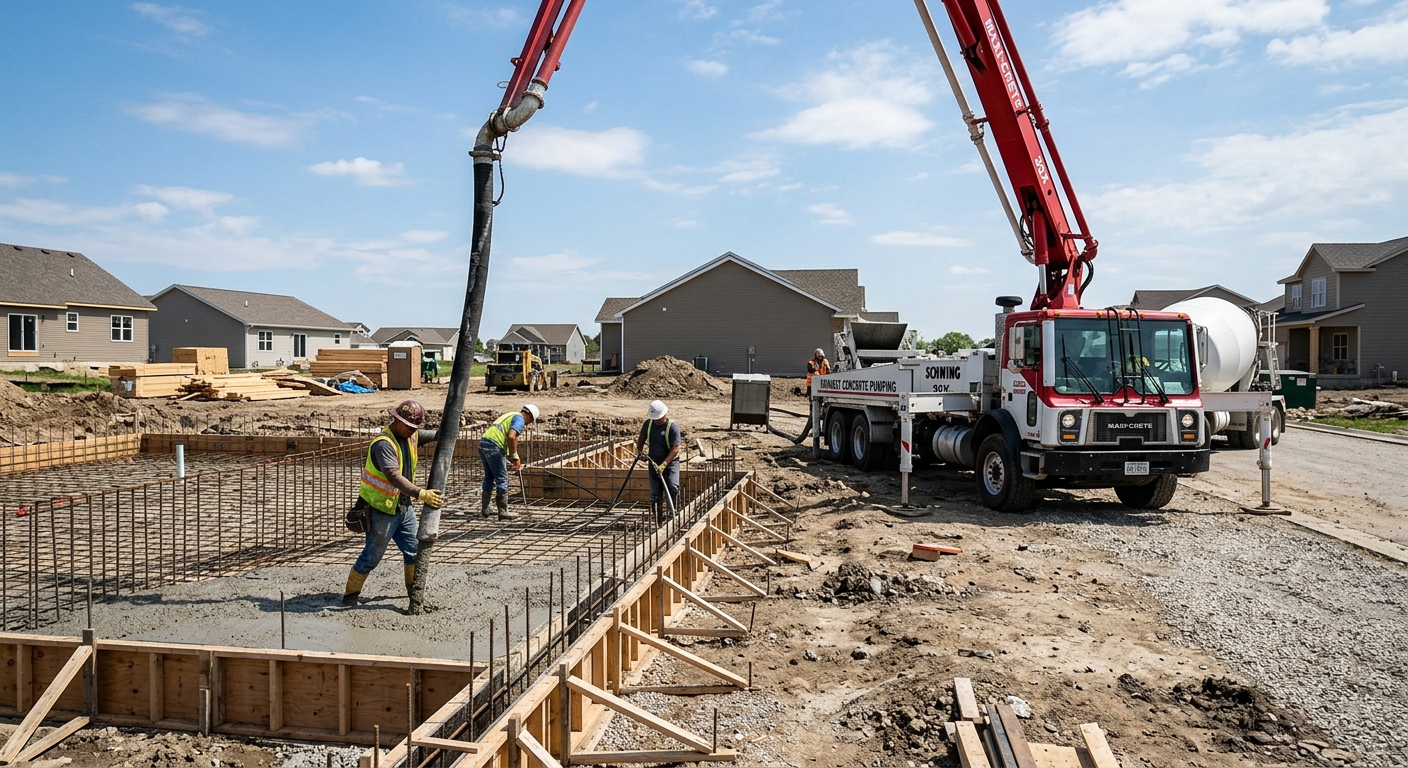
Concrete work options and costs in Penbrooke Meadows
Penbrooke Meadows, Alberta is a strong market for concrete flatwork, and for many homeowners the first project that comes to mind is a new driveway, patio, or walkway. In Calgary’s broader housing market, single-detached homes make up a large share of dwellings, and that shapes contractor demand for exterior concrete like slabs, steps, and garage approaches. With a local population of 8,235 people in the Penbrooke Meadows area (Statistics Canada, 2021 Census), there’s steady work for crews, especially around upgrades for established neighbourhood streets and new builds where foundations and site grading come first.
Calgary’s cold continental climate is the cost driver you feel most directly. Concrete here is engineered around a deeper design frost depth of about 1.2 m (roughly 4 ft), so footings and bases often require more excavation and thicker, better-compacted granular lifts. Freeze–thaw cycles across the Calgary region also push specs toward air-entrained mixes, careful jointing, and—when schedules are tight—cold-weather curing practices like insulation blankets or temporary heat. Local winters shorten the exterior pour season, so labour availability can tighten in late fall and early spring.
In Penbrooke Meadows, demand is especially noticeable around busy collector corridors and near developing pockets such as the immediate vicinity of 37 Street SE where driveways and backyard patio upgrades are common. Use the table below to compare typical applications and finishes before you request itemised quotes.
| Application |
Typical Size |
Key Spec |
Finish Option |
Price Range |
| Concrete driveway (standard broom finish) |
400–500 sq ft (typical double-wide) |
Air-entrained exterior mix, compacted granular base |
Broom finish + control joints |
$12,000–$18,000 |
| Exposed aggregate driveway |
400–500 sq ft |
Air-entrained exterior mix, proper curing |
Exposed aggregate (swirl/sprayed) |
$14,500–$21,500 |
| Stamped concrete driveway or patio |
300–500 sq ft |
Air-entrained exterior mix, base prep for stamping |
Stamp pattern + release + colour hardener |
$15,000–$26,000 |
| Plain concrete patio or walkway |
200–400 sq ft |
Exterior mix with air entrainment + joints |
Float + broom edge |
$5,000–$9,000 |
| Garage floor (interior slab) |
400–520 sq ft |
Interior mix, vapour considerations, joints as needed |
Float/steel trowel finish |
$7,500–$13,500 |
| Foundation footings (structural, below frost) |
Typical single-detached footprint |
Excavation to design frost depth, reinforced footings |
Structural concrete (engineering-driven) |
$28,000–$45,000 |
Prices are estimates only and vary by project scope, site access and material selection.
What affects the price of concrete work in Penbrooke Meadows
In Penbrooke Meadows and the wider Calgary area, it’s normal to see quotes for the “same” concrete job vary by 30–50%. The difference usually isn’t the slab colour—it’s the engineering and workmanship that go into making concrete survive winter. Frost line depth and freeze–thaw cycles dictate every spec: exterior footings and structural supports must extend below the design frost depth so the ground doesn’t heave seasonally. In Alberta, that means deeper excavation and more concrete volume than many homeowners expect when they compare themselves to milder regions.
Those freeze–thaw cycles also require air-entrained concrete for exterior slabs. Without the correct air content, the freeze pressure can drive scaling and spalling, and then you’re paying for repairs sooner than planned. Calgary’s colder temperatures also shorten the practical pour season and require cold-weather curing precautions—often insulating blankets and sometimes temporary heat—to achieve reliable strength gain. On top of that, Penbrooke Meadows driveways and walkways are frequently exposed to de-icing salts, so sealing becomes a practical add-on to slow surface breakdown.
Two examples of what can raise or lower cost here: (1) a driveway on soft or poorly compacted subgrade may require deeper granular base and more excavation, which pushes the job from the lower end of a $12,000–$18,000 driveway band toward the higher end; (2) a small stamped patio might land closer to $15,000–$26,000 if the pattern coverage is tight with many borders and steps, but a simpler rectangle with fewer edges can keep it nearer the lower bracket. As housing stock ages, homeowners also tend to request thicker sections or increased reinforcement for approaches, which is where reinforcement and base specs translate directly into dollars.
| Price Factor |
Why It Matters |
Cost Impact |
| Frost line depth — determines footing depth and form height |
Footings must bear below seasonal movement to prevent heave |
Higher excavation volume and taller forms can add significant cost |
| Site preparation — excavation, grading, compacted granular base |
Proper base thickness and compaction stop settlement and cracking |
Soft soils, utility conflicts, or limited access increase labour |
| Reinforcement — rebar or wire mesh requirement |
Controls cracking in structural slabs and heavy-use driveways |
More reinforcement can shift pricing upward for durability |
| Mix design — air-entrainment and compressive strength spec |
Freeze–thaw resistance depends on correct air content |
Engineered mixes cost more but reduce premature scaling |
| Finish type — broom vs. stamped vs. exposed aggregate |
Complexity changes labour time, tools, and material handling |
Stamped and exposed finishes usually add material and crew time |
| Pour size and concrete truck access to site |
Large pours need efficient placement and pumping/short hauls |
Poor access may require pump costs or more handling labour |
| Cold-weather curing precautions — heating and blankets |
Strength gain depends on temperature and protection from rapid cooling |
Temporary heat and insulation increase labour and material expenses |
| Control joint pattern and sealing cost |
Joints direct cracking; sealing helps protect against de-icing salt |
Better jointing and sealing typically cost more upfront but extend lifespan |
Permits & regulations in Alberta
In Alberta, permit requirements depend on what structural work you’re doing. For concrete, structural items—typically including footings, foundation walls, and grade beams—usually require a building permit and often engineering drawings that the municipality reviews as part of the inspection process. Concrete flatwork like patios, walkways, and standard driveways typically does not require a permit by itself, unless it affects lot grading, drainage, or impervious surface coverage limits, or it ties into municipal right-of-way work. Before breaking ground in Penbrooke Meadows, confirm with the local authority so you don’t end up redoing work to meet grading or drainage requirements.
On the contractor side, verify coverage and accountability. First, ask for proof of liability insurance with a certificate of insurance that lists you as additionally insured where appropriate for your project. Second, confirm they carry WSIB/WCB coverage for their workers (the intent is that workers are protected if there’s an injury on site). Third, request references for similar concrete projects in Calgary—especially exterior slabs poured in winter or in freeze–thaw conditions.
Step-by-step you can do from home: (1) check the Alberta-registry listing for the contractor’s business details and standing; (2) ask the contractor for a current COI and confirm policy validity dates; (3) request a WSIB/WCB clearance letter or verification number; (4) match the company name and address on the paperwork to the quote; and (5) keep copies of everything in your project file so inspections and disputes are easier to resolve.
Getting concrete right in Penbrooke Meadows's freeze-thaw climate
Concrete failures in Penbrooke Meadows usually trace back to predictable freeze–thaw mechanisms: water gets into micro-cracks or porous surfaces, freezes, expands, and then pushes concrete apart—starting as surface scaling and eventually progressing to spalling. The way to prevent this is to spec the job around Calgary’s conditions: deeper frost considerations, air-entrained mixes, disciplined base prep, and curing that achieves strength before winter weather bites.
Start with base preparation: you need a compacted granular sub-base to the correct depth for the local soil and the frost performance expectations (this is where excavation and grading costs come from). Next, mix design: for exterior flatwork, use air-entrained concrete with target air content in the 5–7% range and a minimum 32 MPa compressive strength specified for the application. Then set control joints so cracking happens where you want it, not randomly across the slab. For curing, plan for at least 7 days of proper curing conditions; in colder weather, that may require insulated blankets and/or temporary heating so the surface doesn’t cool too fast. Finally, sealing matters: apply a penetrating sealer after the concrete has cured (often around 28 days post-pour) to help resist de-icing salts.
Here’s a practical dollar example: a plain broom-finished driveway might come in around the lower end of the $12,000–$18,000 band. If you upgrade to a stamped system, the finish itself can push you toward the $15,000–$26,000 range—but the real justification is when the contractor pairs stamping with correct air-entrainment, joint planning, and curing. Stamping without those basics is a false economy because the failure mode (spalling from freeze–thaw) doesn’t care about the pattern.
| Spec |
Why It Matters in Penbrooke Meadows |
What to Ask For |
Impact if Skipped |
| Compacted granular base (depth?) |
Stabilizes the slab and controls frost-related movement |
Provide base thickness by site conditions and soil type |
Settlement and cracking, especially after freeze–thaw cycles |
| Air-entrained concrete mix (target air %?) |
Improves freeze–thaw durability for exterior exposure |
Confirm air content typically 5–7% for exterior flatwork |
Higher risk of scaling and spalling in winters |
| Compressive strength (MPa rating) |
Strength gain supports structural performance over time |
Specify minimum 32 MPa (as required for the use case) |
Surface defects and reduced long-term durability |
| Control joints (spacing per ACI guidelines) |
Manages where cracks will form during curing and temperature changes |
Ask for a joint layout and spacing plan for your slab dimensions |
Random cracking and possible trip hazards |
| Minimum 7-day curing period |
Ensures proper strength development before cold snap effects |
Confirm curing protection plan; allow at least 7 days |
Lower strength and surface scaling risk |
| Penetrating sealer (when applied after cure) |
Helps resist moisture and de-icing salt exposure |
Ask for penetrating sealer applied around 28 days post-pour (typical timing) |
Faster deterioration and more maintenance costs |
How to choose a concrete work contractor in Penbrooke Meadows
Choosing the right contractor matters more in Alberta because exterior concrete is fighting freeze–thaw and de-icing salts every season. Start with verification. In Penbrooke Meadows, ask for proof of Alberta licensing (or the applicable business registration where the work is performed), current liability insurance, and WSIB/WCB coverage. To check: confirm policy validity on the certificate of insurance (COI) and ensure worker coverage is current using WSIB/WCB verification or a clearance letter/number provided by the contractor. Don’t accept “we’re covered” without paperwork.
Then get 2–3 itemised written quotes—ideally with a line-by-line breakdown for excavation, granular base, formwork, reinforcement, concrete supply, finishing, joints, curing, and sealing (if included). Avoid a quote that’s only one lump sum without telling you what’s in the scope and what isn’t. Read for exclusions such as disposal/hauling, permit handling (if required), protection during curing, and whether your quote includes pumping or saw-cutting. If you’re comparing stamped work, confirm the colour and release system, joint plan, and curing protection—those details directly affect longevity.
For warranty, ask for workmanship warranty length and whether it covers surface scaling or settlement-related issues. Confirm product/manufacturer warranty terms and whether they transfer to future owners. For payment schedule, never pay more than 10–15% upfront; hold back the remainder until the job is complete and cleaned up. Finally, lock in a timeline: a start date and completion estimate in writing, including weather contingency language typical for Calgary winters.
- Confirm liability insurance COI is current and matches the quoting company name.
- Verify WSIB/WCB coverage with a clearance letter/verification number.
- Request 2–3 itemised quotes (not lump sum only).
- Ask for drawings or a joint layout showing crack-control plan.
- Confirm air-entrained mix and target air content for exterior pours.
- Specify minimum compressive strength (for example, 32 MPa where appropriate).
- Get base prep details: excavation depth and compacted granular thickness.
- Clarify reinforcement scope: mesh vs rebar, and where it’s installed.
- Ask about cold-weather curing: blankets/heat plan if temps drop.
- Confirm disposal/hauling is included for excess soil and waste.
- Ask whether sealing is included, and when it will be applied post-cure.
- Use holdback: avoid paying the full amount before final finishing and clean-up.
Concrete contractor red flags in Penbrooke Meadows include: refusing to show COIs/WSIB verification, quoting a driveway or patio without discussing base depth and frost considerations, promising exterior cold-weather pours without a curing protection plan, leaving joints and sealing unspecified, and using vague scopes like “standard concrete” with no mix strength or air-entrainment details.
Frequently asked questions — concrete work in Penbrooke Meadows
How do I compare concrete quotes?
In Penbrooke Meadows and across the Calgary economic region, quotes can look similar in price but differ heavily in what’s actually included. Start by comparing line items: excavation depth, compacted granular base thickness, reinforcement type (mesh vs rebar), concrete mix specs (air-entrainment and minimum strength), joint layout, curing protection, and whether sealing is included. For finishing, confirm the method (broom, stamped, exposed aggregate) and the allowances for borders, steps, and neighbour tie-ins. Also check for exclusions like hauling/disposal and any need for pumping due to truck access. As a reference point, a standard driveway often falls around the $12,000–$18,000 band, while stamped work commonly moves toward the $15,000–$26,000 range when labour and materials increase. The best comparison is apples-to-apples scope, not just total dollars.
Can concrete be poured in cold weather in Penbrooke Meadows?
Yes, it can be poured in Alberta during cold weather, but it must be engineered for temperature and curing. In Penbrooke Meadows, freeze–thaw conditions can start early in the season, and surface cooling can prevent concrete from gaining strength properly. A reputable contractor will plan for cold-weather placement: using a winter-grade mix, controlling the rate of temperature drop with insulating blankets, and sometimes using temporary heat so curing continues long enough to reach safe strength. Ask for the exact curing approach and minimum curing period—don’t rely on “we’ll see how it goes.” If a quote doesn’t mention blankets/heat or a curing plan, that’s a sign the concrete may be rushed and more vulnerable to scaling. When cold-weather precautions are included, the cost can rise, but durability improves.
How do I maintain concrete in Penbrooke Meadows's freeze-thaw climate?
Maintenance is about managing moisture and protecting the surface against de-icing salts. For exterior flatwork in Penbrooke Meadows, start with the right specs: air-entrained concrete, correct joints, and proper curing. Then, once fully cured (often around 28 days post-pour), apply a penetrating sealer designed for freeze–thaw exposure. Reapply according to the sealer manufacturer’s schedule or your contractor’s guidance, especially if you use frequent de-icers. Keep drainage working—redirect downspouts away from the slab and don’t let soil mound against edges, because trapped water increases freeze pressure. Avoid applying rock salt aggressively to fresh concrete. Over time, clean regularly to remove grit and salts, and repair small chips quickly so water can’t migrate into cracks.
What causes concrete to spall in Penbrooke Meadows winters?
Spalling in Alberta usually comes from freeze–thaw acting on moisture within the concrete. In Penbrooke Meadows, the most common root cause is inadequate air-entrainment or poor curing, which allows water to freeze internally and build pressure that breaks the surface paste. De-icing salts add another layer: they can accelerate deterioration once the surface is already compromised. Other contributors include insufficient base prep leading to micro-movement, poorly planned or too-infrequent control joints, and letting the surface freeze too early after placement. If the contractor skipped cold-weather curing precautions or didn’t specify an exterior mix appropriate for freeze–thaw, the risk rises. The fix is not cosmetic; it’s about correcting the mix and workmanship so the slab can resist winter conditions.
What is rebar and when is it required in Alberta?
Rebar (reinforcing steel) is used to strengthen concrete and control cracking by giving the slab/foundation tensile resistance. In Alberta, it’s typically required when the design calls for reinforcement—most commonly for structural elements like foundation footings, grade beams, and foundation walls, and sometimes for exterior slabs subjected to heavier loads or specific engineering requirements. Whether rebar is needed for a driveway or slab depends on slab thickness, base support, and the intended loads (like vehicles) as well as the structural design for your project. For concrete flatwork, many contractors use wire mesh or rebar tied and supported at the correct cover, but “required” should come from the engineering spec and your contractor’s scope. Ask for the reinforcement plan in writing so you can confirm what’s being installed and where.
How long does a concrete project take in Penbrooke Meadows?
Timelines in Penbrooke Meadows depend on the application, site conditions, and weather. For typical exterior flatwork, the workflow is usually: layout and forms (if needed), excavation and base compaction, reinforcement placement, then the pour day with finishing and joint cutting. After that, curing must proceed—at minimum, many projects require about 7 days of adequate curing conditions before you treat it as structurally ready. Even after curing, full performance and sealing timing often wait longer; many sealers are applied around 28 days after the pour. Cold-weather placement can extend the overall calendar time because protection and temperature control may need to continue for longer. Foundation footings and structural work also involve engineering and inspection steps, so the schedule is more dependent on municipal review and the build sequence. For planning, request a start date and completion estimate in writing, including weather contingencies typical for Calgary.