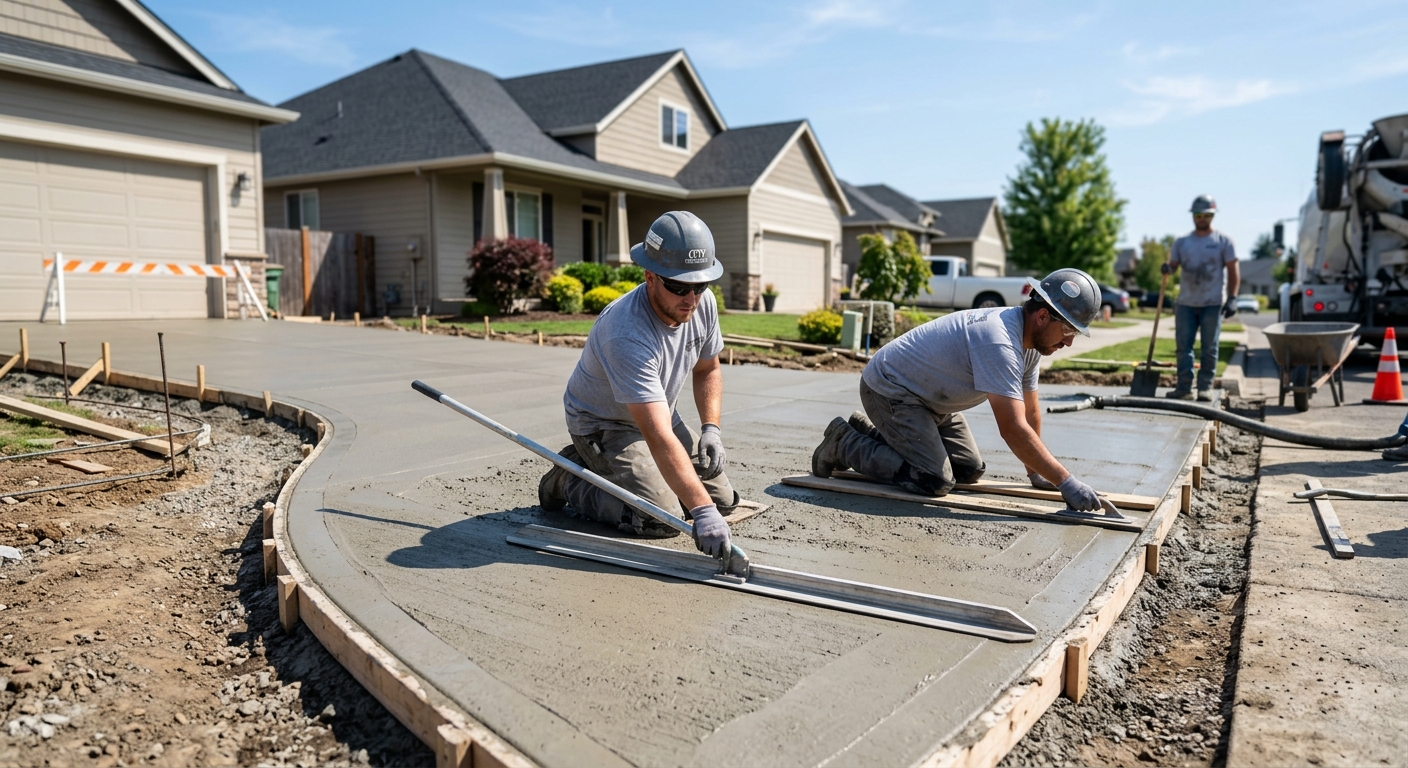
Concrete work options and costs in Temple
Temple, Alberta is a growing community where a lot of homeowners invest in driveways, patios and walkways that look sharp but also stand up to Calgary-area freeze–thaw. With a population of 10,525 (Statistics Canada, 2021 Census), the demand isn’t just constant—there’s real turnover as households upgrade exterior living spaces and replace older flatwork. Most concrete flatwork in this market is installed for single-detached homes and typical backyard layouts, so you’ll often see projects clustered around northwest and newer growth pockets where landscaping, garages and service access are common.
In the Calgary economic region, pricing is engineered around a deeper frost profile and frequent temperature swings. Footings and any concrete element that could be affected by soil movement typically need to bear below the design frost depth, and exterior slabs must be detailed for freeze–thaw durability—air-entrainment, proper base compaction and well-planned control joints are standard, not optional. That engineering reality is why bids for the “same size” driveway can differ by thousands, especially when one quote includes full granular base prep and cold-weather curing precautions and another doesn’t.
Labour availability also tightens during the exterior pour season. Contractors in the Temple area plan schedules around curing windows; placing late in the fall or early in spring can require heated enclosures, insulating blankets and winter-grade mixes to protect the concrete while it gains strength. To help you compare apples-to-apples options, review the typical price ranges below.
| Application |
Typical Size |
Key Spec |
Finish Option |
Price Range |
| Concrete driveway (standard broom finish) |
24 ft x 10 ft (240 sq. ft.) |
Air-entrained exterior slab, compacted granular base, control joints |
Broom finish, saw-cut joints |
$12,000–$18,000 |
| Exposed aggregate driveway |
24 ft x 10 ft (240 sq. ft.) |
Designed aggregate mix, proper curing, joint layout |
Exposed aggregate with sealer |
$14,500–$21,500 |
| Stamped concrete driveway or patio |
16 ft x 12 ft (192 sq. ft.) |
Air-entrained exterior mix, integral colour or surface colouring |
Stamped pattern (e.g., ashlar/stone), release agents |
$15,000–$26,000 |
| Plain concrete patio or walkway |
12 ft x 10 ft (120 sq. ft.) |
Air-entrained slab, compacted base, light broom or trowel finish |
Plain finish with saw-cut joints |
$5,000–$9,000 |
| Garage floor (interior slab) |
22 ft x 20 ft (440 sq. ft.) |
Reinforcement as required, moisture consideration, steel-finish durability |
Light broom/steel trowel, optional sealer |
$10,500–$17,500 |
| Foundation footings (structural, below frost) |
Typical single-detached footprint |
Engineered bearing, excavation to frost depth, reinforcement & formwork |
Structural concrete with proper embedments |
$28,000–$45,000 |
Prices are estimates only and vary by project scope, site access and material selection.
What affects the price of concrete work in Temple
If you’re comparing two quotes in the Calgary region, it’s common to see the same project range swing by 30–50%. The difference usually isn’t the concrete itself—it’s what’s included in the prep, the engineering specs driven by frost, and how the contractor protects curing in cold conditions. In Temple, the deeper frost profile means excavation and footing volumes trend higher than in milder provinces, and that alone can move foundation and structural pricing quickly. For exterior flatwork, the freeze–thaw cycle forces air-entrained mixes and strict joint spacing so the surface doesn’t scale or spall after winter de-icing.
Frost line depth governs footing placement (and formwork height) because footings must bear on undisturbed soil below the design frost depth in Alberta (often up to 2.4 m). The same logic—movement control—applies to driveways and patios through base thickness and compacted granular sub-base. When pours happen in late fall or early spring, cold-weather curing precautions (insulating blankets, heating enclosures, winter-grade admixtures) add labour and equipment cost. Add to that the reality that de-icing salt accelerates damage to poorly sealed surfaces, so sealing becomes part of the longer-term cost story.
Concrete examples that often raise cost in Temple: (1) replacing poorly compacted base under an older driveway to prevent future settlement; (2) adding a reinforced section for a heavier garage door or service access; and (3) extending the slab with proper transitions where drainage patterns change. Costs can be lower when site access is straightforward and you’re building on clean, stable grades—so a broom-finish driveway in the $12,000–$18,000 band may price closer to the low end if excavation and base prep are simple. On the other hand, stamped work in the $15,000–$26,000 band is justified when colour, texture, and pattern layout complexity reduce the need for additional stone/brick landscaping and create a matched exterior look.
| Price Factor |
Why It Matters |
Cost Impact |
| Frost line depth |
Determines footing depth and form height |
Higher excavation and labour; can materially increase foundation pricing |
| Site preparation |
Excavation, grading, compacted granular base |
Missing base prep leads to settlement; doing it properly costs more but prevents callbacks |
| Reinforcement |
Rebar or wire mesh requirement |
Material + placement labour; essential for slabs carrying loads or larger spans |
| Mix design |
Air-entrainment and compressive strength spec |
Exterior-grade mix and testing/handling typically adds cost but improves freeze–thaw performance |
| Finish type |
Broom vs. stamped vs. exposed aggregate |
Stamped/exposed require more labour, materials, and careful finishing steps |
| Pour size and concrete truck access to site |
Delivery distance, pump needs, staging time |
Pump/extra staging can add thousands on constrained sites |
| Cold-weather curing precautions |
Heating and blankets |
Temporary heat/blankets increase labour and equipment rentals during shoulder seasons |
| Control joint pattern and sealing cost |
Crack control + surface protection against de-icing |
Better jointing and sealer cost money up front but reduce spalling risk later |
Permits & regulations in Alberta
In Alberta, structural concrete work—think footings, foundation walls, grade beams and any engineered foundation elements—typically requires a building permit, and many projects also rely on engineered drawings that the municipality reviews as part of the approval process. For concrete flatwork like patios, walkways and driveways, a permit usually is not required, provided you’re not changing lot grading, interfering with lot drainage plans, or running into municipal rules for impervious surface coverage or right-of-way limits. Even then, you should confirm locally before breaking ground, especially if you’re reworking swales, changing runoff paths, or building close to property lines.
For Temple homeowners, the practical best practice is a two-part check: (1) confirm whether your specific scope triggers a permit, and (2) confirm your contractor is properly insured and set up to perform the work. Step-by-step, start by asking the contractor to show their liability insurance certificate and to indicate their WSIB/WCB coverage status (and provide the documentation). Then verify licensing status through Alberta’s online contractor licensing/registry channels applicable to their trade category, and request a clearance letter if they can provide it. After that, ask for references from similar Calgary-area builds (cold-weather exterior pours and reinforced slabs are a good match) and confirm who handles site protection, disposal, and any required inspections.
If any quote treats foundation work like a “standard pour” without engineering and permitting steps, that’s a red flag in Temple and across Alberta.
Getting concrete right in Temple's freeze-thaw climate
Concrete failure in Temple is usually predictable: water gets into a vulnerable surface, freezes, expands, and then the slab chips or scales—especially when the mix isn’t properly air-entrained or when the base isn’t built to drain and stay stable. In the Calgary climate, freeze–thaw cycling is the driver, so the job needs to be specified like a cold-region assembly: (1) base preparation with compacted granular sub-base to the right depth for local soil and frost conditions, (2) an exterior air-entrained mix (target air typically 5–7% for freeze–thaw durability), (3) control joints spaced to limit random cracking, (4) curing that protects the concrete for long enough to develop strength—minimum 7 days under proper conditions, and (5) sealing after the cure period to repel de-icing salts and reduce surface deterioration.
To avoid the most common failure—spalling from inadequate air-entrainment—ask your contractor for the mix spec and confirm it’s air-entrained and designed for exterior exposure, not a generic “standard ready-mix.” Also ask how they’ll handle weather: if you’re pouring near freezing, they should plan for insulation blankets or temporary heat so the surface doesn’t freeze before it gains early strength.
Where the money makes sense: if you’re choosing between plain broom-finish flatwork and stamped concrete, the stamp premium is justified when you want an upgraded visual finish without additional stonework. For example, a plain patio in the $5,000–$9,000 band may be the smart choice if durability is your only goal. If you’re aiming for a “designed” front elevation, stamped work in the $15,000–$26,000 band can be worth it—provided the contractor still includes proper base prep, jointing, and sealing. The finish can be beautiful, but the freeze–thaw engineering is what keeps it intact.
| Spec |
Why It Matters in Temple |
What to Ask For |
Impact if Skipped |
| Compacted granular base (depth?) |
Controls settlement and helps drainage through freeze–thaw cycles |
Base thickness plan and compaction test approach |
Uneven support leads to cracking, pumping, and premature failure |
| Air-entrained concrete mix (target air %?) |
Creates freeze–thaw resilience to reduce scaling and spalling |
Target air content of about 5–7% for exterior flatwork |
Surface deterioration accelerates after winters and salt exposure |
| Compressive strength (MPa rating) |
Strength gain affects durability and performance under load |
Minimum 32 MPa compressive strength (or as engineered) |
Lower strength can mean increased cracking and raveling |
| Control joints (spacing per ACI guidelines) |
Limits random shrinkage and temperature-related cracking |
Planned joint spacing and cutting timing |
Uncontrolled cracks form and can turn into moisture pathways |
| Minimum 7-day curing period |
Ensures proper strength development in cold periods |
Cold-weather curing plan (blankets/heating if needed) |
Premature freeze or poor curing increases long-term scaling risk |
| Penetrating sealer (when applied after cure) |
Repels salt and water, slowing deterioration through cycles |
Penetrating sealer applied after cure—commonly at 28 days post-pour |
Faster surface breakdown and more maintenance costs |
How to choose a concrete work contractor in Temple
Choosing the right contractor in Temple is mostly about verifying the basics—and then requiring clear details in writing. Start by confirming Alberta licensing for the trade they’re performing and whether they’re set up for the type of concrete work you need (structural vs. flatwork). Next, ask for proof of liability insurance and WSIB/WCB coverage before the first shovel hits the ground. A good contractor will provide a certificate of insurance and coverage documentation without pushing back.
For pricing, don’t accept a single lump sum without a scope breakdown. Get 2–3 itemised written quotes that separate labour and materials where possible, and that specify excavation depth, base prep, reinforcement, mix specs, finishing, joints, curing measures, and disposal. Pay attention to inclusions/exclusions: is permit support included if your project requires it? Is hauling/disposal of excavated material part of the price? Are edging, grading tie-ins, and drainage adjustments included? These details are where Calgary-region bids often diverge.
Warranty matters too. Ask for a workmanship warranty length and whether the product/manufacturer warranties are included and transferable if you sell the home. For payments, never pay more than 10–15% upfront; use a holdback until completion and walk-through acceptance. Finally, insist on a start date and completion estimate in writing, especially for exterior pours where curing conditions can affect schedule.
- Provide Alberta licence details for the specific scope (and confirm trade fit for your project).
- Show a liability insurance certificate naming you as certificate holder if required.
- Confirm WSIB/WCB coverage with documentation before work begins.
- Request references for Calgary-area freeze–thaw exterior concrete (driveways/patios) with similar sizes.
- Get itemised quotes: excavation, granular base, reinforcement, concrete mix, finishing, joints, curing, sealing.
- Ask who handles permits/engineering (if your foundation work triggers a permit).
- Confirm disposal/hauling is included (or priced separately with clear allowances).
- Verify control joint plan: spacing, saw-cut timing and layout around edges.
- Ask about air-entrained exterior mix and target strength (don’t accept “standard mix”).
- Confirm cold-weather curing plan: blankets/heating if pouring near freezing.
- Review warranty: workmanship duration, exclusions, and transferability.
- Payment schedule: 10–15% max upfront, with holdback until final acceptance.
Concrete red flags in Temple include: quoting structural/footing work without engineering or permitting steps, skipping details on base depth and compaction, refusing to discuss air-entrainment and joint spacing, demanding large upfront payments, and giving vague schedules like “weather permitting” without a written plan for cold-weather curing.
Frequently asked questions — concrete work in Temple
Why does concrete crack in Temple and how is it prevented?
In Temple and the Calgary region, cracking is commonly driven by shrinkage (as concrete dries), temperature changes, and movement in the supporting soil during freeze–thaw cycles. Even well-built concrete will crack if it’s not given places to crack—this is why control joints matter. Prevention starts with engineered base prep: compacted granular support that drains and stays stable. Next is mix design: exterior air-entrained concrete helps resist freeze–thaw damage that can widen cracks over time. Finally, the contractor should plan joint spacing and cut/cut timing so the slab relieves stress at predictable locations. If you’re comparing quotes for a driveway in the $12,000–$18,000 range, insist the scope includes joint layout, air-entrained mix, and proper curing so cracking doesn’t turn into water pathways.
Stamped vs broom-finish concrete — cost difference?
Stamped concrete generally costs more than broom-finish because it adds multiple steps: applying integral colour or surface colour, setting release agents, placing and aligning stamp mats, and then finishing and curing carefully so the pattern doesn’t blur. You still need the same freeze–thaw engineering—air-entrainment, compacted granular base, and control joints—so the extra cost isn’t “just aesthetics,” it’s labour-intensive finishing. In Temple, broom-finish driveways typically track the $12,000–$18,000 band, while stamped driveway or patio projects commonly fall into the $15,000–$26,000 band depending on square footage, pattern complexity, and access constraints. If you want the upgrade look without overpaying, compare quotes that itemise finishing steps and confirm sealing is included after cure.
When is the best time to pour concrete in Temple?
The best time is when temperatures stay consistently above freezing and crews can complete finishing and curing without risk of early freeze. In Temple’s freeze–thaw climate, late fall or early spring pours can be done, but only if the contractor has a cold-weather curing plan—insulating blankets, temporary heat if needed, and appropriate winter-grade admixtures. A reputable contractor will tell you the feasible windows based on the forecast and will plan the schedule so curing isn’t interrupted. If you’re doing exterior flatwork like a patio or walkway, mid-spring to early fall is usually safest for durability. If you’re adding a driveway in the $12,000–$18,000 range, ask your contractor how they’ll protect the slab when night temperatures drop and whether the quote includes those winter curing precautions.
How long does concrete take to cure?
Concrete gains strength over time, and “curing” is more than just waiting for it to harden. In Temple, for proper performance, crews should plan for a minimum 7-day curing period under proper conditions for many exterior flatwork applications, with full durability improving as the concrete continues to develop strength. If temperatures are cold, the curing period and protection needs increase because strength development slows and surface freeze can cause scaling. For sealing, a common practice is applying penetrating sealer about 28 days after the pour, once curing is complete enough for the surface to be ready for treatment. If your contractor offers to seal immediately after the pour, ask questions—salt and surface moisture protection depend on curing readiness, especially with Calgary-area de-icing exposure.
Do I need a permit for concrete work in Alberta?
In Alberta, concrete permits depend on the scope. Structural concrete work—such as footings, foundation walls, and grade beams—typically requires a building permit and often engineered drawings that the municipality reviews. Concrete flatwork like patios, walkways and driveways usually does not require a permit unless it affects lot grading, impacts drainage, changes impervious surface coverage rules, or touches municipal right-of-way considerations. For Temple homeowners, the safe approach is to confirm with the local authority before you start excavation, especially if you’re changing runoff paths or modifying grades. Also verify your contractor is insured and properly set up: ask for liability insurance and WSIB/WCB coverage documentation before work begins, and request references for similar projects done in the Calgary area’s freeze–thaw conditions.
Concrete vs pavers for a patio in Temple?
Both concrete and pavers can work well in Temple, but the trade-offs come down to freeze–thaw behaviour, installation detail, and long-term maintenance. Concrete patios—especially plain broom-finish—are typically straightforward and can deliver strong, uniform performance when built on a properly compacted granular base with correct jointing and air-entrained exterior mix. Pavers can look great and allow easier spot repairs, but they rely heavily on base thickness, slope, and restraint edging to prevent shifting during winters. If your priority is durability with fewer moving parts, a concrete patio in the $5,000–$9,000 range is often the practical choice when the contractor specifies sealing and correct joint/control details. If your priority is design flexibility or you anticipate future layout changes, pavers may fit—just ensure the installer plans for Calgary-area freeze–thaw and drainage, not just aesthetics.