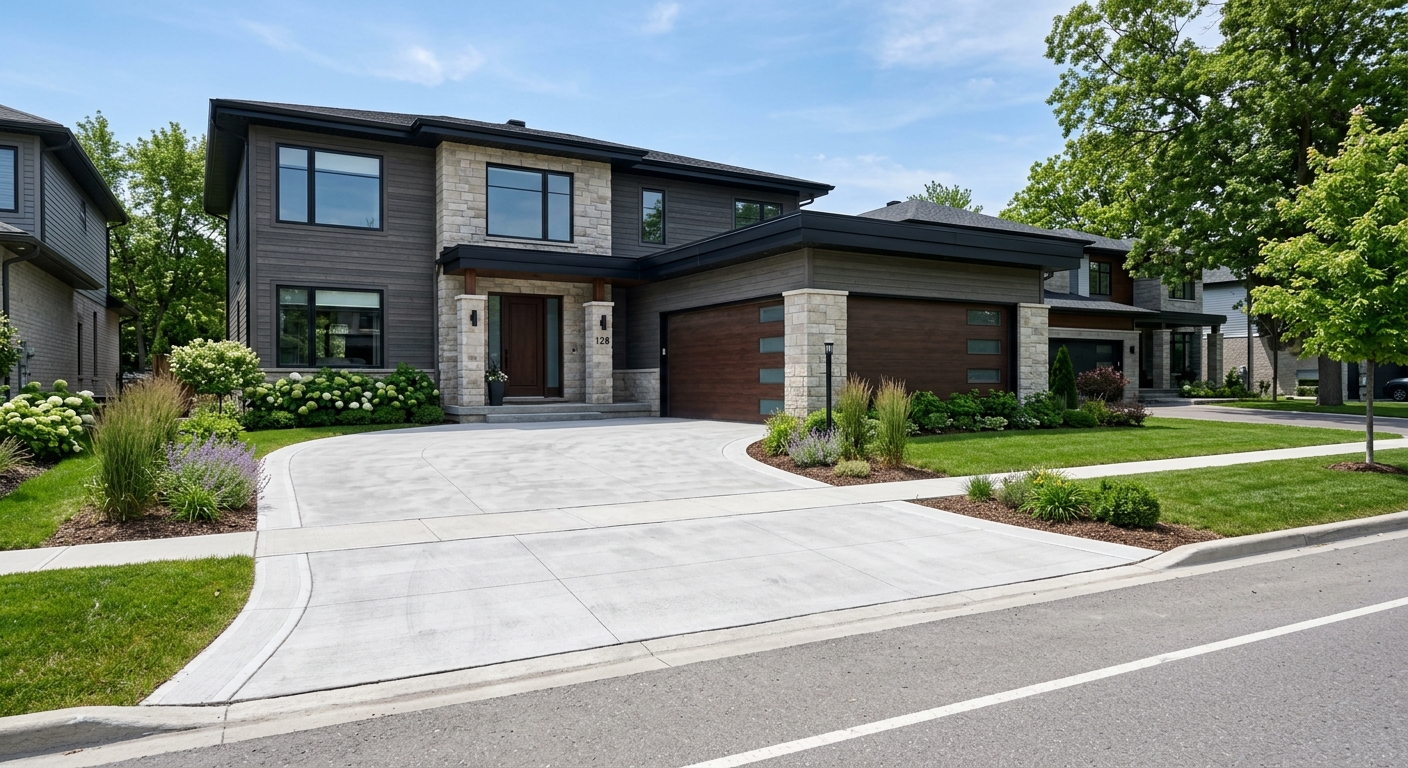
Concrete work options and costs in Wîhkwêntôwin
In Wîhkwêntôwin, Alberta, homeowners usually choose concrete because it’s tough in winter—if it’s engineered for our cold continental conditions. With a population of 18,180 (Statistics Canada, 2021 Census), the Calgary economic region supports steady demand for driveways, patios, walkways and basement foundations. A big share of local housing is single-detached-style living, which typically brings recurring concrete needs: driveway replacement, backyard patios, and foundation/footing pours for new homes or renovations. If you drive through communities along the Calgary-side growth corridor, you’ll notice concrete crews are especially busy around established family neighbourhoods and newer in-fill areas where lots are tighter and excavation access matters.
Pricing here reflects more than just concrete and labour. Calgary-area freeze–thaw cycles are hard on exterior slabs, so local estimates account for engineered footing depths below the design frost depth (about 1.2 m in Alberta practice) and air-entrained mixes. Because our pour season is shorter and cold-weather placement can be risky, contractors plan for insulation blankets, temperature control, and curing time—costs that are rarely needed in milder provinces. That’s why two quotes for “the same” driveway can differ meaningfully depending on base depth, reinforcement, mix design, and finish type.
Below is a practical comparison of the most common concrete options in Wîhkwêntôwin, with typical sizes and the specs that usually separate a durable pour from one that shows scaling and cracking early. Use it to sanity-check your upcoming quote against the local price bands, then cross-reference the scope details in the following sections.
| Application |
Typical Size |
Key Spec |
Finish Option |
Price Range |
| Concrete driveway (standard broom finish) |
400–600 sq ft (e.g., 20’ x 20’) |
Air-entrained exterior mix; compacted granular base; control joints |
Broom finish, standard edging |
$12,000–$18,000 |
| Exposed aggregate driveway |
400–600 sq ft (e.g., 20’ x 20’) |
Air-entrained exterior mix; sealed aggregate exposure; proper curing |
Exposed aggregate (surface retarder + wash) |
$14,000–$20,500 |
| Stamped concrete driveway or patio |
300–600 sq ft |
Air-entrained mix; colour hardener options; sufficient thickness for frost exposure |
Stamped pattern with release and border finish |
$15,000–$26,000 |
| Plain concrete patio or walkway |
200–400 sq ft |
Exterior mix; compacted base; joints sized to slab geometry |
Float + broom or light trowel, clean edges |
$5,000–$9,000 |
| Garage floor (interior slab) |
480–640 sq ft (e.g., 20’ x 24’) |
Vapour barrier; fibre or mesh reinforcement (as specified); proper curing |
Burnished/steel-trowel or broom finish |
$10,500–$16,500 |
| Foundation footings (structural, below frost) |
Typical detached/attached home footprint (engineered) |
Excavate to design frost depth; reinforced footings per engineering |
Structural concrete only (not decorative) |
$28,000–$45,000 |
Prices are estimates only and vary by project scope, site access and material selection.
What affects the price of concrete work in Wîhkwêntôwin
In the Calgary region, including Wîhkwêntôwin, it’s common to see quotes for the same “driveway size” vary by 30–50% because the real cost drivers are hidden in the specs: excavation to frost depth, granular base prep, reinforcement choices, and the concrete mix and curing plan used for our winter conditions. A 500 sq ft driveway can look identical on day one, but the difference between a long-life slab and a prematurely scaling slab is often the base thickness, air-entrainment, and whether joints and sealing were designed for freeze–thaw movement.
Frost depth and freeze–thaw cycles govern the design in Alberta. In Alberta practice, footings and foundation elements must extend below the design frost depth (about 1.2 m) so the soil doesn’t lift and push the foundation or edges upward. Exterior slabs also require air-entrained concrete to survive repeated expansion and contraction, and that mix costs more than standard concrete. Cold weather matters too: the pour season for exterior flatwork is shorter, and if you’re placing concrete in late fall or early spring, contractors may need winter-grade mixes, insulated blankets, and temperature checks to protect curing. Finally, de-icing salt in winter accelerates surface damage, so sealing is usually a smart add-on if you want less scaling and easier maintenance.
Two quick examples from Wîhkwêntôwin: (1) a driveway placed over thin granular base will often require less excavation upfront, but it tends to settle and crack sooner—so a full-depth base increases cost but improves longevity; (2) switching from broom finish to stamped concrete can raise the estimate because it adds labour time, materials, and more careful curing. If your baseline broom driveway is around $12,000–$18,000, a stamped or exposed look often climbs into $15,000–$26,000, where the extra spend is justified by finish complexity and the additional attention needed for Calgary’s temperature swings. For foundations and footings, site conditions and reinforcement per engineering drive the biggest swings, commonly landing in $28,000–$45,000.
| Price Factor |
Why It Matters |
Cost Impact |
| Frost line depth — determines footing depth and form height |
Concrete must bear below the design frost depth to prevent frost heave and seasonal movement. |
Higher excavation and forming can add substantial labour and volume cost. |
| Site preparation — excavation, grading, compacted granular base |
Compaction and base thickness control settlement and prevent water-related freeze damage. |
More trucking, grading time, and base material increases the quote. |
| Reinforcement — rebar or wire mesh requirement |
Reinforcement helps control cracking from loads and temperature cycling. |
Adds material and placement labour; often required for driveways and footings. |
| Mix design — air-entrainment and compressive strength spec |
Air-entrained exterior mixes resist freeze–thaw scaling; strength affects durability. |
Winter-rated, air-entrained mixes cost more than basic mixes. |
| Finish type — broom vs. stamped vs. exposed aggregate |
Decorative finishes require more steps, careful timing, and curing discipline. |
Stamped/exposed typically increases labour hours and finishing materials. |
| Pour size and concrete truck access to site |
Access affects pumping/hosing, labour time, and whether larger trucks can reach. |
Poor access can add equipment and extended crew time. |
| Cold-weather curing precautions — heating and blankets |
Proper curing prevents scaling and strength loss when temperatures drop. |
Winter blankets, heaters, and monitoring add direct costs. |
| Control joint pattern and sealing cost |
Joints manage cracking; sealing helps repel de-icing salt-driven surface damage. |
Materials and labour are small compared with replacement risk, but they add up. |
Permits & regulations in Alberta
In Alberta, concrete permitting depends on what the concrete is doing structurally versus how it’s used on the property surface. Structural concrete work—such as footings, foundation walls, and grade beams—normally requires a building permit, and engineered drawings are typically reviewed as part of the permit process. For Wîhkwêntôwin homeowners, that means if your concrete is part of the load-bearing system of a basement or addition, you should expect permitting requirements.
Concrete flatwork (patios, walkways, driveways and garage slabs) usually does not require a permit on its own unless it triggers concerns with lot grading, drainage, or impervious surface coverage limits, or affects municipal right-of-way areas. Even when a permit isn’t usually required, contractors should still follow the approved site plan and drainage direction so you don’t end up with water pooling near foundation walls.
Step-by-step contractor verification in Alberta:
- Ask for the contractor’s liability insurance certificate (COI) and confirm it lists your address/project or at least the insured business name.
- Confirm Workers’ Compensation (WSIB/WCB) coverage status (and that it’s in good standing).
- Request proof of eligibility for the scope (for structural work, ask how they handle engineered drawings and permit coordination).
- Look up licences/credentials via the appropriate provincial business registry or licensing lookup used for your contractor type, and verify the company name matches the COI.
- Check references for similar-scale jobs in the Calgary area, ideally completed within the last 1–3 years so you can judge current workmanship.
Getting concrete right in Wîhkwêntôwin's freeze-thaw climate
Concrete fails in Wîhkwêntôwin when water gets into the slab or base, freezes, and repeatedly expands—especially across the winter freeze–thaw cycles common in the Calgary market. The most expensive problems start with “cheap fixes”: insufficient base preparation, wrong mix air content, weak curing, and missing or ineffective joints. To spec the job correctly, start at the base: excavate to the proper depth and install a compacted granular sub-base designed for local soil and frost conditions. Next, require an air-entrained exterior mix—typically 5–7% air content for exterior flatwork—and a minimum 32 MPa compressive strength so the concrete has the resilience to handle freeze–thaw without scaling.
Then lock in cracking control: use control joints placed so they limit random cracking (spacing is usually managed using standard engineering/ACI practice relative to slab thickness and geometry). Curing is non-negotiable; aim for minimum 7-day curing under proper conditions. In cold weather, contractors may need insulated blankets or temporary heat to keep concrete curing properly. Finally, sealing matters in Calgary winters: apply a penetrating sealer after the cure—commonly around 28 days post-pour—so de-icing salt has less direct access to the surface pores.
A practical dollar example: if you’re choosing between a plain broom finish patio and a decorative stamped patio, the stamped option may land in the $15,000–$26,000 range for larger areas, while plain patios and walkways often fall around $5,000–$9,000. The finish difference is real, but don’t let aesthetics replace the freeze-thaw basics. The durability spec is what keeps both options looking good year after year.
| Spec |
Why It Matters in Wîhkwêntôwin |
What to Ask For |
Impact if Skipped |
| Compacted granular base (depth?) |
Proper base thickness and compaction reduce settlement and limit water movement that freezes. |
Confirm excavation depth and granular base thickness, plus compaction test method (where applicable). |
Early cracking, uneven slabs, and accelerated freeze-related deterioration. |
| Air-entrained concrete mix (target air %?) |
Freeze–thaw resistance depends on entrained air micro-bubbles. |
Request exterior air-entrained mix with 5–7% air (typical target) and confirmed mix design. |
Higher risk of surface scaling/spalling in Calgary winters. |
| Compressive strength (MPa rating) |
Strength helps durability and reduces damage from repeated temperature stress. |
Require minimum 32 MPa (or higher if engineered for heavy loads). |
Surface wear, cracking progression, and reduced long-term performance. |
| Control joints (spacing per ACI guidelines) |
Joints guide where cracks occur so they don’t spread randomly. |
Ask for joint spacing based on slab thickness and geometry; confirm saw-cut timing/sequence. |
Random cracking, water intrusion, and faster freeze-thaw damage. |
| Minimum 7-day curing period |
Concrete needs time to develop strength before it’s exposed to harsh cold cycles. |
Confirm curing plan and protection method in cold conditions (blankets/heaters if needed). |
Surface scaling and reduced strength development. |
| Penetrating sealer (when applied after cure) |
Helps repel de-icing salts and reduces water absorption into pores. |
Penetrating sealer applied after cure, typically around 28 days post-pour (weather permitting). |
More salt damage, staining, and earlier spalling risk. |
How to choose a concrete work contractor in Wîhkwêntôwin
Choosing the right concrete contractor in Wîhkwêntôwin is mostly about verifying the basics and forcing clarity in the scope. In Alberta, start by checking licensing/credentials for the company you’re hiring and making sure the job is covered properly: request a certificate of insurance (liability COI), confirm Workers’ Compensation coverage (WSIB/WCB), and ask how the contractor handles permit coordination for structural work. You can usually verify coverage by looking at the COI details and confirming the insured party matches the contractor’s business name, then ask for WSIB/WCB clearance information or proof of active coverage. If they can’t provide documentation quickly, treat that as a serious risk.
Next, get 2–3 itemised written quotes. Don’t accept only a lump sum; require a breakdown that shows labour and materials clearly (concrete mix type, base prep, reinforcement, formwork, finishing, joints, and any sealing). Read exclusions: is permit pull included for structural work, is disposal/haul-away included, and are you paying extra for saw cutting, pump charges, or truck access issues? Ask about warranty terms: a workmanship warranty length (and what it covers), plus product/manufacturer warranties where relevant. Clarify whether warranties are transferable if you sell the home.
Payment schedule also matters. For concrete, never pay more than 10–15% upfront; hold back the balance until the job is complete and the surface cure/finish steps are done. Finally, require a start date and completion estimate in writing, including how cold-weather conditions might affect timing in our region.
- Ask for mix design confirmation (air-entrainment for exterior slabs).
- Confirm whether base depth and compaction methods are included.
- Require an itemised line for reinforcement (rebar/wire mesh) and where it goes.
- Get the joint plan in writing (saw-cut timing and spacing basis).
- Confirm curing protection in cold weather (blankets/heaters/temperature monitoring).
- Ask what finish is used and how edges and transitions to existing surfaces are handled.
- Request disclosure of what’s included in disposal/haul-away.
- Check insurance COI expiry date and insured business name match.
- Verify WSIB/WCB coverage is active for the crews who will work on site.
- Confirm warranty length for workmanship and whether it covers scaling/spalling.
- Use a written schedule for pour day prep, finishing day, and curing/sealing steps.
- Make sure the quote includes access charges or explicitly states they’re excluded.
Concrete red flags I see in Wîhkwêntôwin: (1) contractors who won’t discuss air-entrainment and curing details; (2) vague “we’ll do whatever base is needed” language without stating depth/compaction; (3) no written joint plan or refusal to saw cut on schedule; (4) pushing large upfront payments beyond 10–15%; and (5) dismissing sealing as unnecessary despite local de-icing salt exposure.
Frequently asked questions — concrete work in Wîhkwêntôwin
Can concrete be poured in cold weather in Wîhkwêntôwin?
Yes, but in Alberta it’s only “cold weather concrete” if the contractor manages curing temperatures properly. In Wîhkwêntôwin’s freeze–thaw climate, the biggest risk is that concrete won’t cure long enough to develop strength before it gets hit with rapid cooling. A reputable crew will plan for winter-grade mix, wind protection, insulated curing blankets, and sometimes temporary heat to maintain conditions. Ask the contractor how they’ll protect the pour and how long they’ll keep temperature control in place. If you’re aiming for exterior flatwork, pricing can be higher because winter precautions cost labour and equipment—so a driveway that normally sits around $12,000–$18,000 may trend upward depending on the curing plan.
How do I maintain concrete in Wîhkwêntôwin's freeze-thaw climate?
Maintenance in Wîhkwêntôwin is about reducing water and salt damage. Start with de-icing choices: use sand where possible and avoid aggressive salt overuse, especially during the first winters after installation. Keep an eye on joint lines—control joints are intended crack points, so if sealant or edges fail, water can get in and accelerate freeze damage. Sealing helps: for exterior slabs, penetrating sealer is typically applied after cure, commonly around 28 days post-pour. If you already have older concrete, an inspection for scaling at corners and edges is important because those areas see the most freeze–thaw stress. A well-sealed patio/driveway reduces the likelihood of spalling and keeps cleaning easier.
What causes concrete to spall in Wîhkwêntôwin winters?
Spalling usually comes from freeze–thaw pressure inside the concrete surface layer. The most common technical cause is inadequate air-entrainment: without proper entrained air, water that enters the paste expands during freezing and breaks down the surface. Another major contributor is poor curing and early exposure to cold, which can leave the surface weaker and more vulnerable. Joint problems matter too—if joints are poorly spaced or not sealed, water follows those pathways and intensifies deterioration. In Wîhkwêntôwin, de-icing salt speeds the process by increasing chemical stress and water movement at the surface. If you’re comparing bids and someone is vague about mix air content or curing blankets, that’s a major warning sign.
What is rebar and when is it required in Alberta?
Rebar is steel reinforcement placed inside concrete to improve tensile strength and control cracking under loads and temperature movement. In Alberta, whether it’s required depends on the engineered design and the structure’s function. For structural work like footings and foundation walls/grade beams, reinforcement is typically specified by engineering and is part of code-compliant load resistance—especially because of frost and soil movement risk. For exterior slabs like driveways and garage slabs, reinforcement may be specified based on slab thickness, base preparation, and expected loads (vehicle weight and traffic patterns). Ask your contractor for the reinforcement plan (where the rebar or mesh sits, spacings, and laps/chairs) so you can confirm it matches the intended performance in Calgary’s freeze–thaw cycle.
How long does a concrete project take in Wîhkwêntôwin?
Timing depends on scope, access, and curing conditions. For a typical exterior pour, you might see: prep and forms on the first day (or two if excavation is complex), the concrete pour and finishing on pour day, and then curing protection afterward. Even though the concrete can look “set” quickly, it still needs time for strength development; many crews plan at least 7 days before expecting normal exposure, and decorative finishing steps may include additional time for texture work. Cold weather can extend timelines because blankets/heat must stay in place longer and finishing must be scheduled around temperature. If you’re planning sealing, it’s commonly coordinated after full cure—often around 28 days. Budget planning matters: a driveway estimate in the $12,000–$18,000 band can still take longer than expected if access, drainage, or winter curing precautions are included.
What is a concrete overlay and is it suited to Wîhkwêntôwin?
A concrete overlay is a new bonded layer placed on top of an existing concrete slab, intended to improve appearance or extend service life without full replacement. It can be suited to Wîhkwêntôwin when the original slab is structurally sound—no major settling, deep delamination, or widespread failure. However, overlay success is very dependent on surface preparation: the existing concrete must be properly cleaned, profiled, and repaired where needed so the overlay bond is strong. Overlays also respond differently to freeze–thaw than full replacements; trapped moisture or cracking in the original slab can telegraph through. For homeowners considering an overlay versus replacement, ask for a clear assessment plan and a moisture/drainage review. If the base is compromised, replacement tends to be the more reliable long-term approach, even if the upfront number is closer to $12,000–$18,000 for a driveway rather than a smaller “cosmetic-only” option.