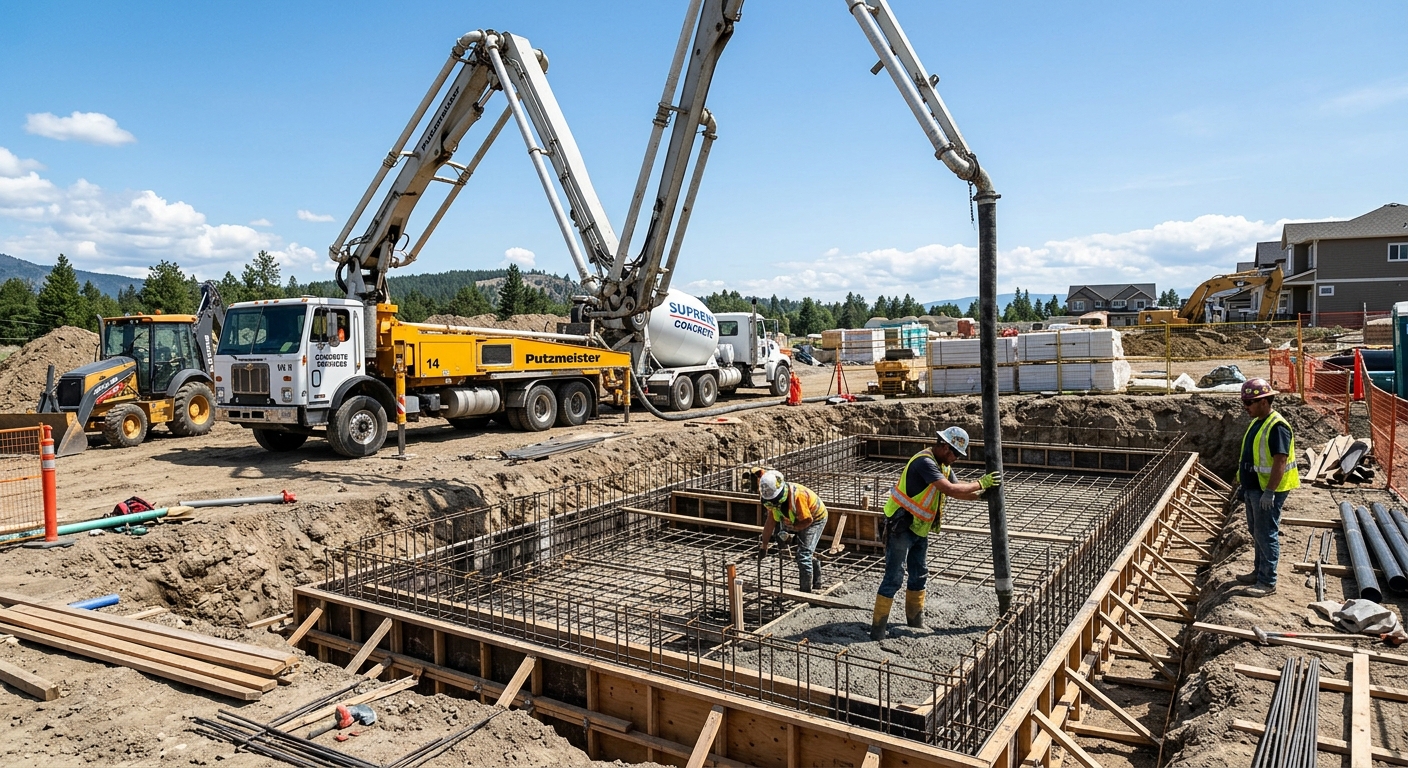
Concrete work options and costs in Bearspaw
Bearspaw, Alberta is a small community where concrete flatwork is common—especially around the growing family homes that rely on durable driveways, patios, and walkways. With Bearspaw’s population at 5,567 (Statistics Canada, 2021 Census), the tradesphere is smaller than Calgary, so scheduling and availability can tighten during the exterior pour season. In this area, concrete companies also price in the reality that the region’s housing stock includes many older properties with established landscaping and utilities, which can add excavation and disposal costs when you upgrade slabs.
Calgary’s cold continental climate drives most of the cost difference between options. The local design frost depth is about 1.2 m (roughly 4 ft), so footings and frost-protected foundation work must be engineered to bear below that line to reduce frost heave and seasonal movement. Exterior slabs also need an air-entrained concrete mix to better resist freeze–thaw damage, and contractors plan around a shorter practical pour window. If you’re doing work near the Bearspaw/Calgary corridor—where access can be constrained by existing drive geometry—truck access and rebar placement become more labour-intensive.
In Bearspaw (including the Springbank/area lifestyle pockets), driveways and front patios are especially in demand because they get heavy daily use and are exposed to de-icing salt. That’s why buyers often compare standard broom-finished concrete against upgrades like stamped concrete or exposed aggregate. Next, here’s a side-by-side of typical scopes and realistic price ranges you’ll see in Bearspaw.
| Application |
Typical Size |
Key Spec |
Finish Option |
Price Range |
| Concrete driveway (standard broom finish) |
400–500 sq. ft. |
Air-entrained, reinforced where needed |
Broom finish, simple control joints |
$12,000–$18,000 |
| Exposed aggregate driveway |
400–500 sq. ft. |
Air-entrained, proper curing to minimize scaling |
Exposed stone surface (brush/wash method) |
$15,000–$22,000 |
| Stamped concrete driveway or patio |
250–500 sq. ft. |
Durable release, sealer-ready mix, joint detailing |
Stamped pattern + colour hardener |
$15,000–$26,000 |
| Plain concrete patio or walkway |
200–350 sq. ft. |
Air-entrained, compacted granular base |
Float + light broom finish |
$5,000–$9,000 |
| Garage floor (interior slab) |
500–650 sq. ft. |
Vapour barrier (if required), reinforcing |
Standard broom or trowel/smooth finish |
$7,500–$13,500 |
| Foundation footings (structural, below frost) |
Per house/area (often 800–1,500 sq. ft. of footing lineal) |
Engineered design; excavation below frost depth |
Reinforced structural concrete |
$28,000–$45,000 |
Prices are estimates only and vary by project scope, site access and material selection.
What affects the price of concrete work in Bearspaw
In Bearspaw and the wider Calgary area, it’s not unusual to see quotes for what looks like the “same” concrete job vary by 30–50%. The spread usually comes from differences in what’s included: excavation depth, granular base spec, reinforcement type, concrete mix requirements, curing/winter protection, and the finish system. Contractors that price low often make up the difference by reducing base prep or reinforcement, or by assuming warmer placement conditions—both of which can lead to premature cracking and surface scaling when freeze–thaw cycles hit.
Here’s the big driver: frost and freeze–thaw. The design frost depth is about 1.2 m, so footings and frost-protected structures must extend below undisturbed soil at that depth. For exterior slabs and driveways, Calgary practice requires air-entrained concrete to handle repeated freeze–thaw cycles, plus a joint layout to control cracking. Cold-weather placement can also add cost because contractors may need insulated blankets, temporary heating, and winter-grade mix adjustments to achieve proper curing. And because Bearspaw properties often use de-icing salt, sealing becomes more important for patios, walkways, and any lightly finished driveway edges—especially if you’re choosing a lighter-colour finish.
Two practical examples: upgrading from a plain patio to stamped concrete might add roughly $10,000+ depending on pattern area, but it’s often justified when you want curb appeal and are willing to budget for proper jointing and sealer maintenance. On driveways, going from standard broom to exposed aggregate can add cost because the surface finishing steps are labour-heavy; however, it can be worth it for texture and salt-scratch resistance. As a reference point, standard driveway work often aligns with the $12,000–$18,000 band, while decorated work frequently moves into the $15,000–$26,000 range.
| Price Factor |
Why It Matters |
Cost Impact |
| Frost line depth — determines footing depth and form height |
Footings must bear below design frost to prevent heave |
Higher excavation and concrete volume; can push foundation/footings toward $28,000–$45,000 |
| Site preparation — excavation, grading, compacted granular base |
Base failure leads to settlement and cracking |
Extra truckloads and labour; can add thousands on reworks and tight lots |
| Reinforcement — rebar or wire mesh requirement |
Controls cracking and improves slab load resistance |
Material and labour increase; omission is a common reason for low bids |
| Mix design — air-entrainment and compressive strength spec |
Air content and strength are critical for freeze–thaw durability |
Winter-grade/verified air mix can raise costs, but reduces long-term failure |
| Finish type — broom vs. stamped vs. exposed aggregate |
Surface system affects labour time, materials, and sealing needs |
Stamped/exposed labour pushes pricing toward decorated bands |
| Pour size and concrete truck access to site |
Smaller pours and limited access increase handling time |
Can increase labour and “pump/short pour” complexity |
| Cold-weather curing precautions — heating and blankets |
Protects strength gain and reduces scaling risk |
Temporary heat/blankets can add significant day costs in shoulder season |
| Control joint pattern and sealing cost |
Joints manage shrinkage; sealing helps defend against salt exposure |
Higher if included as a detailed system with proper timing |
Permits & regulations in Alberta
In Alberta, structural concrete work typically requires a building permit, and many projects need engineered drawings that get reviewed as part of the municipal permitting process. For Bearspaw homeowners, that “permit-required” zone usually includes foundation footings, foundation walls, grade beams, and any structural slabs tied directly into the building’s load path. If you’re planning a basement development, an addition, or any new or modified structural foundation element, assume you’ll be pulling permits.
Concrete flatwork—patios, walkways, most driveways—often does not require a permit by itself. However, it can require municipal review if it changes lot grading, impacts impervious surface coverage rules, or alters drainage in a way that affects neighbouring properties or municipal right-of-way. The safest approach is to check with the local authority before breaking ground, especially if you’re raising slab elevations or adding significant new hardscape.
To verify your contractor for Alberta compliance, walk through this sequence: (1) confirm the contractor’s credentials using the appropriate online business/registration listing; (2) request a current certificate of insurance showing liability coverage limits and confirm it matches your job address; and (3) ask for proof of WSIB/WCB coverage (or an equivalent clearance letter where applicable for the contractor type). Finally, ask for references on similar-scale work—driveways, patios, or footings done below frost depth—so you know they’ve installed this specific system in cold-weather conditions.
Getting concrete right in Bearspaw's freeze-thaw climate
Concrete failure in Bearspaw most commonly shows up as scaling, spalling, and random cracking—problems that trace back to base prep, mix design, air entrainment, jointing, and curing. In a cold continental climate, the slab cycles through freezing and thawing while de-icing salts migrate into the surface. If the mix doesn’t contain enough air or curing is rushed, water expands in the pores, which breaks down the surface over time.
To spec the job correctly, require (1) solid base preparation: excavate to the design level and place compacted granular sub-base to support the slab below the frost-affected zone; (2) mix design: air-entrainment targeted for exterior exposure and a minimum 32 MPa compressive strength so the concrete reaches strength without becoming brittle; (3) control joints: a joint spacing plan that prevents random cracking and guides where cracks will form; (4) curing: minimum 7-day curing under appropriate conditions, with winter blankets or heat if temperatures demand it; and (5) sealing: a penetrating sealer applied after proper cure (typically at 28 days) to repel salts and reduce surface deterioration.
When comparing options, you can see why price differences sometimes matter—and sometimes don’t. For example, if you choose stamped concrete instead of plain broom finish, the extra cost is mostly labour and materials (stamps/colour hardener plus more careful finishing). But if the contractor cuts corners on air content or base thickness, the stamped surface won’t “hide” early scaling—you’ll still be paying for repairs. That’s why the cheapest bid often fails the same basic technical checklist that protects exterior flatwork in Bearspaw.
| Spec |
Why It Matters in Bearspaw |
What to Ask For |
Impact if Skipped |
| Compacted granular base (depth?) |
Supports slab and limits frost-related movement |
Specify excavation to grade and compacted sub-base thickness; confirm compaction testing if available |
Settlement, uneven slabs, cracking |
| Air-entrained concrete mix (target air %?) |
Resists freeze–thaw and reduces scaling/spalling |
Request exterior air content in the 5–7% range |
Surface deterioration and spalling in salt exposure |
| Compressive strength (MPa rating) |
Ensures durable, proper strength gain |
Confirm minimum 32 MPa compressive strength spec |
Premature wear, brittle cracking, lower service life |
| Control joints (spacing per ACI guidelines) |
Controls where shrinkage cracks occur |
Request joint spacing/layout plan and joint depth/finish details |
Random cracking and moisture pathways |
| Minimum 7-day curing period |
Cold-weather curing affects strength development |
Confirm curing method and that work pauses if conditions aren’t met |
Reduced durability, early scaling, weak surface |
| Penetrating sealer (when applied after cure) |
Repels de-icing salts and limits moisture uptake |
Schedule after cure (commonly around 28 days) and specify product type |
Faster surface breakdown and staining |
How to choose a concrete work contractor in Bearspaw
Start by verifying Alberta compliance the right way. Ask the contractor for (1) their business credentials/registration so you know they’re operating properly in Alberta, (2) a current certificate of insurance for liability coverage naming your address, and (3) WSIB/WCB coverage proof (or the applicable clearance documentation based on the contractor type). If they can’t provide documentation promptly, treat that as a red flag—concrete claims can be expensive due to excavation, underground utility risks, and curing-related schedule impacts.
Next, require itemised written quotes rather than one lump total. You want labour and materials separated so you can compare like-for-like: excavation and haul/disposal, granular base spec and thickness, reinforcement type (mesh vs. rebar), concrete mix requirements (including air-entrainment and strength), finish system (broom vs. stamped vs. exposed aggregate), and curing/winter protection. Clarify what’s included in the scope: permit pull (if applicable), any service locates, snow/ice removal from the work area, and cleanup and debris handling.
For warranty, ask for two things: the workmanship warranty length and whether the product/manufacturer warranty applies to stains/colour systems (if stamped). Also confirm whether the warranty is transferable if you sell the home.
Finally, payment terms matter. In Bearspaw, a reasonable approach is to keep upfront deposits to about 10–15% maximum, with a holdback until completion and final inspection. Get the start date and completion estimate in writing, including weather-dependent curing steps for cold-weather placement.
- Ask for proof of liability insurance and confirm it covers the work scope and site address.
- Provide WSIB/WCB coverage documentation before work begins.
- Get 2–3 itemised quotes with labour/material line items (not just a single number).
- Confirm air-entrained exterior mix and minimum compressive strength specs in writing.
- Require a base prep description: excavation depth, compacted granular base thickness, and compaction approach.
- Verify reinforcement details (rebar/wire mesh thickness and where it’s placed).
- Ask how control joints will be laid out to limit random cracking.
- Confirm curing plan (minimum curing time and cold-weather blankets/heat when needed).
- Clarify sealing: product type and when it will be applied after cure.
- Check disposal/haul-away is included (old concrete removal can change the price quickly).
- Make sure truck access and placement method are planned for your driveway shape and grade.
- Review warranty terms: workmanship duration, exclusions, and whether transfer is allowed.
Concrete contractor red flags in Bearspaw include: refusing to discuss frost depth/air-entrainment specs, giving a low bid that doesn’t mention reinforcement or joint spacing, starting exterior pours in cold weather without blankets/heating plans, collecting large upfront payments beyond 10–15%, and failing to provide insurance/WSIB documentation before work.
Frequently asked questions — concrete work in Bearspaw
Concrete vs pavers for a patio in Bearspaw?
In Bearspaw, both concrete and pavers can work well, but they address freeze–thaw differently. Concrete patios are typically poured with air-entrained mix and properly placed joints, and the smooth surface sheds snow and ice more uniformly. Pavers can be very forgiving visually, yet they rely heavily on excellent base preparation and edge restraint—settlement can show up as uneven stones over time, especially where drainage and de-icing salt are issues. If you’re comparing costs, a plain concrete patio often falls into the $5,000–$9,000 band for typical residential sizes, while pavers usually compete based on material/installation complexity and ongoing leveling/maintenance. If you want a low-maintenance surface and consistent performance against Alberta winters, concrete is often the cleaner spec—provided the contractor confirms air content, compacted base, and joint layout.
How long does a concrete driveway last?
With proper specs in Bearspaw—air-entrained exterior mix, well-prepped granular base, reinforcement where required, correct control joints, and curing—concrete driveways commonly last decades. The weak points tend to be surface scaling from salt exposure and random cracking from inadequate jointing or rushed curing. If a driveway is installed with poor base compaction or an under-specified mix, freeze–thaw cycles can accelerate deterioration much sooner. In Alberta, timing matters: cold shoulder-season pours require winter-grade planning (blankets/heating) to achieve proper curing. When your driveway is in the standard $12,000–$18,000 range, the best outcomes usually come from contractors who still include the “invisible” items: correct base, air entrainment, and joint sealing/maintenance. A cheaper bid that skips these often becomes a repair sooner.
What is air-entrained concrete and why does it matter here?
Air-entrained concrete is a mix designed to contain tiny, evenly distributed air bubbles. Those bubbles give water somewhere to expand when it freezes, reducing internal pressure that causes scaling and spalling. In Bearspaw and the broader Calgary region, freeze–thaw cycles are frequent and de-icing salt increases surface vulnerability, so air content is not optional for exterior flatwork. Ask your contractor to target exterior air content in the 5–7% range and confirm in writing how they’ll verify mix design. Skipping or under-specifying air entrainment is one of the most common reasons driveways and patios start showing rough, flaking surfaces even when the concrete looks fine at first. For any exterior work, air-entrainment—combined with a proper curing window—is a key part of getting real long-term value from the job.
How do I prepare the base for a concrete slab?
Base prep in Bearspaw is mostly about depth, drainage, and compaction. Your contractor should excavate to the required grade and remove topsoil/organic material, then place a compacted granular sub-base to the specified thickness. The goal is uniform support—no soft spots—because even small voids can lead to settlement and cracking during freeze–thaw cycles. For exterior slabs, base prep also influences how the slab relates to frost-affected movement; your foundation/footing work must respect the design frost depth (about 1.2 m in this region) for structural stability. For driveways and patios, ask what granular material and compaction method will be used, and whether reinforcement will be installed as required. A well-detailed base is one of the best ways to make sure you don’t pay again for repairs after only a few seasons.
How do I compare concrete quotes?
To compare concrete quotes in Bearspaw, you need to make them “like-for-like.” Ask each contractor to itemise labour and materials, and ensure the technical specs match: air-entrained exterior concrete for outdoor slabs, minimum compressive strength (commonly 32 MPa for many residential specs), granular base thickness and compaction approach, reinforcement placement, and the control joint plan. Also compare curing provisions—especially if work might land in late fall or early spring. Finally, confirm inclusions: excavation haul/disposal, service locates (where needed), permit handling (for structural work that requires it), and whether sealing is included for patios/driveways. Price alone can mislead; for example, standard driveways often land around $12,000–$18,000, while stamped work frequently moves into $15,000–$26,000. The right choice is the quote that matches the engineering and cold-climate specs, not just the one with the lowest number.
Can concrete be poured in cold weather in Bearspaw?
Yes, concrete can be poured in cold weather in Bearspaw, but it shouldn’t be “business as usual.” Cold-weather placement requires a winter-grade approach: protecting the slab with insulated blankets, applying temporary heat when needed, and managing curing conditions so the concrete reaches strength properly. Without that, you can see surface scaling, reduced durability, and strength gain issues—problems that show up after several freeze–thaw cycles. A reputable contractor will tell you the plan for curing and how they’ll respond if temperatures drop or wind is pulling moisture out of the surface too quickly. If your project timing is tight, ask about the added costs for heating/blankets, because that’s one reason quotes differ by 30–50% even when the drawings look similar. For exterior work near Bearspaw’s pour-season edges, proper winter curing is one of the best investments you can make for long-term performance.