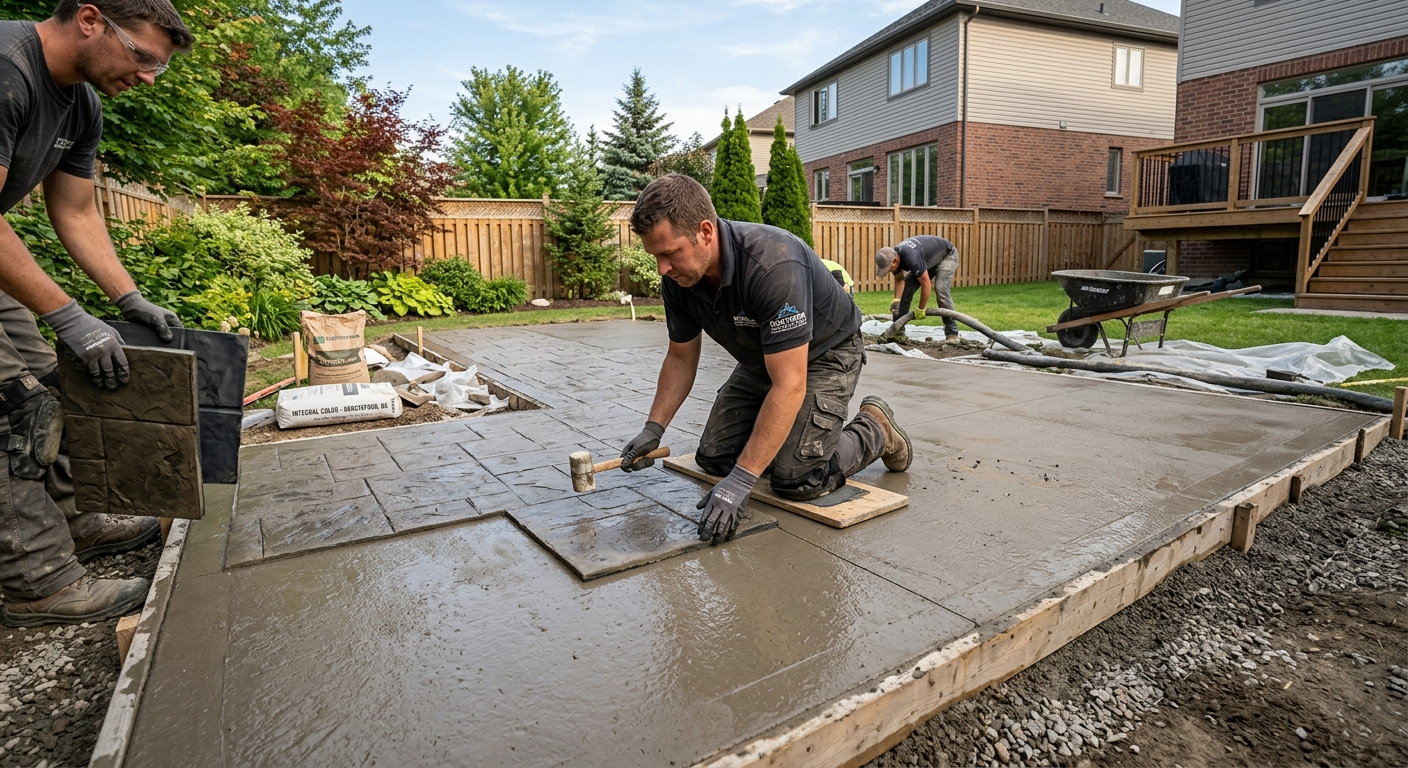
Concrete work options and costs in Fort Saskatchewan
Concrete work in Fort Saskatchewan is mostly about doing it right for our cold continental climate—especially when you’re dealing with exterior flatwork like driveways, patios, and walkways. The market here is strong for these projects because most residents live in single-detached homes (63.9% of dwellings), and a solid share of households own their homes (7,885 homeowner households, 75.7% of households own) (Statistics Canada, 2021 Census). The bigger driver of cost is frost-aware design: in the Edmonton economic region, footings typically need to be placed below the local frost line (often designed around 1.5 m or more) to prevent frost heave. That means excavation, forming height, and backfill work can be more labour-intensive than in milder parts of Canada. Exterior slabs also have to survive frequent freeze–thaw cycles, so Edmonton-area crews commonly build deeper, well-compacted granular bases, use air-entrained mixes, and lay out control joints to manage cracking.
Scheduling can also affect your quote. Pour seasons for flatwork are shorter in this region, so contractor availability tends to tighten late spring through early fall; if weather shifts, it can push crews to rebook, which is where pricing premiums sometimes show up. If you’re in demand areas like Sherbrooke or around Downtown Fort Saskatchewan, you’ll often see more competition for concrete dates because these neighbourhoods have a steady pipeline of driveway renewals and backyard upgrades.
Below is a practical cost comparison for common concrete projects you’ll see quoted in Fort Saskatchewan, using local price bands as the backbone for realistic ranges.
| Application |
Typical Size |
Key Spec |
Finish Option |
Price Range |
| Concrete driveway (standard broom finish) |
20 ft x 10 ft (200 sq. ft.) |
4 in slab, air-entrained mix, control joints |
Broom finish |
$9,000–$14,000 |
| Exposed aggregate driveway |
20 ft x 10 ft (200 sq. ft.) |
4 in slab, surface wash/retard method |
Exposed aggregate |
$13,000–$18,000 |
| Stamped concrete driveway or patio |
20 ft x 10 ft (200 sq. ft.) or patio 12 ft x 15 ft |
4–5 in slab, colour hardener, release agent |
Stamped + coloured |
$16,000–$26,000 |
| Plain concrete patio or walkway |
12 ft x 15 ft (180 sq. ft.) |
4 in slab, granular base, joints |
Steel trowel/finish + light broom edge |
$3,500–$7,500 |
| Garage floor (interior slab) |
22 ft x 24 ft (528 sq. ft.) |
4–5 in slab, vapour barrier often included |
Broom finish or light trowel |
$7,500–$14,000 |
| Foundation footings (structural, below frost) |
Varies by house plan |
Excavation, formwork, reinforced footings below frost |
Structural concrete |
$25,000–$60,000 |
Prices are estimates only and vary by project scope, site access and material selection.
What affects the price of concrete work in Fort Saskatchewan
In Fort Saskatchewan, two quotes for what looks like the same job can swing by 30–50% across the Edmonton area because the cost stack isn’t just “concrete.” It’s excavation, base preparation, reinforcement, cold-weather curing, drainage detailing, and crew scheduling. For example, Edmonton-area residential projects still need to respect frost design—footings must extend below the design frost depth (often up to around 2.4 m in Alberta design conditions for many situations), which can materially increase form height, trench width, and backfill quantities. Exterior slabs also live through repeated freeze–thaw cycles, so air-entrained concrete isn’t optional; it’s a durability requirement.
When the calendar compresses, labour becomes harder to secure, and cold-weather hoarding happens: insulated blankets, heated enclosures, and extra time for proper curing can add both labour and energy costs. That’s one reason a standard broom driveway can land near the lower end of the driveway band (around $9,000–$14,000), while decorative upgrades like stamped concrete or exposed aggregate often move closer to the upper end (up to $13,000–$18,000 for aggregate and $16,000–$26,000 for stamped), even when the slab size is the same.
Two local examples you’ll actually feel in your quote: (1) older homes—31.2% of housing stock is built before 1981 (Statistics Canada, 2021 Census)—often have older grading, weaker drainage paths, and sometimes more extensive demo, so excavation/backfill can be higher; (2) long, narrow access off residential streets near Downtown can slow truck movement and add labour for placement and finishing. Conversely, a straightforward backyard pour with easy access and good existing grade can bring a patio closer to the mid-range of the patio band.
| Price Factor |
Why It Matters |
Cost Impact |
| Frost line depth |
Determines footing depth and form height |
Deeper excavation and higher formwork can add substantial labour and materials |
| Site preparation |
Excavation, grading, compacted granular base |
More stripping and regrading pushes costs up; solid access can reduce time |
| Reinforcement |
Rebar or wire mesh requirement |
Steel and tying/setup time varies by structural design and slab loading needs |
| Mix design |
Air-entrainment and compressive strength spec |
Durability specs increase material cost; skipping them increases failure risk |
| Finish type |
Broom vs. stamped vs. exposed aggregate |
Labour steps and materials (colouring/release/aggregate wash) raise the total |
| Pour size and concrete truck access to site |
Placement speed and how far concrete must be wheelbarrowed |
Poor access can require extra crew and time, increasing labour cost |
| Cold-weather curing precautions |
Heating and blankets for proper set and cure |
Extra equipment and fuel can add noticeable cost during colder stretches |
| Control joint pattern and sealing cost |
Crack control and long-term surface protection |
Better joint layout plus sealing adds line items but reduces premature cracking/spalling |
Permits & regulations in Alberta
In Alberta, structural concrete work—such as foundation footings, foundation walls, and grade beams—typically requires a building permit, and it often involves engineered drawings that get reviewed by the municipality. Concrete flatwork (patios, walkways, driveways) usually does not require a permit on its own, unless it affects lot grading, impervious surface coverage limits, or municipal right-of-way conditions. In Fort Saskatchewan, the safe approach is to confirm the specific scope with the municipality before you break ground, particularly if you’re changing drainage patterns, tying into existing drainage, or removing and reworking significant portions of grade.
Also verify your contractor is properly covered. For Alberta jobs, ask for proof of liability insurance and WSIB/WCB coverage before signing. To check a contractor, start with the Alberta online registry tools (search the contractor/firm name to verify business status and eligibility where applicable), then request a current Certificate of Insurance showing the correct named insured, coverage limits, and effective dates. For clearance, ask whether they can provide a WSIB/WCB clearance letter or documentation that matches the work being performed.
Step-by-step for a Fort Saskatchewan homeowner: (1) get the written scope (footings vs flatwork matters), (2) ask for the contractor’s insurance and WSIB/WCB proof before scheduling, (3) confirm permit responsibility with the city for any grading/right-of-way implications, and (4) keep copies of all documents with your contract and change orders.
Getting concrete right in Fort Saskatchewan's freeze-thaw climate
Concrete can fail in Fort Saskatchewan for predictable reasons: water gets into the slab or around the base, then freeze–thaw cycles expand and weaken the material. The most common failures I see are edge spalling, random cracking, and drainage-related settlement—usually tied back to base prep, air-entrainment, curing, and joint layout. To spec the job correctly, you want the design to match Edmonton-area frost and the real seasonal temperature swings.
First, base preparation: build a properly compacted granular sub-base to the right depth for your soil and frost requirements, with correct grade so water drains away from the slab. Second, mix design: for exterior flatwork in Fort Saskatchewan, air-entrained concrete is key; target air content is typically about 5–7% air for durability. Pair that with a minimum 32 MPa compressive strength specification unless the engineer calls for more. Third, control joints: place joints to limit random cracking—don’t just “add a crack later”; layout should be planned. Fourth, curing: you generally need at least 7 days of proper curing, and when cold nights are involved, you must protect the pour with blankets/heating so the concrete actually develops strength. Fifth, sealing: apply a penetrating sealer about 28 days post-pour to help repel de-icing salts and reduce surface deterioration.
As an example of where the price difference is justified: a standard broom-finish driveway might come in around $9,000–$14,000, but if your base is weak or drainage is questionable, the “cheap option” can cost more later. Spending extra on excavation, compacted granular base, and correct jointing can be the difference between a driveway that stays serviceable for years and one that starts spalling early. On the other hand, if your site is straightforward and access is easy, you shouldn’t pay stamped pricing ($16,000–$26,000) for a finish you won’t use.
| Spec |
Why It Matters in Fort Saskatchewan |
What to Ask For |
Impact if Skipped |
| Compacted granular base (depth?) |
Reduces pumping and settlement during freeze–thaw cycles |
Base depth for your soil + compaction test/confirmation |
Cracking, unevenness, and accelerated edge failure |
| Air-entrained concrete mix (target air %?) |
Controls freeze–thaw durability in Edmonton-region winters |
Air content target of about 5–7% for exterior flatwork |
Higher risk of spalling and surface scaling |
| Compressive strength (MPa rating) |
Strength development and long-term performance |
Minimum 32 MPa (or higher if specified by engineer) |
Premature wear, weaker edges, and faster deterioration |
| Control joints (spacing per ACI guidelines) |
Limits random cracking during temperature cycling |
Planned joint spacing and sawing schedule |
Uncontrolled cracks that allow water ingress |
| Minimum 7-day curing period |
Ensures strength gain despite cold nights |
Curing protection plan (blankets/heating if needed) |
Weak concrete and early surface breakdown |
| Penetrating sealer (when applied after cure) |
Helps repel salts and moisture movement in winter |
Penetrating sealer at about 28 days after pour |
More salt damage, porous surface, shorter lifespan |
How to choose a concrete work contractor in Fort Saskatchewan
Choosing the right concrete contractor matters more in Fort Saskatchewan because “good-looking concrete” isn’t the same as durable concrete in freeze–thaw weather. Start by verifying Alberta coverage: ask for current liability insurance (with effective dates and appropriate limits) and proof of WSIB/WCB coverage for the workers who will be on site. In practice, you can check business status using Alberta online registry search tools, then confirm the details on the Certificate of Insurance and any WSIB/WCB clearance documentation they provide. Don’t accept verbal assurances—ask for documents before work begins.
Then request 2–3 itemised written quotes. You want line items that separate labour, concrete supply, excavation and hauling, granular base, reinforcement, finishing, and (for exterior slabs) any curing/blanket provisions and sealing. Avoid quotes that only state “concrete supply and install” with no specs. Also confirm what’s excluded: disposal of old concrete, regrading, removing trees/shrubs, changing slopes to meet drainage, permit handling, and any right-of-way considerations.
For warranty, ask for (1) the length of workmanship warranty, (2) whether there’s a product/manufacturer warranty for coatings or additives, and (3) whether it’s transferable if you sell the home. For payment, a fair approach is keeping initial payments around 10–15%, then using a holdback until completion and final grading clean-up. Finally, insist on a written timeline with a start date and completion estimate; in this region, scheduling shifts happen, but the plan should be clear.
- Ask for the exact slab thickness and reinforcement details (mesh vs rebar, where applicable).
- Confirm air-entrainment is included for exterior work.
- Require base depth and compaction expectations, not just “granular base.”
- Get joint layout details (where joints are cut/formed and timing).
- Ask how drainage is managed so water doesn’t pool at edges.
- Confirm whether cold-weather curing protection is included when temperatures drop.
- Request sealing scope for exterior slabs (penetrating sealer timing and coverage).
- Ensure old slab/demo and hauling are clearly included or excluded.
- Check that disposal fees aren’t a surprise change order.
- Verify insurance and WSIB/WCB before scheduling.
- Ask for references and photos from similar Edmonton-area climates and slab sizes.
- Agree on a written payment schedule tied to milestones (forms, pour, finish, cure protection, final clean-up).
Concrete contractor red flags in Fort Saskatchewan: they won’t discuss frost-depth/base prep specifics, they dismiss air-entrainment for exterior slabs, they provide a quote without slab thickness and joint/sealing details, they ask for large upfront payments (well over 15%), or they can’t show current insurance/WSIB/WCB documentation and comparable local work.
Frequently asked questions — concrete work in Fort Saskatchewan
Do I need a permit for concrete work in Alberta?
In Alberta, the permit requirement depends on what concrete work you’re doing. Structural concrete like foundation footings, foundation walls, and grade beams typically requires a building permit and often engineered drawings reviewed through the municipal process. For concrete flatwork—driveways, patios, and walkways—permits are commonly not required by default, unless the work affects lot grading, drainage, impervious surface coverage, or a municipal right-of-way. Because Fort Saskatchewan is in the Edmonton economic region with frost-sensitive design expectations, drainage and grading decisions can be the part that triggers municipal review. Before you break ground, confirm with the City and ask whether the contractor will pull any required approvals as part of the scope. As a practical planning point, many driveway renewals quoted near $9,000–$14,000 still need careful grading notes for long-term durability.
Concrete vs pavers for a patio in Fort Saskatchewan?
Concrete and pavers both work in Fort Saskatchewan, but they fail differently in freeze–thaw conditions. Concrete patio slabs rely heavily on base compaction, air-entrained mix, and joint layout to control cracking; if those are done well, a broom-finish patio can hold up for years. Pavers can be more forgiving if one area settles, because individual units may be replaced, but they still need proper base thickness, edge restraints, and good drainage—otherwise they shift and heave. In terms of cost, a plain concrete patio often falls in the local band of $3,500–$7,500, while pavers usually trend higher once you factor in excavation, base, and polymeric sand/edging. If you want an integrated, low-maintenance look that matches a driveway, concrete is often the cleaner fit. If you anticipate heavy seasonal movements or prefer easier spot repairs, pavers can make sense.
How long does a concrete driveway last?
A concrete driveway in Fort Saskatchewan commonly lasts 20–30 years when it’s built with frost-aware footings/base depth, air-entrained concrete for exterior durability, correct joint spacing, and proper curing. In practice, the driveway life is less about “brand of concrete” and more about base prep and water management—standing water and weak base lead to edge spalling and early cracking. De-icing salts can also accelerate surface wear if you don’t seal at the right time. If you’re pricing options, a standard driveway near $9,000–$14,000 can perform very well if the contractor includes granular base design, air-entrainment, control joints, and a drainage-ready grade. Decorative finishes like exposed aggregate or stamping can last just as long, but the surface system and workmanship steps need to be solid too. The best predictor is whether your quote shows those specs clearly.
What is air-entrained concrete and why does it matter here?
Air-entrained concrete is mixed with tiny, evenly distributed air bubbles that give freezing water a space to expand. In Fort Saskatchewan’s climate—where freeze–thaw cycles are frequent through late fall, winter, and spring—that air network is a key durability factor for exterior slabs. Without correct air entrainment, water saturation can damage the paste and lead to spalling or surface scaling, especially along edges where water and salts concentrate. That’s why reputable Edmonton-area crews specify air-entrained mixes for driveways and patios. When asking your contractor, look for a stated air target (commonly about 5–7% air for exterior flatwork) and confirmation that the mix meets the strength spec (often at least 32 MPa). If a contractor won’t talk about air-entrainment details, that’s a sign you should dig deeper before approving the work.
How do I prepare the base for a concrete slab?
Base preparation is where quality shows up—especially in Alberta’s frost-driven conditions. For a concrete driveway or patio in Fort Saskatchewan, the goal is to remove unsuitable material, place the right granular base depth, and compact it to support the slab without pumping or settlement. Your contractor should confirm site grading so water drains away from the slab (standing water is a major failure trigger), then build a compacted granular sub-base designed for frost movement. Ask how they determine base depth based on soil conditions and how they verify compaction (some contractors keep records; at minimum they should explain their process). For exterior slabs, ensure there’s a durable system: air-entrained concrete, correct reinforcement where required, and control joints at planned spacing. Budget-wise, base prep is often reflected in the difference between entry options around $9,000–$14,000 and higher-spec builds that protect the slab for the long term.
How do I compare concrete quotes?
To compare concrete quotes in Fort Saskatchewan, don’t start by comparing the “total.” Start by comparing what’s inside the total. Ask each contractor for an itemised breakdown covering excavation/demo, granular base depth and compaction approach, reinforcement (mesh vs rebar and where it goes), concrete mix specs (including air-entrainment for exterior), slab thickness, finish type, and joint layout. Then verify whether curing protection (blankets/heating) is included when cold weather is possible, and whether sealing is included for exterior slabs (often applied about 28 days after pour). Confirm what’s excluded: disposal, grading tie-ins, permit handling (if applicable), and any right-of-way constraints. A properly detailed stamped driveway quote might fall into the $16,000–$26,000 band, but you should still see the same core durability line items beneath the decorative steps. The goal is like-for-like comparisons, not apples-to-oranges totals.