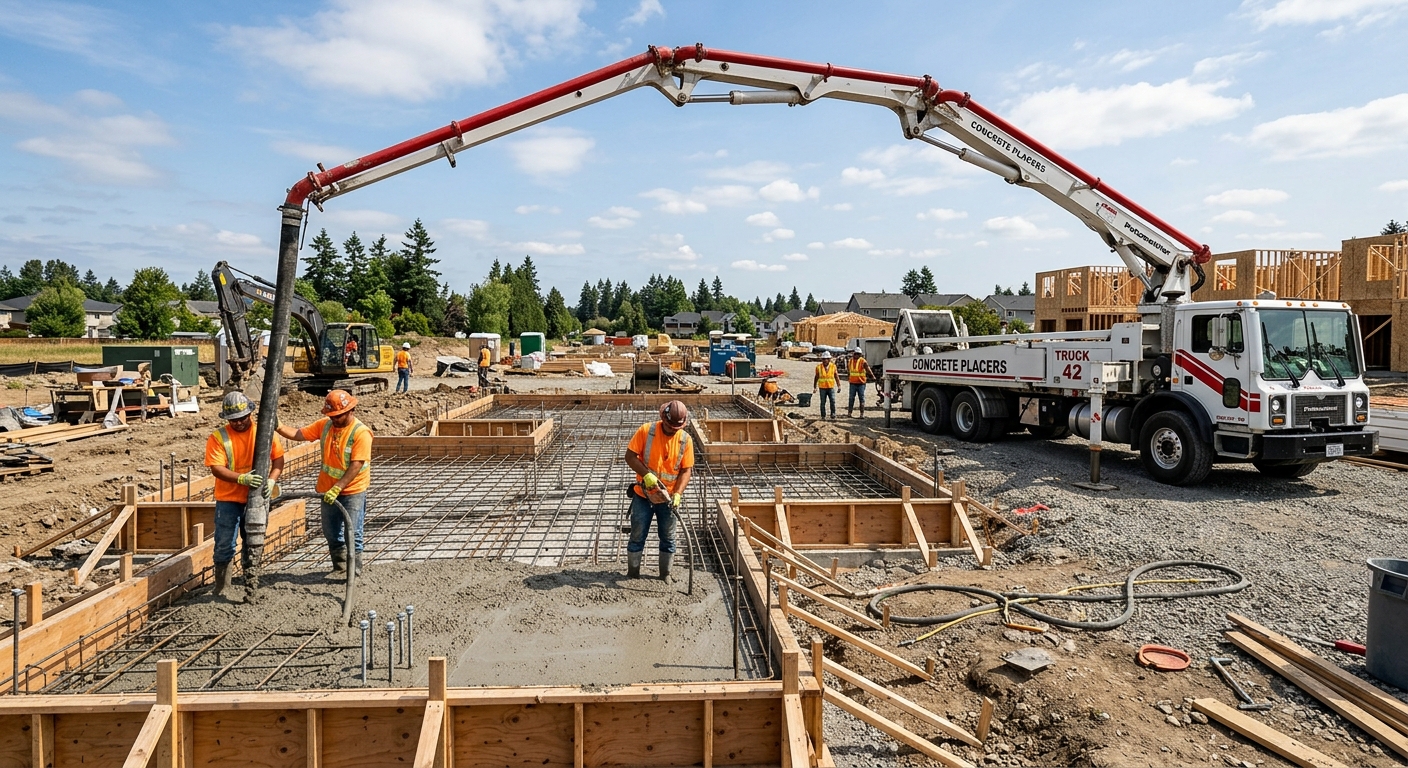
Concrete work options and costs in Riverbend
In Riverbend, Alberta, homeowners typically choose concrete for driveways, patios, walkway runs, garage floors, and—on most new homes—for foundation footings. Riverbend’s population was 9,205 in the 2021 Census (Statistics Canada, 2021 Census). That demand matters because most concrete flatwork goes hand-in-hand with the housing stock: Riverbend sits in Calgary’s broader market, where new builds and periodic upgrades keep crews busy and raise scheduling pressure during the main exterior pour season.
Costs in this area are shaped by Calgary’s cold continental climate, specifically freeze–thaw cycles and a deeper design frost depth (engineered practice commonly targets bearing below the design frost line). That means footing and base excavation is often more intensive than in milder provinces, and exterior slabs require air-entrained mixes plus a proper joint and sealing plan. On top of that, the local pour window is shorter, so late-fall or early-spring placements may need insulated blankets and, sometimes, temporary heat to protect curing.
Contractor availability is another factor: during peak months, better crews get booked quickly and they may adjust pricing based on crew efficiency, truck access, and rebar/prep demands. In Riverbend, trades often see especially consistent demand around the established residential pockets near major approaches and subdivision edges where driveway access and grading are common upgrade triggers.
Below is a practical comparison of typical options and price ranges for Riverbend. Use it to sanity-check quotes before you approve any schedule or finish upgrades.
| Application |
Typical Size |
Key Spec |
Finish Option |
Price Range |
| Concrete driveway (standard broom finish) |
24 ft x 18 ft (432 sq. ft.) |
Air-entrained slab, compacted granular base |
Broom finish with control joints |
$12,000–$18,000 |
| Exposed aggregate driveway |
24 ft x 18 ft (432 sq. ft.) |
Proper surface retarder/curing; air-entrained mix |
Exposed aggregate finish with sealer |
$14,500–$20,500 |
| Stamped concrete driveway or patio |
18 ft x 16 ft (288 sq. ft.) |
Reinforcement as required, air-entrained mix |
Stamp + color hardener (select pattern) |
$15,000–$26,000 |
| Plain concrete patio or walkway |
12 ft x 14 ft (168 sq. ft.) |
Air-entrained concrete; compacted base |
Light broom or trowel finish |
$5,000–$9,000 |
| Garage floor (interior slab) |
24 ft x 22 ft (528 sq. ft.) |
Interior mix design; vapor control where needed |
Plain finish with saw cuts |
$10,500–$16,500 |
| Foundation footings (structural, below frost) |
Typical detached home footprint |
Engineered reinforcement; bearing below design frost |
Structural finish (no decorative) |
$28,000–$45,000 |
Prices are estimates only and vary by project scope, site access and material selection.
What affects the price of concrete work in Riverbend
In Riverbend, you can see quote differences of 30–50% for what looks like the “same” concrete job because Calgary-area concrete pricing isn’t just about the finished surface—it’s about engineering, excavation, and how cold weather protections are planned. Two contractors can quote similar driveway square footage, yet one may include deeper excavation for proper base and footing bearing, a better air-entrained mix spec, or reinforcement that’s required based on soil and loading. Labour scheduling also shifts when crews are tied up with foundation work, rebar prep, or limited truck access—especially during busy stretches in the Spring and early Summer.
The biggest driver is frost and freeze–thaw. Local engineering practice commonly uses a design frost depth around 1.2 m (roughly 4 ft), so exterior foundations and structural elements must be supported on undisturbed soil below that line. Every extra foot of excavation and granular backfill shows up directly in your cost. At the slab level, exterior concrete must be air-entrained to survive repeated freeze–thaw cycles; that mix costs more than non-air-entrained concrete, and it also requires tighter placement and finishing timing.
Seasonality matters too. The exterior pour season is shorter, and if you’re close to shoulder months, contractors may need insulated blankets or temporary heat to protect curing. That can push an otherwise plain patio from the lower end of the $5,000–$9,000 band toward the upper end when cold curing precautions are needed. Conversely, a straightforward standard driveway in good access conditions can sit near the $12,000–$18,000 band, while a stamped upgrade typically lands in the $15,000–$26,000 range because of labour-intensive forming, stamping, and curing steps.
In Riverbend, I also see pricing swing with driveway slope grading, removal/disposal of old slabs, and how tight the site is for the concrete truck. If your project is in a neighbourhood with narrower access or more landscaping obstacles, truck positioning and rework risk often adds cost.
| Price Factor |
Why It Matters |
Cost Impact |
| Frost line depth — determines footing depth and form height |
Footings must bear below design frost to prevent frost heave |
Higher excavation and formwork; can shift foundation pricing materially (often a major driver) |
| Site preparation — excavation, grading, compacted granular base |
Proper base controls settlement and slab cracking |
Extra hauling, granular volume, and compaction labour add noticeable cost |
| Reinforcement — rebar or wire mesh requirement |
Controls cracking and improves load performance |
Material cost plus labour for placement/tie-in; increases with larger/loaded areas |
| Mix design — air-entrainment and compressive strength spec |
Air entrainment resists freeze–thaw damage |
Higher material spec and stricter placement needs; prevents premature scaling/spalling |
| Finish type — broom vs. stamped vs. exposed aggregate |
Finishing complexity affects time, labour, and curing steps |
Stamped/exposed finishes raise labour and material consumption |
| Pour size and concrete truck access to site |
Access affects how efficiently we can place and finish |
Limited access can require additional crew coordination and pump/extended setup |
| Cold-weather curing precautions — heating and blankets |
Ensures adequate cure and reduces surface scaling |
Blankets, heaters, and scheduling can add a meaningful premium near shoulder seasons |
| Control joint pattern and sealing cost |
Joints manage cracking; sealing protects against de-icing salts |
Additional saw cutting time and later sealer materials/visit |
Permits & regulations in Alberta
In Alberta, structural concrete work is generally treated as a permit/engineering matter. That includes foundation footings, foundation walls, grade beams, and any reinforced structural elements tied to the building’s load path. For a Riverbend homeowner, that typically means you’ll need a building permit through the local process, and engineered drawings are often reviewed as part of the approval steps—especially where soil conditions, reinforcement layout, and bearing requirements are involved.
Concrete flatwork like patios, walkways, and driveways usually does not require a separate permit on its own. However, it can become relevant if your plan affects lot grading, drainage away from the foundation, or impervious surface coverage limits, or if the work touches municipal right-of-way requirements. If you’re changing elevations, extending hardscape closer to property lines, or re-routing drainage, confirm the rules with the local authority before excavation.
To verify a contractor in Alberta step-by-step, do this before anyone digs: (1) request their certificate of insurance and confirm liability coverage matches the project scale; (2) ask for WSIB/WCB clearance and current coverage—don’t rely on verbal confirmation; (3) verify the contractor’s business information through appropriate online registries and licensing details the province/municipal process uses for trade contractors; (4) check references for similar-size structural and flatwork jobs in Calgary-area freeze–thaw conditions. A reputable crew will provide documents quickly and explain what’s included (excavation, disposal, rebar, curing protection) in plain language.
Getting concrete right in Riverbend's freeze-thaw climate
Concrete fails in Riverbend when water gets under or into the slab system, then freezes and expands—creating spalling, scaling, and uneven settlement. The fix is not “a stronger concrete and hope.” It’s a correctly engineered assembly: base preparation to the right depth for local soil and frost behavior, an air-entrained mix designed for freeze–thaw, an intentional control joint pattern, and curing that isn’t rushed when temperatures drop. Finally, sealing matters because de-icing salts accelerate surface deterioration.
Spec the base first. Exterior slabs should sit on a properly graded, compacted granular sub-base sized for local frost and drainage needs—over-excavation and re-compaction may be required if soft spots or unsuitable native soil are found. For the mix, aim for air-entrainment around 5–7% air for exterior flatwork and a minimum 32 MPa compressive strength (typical for many residential exterior pours when properly placed). Keep the joint plan deliberate: random cracking is normal, but uncontrolled cracking isn’t. Control joints should be spaced to limit crack widths.
Curing is critical in Calgary’s tighter pour season. A common standard is at least 7 days of curing under proper conditions; in cold weather, insulation blankets and/or temporary heat help the concrete reach adequate early strength. Sealing should be applied after cure—often around 28 days—to repel moisture and reduce salt penetration.
As a price example: if you’re choosing between a broom-finished patio on the low end of $5,000–$9,000 and a more premium stamped surface, the stamp cost may be justified for aesthetics, but do not cut corners on air-entrainment or base depth to “pay for the design.” A driveway or patio that looks good day one but fails in three winters costs far more than the original upgrade difference.
| Spec |
Why It Matters in Riverbend |
What to Ask For |
Impact if Skipped |
| Compacted granular base (depth?) |
Controls settlement and frost-related movement in cold weather cycles |
Confirm excavation depth and compacted granular base thickness; specify compaction testing approach |
Higher risk of uneven slabs, cracking, and water pooling |
| Air-entrained concrete mix (target air %?) |
Freeze–thaw resistance reduces scaling and spalling risk in Alberta winters |
Ask for exterior air content targeting 5–7% and proof of mix spec |
Premature surface damage from trapped moisture freezing |
| Compressive strength (MPa rating) |
Ensures the slab develops adequate strength for early life loads |
Ask for minimum 32 MPa (or higher if engineered) |
Reduced durability and higher chance of cracking under traffic |
| Control joints (spacing per ACI guidelines) |
Manages where cracks occur during shrinkage and thermal movement |
Request joint spacing plan and saw-cut timing; confirm sealant plan where required |
Random cracking and more water ingress into cracks |
| Minimum 7-day curing period |
Develops surface integrity before temperatures stress the slab |
Confirm curing method and protection plan; ask what happens if temps drop |
Surface scaling, weak early strength, and higher long-term deterioration |
| Penetrating sealer (when applied after cure) |
Reduces moisture and salt penetration during winter conditions |
Ask for penetrating sealer application timing (often around 28 days after pour) |
Faster salt damage and more visible spalling over seasons |
How to choose a concrete work contractor in Riverbend
Choosing the right concrete contractor in Riverbend starts with verification, not just price. First, confirm Alberta licensing/trade status where applicable for the work type, and ask for proof of liability insurance—then read the certificate to ensure it covers concrete operations (not just general business). Next, verify WSIB/WCB coverage and obtain a current clearance letter or equivalent proof. If they can’t provide documents promptly, that’s a major risk signal on a job that involves excavation, heavy materials, and winter curing.
Second, don’t accept a “lump sum” without breakdown. Get 2–3 itemised written quotes that separate labour and materials (concrete supply, granular base, rebar or mesh, forms, saw-cutting, disposal, and sealing if included). Clear scope prevents surprises like “gravel included” but no mention of compaction requirements, or “concrete included” but no air-entrainment specification.
Third, read the scope carefully. Ask whether permits are included if structural elements require them, whether disposal of old concrete is included, and how truck access and scheduling are handled. Warranty matters: insist on a written workmanship warranty length and what it covers for cracking, scaling, or joint performance, plus the product/manufacturer warranty details. Finally, use sensible payment terms: never pay more than 10–15% upfront, and hold back a portion until job completion and walkthrough.
Get a timeline in writing with a start date window and completion estimate. In Riverbend’s freeze–thaw climate, weather protection and cure timing are part of schedule planning—quality contractors will explain how they manage it.
- Request proof of liability insurance before any work begins (read the coverage details).
- Confirm WSIB/WCB coverage with current clearance documentation.
- Ask for a written scope including excavation depth, base thickness, and disposal details.
- Verify concrete mix specs: air-entrainment target and minimum compressive strength.
- Confirm reinforcement plan (rebar/mesh type, spacing, and placement method).
- Ask for joint layout drawings or a written joint spacing plan.
- Ensure curing protection is described for cold nights (blankets/heat plan if needed).
- Check whether sealing is included and when it will be applied (after cure).
- Require an itemised quote with labour and materials separated (no vague totals).
- Review warranty in writing—workmanship plus product/manufacturer terms.
- Confirm payment schedule: keep upfront to 10–15%, holdback until final walkthrough.
- Get start date and completion estimate in writing, including weather contingencies.
Concrete red flags in Riverbend include: quoting “standard concrete” without stating air-entrainment; skipping base compaction details; promising curing “no matter the temperature” without a cold-weather plan; inconsistent reinforcement claims (mesh vs. rebar not tied to engineering needs); and vague warranties that don’t address spalling/scaling and joint responsibilities.
Frequently asked questions — concrete work in Riverbend
How do I compare concrete quotes?
In Riverbend and across the Calgary region, the fastest way to compare concrete quotes is to match scope line-by-line, not just the total price. Ask each contractor for an itemised breakdown: excavation and disposal, granular base thickness and compaction method, reinforcement (rebar/mesh details), concrete mix spec (air-entrainment target and minimum compressive strength), finishing approach, and whether control joints and sealing are included. If one quote includes cold-weather curing precautions (blankets/heating) and another doesn’t, that alone can explain a big difference. For reference, a standard driveway in the local $12,000–$18,000 band can jump toward the upper end when access is tight or the base prep is deeper. Also compare joint spacing and sealing—those are the items most often missing, and they strongly affect freeze–thaw performance.
Can concrete be poured in cold weather in Riverbend?
Yes, but it has to be managed correctly. In Riverbend, concrete work is engineered for freeze–thaw conditions, and that means the contractor must protect curing when temperatures drop. The key is early strength development: if the concrete can’t cure adequately, you can end up with surface scaling and long-term durability issues. A reputable Alberta contractor will talk about cold-weather placement plans such as insulating blankets, controlled temperature methods, and scheduling so the concrete reaches appropriate strength before exposure to harsher conditions. Don’t accept a contractor who treats curing as optional. If your job is late in the season, you may still proceed, but expect additional costs for protection—this is one reason two quotes for similar patios can differ materially within the $5,000–$9,000 patio band. Always confirm their exact protection plan in writing.
How do I maintain concrete in Riverbend's freeze-thaw climate?
Maintenance in Riverbend is mostly about keeping moisture out and managing winter salts. Start with sealing: apply a penetrating sealer after the concrete is fully cured—often around 28 days post-pour—so the slab repels water and reduces salt penetration. Next, keep an eye on joints: if you have sealed joints, make sure sealant stays intact; joints are where freeze–thaw pressure relieves stress. Use de-icing carefully—calcium chloride can be harsher on some surfaces than you might expect, and aggressive chipping off ice damages edges. For driveways and patios, address small cracks early with the correct joint/sealant method rather than patching incorrectly. Proper maintenance complements the specs from the pour: correct air-entrainment and joint spacing are what prevent spalling from becoming widespread.
What causes concrete to spall in Riverbend winters?
Spalling usually comes from freeze–thaw damage combined with water access. In Alberta winters, the freeze cycle expands water in pores and at the surface, and if your concrete isn’t properly air-entrained, it can’t tolerate that expansion. Another common cause is inadequate base drainage or poor grading that lets water sit on the slab, then repeatedly freezes. Joint mistakes matter too: if joints are too far apart or not sealed as planned, cracking becomes random and water finds a path into the concrete. Finally, rushed curing in cold weather can reduce surface durability. You can think of it like this: the slab may look fine initially, then within a few winters you see scaling and spalling as the weakest surfaces repeatedly face Calgary-area temperature swings and de-icing exposure. That’s why reputable bids specify air content, curing protection, and sealing timing—not just “concrete thickness.”
What is rebar and when is it required in Alberta?
Rebar (reinforcing steel) is used to control cracking and add tensile strength to concrete where loads and shrinkage/temperature movement create stress. In Alberta, whether rebar is required depends on the engineered design and the intended use and loading of the slab or foundation element. For foundation footings below the design frost depth, reinforcement requirements are typically governed by engineering and code expectations—so rebar is common in structural work like footings and foundation walls. For driveways and garage floors, reinforcement may be recommended or required based on slab thickness, soil conditions, and whether the slab is ground-supported and exposed to vehicle loads. In a quote, don’t accept “mesh or rebar” without details: ask for the rebar type, spacing, cover, and placement method. If a contractor can’t explain why reinforcement is specified for your Riverbend conditions, you should question the plan before work starts.
How long does a concrete project take in Riverbend?
The duration depends on scope and curing conditions, not just the pour day. In Riverbend, excavation and base prep typically take the longest lead time—especially if the design requires deeper frost-bearing excavation for footings, or if access and grading are complex. For flatwork like patios and walkways, you usually see time split into demo/removal (if applicable), base prep and compaction, forms, rebar/mesh placement (if included), the pour and finishing, then curing protection and saw-cut timing. The concrete may be walkable after a short period, but it still needs proper curing—often at least 7 days for strength development before heavier use. If cold-weather precautions are required, plan extra time for insulating blankets/heating and for schedule buffers. For driveways in the $12,000–$18,000 range, realistic timelines often span multiple days; foundations in the $28,000–$45,000 band can take longer because of engineering steps and inspection coordination.