Concrete work options and costs in Carter Crest
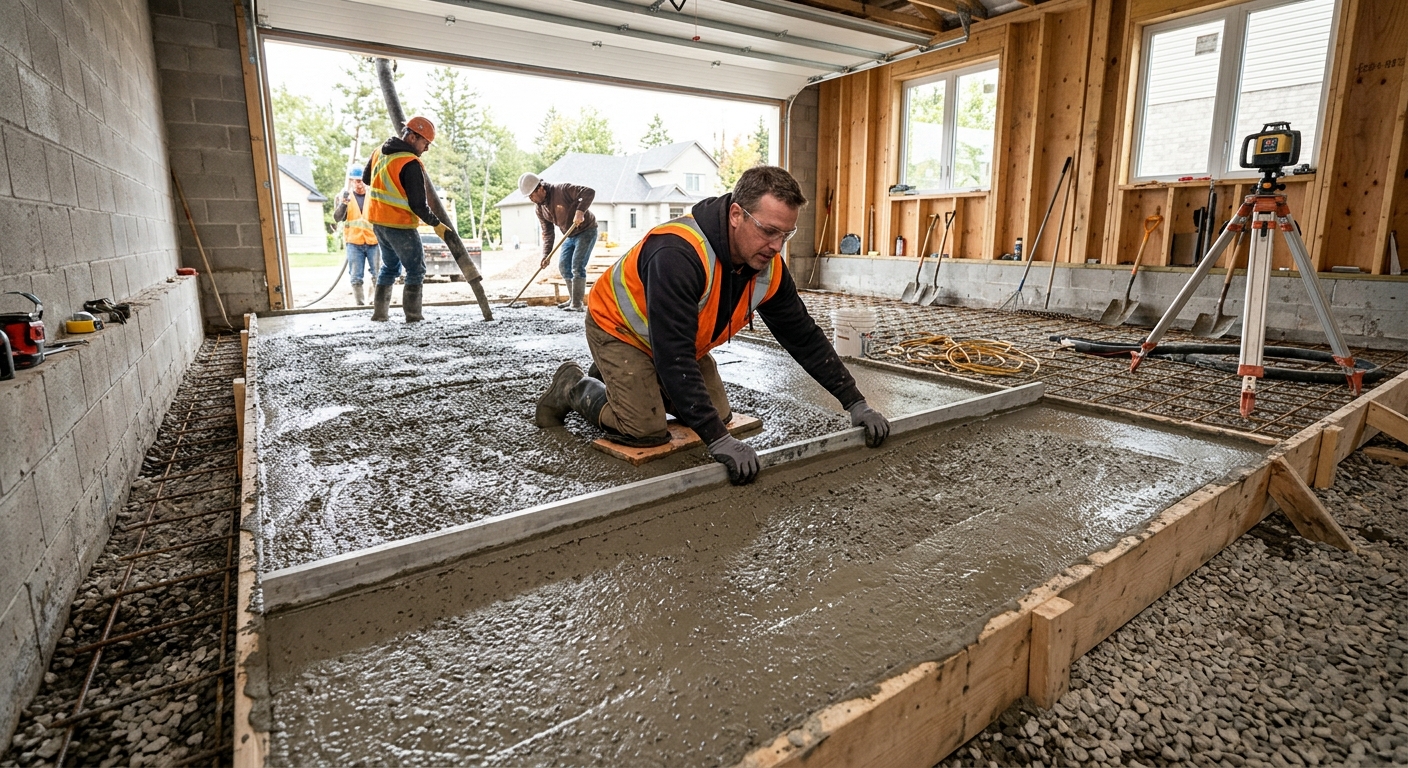
Carter Crest homeowners usually start with one of three concrete projects: driveways, patios/walkways, or foundation-related work. With a small community population of 1,716 people (Statistics Canada, 2021 Census), contractors tend to serve Carter Crest and nearby Calgary-area communities as a cluster, which can affect scheduling and availability. Housing here is dominated by single-unit homes, the same type of property where concrete flatwork is most common, so you’ll often see competing quotes for driveway replacements, garage floors, and outdoor slabs.
Cost in the Calgary economic region isn’t just about concrete price—it’s about engineering for a cold continental climate. Alberta’s design practice uses a deeper frost depth (commonly up to about 1.2 m, roughly 4 ft, in this region) so footing excavations and foundation volumes are higher than in milder provinces. Freeze–thaw cycles also push contractors toward air-entrained mixes, proper granular base prep, and well-spaced control joints, which increases labour and material handling. On top of that, exterior pours have a shorter practical season, so late-fall or early-spring work may require insulated blankets or heat to protect curing concrete.
In Carter Crest, demand is especially steady around the newer infill and building activity in the closest “corridor” areas toward Calgary, where lots are frequently prepared for garages, drive aisles, and backyard patios right after rough grading. Next, compare the most common applications side-by-side so you can see where your budget is likely to land.
| Application |
Typical Size |
Key Spec |
Finish Option |
Price Range |
| Concrete driveway (standard broom finish) |
24 ft x 10 ft (240 sq ft) |
Air-entrained mix for exterior + compacted granular base |
Broom finish + control joints |
$12,000–$18,000 |
| Exposed aggregate driveway |
24 ft x 10 ft (240 sq ft) |
Higher-spec surface prep + air-entrained exterior mix |
Exposed aggregate + sealing-ready finish |
$15,000–$22,000 |
| Stamped concrete driveway or patio |
300 sq ft (typical driveway/patio mix) |
Air-entrained exterior mix + proper base and curing |
Stamped pattern + integral colour/antique wash |
$15,000–$26,000 |
| Plain concrete patio or walkway |
12 ft x 12 ft (144 sq ft) |
Air-entrained exterior mix + control joints as needed |
Broom or smooth float with light texture |
$5,000–$9,000 |
| Garage floor (interior slab) |
22 ft x 22 ft (484 sq ft) |
6–4 in thickness typical + vapour barrier + steel reinforcement as required |
Float finish + trowel/sheen control |
$10,500–$16,500 |
| Foundation footings (structural, below frost) |
Typical single-detached house footing scope |
Excavation and placement engineered to bear below design frost depth |
Structural grade concrete (not decorative) |
$28,000–$45,000 |
Prices are estimates only and vary by project scope, site access and material selection.
What affects the price of concrete work in Carter Crest
In Carter Crest, it’s common to see quotes for the “same” concrete job swing by 30–50% across the Calgary region and Alberta. The biggest reason is that concrete pricing is really a bundle of site conditions plus engineering decisions—how deep you dig, how you prep the base, what mix design you use for air and strength, and how the contractor handles curing in a climate that punishes shortcuts.
Frost depth and freeze–thaw cycles dictate nearly every spec here. Footings must extend below the design frost depth (about 1.2 m, roughly 4 ft, in this region) to prevent frost heave and seasonal movement. Exterior slabs and driveways also require air-entrained concrete so the paste can resist repeated freezing and thawing; without it, you’ll often see early surface scaling. Calgary’s cold-weather realities shorten the exterior pour season, and contractors may add winter-grade mixes, curing blankets, and sometimes temporary heat to keep temperatures and curing conditions within spec—those precautions add cost. Finally, de-icing salts accelerate surface spalling, so sealing at the right time is a practical “insurance” cost.
Two examples in Carter Crest that often raise cost: a sloped yard that increases excavation and re-grading, and tight truck access along the approach where the crew must stage materials differently. On the other hand, a straightforward, flat lot with easy access can keep a driveway closer to the lower end of the $12,000–$18,000 range. Decorative upgrades can also be worth it: a basic broom-finish driveway might stay in that band, while stamped work usually moves toward the $15,000–$26,000 range because of the extra forming, pattern tooling, colour system, and labour time for curing and finishing.
| Price Factor |
Why It Matters |
Cost Impact |
| Frost line depth — determines footing depth and form height |
Deeper bearing increases excavation volume and concrete quantity |
Can drive major foundation pricing; often the difference between “good” and “barely compliant” installs |
| Site preparation — excavation, grading, compacted granular base |
Proper base prevents settlement and reduces cracking |
Higher where soils are variable, wet, or require rework and additional granular material |
| Reinforcement — rebar or wire mesh requirement |
Reduces slab curling and improves load resistance |
Usually adds labour and steel costs, especially for driveways and thicker slabs |
| Mix design — air-entrainment and compressive strength spec |
Air protects against freeze–thaw; strength supports structural performance |
More in cold months and when winter-grade protection is included |
| Finish type — broom vs. stamped vs. exposed aggregate |
Finish affects labour time and curing/finishing steps |
Stamped and exposed aggregate typically move costs toward the top of decorative bands |
| Pour size and concrete truck access to site |
More concrete needs coordination; access affects staging and placement time |
Tighter access or long pumping/hoisting needs raise costs |
| Cold-weather curing precautions — heating and blankets |
Protects early-age strength so concrete doesn’t scale or weaken |
Can add a noticeable premium in late fall/early spring pours |
| Control joint pattern and sealing cost |
Controls cracking locations; sealing helps resist salt damage |
Often small line items individually, but essential for longevity of exterior slabs |
Permits & regulations in Alberta
In Alberta, the rule of thumb is that structural concrete work generally needs permitting and engineered documentation, while decorative and flatwork often does not—unless it changes site grading, drainage, or lot coverage. For Carter Crest homeowners, concrete work that typically DO require a building permit includes: foundation footings and foundation walls, grade beams, structural retaining elements tied to the structure, and any concrete that is part of the building’s structural system. In many cases, engineered drawings are required and reviewed through the municipal process.
Concrete flatwork—like patios, walkways, driveways, and garage floors—usually does NOT require a permit when it’s staying within existing grade and doesn’t impact required drainage or municipal impervious surface coverage. However, if your proposed slab affects lot grading, changes how runoff reaches swales/ditches, or encroaches toward municipal right-of-way considerations, the municipality may require review.
How to verify a contractor in Alberta, step-by-step: (1) confirm they’re properly licensed/registered where required for the scope you’re hiring; (2) ask for a current certificate of insurance showing general liability limits that match residential work; (3) request proof of workers’ compensation coverage (WSIB/WCB); (4) request the clearance letter/active account status where applicable; and (5) check references for projects in similar scope and winter conditions. If anything is missing, it’s a red flag—especially for foundation schedules where late-season curing isn’t forgiving.
Getting concrete right in Carter Crest's freeze-thaw climate
Concrete failure in Carter Crest is usually a freeze–thaw story with a workmanship twist. The most common issues are spalling (surface flaking) from inadequate air-entrainment, random cracking from poor jointing and restrained shrinkage, and settlement from weak or uncompacted base. To spec the job correctly for this Calgary-area climate, start with base preparation: use a properly compacted granular sub-base to the right depth for the soil and project loads, and ensure drainage is correct so water doesn’t sit under the slab.
Next is mix design. For exterior flatwork, insist on air-entrained concrete (typically about 5–7% air content for durable exposure) and a minimum 32 MPa compressive strength so the slab has both freeze resistance and adequate structural performance. Then plan control joints—spacing should limit where cracks will occur rather than letting them find their own path. Curing is critical in this region: aim for at least 7 days of proper curing conditions, and in cold weather that means insulated blankets and/or temporary heat as needed to protect early-age strength. Finally, consider penetrating sealer applied after the slab has cured (commonly 28 days post-pour) to help repel de-icing salts and reduce surface deterioration.
If you’re deciding between options, use a simple reality check. For example, moving from a plain broom-finish patio toward a stamped surface might add several thousand dollars (often aligning with the $15,000–$26,000 decorative band for larger stamped driveway/patio scopes). That premium is justified only if the contractor proves consistent base prep, correct air, and patient curing—otherwise the looks won’t survive the freeze–thaw cycle.
| Spec |
Why It Matters in Carter Crest |
What to Ask For |
Impact if Skipped |
| Compacted granular base (depth?) |
Prevents settlement and reduces frost-driven movement |
Confirm granular type, thickness, compaction method and target elevations |
Uneven support leads to cracking, rocking slabs, and early surface failure |
| Air-entrained concrete mix (target air %?) |
Resists freeze–thaw damage in Calgary’s winter |
Specify air content about 5–7% for exterior exposure and frost conditions |
Higher risk of surface scaling/spalling within a few seasons |
| Compressive strength (MPa rating) |
Supports durability and structural capacity |
Ask for minimum 32 MPa (or higher if engineered) |
Weaker concrete may not reach expected strength before winter stress hits |
| Control joints (spacing per ACI guidelines) |
Controls cracking locations during shrinkage and temperature swings |
Confirm planned spacing, saw-cut timing, and joint sealant approach (if required) |
Random cracking that’s unsightly and can open paths for water and salt |
| Minimum 7-day curing period |
Early-age strength development is critical before freeze conditions |
Ask what curing method is used and how temperature is protected in cold weather |
Scaling, weak surfaces, and long-term durability issues |
| Penetrating sealer (when applied after cure) |
Improves resistance to de-icing salts and moisture ingress |
Confirm application after cure (often about 28 days post-pour) |
Faster salt-related deterioration and increased spalling risk |
How to choose a concrete work contractor in Carter Crest
Choosing a concrete contractor in Carter Crest comes down to proof, not promises. Start with Alberta licensing/registration for the work they’re doing (especially if they’re coordinating structural components), then verify liability insurance and workers’ compensation (WSIB/WCB). The process is straightforward: ask for their certificate of insurance showing coverage for general liability; request proof of active WSIB/WCB clearance; and make sure the certificate lists the correct legal entity that will be performing the work (not just a trading name). If they can’t provide current paperwork quickly, you’re taking on unnecessary risk—particularly with winter pours where curing issues can take months to show up.
Next, get 2–3 itemised written quotes. Don’t accept a single lump-sum with vague language. You want line items that separate labour, concrete supply, excavation/grading, granular base, reinforcement, forms, finish work (broom/stamped/exposed), sealing, and any winter curing provisions (blankets/heat). Also check what’s excluded: site access fees, disposal/dump charges, permit fees (if required), and any landscape restoration.
Warranty matters, too. Ask for the workmanship warranty length and whether product/manufacturer warranties apply to admixtures or finishing systems. Confirm if warranties are transferable to a future buyer.
For payment, avoid large deposits. A common safe approach is keeping upfront payment around 10–15%, then using a holdback until the job is complete and the finish is inspected. Finally, get the start date and completion estimate in writing, and confirm their plan for cold-weather curing—Carter Crest and the wider Calgary area don’t forgive rushed schedules.
- Request proof of active WSIB/WCB coverage before work starts.
- Ask for a current certificate of insurance and verify the insured name matches the contractor’s legal entity.
- Confirm they have experience with air-entrained exterior mixes in Alberta freeze–thaw conditions.
- Get itemised pricing (base prep, reinforcement, concrete supply, finish, sealing, curing protection).
- Ask for the planned slab thickness and joint layout—not just “standard thickness.”
- Confirm disposal/dump charges and restoration are included or clearly excluded.
- Require a written timeline including start date, pour date, and cure/protection steps.
- Ask how they manage rain/frost risk during early curing and during cold nights.
- Check whether they include saw-cut timing and how they protect joints after cutting.
- Ensure the quote states whether sealing is penetrating sealer and when it will be applied.
- Ask about warranty terms in writing, including what defects are covered and for how long.
- Don’t pay more than 10–15% upfront; hold back until completion and cleanup are verified.
Concrete red flags I see in Carter Crest: a quote that skips air-entrainment details for exterior slabs, no clear plan for cold-weather curing (blankets/heat), vague joint spacing or “we’ll figure it out later,” pressure to pay most of the amount before formwork and base are complete, and finishing promises with no warranty terms tied to durability outcomes.
Frequently asked questions — concrete work in Carter Crest
How deep must footings be for Carter Crest's frost line?
In Carter Crest and the Calgary region, footings are engineered to bear below the design frost depth (commonly about 1.2 m, roughly 4 ft, in Alberta cold-continent practice). The exact depth for your house depends on soil conditions, structural design loads, and what the engineered foundation drawings specify. That’s why you’ll often see excavation and footing volumes drive foundation pricing: deeper bearing means more digging, more formwork, and more concrete. If a contractor quotes foundation work without referencing engineered drawings (or without explaining how they meet frost-depth requirements), that’s a serious concern. Also remember that freeze–thaw cycles can move water and soils; proper bearing below frost helps prevent frost heave and reduces seasonal movement. (Statistics Canada, 2021 Census)
Why does concrete crack in Carter Crest and how is it prevented?
Concrete cracks for predictable reasons in Carter Crest: shrinkage as it cures, temperature changes, and the restraint of movement (especially when the slab is tied to other elements). In a freeze–thaw climate, water can also find small openings and worsen deterioration at crack lines. Prevention is spec-driven: compacted granular base to stable support, a correct air-entrained exterior mix for durability, and a control joint pattern planned to “invite” cracking at known locations. Contractors also manage curing so the slab develops strength properly; rushing curing increases surface and early-age cracking risk. Finally, sealing after the slab cures helps reduce salt-driven damage. If you’re comparing bids, a driveway in the $12,000–$18,000 band should still include jointing and air—cheapest bids that skip these details often cost more later.
Stamped vs broom-finish concrete — cost difference?
Stamped concrete costs more than a broom-finish because it adds labour and materials: pattern mats, release agents, integral colour or colouring systems, and more careful finishing and curing steps. In Calgary-area cold conditions, you don’t get to “cheat” on base prep or air content to save money—so even decorative work still needs the same freeze–thaw durability specs. For a typical driveway/patio scale, broom-finish concrete commonly lands around $12,000–$18,000, while stamped driveway or patio scopes often move toward $15,000–$26,000. The higher price is often justified when the contractor shows a complete scope: engineered base prep, correct joint spacing, and a curing/blanket plan for the season. If a stamped quote is only slightly higher than broom-finish, ask what steps were reduced.
When is the best time to pour concrete in Carter Crest?
The best time to pour in Carter Crest is typically late spring through summer, when temperatures support predictable curing and you can complete finishing and protection without extra winter measures. In the Calgary region, freeze risk and shorter practical exterior pour windows mean contractors may need winter-grade mixes, insulated blankets, or temporary heat for pours in late fall or early spring. That doesn’t mean you can’t pour—just that the contractor’s curing plan becomes a cost and quality control point. If you’re targeting outdoor slabs (driveways, patios, walkways), confirm your scheduled pour date, the temperature protection approach overnight, and how long curing will be protected. A contractor should also explain how they handle de-icing salt risk after you move in—sealing applied after cure helps protect surfaces from winter salt exposure.
How long does concrete take to cure?
Concrete curing is more than “it looks dry.” For durability in Alberta’s freeze–thaw climate, plan for at least a 7-day curing period under conditions that keep concrete warm enough and protected from freezing early on. Early-age protection is especially important in Carter Crest: if temperatures drop too fast, you can reduce strength development and invite surface scaling. Full strength development continues well beyond 7 days, but that first week is a practical minimum for many exterior flatwork schedules. Sealing typically happens later—often around 28 days post-pour—so the slab has time to cure and stabilize before sealer is applied. If a contractor proposes curing shortcuts to meet a late-season timeline, ask what extra protection they’ll use and whether they’ll adjust the mix and method to ensure the slab reaches the required performance.
Do I need a permit for concrete work in Alberta?
In Alberta, it depends on what you’re building. Structural concrete work—like foundation footings, foundation walls, and grade beams—usually requires a building permit and often engineered drawings reviewed through the municipal process. Concrete flatwork such as patios, walkways, and driveways typically does not require a permit unless it affects lot grading, drainage, impervious/coverage limits, or municipal right-of-way considerations. For Carter Crest homeowners, the safest approach is to confirm with the local authority before breaking ground, especially if you’re changing drainage patterns or raising/lowering grades. Regardless of permits, verify the contractor carries liability insurance and active workers’ compensation (WSIB/WCB coverage) and provides clear paperwork. That protection matters on every pour—especially when cold-weather curing procedures are needed.