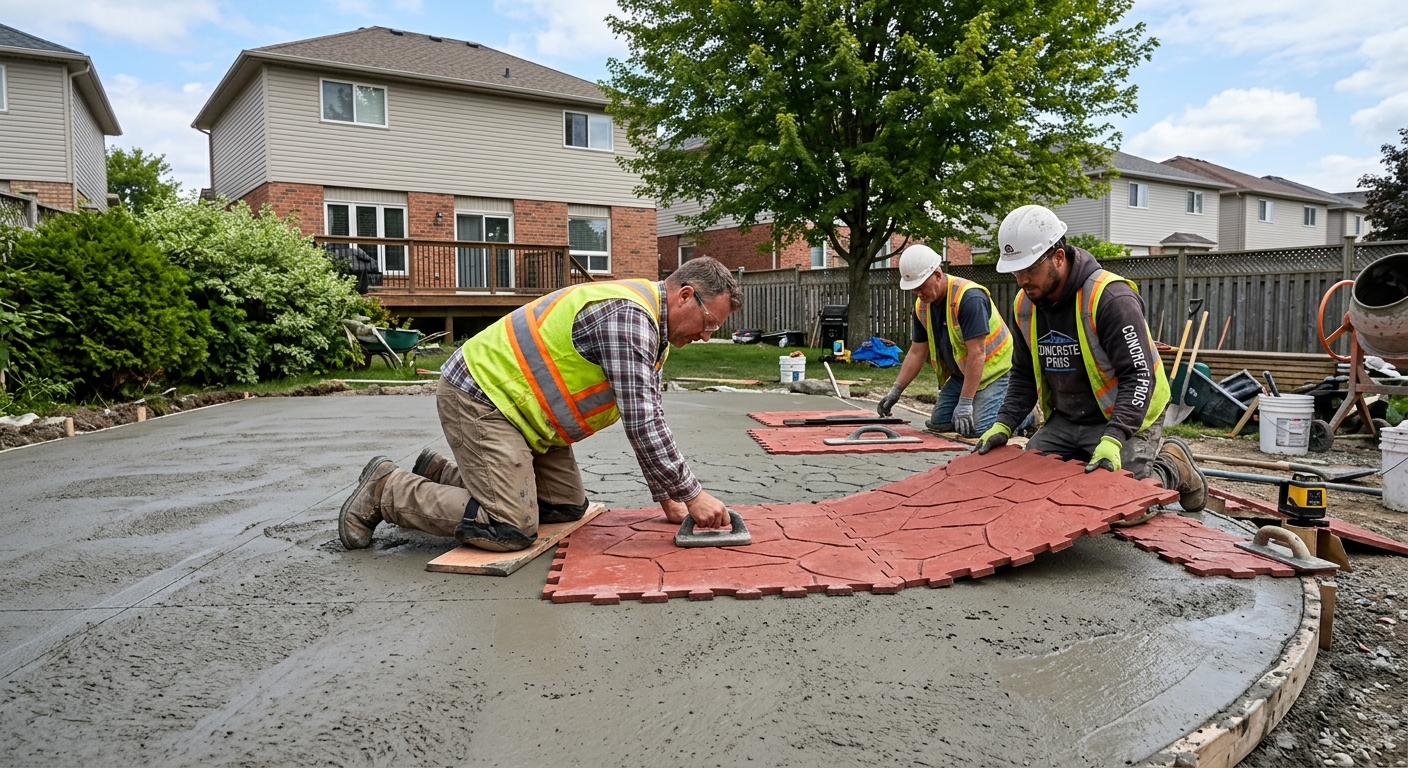
Concrete work options and costs in Albany
In Albany, Alberta, concrete is one of the most practical ways to create durable driveways, patios, walkways and foundations that can handle long, cold winters. With a small population of 1,776 (Statistics Canada, 2021 Census), demand is concentrated among homeowners in established pockets—particularly where you see older, single-detached housing stock and frequent renovations. If your area is near the newer infill pockets off main access routes to the Calgary region, you’ll also notice more requests for upgraded front entries and outdoor flatwork.
Contractors in the Calgary economic region price concrete with the climate in mind. Calgary-area freeze–thaw cycles are hard on exterior slabs, so mixes are engineered for air entrainment, and base prep gets more attention than in milder parts of Canada. The design frost depth is about 1.2 m (roughly 4 ft), so footings for houses, garages, decks and retaining structures generally must bear below that depth. That excavation and increased footing volume are a major reason foundation work typically comes in at the higher end of local bands.
Availability also shifts with the shorter exterior pour season. Late fall and early spring placements often require winter-grade materials, insulated blankets and sometimes temporary heat to protect curing. The result is that two similar-sounding projects can price differently depending on timing, access, and finish complexity.
Below is a realistic comparison of typical options for Albany, so you can match your goals to the most common cost ranges.
| Application |
Typical Size |
Key Spec |
Finish Option |
Price Range |
| Concrete driveway (standard broom finish) |
24 ft x 10 ft (240 sq. ft.) |
Air-entrained exterior mix, compacted granular base, control joints |
Broom finish with sealer after cure |
$12,000–$16,500 |
| Exposed aggregate driveway |
24 ft x 10 ft (240 sq. ft.) |
Air-entrained exterior mix, proper base, aggregate exposure plan |
Exposed aggregate with broom edges |
$15,000–$18,000 |
| Stamped concrete driveway or patio |
400 sq. ft. (driveway section or patio) |
Reinforcement per design, air entrainment, release agent system |
Stamp pattern + colour hardener (or integral colour) |
$18,000–$26,000 |
| Plain concrete patio or walkway |
12 ft x 12 ft (144 sq. ft.) |
Air-entrained mix, compacted base, edge forms, joints |
Float + broom or light broom finish |
$5,000–$8,500 |
| Garage floor (interior slab) |
22 ft x 20 ft (440 sq. ft.) |
Vapour barrier, thickened edges, 32 MPa class concrete |
Steel trowel/smooth finish or broom for traction |
$9,500–$14,500 |
| Foundation footings (structural, below frost) |
Typical single-detached house bearing wall system |
Excavation to design frost depth, engineered reinforcement, formwork |
Structural concrete with vibration and proper curing |
$28,000–$45,000 |
Prices are estimates only and vary by project scope, site access and material selection.
What affects the price of concrete work in Albany
In Albany, Alberta, quotes for the “same” concrete job can swing by about 30–50% because Calgary-area pricing is driven by engineered frost performance, site conditions, and how much protection is needed for curing. Two slabs that look similar on a plan can require different excavation volumes, reinforcement, and heating/insulation depending on the subgrade and the timing of the pour season.
Start with frost depth and freeze–thaw cycles. In this region, the design frost depth is about 1.2 m (roughly 4 ft), which means exterior structural support often has to go deeper than many homeowners expect. When crews dig to that depth and build the granular base properly, the cost rises—especially for foundations and thickened edges. For exterior flatwork like driveways and patios, air-entrained concrete is essential to resist spalling as water repeatedly freezes and thaws at the surface. The colder the schedule and the more freeze–thaw exposure the slab sees before it’s fully cured, the more contractors must pay attention to winter-grade procedures.
Pour timing matters. The practical exterior pour season is shorter, so late-year or early-spring pours may add insulated blankets, temporary heat, and extra labour to protect curing. Add de-icing salt exposure on driveways and steps, and sealing becomes a cost-effective “insurance” step.
Local examples in Albany: (1) A sloped driveway that needs significant grading and haul-off will push you toward the upper end of exterior slab pricing (often closer to $12,000–$18,000 for driveways). (2) A foundation where excavation hits wetter soil typically means higher granular replacement and formwork labour, moving foundation quotes toward $28,000–$45,000. (3) A stamped or exposed finish on a small patio can cost disproportionately more than a plain slab because of extra prep, branding labour, and finishing time.
| Price Factor |
Why It Matters |
Cost Impact |
| Frost line depth — determines footing depth and form height |
Footings must bear below the design frost depth to prevent frost heave and seasonal movement |
Higher excavation and concrete volume increases foundation pricing significantly |
| Site preparation — excavation, grading, compacted granular base |
Concrete lasts only if the base is graded correctly and compacted to support loading |
Wet/soft soil, haul-away and extra base thickness can add major labour and material cost |
| Reinforcement — rebar or wire mesh requirement |
Reinforcement controls cracking and improves performance under freeze–thaw and loads |
More steel, chairs/ties and labour to install it moves costs upward |
| Mix design — air-entrainment and compressive strength spec |
Exterior slabs need air entrainment to resist freeze–thaw damage; strength spec protects long-term durability |
Engineered mix and quality control add material cost compared to basic mixes |
| Finish type — broom vs. stamped vs. exposed aggregate |
Finishes change labour time, curing timing, and surface preparation requirements |
Stamped/exposed generally increases costs due to finishing steps and rejection risk |
| Pour size and concrete truck access to site |
Smaller pours can lose economies of scale; difficult access may require more crew time |
Scheduling constraints and pump/extra handling can add thousands |
| Cold-weather curing precautions — heating and blankets |
Proper curing is critical to reduce scaling/spalling risk in Alberta’s cold snaps |
Temporary heat/insulation increases labour and equipment charges |
| Control joint pattern and sealing cost |
Joints manage shrinkage and cracking; sealing helps repel de-icing salt moisture |
Proper joint layout and a quality sealer add cost but reduce long-term surface deterioration |
Permits & regulations in Alberta
In Alberta, structural concrete work typically requires more approvals than simple flatwork. For Albany homeowners, this usually means you should plan for a building permit and often engineered drawings when you’re doing structural concrete such as footings, foundation walls, grade beams and other load-bearing foundation components. Municipal review commonly ties into how the structure is designed to handle frost action and loads.
Concrete flatwork like patios, walkways and driveways often does not require a permit by default. However, permits can be triggered if your project affects lot grading, changes impervious surface coverage rules, modifies drainage patterns, or interacts with municipal right-of-way requirements (for example, if you’re adjusting driveway access at the street line). In practice, the safe approach is to confirm with the local authority before breaking ground.
Step-by-step, here’s how to verify a contractor in Albany for Alberta compliance:
1) Ask for their company info and check whether they’re eligible/covered for the scope you’re hiring. 2) Request a certificate of insurance for liability, and confirm the coverage limit matches the project size and that it lists you as an additional insured where appropriate. 3) Ask for proof of WSIB/WCB coverage (or the applicable provincial coverage documentation) and verify the clearance letter/status. 4) Request references for similar-scale concrete jobs (exterior flatwork in freeze–thaw conditions is a good fit).
Bottom line: get proof before signing—don’t rely on verbal assurances.
Getting concrete right in Albany's freeze-thaw climate
In Albany’s Alberta freeze–thaw conditions, concrete fails most often due to water movement at the surface and weak interfaces between slab, base and air-void system. The biggest preventable issue is spalling caused by inadequate air entrainment and poor curing—especially when crews rush exterior pours or rely on milder-weather habits. To spec the job correctly, treat the slab as a system: base, mix, joints, curing and sealing.
Base preparation is first. Exterior slabs still need a compacted granular sub-base to the correct depth and bearing conditions, because frost heave is a base problem as much as a concrete problem. Next, specify a true air-entrained exterior mix (commonly 5–7% air content for freeze–thaw durability) and a minimum strength target such as 32 MPa compressive strength. Then plan control joints so shrinkage cracks occur where you want them, not randomly. For curing, in this region you should budget for at least 7 days of proper curing conditions; in cold weather, contractors may need insulated blankets and controlled heat to keep the curing window intact. Finally, use a penetrating sealer after the concrete has cured (often around 28 days post-pour) to reduce moisture and de-icing salt penetration.
Ask technical questions like: “What air content are you targeting for this exterior mix?” and “How are you protecting curing in the next 3–5 days?” If you’re comparing options, here’s a realistic justification: a broom-finished driveway may land around the lower band (for example, $12,000–$16,500), while stamped work often increases cost due to finishing steps and tighter sequencing (commonly higher bands like $15,000–$26,000 depending on size and design). When the contractor uses the correct mix and curing regardless of finish, the higher cost should reflect finish complexity, not shortcuts.
| Spec |
Why It Matters in Albany |
What to Ask For |
Impact if Skipped |
| Compacted granular base (depth?) |
Provides stable support; prevents differential movement that accelerates cracking under freeze–thaw |
Confirm excavation depth, granular type, lift thickness and compaction test method |
Premature cracking, settlement, and uneven slab movement |
| Air-entrained concrete mix (target air %?) |
Air voids help the concrete survive repeated freezing and thawing |
Ask for target air content (commonly 5–7% for exterior flatwork) and how it’s verified at placement |
Spalling and surface scaling, especially after winter de-icing |
| Compressive strength (MPa rating) |
Strength supports long-term durability and resistance to surface wear |
Confirm the minimum mix design strength (commonly 32 MPa for typical structural/exterior flatwork specs) |
Higher risk of surface damage and reduced service life |
| Control joints (spacing per ACI guidelines) |
Controls where shrinkage cracks happen to limit water intrusion |
Ask for proposed joint spacing, saw-cut timing and location around edges |
Random cracking and water paths that worsen freeze–thaw damage |
| Minimum 7-day curing period |
Proper curing helps develop strength and reduces scaling/spalling risk |
Ask how curing is protected in cold weather (blankets/heating as needed) |
Reduced strength and early surface failure |
| Penetrating sealer (when applied after cure) |
Helps repel moisture and de-icing salt exposure |
Ask for application timing after cure (often around 28 days) and which sealer type they use |
Faster deterioration, staining, and increased risk of salt-related surface breakdown |
How to choose a concrete work contractor in Albany
Choosing the right contractor in Albany, Alberta, is mostly about verifying proof, insisting on a clear scope, and comparing itemized quotes. Start with Alberta compliance. Ask for their company credentials and confirm their liability insurance (request a certificate of insurance). Then ask for proof of WSIB/WCB coverage—you want to see documentation and a clear status/clearance letter where applicable. For larger structural scopes, you should also confirm they’re capable for engineered foundation work and that they coordinate with the design requirements.
Next, request 2–3 written itemised quotes, not a single lump sum. Good quotes separate labour and materials, and they show line items for excavation, forms, reinforcement, concrete supply, pump/access equipment, finishing, curing measures and sealing (if included). Read the scope carefully: does it include permit pull (when required), disposal, topsoil replacement, haul-away, and protection of landscaping? If something isn’t listed, assume it’s excluded.
Review warranty terms. Ask the contractor how long they stand behind workmanship, whether there’s a product/manufacturer warranty for materials, and whether it’s transferable to future homeowners. For payment, avoid large deposits—commonly keep upfront payments around 10–15% and use a holdback until completion and cleanup.
Finally, confirm a written timeline: the start date, weather contingencies, and the estimated completion window. In Calgary’s cold continental climate, scheduling and curing protection are part of the real scope—not an afterthought.
- Request proof of liability insurance (and verify policy dates/coverage limits).
- Request documentation for WSIB/WCB coverage and confirm current clearance/status.
- Get 2–3 itemised quotes showing labour and materials separately.
- Ensure the quote lists excavation depth, base thickness and reinforcement scope.
- Confirm whether the price includes rebar/wire mesh, chairs/ties and proper placement.
- Ask if pump, wheelbarrow handling, or crane access is included for hard-to-reach areas.
- Confirm the plan for cold-weather curing (blankets/heating) if the schedule is tight.
- Ask when control joints will be cut and how timing is handled.
- Verify if sealing is included, and whether it’s penetrating sealer applied after curing.
- Clarify haul-away, disposal and site restoration expectations in writing.
- Check for a clear warranty for workmanship and whether it includes finishing items.
- Agree to a payment schedule with a holdback until the job is finished and cleaned up.
Concrete red flags specific to Albany projects: (1) a quote that doesn’t mention air-entrained mix or curing protection despite exterior freeze–thaw exposure; (2) skipping control joint locations or leaving them “to be decided later”; (3) promising an exterior pour in late fall without any plan for blankets/heating; (4) refusing to provide insurance/WSIB/WCB documentation; and (5) using vague scope language like “finish as needed” without detailing sealing and joint work.
Frequently asked questions — concrete work in Albany
Stamped vs broom-finish concrete — cost difference?
In Albany, the difference is usually labour and finishing complexity, not just the concrete itself. A broom-finished exterior slab is typically priced in the driveway band of $12,000–$16,500 for a common two-car driveway scale, assuming proper base prep and joints. Stamped concrete takes more steps—release agents, texture mats, sometimes colour hardener—and it requires tight sequencing around curing and weather control, so pricing commonly moves into the stamped range like $15,000–$26,000 depending on size, pattern detail and colours. If the contractor cuts corners on air entrainment, joints or curing, you’ll pay twice later through spalling or random cracking—so insist on the same durability specs for both finishes.
When is the best time to pour concrete in Albany?
For exterior work in Albany, you want to pour when the forecast supports proper curing without aggressive cold-weather measures. In the Calgary region’s freeze–thaw climate, that usually means late spring through summer and into early fall, when temperatures stay steadier for several days. Late fall and early spring can still work, but contractors often need winter-grade protection—insulated blankets, curing measures and sometimes temporary heat—to reliably hit strength development during the critical curing window. A reputable team will schedule around temperature swings and explain what they’ll do if nights drop below the recommended curing temperatures. If a quote doesn’t address curing protection, it may look cheaper but carries more risk.
How long does concrete take to cure?
Concrete curing has two timelines: strength gain and surface readiness. For typical exterior flatwork in Alberta, you should plan for at least 7 days of proper curing before expecting meaningful exposure (traffic considerations can vary by strength and temperature). The surface also benefits from slower curing conditions, which helps reduce scaling risk during freeze–thaw cycles. For sealing, many contractors apply a penetrating sealer around 28 days after the pour to ensure the slab is sufficiently cured and ready to accept the sealer. If you’re comparing contractors in Albany, ask how they protect curing during cold nights—blankets and controlled conditions can be the difference between a slab that lasts and one that spalls after its first winter.
Do I need a permit for concrete work in Alberta?
Often, concrete flatwork like patios, walkways and driveways does not require a permit in Alberta, unless the work affects lot grading, drainage, or municipal rules around impervious surface coverage, or impacts the municipal right-of-way. In Albany, you should confirm with the local authority before starting—especially if you’re changing drainage patterns near the street or altering how water sheds off your property. Structural concrete such as footings, foundation walls and grade beams typically requires a building permit and often engineered drawings for municipal review. Before hiring, ask the contractor what permits are required for your exact scope, and verify they know what triggers approval versus what typically doesn’t.
Concrete vs pavers for a patio in Albany?
Concrete and pavers can both work well for patios in Albany, but the decision usually comes down to cost, maintenance and desired appearance. A plain concrete patio typically sits in the $5,000–$9,000 band for common sizes, and it’s straightforward—joints and base prep are what matter most for freeze–thaw durability. Pavers can look more custom and allow localized repairs if a section settles, but paver installations rely heavily on excavation quality, sand base depth, and proper edging/drainage; if those are off, weeds, movement and uneven surfaces can show up faster. If you’re comparing quotes, focus on base thickness, drainage plan and jointing details for concrete, and base/compaction details for pavers—not just the finish price.
How long does a concrete driveway last?
In Alberta’s freeze–thaw climate, a well-built driveway often lasts many years—commonly decades—if it’s designed for the conditions: air-entrained concrete, proper compaction and base prep, correctly spaced control joints, and adequate curing. Where driveways fail early, it’s frequently due to moisture and de-icing salt exposure combined with insufficient air content or skipped curing/finishing steps. Sealing after the concrete has cured (commonly around 28 days) can help repel moisture and reduce salt-related surface breakdown. Many homeowners in Albany see the biggest early-life issues within the first few winters, so the “how” of the build matters more than the “what” of the finish. If your quote doesn’t address joints, sealing and winter curing, ask for those details before signing.