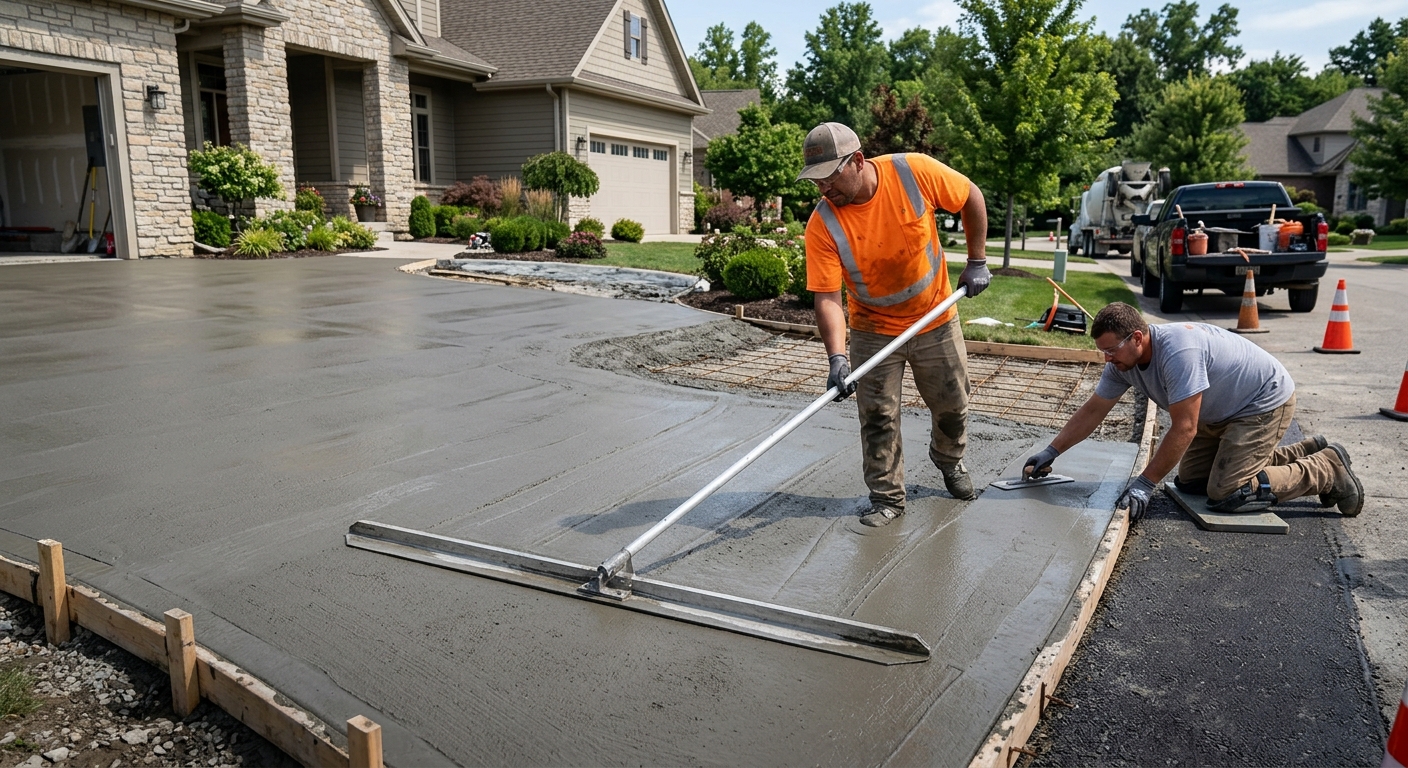
Concrete work options and costs in Breckenridge Greens
Breckenridge Greens, Alberta has the kind of neighbourhood where concrete flatwork is part of everyday life: driveways, patios, walkways, and even interior garage slabs. In the Calgary economic region, the housing stock is heavily dominated by single-detached homes (Statistics Canada, 2021 Census), which is a big reason concrete contractors stay busy with driveway and backyard projects rather than just commercial work. With a small local population of 1,916 (Statistics Canada, 2021 Census), scheduling and material availability often matter—good crews can book out quickly during the short exterior pour window.
In Calgary’s cold continental climate, costs aren’t just about “more concrete”; they’re about engineering around frost and freeze–thaw. Local codes and engineering practice use a design frost depth of about 1.2 m (roughly 4 ft), so footings for houses and garages typically need to extend onto undisturbed soil below that level. Exterior slabs and driveways also require granular base prep, air-entrained concrete mixes, and control joints to reduce cracking and surface scaling when temperatures swing back and forth. If you’re pouring late fall or early spring, cold-weather curing precautions—insulated blankets or temporary heat—can add labour and equipment time, which shows up in the quote.
Trade demand is especially high in established residential pockets near everyday access routes in Breckenridge Greens, where homeowners regularly upgrade curb appeal and replace older, salt-damaged slabs. Below is a practical comparison of typical options and what they usually cost before you ask for an itemised quote.
| Application |
Typical Size |
Key Spec |
Finish Option |
Price Range |
| Concrete driveway (standard broom finish) |
24 ft x 10 ft (240 sq ft) |
Air-entrained mix, compacted base, control joints |
Broom finish, optional light edging |
$12,000–$18,000 |
| Exposed aggregate driveway |
24 ft x 10 ft (240 sq ft) |
Air-entrained mix, retarder process, proper curing |
Exposed aggregate (medium/small stone) |
$15,000–$22,000 |
| Stamped concrete driveway or patio |
20 ft x 12 ft (240 sq ft) |
Air-entrained mix, integral colour, seal-ready cure |
Stamped pattern (fieldstone/ashlar-style) |
$15,000–$26,000 |
| Plain concrete patio or walkway |
12 ft x 14 ft (168 sq ft) |
Air-entrained mix, compacted base, joints |
Float/smooth or light broom |
$5,000–$9,000 |
| Garage floor (interior slab) |
22 ft x 22 ft (484 sq ft) |
Minimum 32 MPa, vapour management as needed, joints |
Smooth finish with hardener/trowel marks |
$10,000–$16,000 |
| Foundation footings (structural, below frost) |
Typical single-detached house |
Excavation, rebar, engineered forms, below-design frost depth |
Structural concrete only (no decorative finish) |
$28,000–$45,000 |
Prices are estimates only and vary by project scope, site access and material selection.
What affects the price of concrete work in Breckenridge Greens
In Breckenridge Greens, it’s common to see quotes for the “same” concrete job come in 30–50% apart across the Calgary area. A lot of that spread isn’t about the concrete—it’s about excavation, base thickness, reinforcement decisions, and how contractors protect curing performance in a climate with frequent freeze–thaw. In cold continental conditions, engineered frost protection drives deeper and larger excavation than homeowners expect, and that labour/haulage cost can swing quickly.
The design frost depth in Alberta is the biggest cost lever: footings for houses, garages, decks and retaining structures must bear on undisturbed soil below the design frost depth (about 1.2 m, roughly 4 ft in this region). That requirement affects trench depth, form height, and the volume of structural concrete. Exterior slabs also need air-entrained concrete mixes to survive repeated freeze–thaw cycles, along with a well-graded granular base and well-spaced control joints to manage shrinkage and temperature movement.
Cold-weather placement adds cost too. When the pour season is shorter, crews may need winter-grade mixes, insulated blankets and sometimes temporary heat to meet curing expectations. If de-icing salts are used (typical on driveways in Calgary), surface spalling risk rises unless the mix has the right air content and the concrete is properly sealed after cure. That’s why a sealed broom-finished driveway might land nearer the lower end of the $12,000–$18,000 band, while premium finishes like stamping can push toward the $15,000–$26,000 range.
In Breckenridge Greens specifically, cost can rise when access is tight (long reach or more wheelbarrowing), when older slabs need removal and disposal, or when excavation reveals unsuitable soil requiring extra base. It can come down when the site is level, drainage is straightforward, and the schedule is planned for stable curing temperatures—especially for patios and walkways that commonly fall into the $5,000–$9,000 band.
| Price Factor |
Why It Matters |
Cost Impact |
| Frost line depth — determines footing depth and form height |
Footings must be below design frost depth to prevent frost heave |
Major increase with deeper excavation and higher concrete volume |
| Site preparation — excavation, grading, compacted granular base |
Compaction and base thickness control settlement and cracking |
Moderate to major swing based on soil conditions and haul distance |
| Reinforcement — rebar or wire mesh requirement |
Helps resist cracking from movement and loading |
Adds material and labour; can be significant on larger slabs |
| Mix design — air-entrainment and compressive strength spec |
Air entrainment reduces freeze–thaw damage and scaling |
Usually moderate; avoids costly failures and repairs |
| Finish type — broom vs. stamped vs. exposed aggregate |
Complex finishes require extra steps and longer crew time |
Typically moves you up into higher price tiers |
| Pour size and concrete truck access to site |
Smaller pours may require extra staging; poor access limits truck placement |
Can add labour, pumping, or multiple trips |
| Cold-weather curing precautions — heating and blankets |
Proper curing is critical in Alberta’s short exterior pour season |
Can add noticeable cost on late/early season pours |
| Control joint pattern and sealing cost |
Joints manage cracking; sealing helps repel de-icing salt impacts |
Small to moderate upfront cost vs. reduced long-term surface damage |
Permits & regulations in Alberta
In Alberta, structural concrete work typically requires a building permit and often engineered drawings that get reviewed through the municipal process. This usually includes foundations and other load-bearing concrete elements such as footings, foundation walls, grade beams, and any structural additions tied into the building’s support system. Concrete flatwork—like driveways, patios, and walkways—often does not require a permit by default, but it can if the work changes lot grading, impacts drainage, affects impervious surface coverage limits, or alters what’s within a municipal right-of-way.
For homeowners in Breckenridge Greens, the best approach is to confirm in writing with the local authority before breaking ground. Also verify your contractor is properly insured and set up to work. Ask for proof of liability insurance and their WSIB/WCB coverage (coverage type depends on the contractor’s situation). Then request references on similar-scale concrete projects—driveway and footing jobs, not just small patch work—because frost-depth excavation and finishing quality are where the risk lives.
Step-by-step: (1) ask for the contractor’s licence/registration information where applicable, plus their certificate of insurance and WSIB/WCB clearance; (2) check the insurance certificate dates and that the named insured matches the contracting company; (3) verify the WSIB/WCB clearance letter is current; (4) look for matching project examples in similar weather conditions; and (5) ensure the permit responsibilities and inspections (if required) are clearly listed in your written scope.
Getting concrete right in Breckenridge Greens's freeze-thaw climate
Concrete failures in Breckenridge Greens usually trace back to water movement, poor base support, or freeze–thaw damage that starts small and becomes visible as scaling, cracking, and spalling over time. In a Calgary-area cold continental climate, the concrete mix and curing plan aren’t optional extras—they’re part of the structural performance. If the base isn’t excavated and compacted to the right depth and profile, slabs settle and joints open. If the mix lacks the right air entrainment, freeze–thaw cycles can break down the surface even when the “concrete looks fine” at first.
Spec the job with five fundamentals. First, base preparation: compacted granular sub-base to suit local soil and frost protection needs, not just “a few inches.” Second, mix design: air-entrained concrete for exterior flatwork with target air content around 5–7% and a minimum 32 MPa compressive strength. Third, control joints: plan spacing to limit random cracking and create predictable crack locations. Fourth, curing: hold proper curing for at least 7 days; in cold snaps, this is where blankets or heating may be needed to protect strength gain. Fifth, sealing: use a penetrating sealer applied after full cure (commonly 28 days) to help repel de-icing salts from attacking the surface.
For example, choosing a sealed driveway with proper air entrainment may cost more than a barebones pour, but it can be the difference between staying near the lower $12,000–$18,000 driveway band versus paying for early resurfacing. Stamping is also often worth it when homeowners want aesthetics plus consistent jointing and sealing—though it typically moves projects toward the higher $15,000–$26,000 stamped range.
| Spec |
Why It Matters in Breckenridge Greens |
What to Ask For |
Impact if Skipped |
| Compacted granular base (depth?) |
Controls settlement and provides frost-resilient support |
Base depth and compaction method; confirm suitability for local soil |
Uneven settling, cracking, and premature joint failure |
| Air-entrained concrete mix (target air %?) |
Improves freeze–thaw durability and reduces scaling/spalling risk |
Target air content for exterior work (typically 5–7%) |
Surface scaling and spalling after freeze–thaw cycles |
| Compressive strength (MPa rating) |
Ensures strength gain for load and long-term durability |
Minimum 32 MPa and mix documentation if requested |
Reduced durability and higher risk of cracking under loads |
| Control joints (spacing per ACI guidelines) |
Manages shrinkage and temperature movement predictably |
Joint spacing plan and joint type for slab thickness |
Random cracking across visible areas |
| Minimum 7-day curing period |
Strength development is critical, especially around Alberta temperature swings |
Curing plan (blankets/heating if needed) and protection steps |
Weak surface, scaling, and long-term performance issues |
| Penetrating sealer (when applied after cure) |
Repels de-icing salt and reduces water ingress |
Penetrating sealer applied after full cure (commonly 28 days) |
Faster salt-related deterioration and more frequent maintenance |
How to choose a concrete work contractor in Breckenridge Greens
Choosing the right contractor in Breckenridge Greens is mostly about verifying paperwork and then matching the scope to the frost-and-salt reality of Calgary winters. Start by confirming Alberta coverage: ask for a current certificate of liability insurance and proof of WSIB/WCB coverage. How to check: (1) ensure the insurance certificate is current and lists the correct legal company name; (2) confirm WSIB/WCB clearance is not expired and that it applies to the work crew performing the job; (3) request references for comparable work—driveways, patios, and any structural foundation/footing work similar in scale; and (4) look at their process for base prep, mix design, curing protection and joint/sealing details, not just photos.
Next, get 2–3 itemised written quotes. The strongest quotes break down labour and materials: excavation and hauling, granular base and compaction, reinforcement, concrete supply, finish labour, joints, curing materials (blankets/heating if applicable), and sealing (if included). Avoid lump-sum pricing with vague language like “concrete and finish.” Carefully review what’s excluded: demolition and disposal, permit fees (if required), topsoil/grading tie-ins, and any drain/step modifications.
Warranty and payment terms matter. Ask for a workmanship warranty length (and what it covers), plus the product/manufacturer warranty. Clarify whether warranties are transferable if you sell. Payment schedule: never pay more than 10–15% upfront; hold back a portion until completion and cleanup.
Finally, get the timeline in writing: proposed start date, cure/finish sequencing, and an estimated completion date. A dependable contractor will plan around temperature, not just calendar dates.
- Request proof of liability insurance (current certificate) and verify the insured party matches the contractor.
- Confirm WSIB/WCB clearance is current and covers the crews who will do the concrete work.
- Ask if any permits are required for your scope and whether the contractor will pull them (when applicable).
- Get quotes broken into labour, materials, and line items for base prep, reinforcement, and finishing.
- Ask for the concrete mix spec: air-entrainment and minimum compressive strength (for exterior flatwork, target air is typically 5–7%).
- Confirm how they handle cold-weather curing (blankets/heating) if conditions are marginal.
- Require a written plan for control joints: spacing and where joints are located to prevent random cracking.
- Ask how they’ll prep and compact the granular base and what depth/compaction target they use.
- Confirm curing time and protection (don’t accept “we poured, it will be fine” language).
- Ask whether sealing is included and, if yes, what type (penetrating) and timing (after full cure).
- Review disposal/demolition scope: include removal of old concrete and proper debris disposal if needed.
- Agree on a payment schedule that limits upfront deposits and includes a holdback until punch list completion.
Concrete contractor red flags I watch for in Breckenridge Greens: quoting “one price” without base depth details, skipping mention of air-entrainment for exterior slabs, promising fast cure timelines in late fall/early spring, offering no sealing plan when de-icing salts will be used, and refusing to provide itemised scope or proof of coverage (liability and WSIB/WCB).
Frequently asked questions — concrete work in Breckenridge Greens
How long does a concrete project take in Breckenridge Greens?
For most driveway and patio projects in Breckenridge Greens, the concrete placement day is only part of the timeline. Typical durations are: site prep and base work (often 1–3 days depending on access and removal), forming and finishing (generally 1 day), and then curing and protection. Even if the surface looks ready in a day, proper curing matters in Calgary’s freeze–thaw climate. You should plan around at least 7 days for strength development before treating it as fully “at service,” and about 28 days before sealing (if sealing is part of the scope). If you’re scheduling near cold snaps, contractors may extend timelines to protect curing with insulated blankets or heat, which is also why exterior jobs can cost more toward the higher end of the $5,000–$9,000 patio/walkway or $12,000–$18,000 driveway ranges.
What is a concrete overlay and is it suited to Breckenridge Greens?
A concrete overlay is a topping layer applied over an existing concrete surface, usually to improve appearance or level minor unevenness without full removal. It can be suited to Breckenridge Greens when the original slab is still structurally sound—meaning it’s not moving, heavily spalled, or riddled with large cracks and active settlement. Overlays are not a fix for frost-related movement problems, poor base support, or drainage failures, which are common culprits when older slabs deteriorate in Alberta winters. If your driveway shows scaling or widespread cracking, full replacement often protects you better against future freeze–thaw damage. A contractor should evaluate the slab condition and explain whether the base is stable. If replacement is needed, pricing typically aligns with the $12,000–$18,000 driveway band; if the slab is stable and an overlay is truly viable, you may see a lower cost, but only when prep and bonding are done correctly.
How do I seal concrete to protect it in Breckenridge Greens?
Sealing concrete in Breckenridge Greens is about reducing water and salt intrusion from Calgary-area de-icing. Use a penetrating sealer (not just a film-forming coating) because it works by reducing liquid uptake into the concrete surface. Timing matters: most contractors wait until the concrete has fully cured—commonly about 28 days post-pour—before applying sealer. Before sealing, the surface should be clean and dry; any remaining dust, curing compounds, or moisture can prevent proper penetration. Ask your contractor to include sealing in the scope and specify the sealer type and coverage rate. Also plan for regular maintenance: even good sealers wear down over seasons, especially on driveways that see heavy salt. If you’re trying to stay within the $12,000–$18,000 driveway range, sealing is one of the simplest upgrades that can meaningfully extend surface life when freeze–thaw cycles are hard on exterior concrete.
What is the difference between concrete and cement?
Concrete is the final building material, while cement is just one component inside it. Cement is the binder—typically Portland cement—that reacts with water to form the paste that hardens. Concrete is cement plus aggregates (sand and gravel), water, and often performance additives such as air-entrainment and admixtures for workability and strength. This distinction matters in Alberta because for exterior work in Breckenridge Greens, contractors must select the right concrete mix design—especially air-entrainment for freeze–thaw durability. You can’t “fix” poor mix design by using a different cement brand alone if the overall concrete isn’t engineered for exterior conditions. When contractors quote driveway or patio work, they should speak in terms of concrete specifications: target air content (typically 5–7% for exterior flatwork) and minimum compressive strength (commonly 32 MPa). That’s the language that matters for performance in Calgary’s winter conditions.
How much does concrete work cost in Breckenridge Greens?
Concrete pricing in Breckenridge Greens generally falls into the tiered ranges seen across the Calgary market, but your final number depends on base prep, reinforcement, access, and finish details. As a baseline, driveways are commonly estimated around $12,000–$18,000 for a standard broom finish, assuming typical sizes and proper frost-resilient base work. Patios and walkways often land around $5,000–$9,000 depending on square footage and site conditions. If you choose decorative options—stamped designs or exposed finishes—prices more often move toward $15,000–$26,000. Foundations and footings are a different category because frost protection drives excavation and concrete volume; that structural work commonly falls around $28,000–$45,000. If you’re comparing bids, ask whether they included cold-weather curing precautions and sealing—those items can shift the estimate by a lot.
How deep must footings be for Breckenridge Greens's frost line?
For Breckenridge Greens in the Calgary area, the engineering assumption commonly used for exterior structural support is a design frost depth of about 1.2 m (roughly 4 ft). In practice, footings and other structural concrete elements like foundation walls and grade beams are designed to extend below that depth to bear on undisturbed soil and reduce the risk of frost heave and seasonal movement. Exact footing depth can vary by engineering requirements, soil conditions, and the specifics of the house plan, so it’s not something you should guess from a website or a neighbour’s example. What you can verify is that your contractor or engineer is designing for below the local design frost depth and that excavation is taken to the proper bearing level. If frost-depth requirements weren’t met, repairs later are usually much more expensive than doing it correctly the first time.