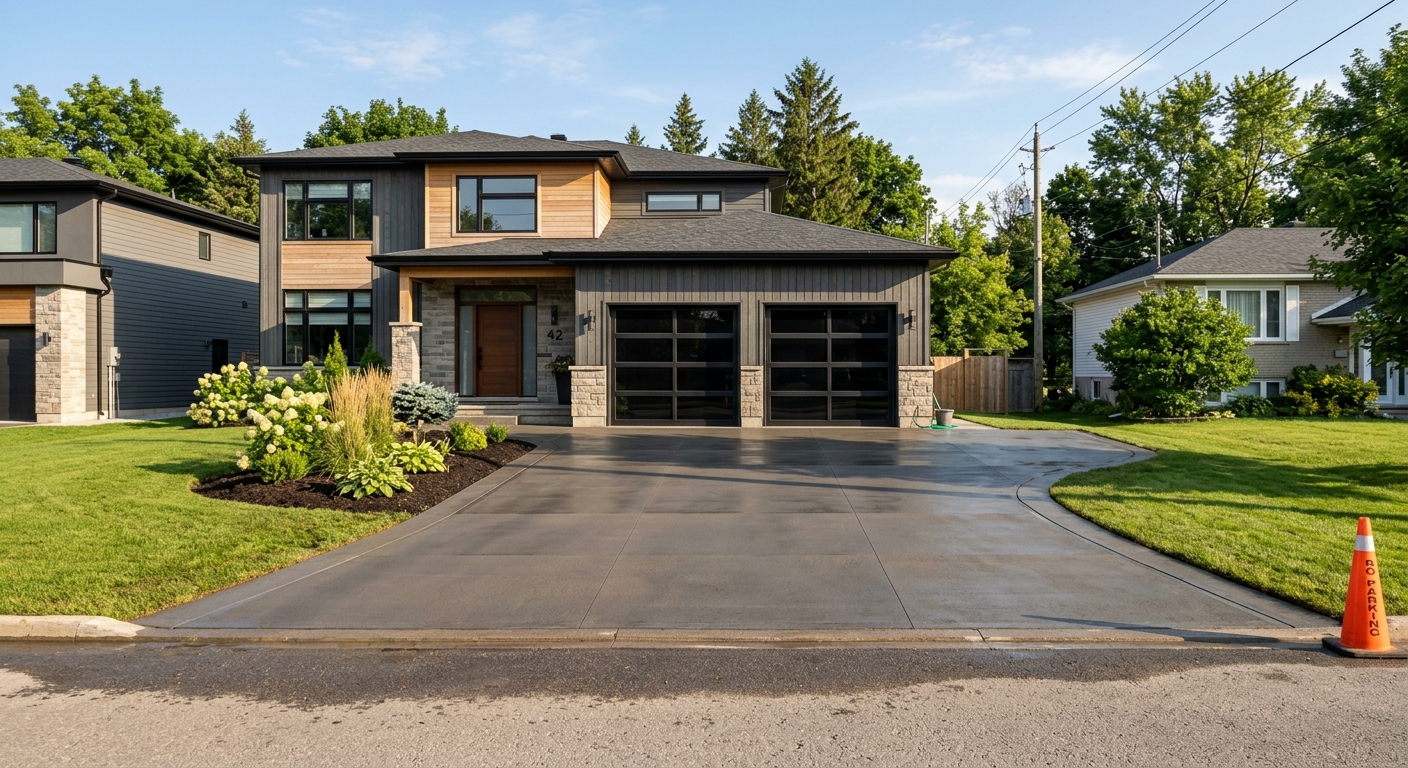
Concrete work options and costs in Downtown Commercial Core
Downtown Commercial Core, Alberta is a tight, high-turnover market where concrete flatwork gets planned around shop access, snow removal schedules, and fast turnarounds for driveways, patios and walkways. In the Calgary area, the customer base is active—Calgary’s population was 8,225 in the 2021 Census profile for Downtown Commercial Core (Statistics Canada, 2021 Census)—and that mix of homeowners and infill projects tends to keep crews busy. At the same time, Alberta’s cold continental climate and frequent freeze–thaw cycles make “cheapest” concrete a false economy: the job specs must be engineered for frost exposure, not just poured and cured. In practice, that means deeper excavation and more granular base prep for exterior slabs, air-entrained mixes, and strict curing controls during Calgary’s shorter exterior pour season.
Within Downtown Commercial Core, areas near the inner-city corridors—like the beltway-linked access routes around Beltline-style infill pockets—tend to see higher demand because many lots have limited driveway width, require careful truck staging, and see faster deterioration from de-icing salt and winter traffic. That combination influences labour availability and scheduling, so quotes can shift as much as 10–20% based on timing and site access.
Use the table below as a grounded starting point for what different concrete options typically cost in the Calgary market tier.
| Application |
Typical Size |
Key Spec |
Finish Option |
Price Range |
| Concrete driveway (standard broom finish) |
20 m² (approx. 10 ft × 20 ft) |
Air-entrained mix; granular base; control joints |
Broom finish |
$12,000–$18,000 |
| Exposed aggregate driveway |
20 m² (approx. 10 ft × 20 ft) |
Air-entrained mix; higher labour time for wash/sculpt |
Exposed aggregate (light/medium exposure) |
$14,000–$22,000 |
| Stamped concrete driveway or patio |
30 m² (approx. 12 ft × 25 ft) |
Air-entrained mix; integral colour; seal coat |
Stamped pattern + colour |
$15,000–$26,000 |
| Plain concrete patio or walkway |
20 m² (approx. 10 ft × 20 ft) |
Air-entrained mix; proper slope/drainage |
Plain broom or trowel lightly |
$5,000–$9,000 |
| Garage floor (interior slab) |
30 m² (approx. 12 ft × 25 ft) |
Vapour barrier/insulation as needed; thicker slab |
Burnished or broom-ready finish |
$7,000–$13,000 |
| Foundation footings (structural, below frost) |
Typical single-family bearing footprint |
Reinforced concrete; footing depth below design frost |
Structural finish (not decorative) |
$28,000–$45,000 |
Prices are estimates only and vary by project scope, site access and material selection.
What affects the price of concrete work in Downtown Commercial Core
In Downtown Commercial Core, Alberta, it’s common to see quotes for the “same” concrete job vary by 30–50% because the differences usually aren’t in the concrete itself—they’re in the excavation, base build-up, reinforcement detailing, curing plan, and site logistics. Two contractors can both say “air-entrained concrete,” yet one may price a deeper, well-compacted granular base and stricter curing, while the other cuts those steps to hit a lower number. In this market, that gap widens with cold-weather planning and limited access for trucks and finishing equipment.
Calgary’s frost and freeze–thaw cycle dictates specs from the ground up. Footings must extend below the design frost depth (about 1.2 m in Alberta practice for many residential applications), otherwise frost heave and seasonal movement can work against your foundation and flatwork. Exterior slabs also need air-entrained concrete to survive repeated freezing and thawing, especially where de-icing salt accelerates surface deterioration. Finally, the practical pour season is shorter: if crews need winter-grade mixes, insulated blankets, or temporary heat to protect early-age concrete, costs rise.
Here are a few real examples that shift cost in Downtown Commercial Core. If you’re replacing a driveway at the edge of a lot with limited staging, labour and traffic control can add several thousand dollars on a broom-finished pour in the $12,000–$18,000 tier. If you upgrade to stamped concrete, the price increase is usually justified by additional labour, integral colouring, stamping labour, and sealing—often landing in the $15,000–$26,000 tier. Conversely, a simple plain patio with good drainage and straightforward access can hold closer to the $5,000–$9,000 band.
Climate and housing stock matter too: older neighbourhood layouts often have settled soils, tighter driveway approaches, and more unknown subgrade conditions, so excavation volume and base thickness can add cost compared with newer builds.
| Price Factor |
Why It Matters |
Cost Impact |
| Frost line depth — determines footing depth and form height |
Footings must bear below the design frost to prevent heave |
Higher excavation; more formwork; typically large swing on foundation budgets |
| Site preparation — excavation, grading, compacted granular base |
Good base prevents voids, settlement and cracking |
Unstable soils or thick topsoil can add significant labour and haul cost |
| Reinforcement — rebar or wire mesh requirement |
Controls cracking and improves structural capacity |
Extra material + chairing/tie-wire labour; can raise total by thousands |
| Mix design — air-entrainment and compressive strength spec |
Air entrainment protects from freeze–thaw damage |
Winter-grade and higher strength specs cost more but reduce long-term failures |
| Finish type — broom vs. stamped vs. exposed aggregate |
Finish complexity drives labour time and curing/sealing steps |
Stamped/exposed finishes typically add labour and materials (colour/sealer) |
| Pour size and concrete truck access to site |
Short access windows can require more labour or pump/long reach |
Staging constraints can add transportation and crew costs |
| Cold-weather curing precautions — heating and blankets |
Early-age protection prevents scaling and strength loss |
Often needed later in the season; can push exterior pours higher |
| Control joint pattern and sealing cost |
Joints guide cracking; sealing protects against salt and water |
Proper jointing and sealer add cost but reduce spalling risk |
Permits & regulations in Alberta
In Alberta, concrete work is handled through typical building-permit pathways based on structural impact. Structural concrete work—footings, foundation walls, grade beams, and any reinforced foundation elements that support a building—requires a building permit, and it often depends on engineered drawings being reviewed by the municipality. For concrete flatwork like patios, walkways and driveways, a permit is usually not required unless the work affects lot grading, impervious surface coverage limits, drainage/sidewalk interfaces, or municipal right-of-way. Even when a permit isn’t required, you still need to follow setbacks, drainage direction, and any applicable municipal standards.
Before breaking ground in Downtown Commercial Core, confirm the contractor carries liability insurance and WSIB/WCB coverage (worker protection). Step-by-step, here’s how homeowners can verify eligibility in Alberta:
- Ask for a certificate of insurance (liability) that matches the project address and dates.
- Request proof of WSIB/WCB coverage (or the applicable clearance/registration documentation).
- Check the contractor’s Alberta trade licensing/registration status via the appropriate online public registry for trades and contractors.
- Verify the contractor provides references on similar-scale jobs (especially exterior slabs in Calgary’s freeze–thaw conditions).
- Confirm whether a permit is required for your specific scope and who pulls it (builder vs. homeowner vs. contractor).
If you’re unsure whether your driveway expansion triggers grading or right-of-way impacts, call your local permitting office first—two minutes saved now prevents costly rework later.
Getting concrete right in Downtown Commercial Core's freeze-thaw climate
Concrete failures in Downtown Commercial Core are usually about water, timing, and frost—not about “bad luck.” The biggest long-term issue I see is spalling and surface scaling, often from inadequate air-entrainment, poor base prep, or curing that’s rushed or protected poorly during cold snaps. Calgary’s cold continental climate cycles through freezing and thawing repeatedly, and de-icing salt accelerates deterioration where water can reach the surface.
To spec the job correctly, I recommend focusing on five fundamentals. First is base preparation: excavate to suit local soil conditions and compact a granular sub-base to the right depth for stability and frost resistance. Second is mix design: for exterior flatwork, air-entrainment is commonly targeted around 5–7% and paired with a minimum compressive strength of 32 MPa for structural performance. Third is control joints: joints should be planned to keep random cracking from turning into wide, water-pulling fissures. Fourth is curing: you should expect at least 7 days of proper curing conditions—cold-weather pours often require insulated blankets and, sometimes, temporary heat. Fifth is sealing: apply a penetrating sealer after the concrete has cured (typically around 28 days post-pour) to help repel chloride salts.
Ask technical questions like: “What air content do you target for exterior exposure?” and “What’s your winter curing plan and how do you protect early-age concrete?” If you’re comparing options, this is also where the price difference is either earned or wasted. For example, upgrading from plain broom-finish to stamped concrete may add substantial cost in the $15,000–$26,000 tier, and that’s justified when the contractor also delivers the same robust freeze–thaw specs and correct sealing—not just more finishing.
| Spec |
Why It Matters in Downtown Commercial Core |
What to Ask For |
Impact if Skipped |
| Compacted granular base (depth?) |
Stable base reduces settlement and supports frost resistance |
Base depth tied to your soil conditions and frost strategy; compact to spec |
Uneven support, cracking, and premature failure |
| Air-entrained concrete mix (target air %?) |
Provides freeze–thaw protection in Alberta winters |
Target 5–7% air for exterior flatwork; mix design documentation |
Spalling, scaling, and rapid surface deterioration |
| Compressive strength (MPa rating) |
Strength affects durability and load performance under freeze–thaw |
Minimum 32 MPa (as applicable to your engineered design) |
Reduced durability and higher risk of cracking and wear |
| Control joints (spacing per ACI guidelines) |
Controls where cracks form so water doesn’t infiltrate randomly |
Joint spacing plan drawn to slab dimensions and reinforcement layout |
Random cracking and water ingress at uncontrolled locations |
| Minimum 7-day curing period |
Early-age strength gain is critical before cold cycles hit |
7 days minimum curing with cold-weather protection if needed |
Surface scaling and reduced long-term performance |
| Penetrating sealer (when applied after cure) |
Salt and moisture exposure threaten exterior surfaces each winter |
Apply penetrating sealer after cure (commonly around 28 days) |
Faster salt damage and spalling risk |
How to choose a concrete work contractor in Downtown Commercial Core
Choosing the right contractor matters more in Downtown Commercial Core than most homeowners expect, because Alberta’s freeze–thaw conditions punish shortcuts. Start with compliance: verify Alberta licensing/registration for the contractor (and any required trade permits), then confirm liability insurance and WSIB/WCB coverage. How to check: ask for a current certificate of insurance (make sure it lists your project address or general coverage for the job period) and request proof of WSIB/WCB registration/clearance. A reputable contractor will provide these without hesitation and will match the documents to the scope you’re purchasing.
Next, demand 2–3 itemised written quotes, not just lump sums. You want labour and materials breakdown so you can compare excavation depth, base thickness, reinforcement (rebar/wire mesh), mix design, finish type, curing plan, and sealing. Also read the exclusions carefully: is disposal of excess material included? Is snow removal protection included during the curing window? Will the contractor pull permits if required for structural work (footings/foundation elements)?
Warranty should be specific—workmanship warranty length and what it covers (cracking, spalling due to documented mix/spec issues, joint failure) plus product/manufacturer warranty details for sealers or specialty products. Confirm whether warranties are transferable if you sell the property.
For payment scheduling, never pay more than 10–15% upfront. Hold back retainage until key milestones are complete and the surface is finished to spec. Get a start date and completion estimate in writing, because Calgary scheduling and cold-weather restrictions can affect the curing timeline.
- Request concrete mix design and confirm air-entrainment for exterior work
- Ask what base depth and compaction method they use for your soil
- Confirm reinforcement type (rebar vs. wire mesh) and placement (chairs/tie wire)
- Get joint spacing plan before the pour
- Ask how they protect curing in late fall or early spring (blankets/heating)
- Clarify whether disposal and trucking are included in the quote
- Confirm sealing is included (and the cure timing responsibility)
- Check references on similar exterior slabs in Calgary winters
- Verify liability insurance limits and dates on the certificate
- Verify WSIB/WCB coverage and request clearance documentation
- Ensure the contract includes engineered/permit requirements where needed
- Review payment schedule and retainage terms in writing
Concrete red flags I see in Downtown Commercial Core include: no clear air-entrainment discussion, vague base prep (“we’ll grade it and pour”), skipping control joint planning, offering a low price without cold-weather curing protection, and pushing for a large upfront deposit (or avoiding itemised scope and exclusions).
Frequently asked questions — concrete work in Downtown Commercial Core
How do I maintain concrete in Downtown Commercial Core's freeze-thaw climate?
In Downtown Commercial Core and across Alberta, concrete maintenance is mainly about managing moisture and chlorides through the winter cycle. Start with safe de-icing practices: use de-icers sparingly and avoid repeated heavy salting in the same spot (salt-laden meltwater is what speeds spalling). Sweep off sand and grit after storms, keep surface drainage working (so water doesn’t pond at the edges), and don’t cover cracks with thick sealants until you’ve cleaned out loose debris. If your contractor included a penetrating sealer, maintain the seal system on schedule—typically re-evaluated after a few seasons depending on exposure. For newer exterior slabs, avoid parking heavy loads immediately if the curing plan was tight. If you’re comparing options, expect properly built exterior patios and driveways to hold better, especially those priced within the local bands (like $12,000–$18,000 for standard driveway work) where air entrainment and base prep are usually accounted for.
What causes concrete to spall in Downtown Commercial Core winters?
Spalling in Downtown Commercial Core is most often caused by freeze–thaw damage plus salt exposure. If concrete isn’t properly air-entrained (targeting the correct air content for exterior flatwork), freezable water can expand inside the paste and break off the surface. The risk also increases when the base isn’t stable or when water has a route to reach the slab edge—poor drainage and undersized base build-ups can create micro-voids. Cold-weather placement without proper curing protection can further reduce early-age strength, making surface scaling more likely. Finally, repeated chloride-rich meltwater from de-icing salts accelerates deterioration. When you’re budgeting, don’t assume all exterior pours are equal: a driveway in the $12,000–$18,000 range built to spec typically includes the durability measures that prevent spalling; the cheaper end of a poorly detailed quote often omits one or more of those steps.
What is rebar and when is it required in Alberta?
Rebar (reinforcing steel) is used to increase tensile capacity and control crack widths in reinforced concrete. In Alberta, rebar is commonly required when your concrete element is designed to carry structural loads or resist bending—most notably for foundation footings and foundation walls, and often in engineered grade beams or slabs-on-grade where the design calls for reinforcement. For many exterior flatworks like driveways and patios, reinforcement (rebar or wire mesh) may be specified depending on slab thickness, soil bearing, and expected loads (vehicle use changes the design). Even if reinforcement isn’t installed, joints and base prep become more critical to control cracking and water intrusion. If you’re doing structural work in Downtown Commercial Core, ensure engineered drawings and permits align with the reinforcement details. The simplest check for homeowners: ask your contractor to show where reinforcement sits (chairs/tie-wire placement) and whether it matches the engineered or spec sheet for your application.
How long does a concrete project take in Downtown Commercial Core?
Timelines in Downtown Commercial Core usually break into site prep, forming, pour day, finishing, curing, and post-cure sealing (for exterior durability). The actual pour day is often only part of the schedule; cure protection in Alberta cold weather can extend the calendar even when “work hours” are short. For a driveway or patio, many crews complete excavation and base prep within a day or two, the pour and finishing in one day, and then keep traffic and heavy loads off until early strength develops. Full durability typically depends on curing conditions; minimum curing expectations are commonly around 7 days, and sealers are usually applied after cure (often around 28 days post-pour). For foundation/footings, you should expect a more staged process due to inspections and formwork/reinforcement. If winter weather is involved, allow extra time for heated enclosures or insulated blankets to protect the early-age concrete.
What is a concrete overlay and is it suited to Downtown Commercial Core?
A concrete overlay is a new concrete layer placed over an existing slab, typically using surface preparation, bonding agents or mechanical bond systems to attach the overlay to the old concrete. In Downtown Commercial Core, overlays can be suited for some driveways or patios when the existing slab is still mostly structurally sound and the cracking is not severe or actively spreading from foundation movement. However, overlays don’t solve underlying base failure or drainage problems—if water can still reach the slab system and freeze, the overlay can deteriorate too. Good candidates often have stable subgrade, manageable crack patterns, and a contractor who does thorough surface profiling and proper bonding. Before budgeting, ask whether your contractor is quoting an overlay or a full replacement. It’s also worth comparing durability: a full replacement in the $12,000–$18,000 tier may cost more upfront than an overlay option, but it can be the better long-term fix if the base and frost strategy are failing.
How do I seal concrete to protect it in Downtown Commercial Core?
Sealing helps protect exterior concrete from moisture and chlorides from de-icing salts, which is crucial in Downtown Commercial Core’s freeze–thaw winters. The key is timing and product selection. Most penetrating sealers should be applied after the concrete has cured properly—commonly around 28 days post-pour—so the concrete has released enough moisture for the sealer to do its job. Before sealing, the surface must be clean, dry, and free of dust, curing compounds, and contaminants; contractors usually power wash and allow full dry time. Apply the sealer evenly at the manufacturer’s recommended coverage rate, and avoid trapping moisture under an inappropriate product. Plan for maintenance by re-evaluating after a few winters, especially near driveway edges where salt spray is worst. If your driveway or patio is priced in the local durability-focused bands (for example, $5,000–$9,000 for plain exterior work when built to spec), sealing is commonly part of the long-term protection plan.