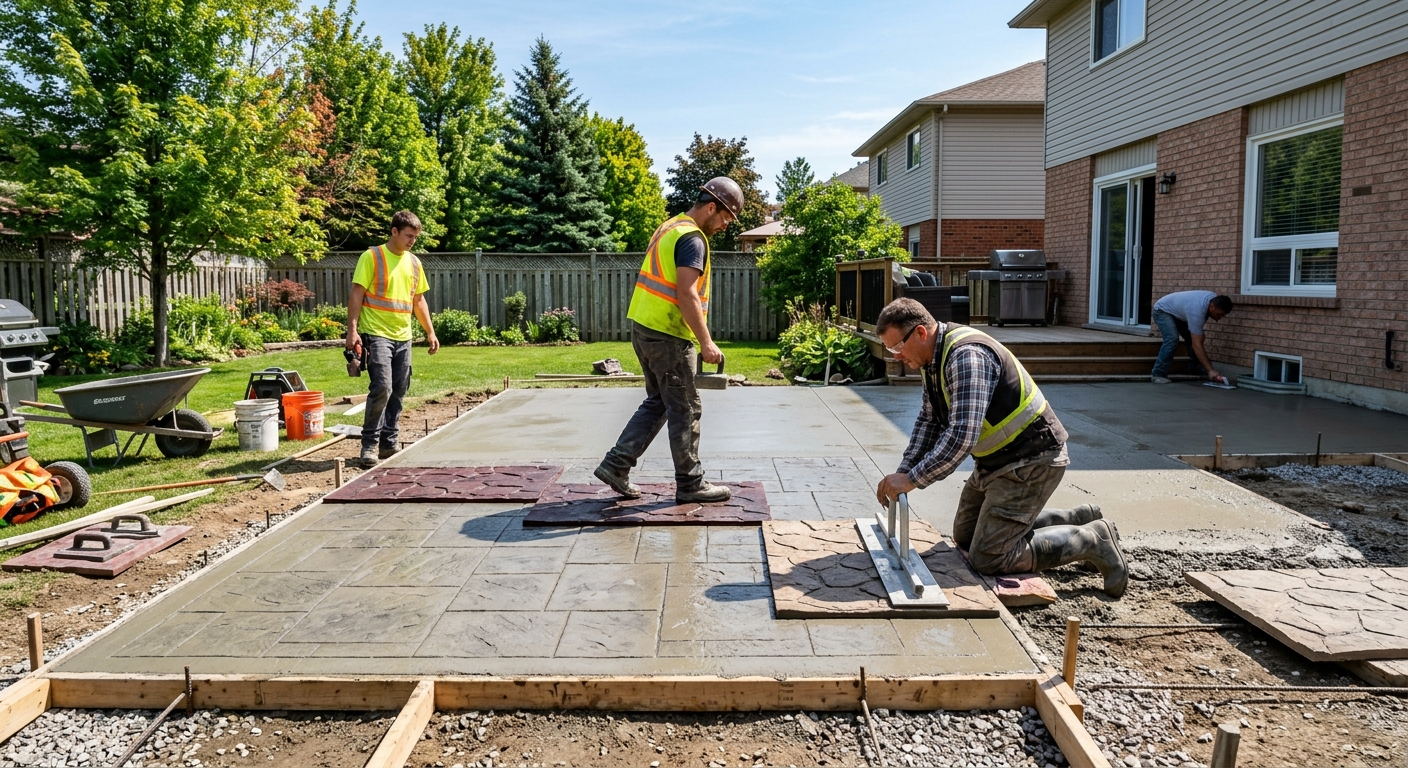
Concrete work options and costs in Drumheller
Drumheller homeowners usually start pricing concrete when they notice driveway dips, patio trip hazards, or older sidewalks that no longer drain well. With 76.4% of area dwellings being single-detached homes, the demand is steady for driveways, patios, and walkways—work that also helps properties keep curb appeal as the town’s built form ages (62.6% of homes were built before 1981) (Statistics Canada, 2021 Census). In Lethbridge–Medicine Hat, the big cost drivers are frost depth and freeze–thaw cycles. We typically excavate and form footings below frost for structural work, and we design exterior flatwork with air-entrained concrete and proper jointing so water pressure doesn’t build up as it freezes.
That climate reality also shapes scheduling and availability. Exterior pours get clustered into warmer, drier windows, and cold-weather protection—tarps, insulating blankets, and sometimes heaters—can add to labour and materials. On the plus side, site access around areas like East Coulee can be straightforward, so many homeowners see tighter estimates when there’s clear truck access and a defined finish choice.
Below is a realistic comparison of common options in Drumheller based on typical sizes and local specs, then you can match it to your site conditions. Use the table as a starting point for budgeting before a contractor measures excavation, base depth, reinforcement, and finish requirements.
| Application |
Typical Size |
Key Spec |
Finish Option |
Price Range |
| Concrete driveway (standard broom finish) |
400–600 sq. ft. |
Air-entrained mix; compacted granular base |
Broom finish + control joints |
$5,600–$13,200 |
| Exposed aggregate driveway |
400–600 sq. ft. |
Air-entrained mix; proper timing for wash |
Exposed aggregate top finish |
$7,000–$16,500 |
| Stamped concrete driveway or patio |
250–500 sq. ft. |
Air-entrained mix; stamped release system |
Stamping + colouring + sealed finish |
$8,000–$20,000 |
| Plain concrete patio or walkway |
150–350 sq. ft. |
Air-entrained mix; base prep and joints |
Smooth or lightly broomed surface |
$2,000–$6,600 |
| Garage floor (interior slab) |
300–600 sq. ft. |
Vapour barrier; target 32 MPa concrete |
Standard broom or steel trowel (light) |
$4,200–$12,000 |
| Foundation footings (structural, below frost) |
Varies by foundation plan |
Reinforced structural concrete below frost depth |
Formed + engineered rebar cage |
$10,000–$24,000 |
Prices are estimates only and vary by project scope, site access and material selection.
What affects the price of concrete work in Drumheller
If you get two quotes for the “same” concrete job in the Lethbridge–Medicine Hat region, it’s not unusual to see a 30–50% difference. The gap usually comes down to how each contractor handles frost depth, base prep, reinforcement, mix design, and whether they price for freeze–thaw protection instead of “just pouring a slab.” In Alberta, exterior work needs air-entrained concrete to help relieve pressure when moisture inside freezes. For structural work, footings must extend below the design frost depth, which in Alberta can be in the 0.5–1.2 m range depending on conditions and design—driving excavation, forming, and disposal costs higher than milder climates.
Timing also matters. Cold snaps shorten the practical pour season for exterior slabs, and cold-weather curing precautions—insulating blankets, heaters, and more labour attention—can add cost versus a simple summer pour. De-icing salt contributes to surface spalling over time, so sealing and correct jointing become more than “nice-to-haves.”
In Drumheller, older housing stock means more retrofit work: replacing broken driveway aprons, removing compromised base, or re-grading around steps. Those add labour and may require deeper excavation—often pushing plain patio/walkway work toward the upper end of the $12–$20 band. Conversely, if you choose a standard broom finish and the site has solid access and well-compacted granular base, you may land closer to the lower end of the $14–$22 driveway band. For example, switching from plain concrete to exposed aggregate can add roughly $1,400–$3,300 on a typical driveway because the extra wash/finishing time and materials reduce productivity, but it can look far better for longer in a town where surfaces get sanded, salted, and re-surfaced over the years.
| Price Factor |
Why It Matters |
Cost Impact |
| Frost line depth — determines footing depth and form height |
Deeper excavation reduces frost heave risk |
Higher excavation, more forming, more disposal |
| Site preparation — excavation, grading, compacted granular base |
Correct grade and compaction prevent settlement |
More depth/base = more labour and material |
| Reinforcement — rebar or wire mesh requirement |
Controls cracking and improves structural capacity |
Material cost plus tying/layout labour |
| Mix design — air-entrainment and compressive strength spec |
Freeze–thaw durability and strength gain |
Higher-spec mix and batching requirements |
| Finish type — broom vs. stamped vs. exposed aggregate |
Different labour steps and finishing windows |
Stamped/exposed usually adds 15–40%+ labour |
| Pour size and concrete truck access to site |
Small pours still need crews; access affects productivity |
Restricted access can increase labour time |
| Cold-weather curing precautions — heating and blankets |
Concrete needs time to reach usable strength |
Added rental supplies and monitoring labour |
| Control joint pattern and sealing cost |
Joints manage random cracking; sealing helps durability |
More saw cuts and sealer material/application |
Permits & regulations in Alberta
In Alberta, the rules depend on what you’re building. Structural concrete work—like foundation footings, foundation walls, and grade beams—typically requires a building permit, and municipal review often expects engineered drawings for the structural parts. For concrete flatwork (driveways, patios, and walkways), a permit usually isn’t required unless the work affects lot grading, drainage plans, or impervious surface/driveway approaches near municipal right-of-way requirements. Even when a permit isn’t standard for flatwork, the safest move in Drumheller is to confirm with the local authority before excavation begins—especially if you’re changing slopes, adding drainage, or tying into existing sidewalks/curbs.
Also verify your contractor’s credentials before they break ground. Start by checking that the company carries current liability insurance and has proper worker coverage (WSB/WCB) for the people doing the work—don’t rely on a verbal confirmation. Next, ask for a certificate of insurance (COI) that lists your address as an interested party if possible. Then request references on similar structural or driveway projects completed within the last few years, ideally in Alberta.
For contract accountability: ensure the written quote clearly states what’s included (excavation limits, rebar/wire mesh allowance if applicable, disposal, forming, saw cutting, and whether permit coordination is included). If you’re unsure whether your scope triggers a permit, ask the contractor to outline the exact work items and then verify with the municipality. That step alone prevents delays and change-order surprises.
Getting concrete right in Drumheller's freeze-thaw climate
Concrete failures in Drumheller winters almost always trace back to moisture movement and inadequate freeze–thaw detailing. In our climate and local Lethbridge–Medicine Hat market, the most common issues are spalling, scaling, and premature cracking—usually when contractors shortcut base prep, omit air-entrainment, or place weak mixes without the right curing and protection. To spec the job correctly, focus on five areas.
(1) Base preparation: require a compacted granular sub-base to the specified depth for local soil and frost conditions, with proper grading so water doesn’t pond. (2) Mix design: specify air-entrained concrete—commonly in the 5–7% air range for exterior flatwork—plus a minimum 32 MPa compressive strength, so strength develops and the mix survives freeze–thaw cycles. (3) Control joints: ask for a joint layout that limits random cracking and manages where shrinkage happens, with saw timing and spacing planned. (4) Curing: insist on a minimum 7-day curing period under proper conditions; cold pours often require blankets or heaters to keep temperature and moisture consistent so the slab can reach usable strength before backfill or load. (5) Sealing: plan for a penetrating sealer applied after the cure period (often around 28 days post-pour) to improve resistance to de-icing salts and water intrusion.
When you get technical, ask pointed questions: “What air content are you targeting?”, “What’s the curing plan if the forecast drops?”, and “What joint spacing will you follow?” If you compare options, the dollar trade-off can be clear. For instance, moving from plain broom-finished concrete to stamped concrete might add about $4,000–$8,000 on a typical project depending on size and colour work; that price is justified when the contractor also provides the same durability specs (air content, jointing, curing). Stamped looks great, but it won’t last if the freeze–thaw detailing is wrong.
| Spec |
Why It Matters in Drumheller |
What to Ask For |
Impact if Skipped |
| Compacted granular base (depth?) |
Reduces settlement and supports slab under frost movement |
Specified base depth, compaction testing, and drainage grade |
Premature cracking, dips, and voids that hold water |
| Air-entrained concrete mix (target air %?) |
Protects against freeze–thaw scaling and internal pressure |
Target air content (commonly 5–7% for exterior flatwork) |
Spalling and surface scaling during Drumheller winters |
| Compressive strength (MPa rating) |
Ensures strength gain for loading and backfilling |
Minimum 32 MPa and documented cold-weather curing approach |
Surface damage, increased permeability, weaker long-term performance |
| Control joints (spacing per ACI guidelines) |
Controls where cracks form as concrete shrinks |
Joint layout and saw-cut timing |
Random cracking that can become water pathways |
| Minimum 7-day curing period |
Cold temps slow strength gain; curing sets durability |
How they protect the slab if temperatures drop; moisture plan |
Weaker surface and increased risk of scaling/spalling |
| Penetrating sealer (when applied after cure) |
Helps repel salt water intrusion from de-icing |
Penetrating sealer application after cure (often ~28 days) |
Faster deterioration and more frequent surface repairs |
How to choose a concrete work contractor in Drumheller
Choosing a contractor in Drumheller is mostly about verifying capability, not just price. Start with Alberta licensing status for business compliance (for example, ensuring the contractor is legitimately registered to operate and will sign your agreement clearly). Next, confirm liability insurance. Ask for the COI and read it: it should match the company name on the contract, show current coverage dates, and list appropriate coverage limits for construction work.
Then verify worker coverage—WSB/WCB coverage—for everyone who will be on-site. Don’t accept “we’re covered” without paperwork. A reputable contractor can produce documents immediately and will also provide a clearance letter or verification details as required. If they hesitate, that’s a red flag.
Get 2–3 itemised written quotes, ideally broken into labour, concrete supply, excavation/grading, forms, reinforcement allowance, finishing, saw cuts, and disposal. Avoid lump-sum quotes that don’t state what’s excluded. Look for whether permit coordination is included if needed for structural work, and confirm whether disposal/hauling of excess material is part of the price.
Warranty matters too: ask for the workmanship warranty length, what it covers (cracks vs. spalling vs. settlement), and whether the warranty is transferable to a new homeowner. Finally, keep payment terms sensible: never pay more than 10–15% upfront; use a holdback until completion and cleanup are confirmed. Ask for a written start date and completion estimate—cold snaps and curing conditions can affect timelines in southern Alberta.
- Request COI for liability insurance before work begins (and verify expiry dates).
- Confirm WCB/WSB coverage for all crew members.
- Ask for references on similar-size Drumheller projects (driveways, patios, or structural footings).
- Require itemised quotes (labour, materials, excavation, base, reinforcement, finishing).
- Confirm air-entrainment and minimum 32 MPa strength in writing for exterior work.
- Get the base prep spec (granular type, depth, compaction method).
- Ask for the control joint spacing and saw-cut timing plan.
- Clarify disposal/haul-away for excess soil and old concrete demolition.
- Confirm cold-weather protection plan if pouring occurs in shoulder months.
- Review warranty terms: workmanship duration, exclusions, and transferability.
- Use a payment schedule with no more than 10–15% upfront and a holdback on completion.
- Get start and completion dates in writing, plus weather contingency notes.
Red flags in Drumheller include: promises of “cheap concrete” without discussing air-entrainment; quotes that don’t mention jointing or curing; refusal to provide proof of insurance/coverage; missing itemisation for base depth and reinforcement; and insisting on an aggressive schedule that doesn’t account for curing time in freeze–thaw weather.
Frequently asked questions — concrete work in Drumheller
What causes concrete to spall in Drumheller winters?
In Drumheller and other parts of Alberta with freeze–thaw cycles, spalling usually starts when water gets into the concrete and freezes repeatedly. Without proper air-entrainment, internal freezing pressure builds up and pushes the surface material off, especially where de-icing salts and meltwater concentrate (Statistics Canada, 2021 Census). Poor base prep and weak drainage can also create wet zones that stay saturated longer. Another common cause is inadequate curing—if the slab is poured in cool conditions without heating/blankets, the concrete may not reach the strength and durability you expect. When you’re comparing quotes, check that the mix is air-entrained and that control joints are correctly planned to limit cracking pathways.
What is rebar and when is it required in Alberta?
Rebar (reinforcing steel bars) is used to control cracking and add tensile capacity in structural concrete. In Alberta, rebar requirements depend on the engineered design and the structural element—so for foundation footings, foundation walls, and grade beams, rebar is commonly specified by engineers and reviewed through the permitting process for structural work. For exterior flatwork like driveways and patios, reinforcement may be required or recommended depending on slab thickness, soil conditions, loading (heavy vehicles), and local design standards—especially when the contractor is dealing with older lots or compromised base. Your best protection is to ask the contractor what reinforcement plan is included in the quote and to ensure it matches the drawings or structural intent. If you’re budgeting, structural work typically sits higher, often in the $18–$35 band for foundation/footings per the local market pricing guidance.
How long does a concrete project take in Drumheller?
Typical timelines in Drumheller depend on size, access, weather, and curing conditions. A small patio or walkway can often be completed in about 2–4 days total once forms and prep are done, but the curing period still matters for durability. For a driveway, plan for roughly 3–7 days of site activity, with additional time if cold weather protection (blankets/heaters) is needed. Structural work like footings usually takes longer because excavation depth, forming, reinforcement installation, inspection steps, and cure time must align with permit/engineering requirements. Even if the crew finishes placing and finishing quickly, you can’t rush strength gain: minimum curing expectations for durability are critical in freeze–thaw season. If your pour is near a cold snap, ask your contractor how they manage temperature and how that affects the schedule.
What is a concrete overlay and is it suited to Drumheller?
A concrete overlay is a new concrete layer placed over an existing slab. It can be a good solution when the old concrete is still reasonably sound, but it can fail quickly in Drumheller if the base is saturated, the old slab is heaving, or if there’s moisture coming from below. Freeze–thaw cycles and de-icing salts are harsh on bond lines; overlays need excellent surface prep (often grinding/scarifying) and the right bonding system. Also consider whether joints and drainage are addressed—overlaying without fixing drainage often recreates the wet areas that caused deterioration in the first place. Cost-wise, overlays can sometimes be cheaper than full replacement, but they’re not automatically the right choice. Get a contractor to assess whether the existing slab is structurally stable and whether proper prep brings the overlay into the durability zone you need for Alberta winters.
How do I seal concrete to protect it in Drumheller?
Sealing helps reduce water and salt intrusion, which is important in Drumheller where de-icing products and freeze–thaw cycles can accelerate surface deterioration. For best results, use a penetrating sealer designed for concrete and apply it after the slab has cured properly—commonly after about 28 days, when the concrete is mature enough for the product to work effectively. Timing matters: sealing too early can trap moisture and reduce performance. Prep is also critical; the surface should be clean and dry, free of dust, oils, and curing compounds that interfere with penetration. When you’re reviewing quotes, ask whether sealing is included and what type of sealer is specified (and how many coats, if applicable). Proper sealing doesn’t replace air-entrainment and jointing, but it can extend service life and reduce spalling risk from salts.
What is the difference between concrete and cement?
Concrete is the full building material you see and place—cement plus aggregates (sand and gravel), water, and often air-entraining admixtures. Cement is one ingredient within concrete, typically Portland cement, which provides the binding capability. In Drumheller projects, you’ll often hear contractors talk about “mix design” because that’s what controls performance in freeze–thaw weather: air content, compressive strength (commonly 32 MPa minimum for many exterior specs), and workability. That’s also why simply comparing “cement” prices doesn’t tell you durability—two concretes with different air-entrainment or curing plans can perform very differently in Alberta winters. If your quote is aiming for a typical plain patio/walkway range (often around $12–$20), make sure it isn’t hiding behind vague wording like “standard concrete” and that it clearly references air-entrainment, curing, and jointing steps.