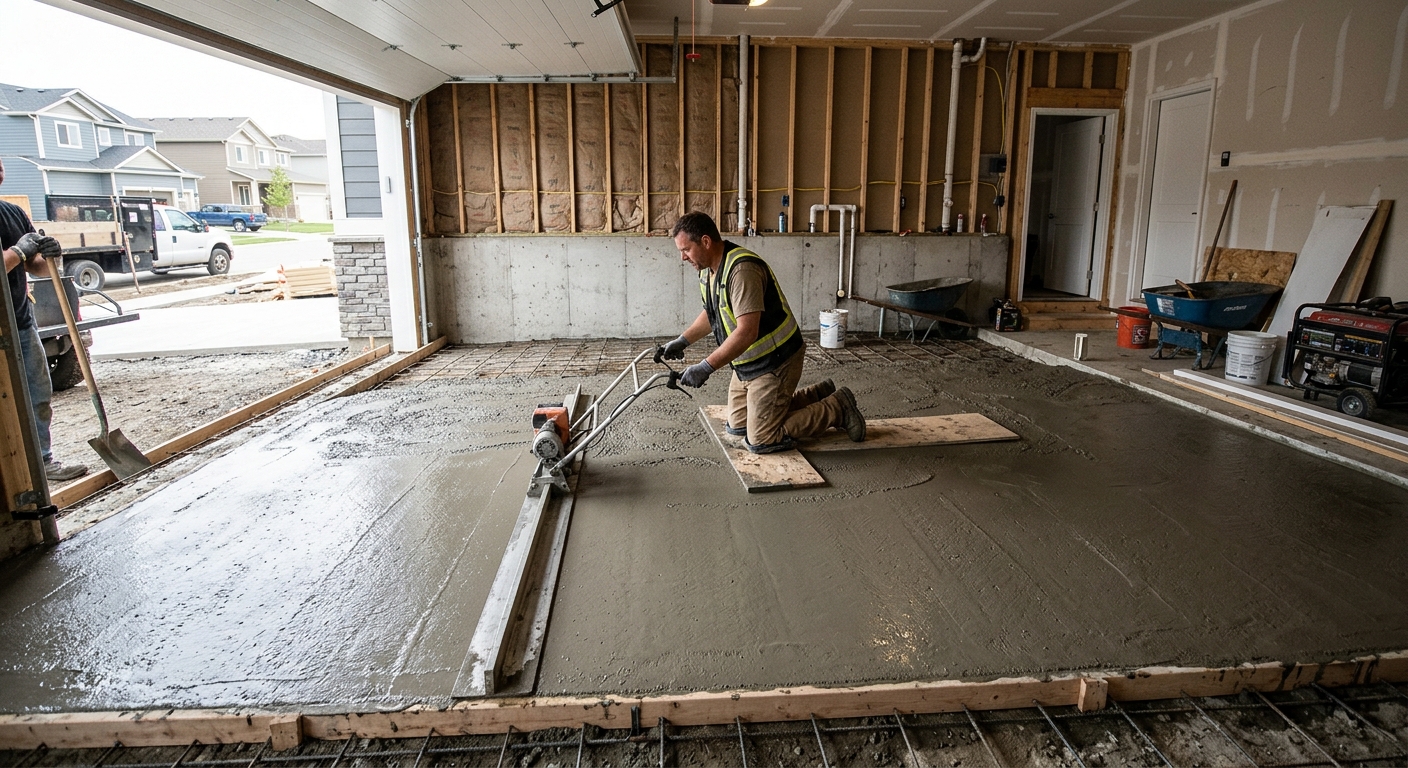
Concrete work options and costs in Ottewell
Ottewell, Alberta has a steady mix of homeowners and builders who rely on durable concrete for driveways, patios, walkways, and foundations. With a population of 5,848 (Statistics Canada, 2021 Census) in the wider community profile, you’ll notice concrete flatwork demand tied closely to housing turnover, garage additions, and basement development. In this part of Calgary, most concrete work is paired with long-lived residential flatwork—so the market has to budget for the region’s tough freeze–thaw reality, not just the finish you can see.
In the cold continental climate around Calgary, the design frost depth is engineered around deep frost penetration (about 1.2 m, roughly 4 ft). That means excavations are deeper and footing volumes are higher than in warmer provinces, which pushes foundation costs upward (often toward the higher end of the $28,000 – $45,000 band). Exterior slabs also need air-entrained concrete mixes and a careful curing plan; if crews try to rush pours in late fall or early spring, you’re more likely to see scaling and surface wear sooner.
Contractor availability can also affect your quote: in busier months, you may get scheduling lead-times, and that sometimes limits add-ons (like heavy regrading or decorative options) to the later pour schedule. Concrete flatwork is especially in demand in areas with frequent infill and renovation activity—around the established residential streets near 78 Avenue SE and the broader Ottewell–Southeast Calgary corridor—where homeowners upgrade driveways, replace aging patios, and add insulation-ready garage pads.
Below is a practical comparison of common options you’ll see quoted in Ottewell.
| Application |
Typical Size |
Key Spec |
Finish Option |
Price Range |
| Concrete driveway (standard broom finish) |
24 ft x 12 ft (approx. 288 sq. ft.) |
Air-entrained exterior mix; compacted granular base |
Broom finish + control joints |
$12,000–$18,000 |
| Exposed aggregate driveway |
24 ft x 12 ft (approx. 288 sq. ft.) |
Air-entrained mix; proper curing before wash |
Exposed aggregate (wash finish) |
$14,000–$20,000 |
| Stamped concrete driveway or patio |
20 ft x 12 ft (approx. 240 sq. ft.) |
Air-entrained mix; release agent + curing discipline |
Stamped patterns + sealer |
$15,000–$26,000 |
| Plain concrete patio or walkway |
12 ft x 12 ft (approx. 144 sq. ft.) |
Air-entrained exterior mix; compacted base |
Float/screed + light broom |
$5,000–$9,000 |
| Garage floor (interior slab) |
22 ft x 20 ft (approx. 440 sq. ft.) |
16–20 MPa (typical); vapour barrier where required |
Broom finish |
$6,500–$12,000 |
| Foundation footings (structural, below frost) |
Typical single-family pad size (varies) |
Below design frost depth; reinforced concrete |
Structural footing (engineered) |
$28,000–$45,000 |
Prices are estimates only and vary by project scope, site access and material selection.
What affects the price of concrete work in Ottewell
If you’re comparing quotes for the same concrete work in Ottewell, it’s not unusual to see swing-room of 30–50% across Calgary and Alberta. The difference usually isn’t the concrete itself—it’s the amount of engineered prep required, the mix design they’re specifying for our climate, and how well the contractor plans around frost, truck access, and curing.
First, frost depth governs everything for exterior structural work. In Alberta, footings must be designed to extend below the local design frost depth to prevent frost heave; in our region, that depth is commonly treated around 1.2 m (about 4 ft). Because excavation is more intensive and footing volumes are higher here than in milder areas, foundation and footing pricing tends to track the higher $28,000 – $45,000 band more often. Second, Calgary-area freeze–thaw cycles dictate air-entrained mixes for exterior slabs. That air-entrainment (typically in the 5–7% range for exterior flatwork) costs a bit more and requires correct finishing timing, but it’s essential for durability.
Third, the pour season can be shorter, especially if you’re placing exterior slabs when temperatures drop. Cold-weather curing precautions—insulated blankets, temperature monitoring, and sometimes temporary heating—add labour and consumables. Finally, road salt and de-icing accelerate surface wear if sealing and joint spacing aren’t handled properly, which pushes contractors to include sealer and a control-joint plan.
Concrete patios and walkways often land in the $5,000 – $9,000 band, but a larger area, poor drainage, or extra base depth can move the cost toward the top end quickly. For driveways, standard broom-finish work may start near the lower $12,000 – $18,000 range, while decorative systems like exposed aggregate or stamping add labour, materials, and curing sensitivity. As a practical example, a 288 sq. ft. driveway can look similar on paper, but if one quote includes deeper base prep and correct air-entrained mix while another doesn’t, the “cheaper” option can cost you more in early repairs.
| Price Factor |
Why It Matters |
Cost Impact |
| Frost line depth — determines footing depth and form height |
Footings must bear below design frost to prevent movement. |
Higher excavation can push foundation work toward the upper range. |
| Site preparation — excavation, grading, compacted granular base |
Proper base reduces settlement and cracking risk. |
Unexpected over-excavation for poor subgrade increases labour and material. |
| Reinforcement — rebar or wire mesh requirement |
Rebar controls cracking for structural and thicker slabs. |
More steel and correct placement labour adds cost. |
| Mix design — air-entrainment and compressive strength spec |
Air and strength are critical for freeze–thaw and durability. |
Correct exterior mix and testing-ready spec can raise concrete line items. |
| Finish type — broom vs. stamped vs. exposed aggregate |
Decorative work is labour-intensive and timing-sensitive. |
Stamped/exposed finishes usually add both labour and materials. |
| Pour size and concrete truck access to site |
Access affects crew efficiency, pumping needs, and haul time. |
Pump/extended hose or limited access can add a notable surcharge. |
| Cold-weather curing precautions — heating and blankets |
Proper curing reduces scaling and structural issues. |
Insulation/heating can add a meaningful per-day cost in shoulder season. |
| Control joint pattern and sealing cost |
Joints control cracking; sealer improves salt and moisture resistance. |
Skipping proper jointing or reducing sealer coverage can lead to early failure. |
Permits & regulations in Alberta
In Alberta, structural concrete work—especially anything related to your foundation system—usually requires a building permit. That typically includes footings, foundation walls, and grade beams, where engineered drawings are commonly reviewed by the municipality before construction. Concrete flatwork (patios, walkways, and driveways) often does not require a permit unless the work changes lot grading, affects impervious surface coverage limits, or involves municipal right-of-way considerations. Even when a permit isn’t required for the slab itself, drainage and grading changes can still trigger a review, so it’s smart to confirm with your local authority before breaking ground.
Step-by-step, here’s how a homeowner in Ottewell can verify a contractor in Alberta:
- Confirm they have the appropriate licence/registration for their scope (and that it’s current).
- Ask for a current certificate of insurance showing general liability.
- Verify workplace coverage: request proof of WSIB/WCB coverage (or confirm exemption status in writing if applicable).
- Request references for similar concrete scope and ask to see photos from at least one recent project in the Calgary area.
- Make sure the quote references engineering/permit drawings where structural work is involved, not “standard details.”
- Check whether permit pull (if required) is included in the proposal or explicitly excluded.
Finally, keep everything in writing: scope, schedule, and responsibilities for excavation, disposal, and any required municipal sign-offs.
Getting concrete right in Ottewell's freeze-thaw climate
Concrete fails in Ottewell most often due to freeze–thaw damage, poor base preparation, and curing issues—not because the slab “looks bad” on day one. In a climate with repeated winter thaw cycles, water gets into micro-cracks and around poorly compacted base layers, then expands when it freezes. That is why your job spec has to be built around durability: (1) a properly compacted granular sub-base at the right depth for local frost conditions, (2) an exterior air-entrained mix designed to survive freezing, (3) a control joint plan that manages shrinkage cracking, (4) curing that’s long enough and protected enough to develop strength, and (5) sealing applied after full curing so de-icing salts don’t accelerate surface deterioration.
For exterior flatwork, I recommend air-entrainment in the 5–7% range and a minimum 32 MPa compressive strength spec for the slab performance most homeowners are expecting in Calgary’s environment. Control joints matter: spacing should be set to limit random cracking patterns, especially on driveways and patios that span broader widths. Curing is equally non-negotiable—minimum 7-day curing under proper conditions, with extra measures like insulating blankets or gentle heat if cold weather arrives. A penetrating sealer applied 28 days post-pour helps repel moisture and reduces the impact of de-icing salts.
Here’s a dollar example: if a contractor under-specifies air-entrainment on a driveway replacement near the $12,000 – $18,000 band, you might “save” a few hundred to a couple thousand dollars upfront. But in our freeze–thaw conditions, insufficient air can lead to surface scaling and spalling that forces patching sooner—turning a manageable repair into an expensive rework cycle.
Use these questions to avoid the most common failure: spalling driven by inadequate air-entrainment, rushed finishing, or curing shortcuts.
| Spec |
Why It Matters in Ottewell |
What to Ask For |
Impact if Skipped |
| Compacted granular base (depth?) |
Proper base prevents settlement and reduces water movement under slab. |
Ask for base type, thickness, and compaction testing/requirements. |
Early cracking, uneven slab, and accelerated freeze–thaw damage. |
| Air-entrained concrete mix (target air %?) |
Air voids protect against freeze–thaw scaling and spalling. |
Ask for target air content (typically 5–7% for exterior flatwork). |
Higher risk of surface scaling within a few winters. |
| Compressive strength (MPa rating) |
Sufficient strength supports durability and load performance. |
Ask for minimum 32 MPa for exterior flatwork specifications. |
Reduced wear resistance and faster surface deterioration. |
| Control joints (spacing per ACI guidelines) |
Controls where cracks happen so they don’t become random. |
Ask for planned joint spacing and sawcut timing. |
Random cracking and wider joints that trap moisture. |
| Minimum 7-day curing period |
Cold snaps can interrupt early strength gain and increase damage risk. |
Ask how they’ll protect curing in late fall/early spring. |
Surface weakness, scaling, and reduced long-term performance. |
| Penetrating sealer (when applied after cure) |
Helps resist moisture and de-icing salt attack in Calgary winters. |
Confirm sealer type and timing (after 28 days of cure). |
Faster salt wear, mottling, and increased spalling risk. |
How to choose a concrete work contractor in Ottewell
Choosing the right contractor in Ottewell starts with verifying they’re properly covered and clearly accountable for the concrete performance you need in Alberta’s freeze–thaw climate. First, confirm Alberta licensing/registration for their scope—then request proof of liability insurance and ask for WSIB/WCB coverage documentation. The easiest way to check is to look for the contractor’s current status online where applicable, then compare it to the certificate dates on their insurance paperwork. If anything looks outdated, treat it as a red flag.
Next, insist on 2–3 itemised written quotes. You want a breakdown that separates labour and materials (concrete supply, reinforcement, base prep, formwork, finishing, joints, sealing, and disposal). Avoid quotes that only provide one lump number without scope details, because exclusions—like grading corrections, required excavation depth, or whether permit pull is included—are where budget blowouts happen. Make sure the quote clearly states what is included for: site access, sawcut timing, curing protection, and debris removal.
Warranty should be specific: ask for the workmanship warranty length and whether manufacturer coverage applies to products like sealers or admixtures. Confirm whether a warranty is transferable if you sell the home. Payment schedules matter too: never pay more than 10–15% upfront, and use a holdback until the job is complete and cleaned. Finally, get a written timeline with a realistic start date and completion estimate—particularly for shoulder season when crews may add curing protection costs.
- Ask for Alberta permit responsibility: who pulls it and who pays for it (if required).
- Confirm the concrete mix is specified as air-entrained for exterior slabs.
- Require base prep details: thickness, materials, and compaction expectations.
- Check whether reinforcement (mesh/rebar) is included where needed.
- Ask when control joints will be sawcut and the spacing plan.
- Confirm cold-weather curing measures (blankets/heating) are in scope if temperatures drop.
- Ask what sealer is included (type) and whether it’s scheduled after 28 days cure.
- Verify liability insurance limits and ensure the certificate matches the legal name.
- Confirm WSIB/WCB coverage documentation is current for the crews on your site.
- Request proof of recent similar work in the Calgary area (photos with dates).
- Ensure disposal/haul-off is included if they remove unsuitable soil or excess excavation.
- Get the concrete truck plan: access, placement method, and contingency for delays.
Concrete contractor red flags in Ottewell: vague mix specs (“regular concrete” without air-entrainment), no mention of frost depth/base requirements, refusal to itemise labour vs materials, unclear curing plan for late pours, and payment demands that exceed 10–15% upfront or offer no holdback.
Frequently asked questions — concrete work in Ottewell
When is the best time to pour concrete in Ottewell?
The best time to pour concrete in Ottewell is when daytime and nighttime temperatures are within the contractor’s planned curing window—typically late spring through early fall. In Calgary’s cold continental climate, early freezes can halt proper strength gain and raise the risk of surface scaling. If you’re working in shoulder season, experienced crews will add winter-grade mix protection, insulation blankets, and temperature monitoring, but that can affect your total cost and schedule.
If you’re planning a driveway near the $12,000 – $18,000 band or a patio in the $5,000 – $9,000 band, it’s smart to lock the pour date early so the crew isn’t forced to squeeze into colder weather. For best results, ask your contractor how they plan to protect curing if temperatures drop during the first week.
How long does concrete take to cure?
Concrete cure time depends on temperature, mix design, and whether cold-weather protection is used. For most residential slabs in Alberta, you should plan on minimum 7-day curing before you treat the surface as “in service-ready” for light use. Full design strength develops over longer time—often around 28 days—especially for exterior durability.
That 28-day period matters for sealing too: penetrating sealers are typically applied after the slab has fully cured (commonly at 28 days) so the sealer can actually repel moisture and de-icing salts. If you’re pouring in colder conditions in Ottewell, the contractor may extend protection beyond the standard window to ensure adequate early strength gain.
Do I need a permit for concrete work in Alberta?
In Alberta, structural concrete work such as footings, foundation walls, and grade beams generally requires a building permit and often engineered details reviewed through the municipal process. Concrete flatwork—like patios, walkways, and driveways—often does not require a permit unless it affects lot grading, drainage, or impervious surface coverage rules, or it involves municipal right-of-way considerations.
For Ottewell homeowners, the practical approach is to ask your contractor to clarify permit responsibility in the quote. If grading will change, ask the municipality whether a review is needed before excavation. Also verify the contractor carries proper liability insurance and WSIB/WCB coverage, and that any engineered drawings are reflected in their scope.
Concrete vs pavers for a patio in Ottewell?
Concrete and pavers both work well for patios, but they fail differently in Calgary-area freeze–thaw cycles. Concrete patios are monolithic: once properly built with air-entrained concrete, correct base prep, control joints, and proper curing, they can deliver long service with fewer moving parts. Pavers, on the other hand, can shift if the bedding base isn’t built correctly or if water doesn’t drain—leading to uneven surfaces over time.
Cost-wise, a plain concrete patio often lands around the $5,000 – $9,000 band depending on size and thickness, while pavers can trend higher once you add excavation, compacted base, edging, and labour. If you want the simplest long-term maintenance plan, concrete is often the practical choice—provided your contractor specs air-entrainment and joints for our climate.
How long does a concrete driveway last?
A properly built concrete driveway in Ottewell can last decades. Realistically, “lifespan” depends on base preparation, air-entrained mix design for freeze–thaw, control joint spacing, curing quality, and whether the homeowner maintains the surface with sealing. If the slab is built with correct specs and protected during curing, the driveway should resist scaling and spalling far better than a standard mix poured without air-entrainment or cold-weather precautions.
Many driveways in Calgary perform well for long periods, but the risk accelerates when de-icing salts and moisture get into uncontrolled cracks. If you’re replacing a driveway in the $12,000 – $18,000 range, ask your contractor about sealer timing and joint design—those details are often the difference between “looks fine” and truly durable performance.
What is air-entrained concrete and why does it matter here?
Air-entrained concrete includes tiny, evenly distributed air bubbles created by the mix design. Those microscopic voids give freezing water room to expand without rupturing the concrete matrix. In Ottewell and the wider Calgary region, freeze–thaw cycles are frequent, and that’s why exterior slabs like driveways, patios, and walkways need air-entrainment to reduce scaling and spalling.
When contractors skip air-entrainment or don’t dose the mix correctly, you’ll often see surface scaling within a few winters—especially where de-icing salt and meltwater contact the slab. If you’re quoting a driveway around the $12,000 – $18,000 band or a stamped patio in the higher decorative range, ask for the air-entrainment target and exterior exposure spec. It’s one of the most important technical details you can verify before the pour.