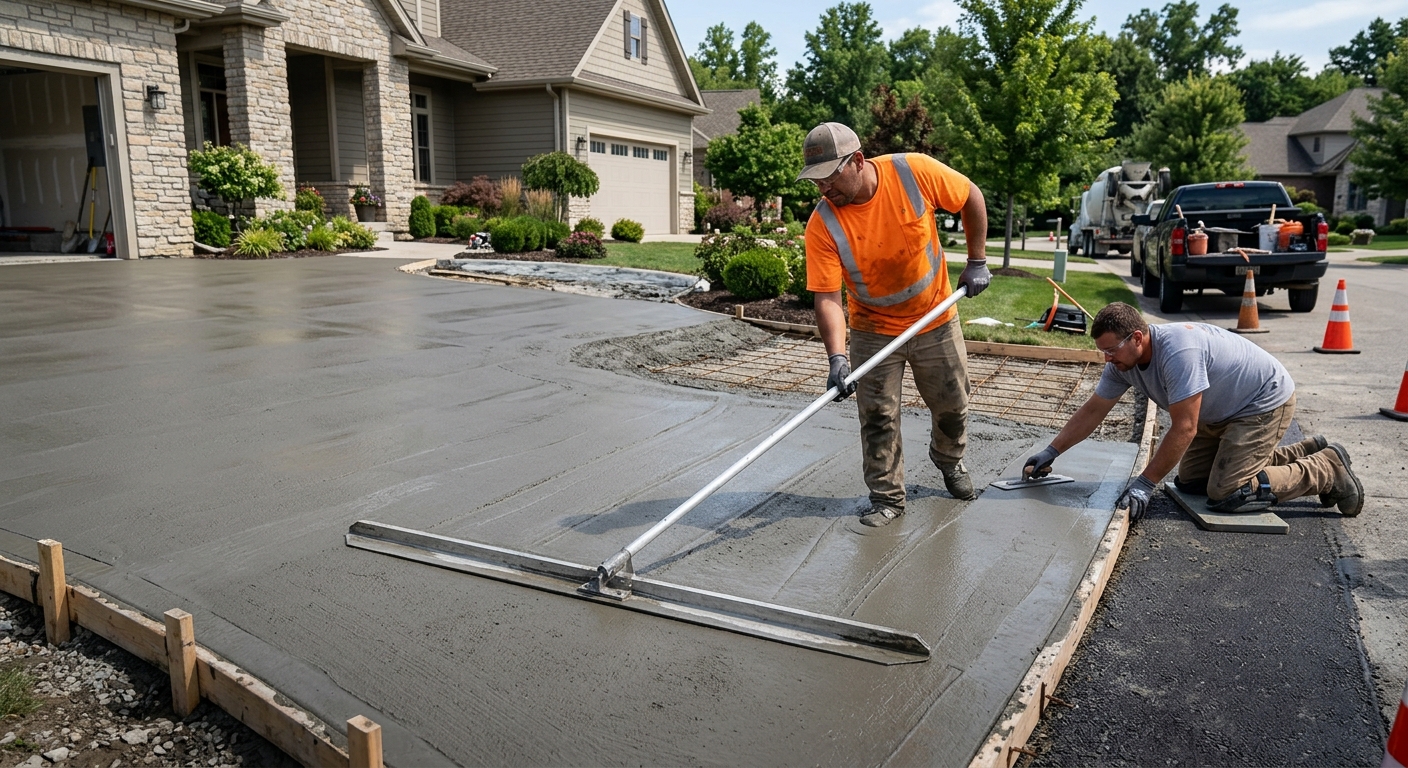
Concrete work options and costs in Red Carpet
In Red Carpet, Alberta, homeowners typically start with three concrete needs: a durable driveway, a clean patio or walkway, and—if you’re building or upgrading—new foundation footings. With a small local population of 1,745 (Statistics Canada, 2021 Census), the best crews do get booked, especially around the spring thaw and early summer when excavation and grading are most practical. That matters because in the Calgary region, exterior concrete is engineered for a cold continental climate with freeze–thaw cycles, so the “same size” job can cost more if frost protection, air-entrainment, and curing controls have to be handled on the schedule.
Concrete flatwork is also a big part of the market because the area’s housing stock is largely made up of single-detached homes—the type of property that most often needs driveways, garage floors, and backyard walkways. In and around Red Carpet, work demand is especially steady for driveways and back patios where access from the street and snow-storage patterns require thicker slabs and more careful jointing to limit random cracking.
Prices in this region generally track the reality that Alberta frost depth and base prep can drive foundation and slab volumes higher than in milder climates. For exterior slabs, freeze–thaw performance depends on granular base prep, air-entrained mixes, and control joints spaced to keep cracks from going wild. All of that gets priced into contractor labour, truck access planning, and whether cold-weather curing measures are needed.
Below is a practical comparison of common options so you can line up the scope with a realistic budget before you request quotes.
| Application |
Typical Size |
Key Spec |
Finish Option |
Price Range |
| Concrete driveway (standard broom finish) |
20 ft x 10 ft (200 sq ft) |
Air-entrained exterior mix, rebar or mesh, control joints |
Broom finish |
$12,000–$18,000 |
| Exposed aggregate driveway |
20 ft x 10 ft (200 sq ft) |
Air-entrained mix, proper cure before wash/expose |
Exposed aggregate |
$15,000–$22,000 |
| Stamped concrete driveway or patio |
20 ft x 10 ft (200 sq ft) |
Air-entrained mix, base prep, integral colour, release agent |
Stamped pattern |
$15,000–$26,000 |
| Plain concrete patio or walkway |
10 ft x 12 ft (120 sq ft) |
Air-entrained mix, welded wire mesh where required |
Saw-cut control joints, light broom or trowel finish |
$5,000–$9,000 |
| Garage floor (interior slab) |
22 ft x 20 ft (440 sq ft) |
Vapour barrier, compacted base, perimeter insulation (as needed) |
Trowel finish or broom finish with densifier |
$10,500–$16,500 |
| Foundation footings (structural, below frost) |
Typical detached house: 800–1,200 sq ft of footing area |
Engineered design, concrete pours below design frost depth |
Structural concrete (no decorative finish) |
$28,000–$45,000 |
Prices are estimates only and vary by project scope, site access and material selection.
What affects the price of concrete work in Red Carpet
In Calgary and across the surrounding region, you can absolutely see the same basic project come in 30–50% apart depending on how the contractor handles engineering, climate controls, and job-site constraints. The sticker shock is usually less about “concrete itself” and more about what’s underneath and around it: excavation depth, granular base thickness, reinforcement, and whether the crew can protect the pour and curing process during cold snaps.
Two big drivers are the frost line depth and freeze–thaw cycles. In Alberta, footings and structural supports must extend below the design frost depth (up to about 2.4 m in Alberta) to reduce frost heave and seasonal movement. That means more digging and more concrete volume for foundations and any below-grade elements. For exterior slabs—driveways, patios and walkway runs—every placement depends on an air-entrained mix engineered to survive repeated freeze–thaw. When the pour season is shorter, or you’re close to late fall or early spring, contractors may need cold-weather curing precautions like insulated blankets and temporary heat, which adds labour and equipment cost.
De-icing salt also affects long-term surface condition. Sealing (typically after full cure) is often the difference between a slab that looks good for years and one that starts scaling sooner. In practical terms for Red Carpet: a simple broom-finished driveway can land in the $12,000–$18,000 band, while upgrades like exposed aggregate or stamped patterns often push into the $15,000–$26,000 range because of added material, labour time, and stricter curing/finishing windows. Likewise, if your soil is looser or you need thicker base prep to get proper compaction, expect costs to trend upward even before you choose a finish.
Local housing age can be another factor. Older properties may have settled walkways or driveways that require extra demo, haul-away, and regrading—so the “foundation” of the project becomes more complicated than new-slab builds.
| Price Factor |
Why It Matters |
Cost Impact |
| Frost line depth — determines footing depth and form height |
Footings must bear below design frost depth to prevent heave and movement |
Higher excavation and concrete volume; typically increases foundation/footings budgets |
| Site preparation — excavation, grading, compacted granular base |
Compaction and base thickness control settlement and cracking pathways |
Can add significant labour, equipment time, and disposal/haul costs |
| Reinforcement — rebar or wire mesh requirement |
Reduces cracking and improves performance under loads and thermal stress |
Material and placement labour; may increase cost especially for driveways and garage slabs |
| Mix design — air-entrainment and compressive strength spec |
Air entrainment improves freeze–thaw durability; strength affects long-term integrity |
Higher-spec mixes can raise material cost and require tighter placement |
| Finish type — broom vs. stamped vs. exposed aggregate |
Decorative finishes add steps and depend on controlled timing and surface quality |
Stamped/exposed generally costs more than broom-finished flatwork |
| Pour size and concrete truck access to site |
Access affects pumping needs, labour for forming, and overall pour logistics |
Pumping/extended wheelbarrowing can raise labour and equipment charges |
| Cold-weather curing precautions — heating and blankets |
Cold slows strength gain and increases scaling risk without protection |
Added labour, heaters, blankets, and longer scheduling windows |
| Control joint pattern and sealing cost |
Joints control cracking; sealing helps repel de-icing salts and moisture |
Sealing and extra layout labour add cost but often reduce early deterioration |
Permits & regulations in Alberta
In Alberta, structural concrete work—think footings, foundation walls, and grade beams—generally requires a building permit, and engineered drawings are often reviewed as part of that process. Municipal requirements can vary by site specifics, but the typical expectation is that engineered structural components are permitted and inspected as the work progresses. For concrete flatwork like driveways, patios, walkways, and garage floors, a permit is usually not required when it’s simply replacing an existing slab or adding slab-on-grade that doesn’t alter approved grading or create issues with drainage, lot grading compliance, or impervious surface rules.
Before you break ground in Red Carpet, confirm the scope with the local authority—especially if your project changes site drainage, ties into a foundation, or includes retaining work. Also verify your contractor carries liability insurance and WSIB/WCB coverage. For documentation, ask for certificates in writing before work starts.
How to verify contractor coverage in Alberta (step-by-step):
- Ask for a current certificate of insurance (liability) showing the project’s address/job name.
- Ask for proof of WSIB/WCB coverage (or their exemption if applicable) and confirm it covers your type of work site.
- Check the contractor’s standing via the relevant Alberta online registry for corporate/contact details and any available licensing/registration information.
- Request clearance or proof documents that are recent (not expired).
- Get 2–3 references on similar concrete scopes and compare timelines and finish outcomes.
Getting concrete right in Red Carpet's freeze-thaw climate
Concrete failure in Red Carpet usually comes down to one of four issues: inadequate base, weak or wrong air content, poor jointing, or rushed curing. In a cold continental climate with frequent freeze–thaw cycles, water that gets into the slab and mortar layers expands during freezing. If the concrete mix isn’t properly air-entrained and the base isn’t built to stay stable, you’ll commonly see surface scaling and eventual spalling—especially on driveways and walkways that face sand and de-icing salts.
To spec the job correctly in Red Carpet:
- Base preparation: require a compacted granular sub-base to the right depth for local conditions and frost considerations so the slab doesn’t settle and crack.
- Mix design: insist on air-entrainment for exterior flatwork—target 5–7% air—and a minimum compressive strength of 32 MPa for typical residential specs.
- Control joints: spacing should be planned to limit random cracking into shrinkage and thermal zones.
- Curing: plan for at least 7 days of appropriate curing conditions; if it’s cold, heating/blankets may be necessary to reach strength properly.
- Sealing: use a penetrating sealer after full cure—commonly around 28 days—to help repel de-icing salt and reduce moisture movement.
Here’s where dollars should match decisions: choosing stamped concrete might add roughly $3,000–$8,000 over a broom-finished driveway of similar size because decorative work requires more labour, colour materials, and tighter surface timing. If the contractor skips proper base prep or air content to “fund the look,” the added cost won’t protect you long-term.
| Spec |
Why It Matters in Red Carpet |
What to Ask For |
Impact if Skipped |
| Compacted granular base (depth?) |
Reduces settlement and helps prevent moisture-related cracking under freeze–thaw |
Base depth based on your site soils + compacted to spec with proof of compaction |
Settlement cracks, uneven slab, faster water intrusion |
| Air-entrained concrete mix (target air %?) |
Helps concrete resist freezing and thawing while exposed to salt and water |
Target 5–7% air for exterior flatwork; confirm mix design with delivery ticket |
Scaling and spalling risk increases significantly in Calgary-area winters |
| Compressive strength (MPa rating) |
Ensures durability and proper strength gain before traffic and seasonal stresses |
Minimum 32 MPa (or engineered higher if specified) |
Reduced long-term performance and potential surface deterioration |
| Control joints (spacing per ACI guidelines) |
Creates planned crack locations so freezing/thermal movement doesn’t cause random cracking |
Joint layout plan and saw-cut timing; confirm spacing approach |
Random cracking that can widen and let moisture reach the slab edges |
| Minimum 7-day curing period |
Cold conditions slow strength gain; proper curing lowers scaling risk |
Minimum 7 days with cold-weather protection if needed |
Surface weakness, scaling, and reduced durability |
| Penetrating sealer (when applied after cure) |
Repels moisture and helps protect against de-icing salt and freeze–thaw cycling damage |
Penetrating sealer applied after full cure—commonly at 28 days |
More moisture ingress and earlier surface wear/spalling |
How to choose a concrete work contractor in Red Carpet
Choosing the right concrete contractor in Red Carpet is mostly about verifying three things: competence with frost/flatwork details, proper insurance coverage, and transparent pricing. Start by requesting proof of liability insurance and WSIB/WCB coverage before work begins. In Alberta, you should confirm the certificate is current and includes coverage for the type of work being performed; don’t accept “we’re covered” without documentation. If you’re using an incorporated company, verify the business name on the insurance certificate matches the contractor you’re hiring.
Next, get 2–3 itemised written quotes rather than a single lump-sum number. A good quote breaks out labour and materials (demo, excavation, granular base, reinforcement, concrete supply, finishing, curing protection like blankets/heaters if applicable, and sealing). It should clearly list what’s excluded: disposal/haul-away, permits (if required), saw-cutting existing edges, wire mesh vs rebar, and whether they include any pumping or cutting to fit truck access.
Pay attention to warranty terms. A workmanship warranty should specify length and what it covers. Also ask whether the manufacturer/product warranty for concrete materials (where applicable) transfers to you. For payments, use a schedule that keeps your exposure low—typically no more than 10–15% upfront, then holdback until substantial completion.
Finally, insist on a written timeline with a start date and estimated completion window. In Calgary’s seasonal climate, scheduling affects curing and finish quality as much as it affects convenience.
- Ask for proof of liability insurance and confirm project/address is covered.
- Ask for WSIB/WCB clearance/proof for the workers assigned to your job.
- Confirm the crew has done similar cold-climate exterior flatwork (driveways/patios) locally.
- Get itemised labour + materials (not just “concrete and finish”).
- Verify what’s included: demo, excavation depth, base material, reinforcement, disposal.
- Check whether truck access is planned (and whether pumping/wheelbarrowing is included).
- Make sure the quote mentions air-entrained exterior mix for freeze–thaw durability.
- Request details on cold-weather protection if the pour might be near shoulder season.
- Clarify control joint layout and saw-cut timing.
- Ask whether they include curing protection and what curing duration is expected.
- Confirm sealing inclusion and timing (commonly around 28 days) or plan for it later.
- Use a payment schedule: limit upfront to 10–15% and hold back for completion.
Concrete red flags I see in the Red Carpet area: (1) quotes that don’t mention air-entrainment for exterior slabs, (2) vague base depth/compaction details, (3) “we’ll pour no matter the temperature” without curing protection, (4) no discussion of control joints or sealing, and (5) refusals to provide insurance/WSIB/WCB proof or itemised scope.
Frequently asked questions — concrete work in Red Carpet
How long does a concrete project take in Red Carpet?
For typical residential work in Red Carpet, the visible “pour day” is often just one part of the timeline. Prep, excavation, forms, reinforcement, and haul/disposal can take several days depending on access and how much demo is involved. After the pour, concrete still needs curing time: most workmanship issues are tied to how well curing is protected, not just how fast it “sets.” For exterior flatwork, plan for at least 7 days of proper curing before normal use, and be mindful of Alberta temperature swings. Decorative and sealed surfaces can require additional coordination—sealers are commonly applied around 28 days after the pour. If you’re near shoulder season, crews may add insulated blankets/heating, which extends scheduling but protects long-term durability in Calgary-area freeze–thaw cycles.
What is a concrete overlay and is it suited to Red Carpet?
A concrete overlay is a new layer of concrete placed over an existing slab after surface prep (usually grinding/scarification, repairs, and sometimes bonding systems). It can be a cost-effective way to refresh a damaged driveway when the original slab is still structurally sound and not heavily heaved or extensively cracked. In Red Carpet and the Calgary region, the suitability depends on why the original concrete failed in the first place: if freeze–thaw caused widespread scaling/spalling and the slab has ongoing movement, an overlay may just replicate the problem in a thinner layer. Overlays also require careful drainage control and joint detailing to avoid trapped moisture. If you want a budget benchmark, a new broom-finished driveway often falls around $12,000–$18,000, while overlays can vary widely—so the best approach is to have a contractor assess settlement and moisture pathways before committing.
How do I seal concrete to protect it in Red Carpet?
Sealing helps protect concrete in Alberta by reducing moisture and de-icing salt penetration—both of which contribute to freeze–thaw damage over time. For Red Carpet projects, I recommend using a penetrating sealer (not a surface film) and applying it after the concrete has fully cured. A common timing is around 28 days post-pour, assuming weather and curing conditions have been suitable. Before sealing, the surface should be clean and dry, with any required curing residues removed. Ask your contractor what sealer type they use, how many coats are required, and whether the product is compatible with your concrete finish (broom, stamped, or exposed aggregate). Also note that sealing doesn’t “stop” cracking—control joints still matter—so your best protection is a properly specified mix with air-entrainment plus correct jointing.
What is the difference between concrete and cement?
In everyday conversation, “cement” and “concrete” get used like they’re the same thing, but they’re not. Cement is one ingredient—typically Portland cement—that acts as the binder. Concrete is the full engineered material: cement plus water, aggregates (sand and gravel), and often additives such as air-entrainment for freeze–thaw durability. In Red Carpet and the wider Calgary market, that air-entrainment and correct mix design are what protect the slab through Alberta winters. When you request quotes, don’t just ask for “concrete”—ask for the mix spec, target air content for exterior flatwork, and compressive strength rating. That’s what ensures durability beyond how it looks on day one.
How much does concrete work cost in Red Carpet?
Concrete costs in Red Carpet generally align with the Calgary-area price bands driven by frost depth, base prep, reinforcement, and finish complexity. As a rough benchmark for homeowners: a typical concrete driveway (standard broom finish) is often around $12,000–$18,000, while a plain patio or walkway commonly lands around $5,000–$9,000 depending on size and site access. Decorative work typically costs more—stamped concrete driveway or patio work commonly sits in the $15,000–$26,000 range. Foundation/footings (structural, below frost) are usually much higher, often around $28,000–$45,000 depending on engineered design and excavation conditions. If you’re comparing quotes, look for differences in base depth, reinforcement, air-entrained mix, and whether cold-weather curing precautions are included.
How deep must footings be for Red Carpet's frost line?
Footing depth is based on the project’s design frost depth and engineered foundation requirements for Alberta, not a one-size number. In the Calgary region, the design frost depth is roughly about 1.2 m (around 4 ft) for typical design considerations, but actual requirements can be deeper depending on local soil conditions and the specific engineering for the structure. The key homeowner takeaway is that footings must bear on undisturbed soil below the design frost depth to reduce frost heave and seasonal movement. In Alberta, because the frost penetration is deeper than in warmer areas, foundation excavations are more intensive and footing volumes are higher—one reason foundation pricing typically trends above milder climates. Always follow the engineered drawings for your house layout and soil conditions, and don’t accept “shallow footing” recommendations without the proper engineering.