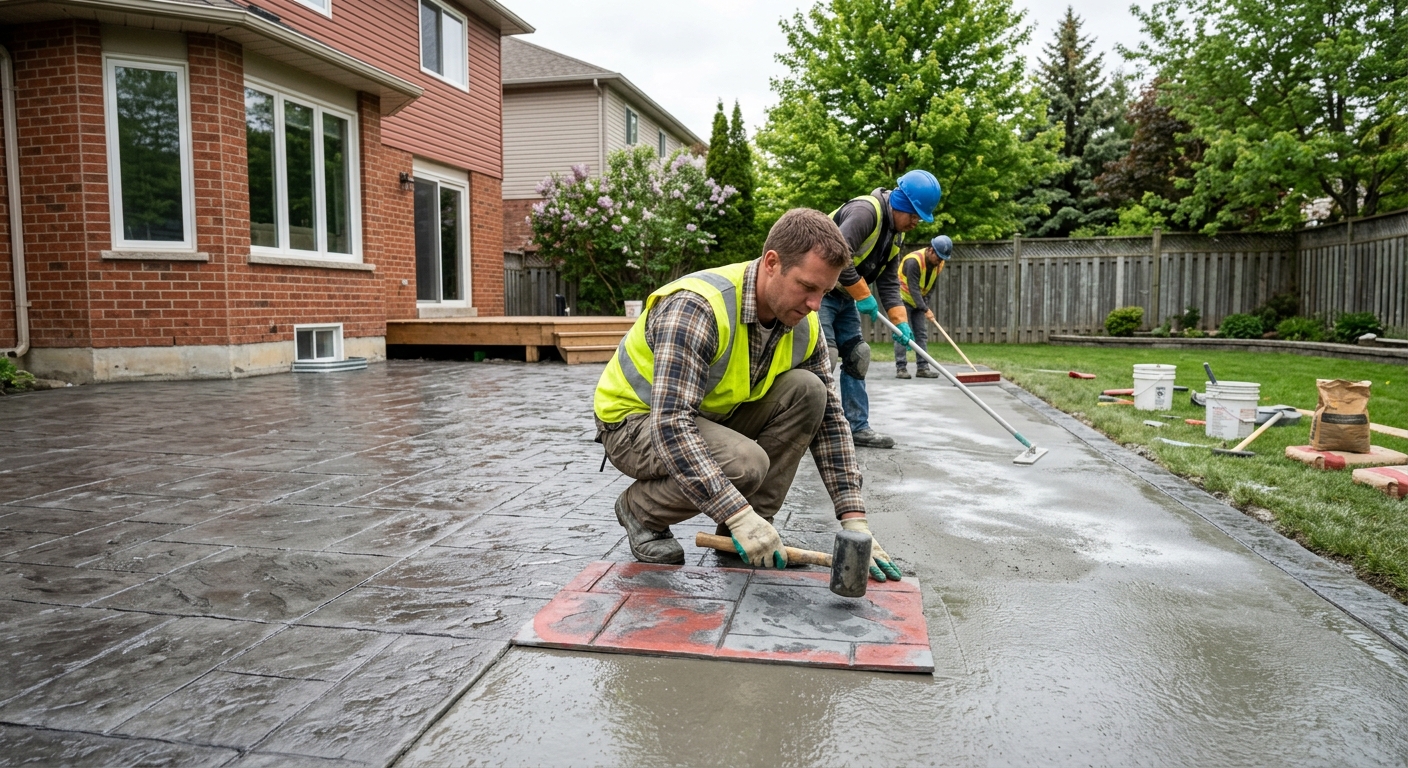
Concrete work options and costs in Ozerna
Ozerna, Alberta is a small community, and in a place like this the concrete crews tend to be busy when neighbours start building and landscaping. With a population of 4,495 (Statistics Canada, 2021 Census), most concrete flatwork demand comes from owner-occupied, single-family homes and the upgrades that follow—new driveways, patio replacements, and foundation/garage-related work. In practical terms, Calgary’s concrete market is the backbone for pricing because suppliers and crews pull from the wider Calgary area.
What you pay is heavily shaped by the cold continental climate and the local frost depth assumptions used in engineering. In this region, design frost depth is about 1.2 m (roughly 4 ft), so footings for houses, garages and retaining structures must bear on undisturbed soil below that depth. That means deeper excavation and larger footing volumes. At the same time, frequent freeze–thaw cycles require air-entrained concrete, careful base prep, and well-planned control joints for exterior slabs like driveways and walkways.
Because the pour season for exterior work is shorter and winter placement demands cold-weather curing measures (insulation blankets and/or temporary heat), late-fall or early-spring pours can cost more than mid-summer pours. Contractor availability also tightens during peak months, and that can influence labour rates and scheduling. In Ozerna, flatwork demand is especially common around new builds and intensification pockets tied to the broader Calgary growth—projects in and around newer residential developments typically see the fastest turnaround for driveway and patio work.
Below are common options homeowners request in Ozerna, with realistic cost bands to help you compare quotes before you choose finishes and specs.
| Application |
Typical Size |
Key Spec |
Finish Option |
Price Range |
| Concrete driveway (standard broom finish) |
20 ft x 9 ft (180 sq. ft.) |
Air-entrained exterior mix, compacted granular base |
Broom finish + joints + seal-ready surface |
$12,000–$16,000 |
| Exposed aggregate driveway |
20 ft x 9 ft (180 sq. ft.) |
Air-entrained exterior mix + controlled wash |
Exposed aggregate (wash finish) + joints |
$14,000–$18,000 |
| Stamped concrete driveway or patio |
20 ft x 10 ft (200 sq. ft.) |
Air-entrained exterior mix + release + reinforcement |
Stamped pattern with sealer |
$15,000–$26,000 |
| Plain concrete patio or walkway |
12 ft x 12 ft (144 sq. ft.) |
Air-entrained exterior mix + compacted base |
Steel trowel or broom finish |
$5,000–$9,000 |
| Garage floor (interior slab) |
24 ft x 22 ft (528 sq. ft.) |
Vapour barrier, reinforcement, proper curing |
Steel trowel finish |
$10,000–$17,000 |
| Foundation footings (structural, below frost) |
Typical single-family perimeter (varies) |
Excavate to design frost depth, engineered rebar |
Structural concrete (reinforced) |
$28,000–$45,000 |
Prices are estimates only and vary by project scope, site access and material selection.
What affects the price of concrete work in Ozerna
In Ozerna and across the Calgary economic region, two quotes for the “same” concrete job can differ by 30–50% because the cost drivers aren’t just the concrete itself—they’re excavation, soil conditions, reinforcement, mix design, finishing complexity, and the cold-weather process. A driveway slab may look straightforward, but if the base needs deeper removal, if steel has to be added for support, or if the pour is scheduled during colder weeks requiring blankets and controlled curing, the labour and materials change quickly.
Frost depth and freeze–thaw cycles dictate nearly every spec in Calgary: footings must extend below the design frost depth (about 1.2 m) to prevent frost heave and seasonal movement. Exterior slabs also need air-entrained concrete mixes to survive repeated freezing and thawing without scaling and spalling. In practice, colder placement means a tighter curing window; contractors may need insulated blankets, heated enclosures, or winter-grade admixtures to keep concrete from freezing too early.
De-icing salt is another Calgary-region reality. Salt increases surface deterioration, so sealing becomes more than an optional “nice to have.” That’s why a standard broom driveway might land in the $12,000–$18,000 band, while stamped or decorative work can climb into the $15,000–$26,000 range—partly due to labour and partly because these finishes demand consistent timing and curing to look right and last.
In Ozerna, the age of the housing stock also plays a role. Older properties often have earlier drainage patterns and settled approaches; that can mean additional grading, thicker base correction, or thicker edges. As an example, a small patio may stay near the $5,000–$9,000 band, but if the contractor must rebuild the granular base due to poor subgrade, that same patio can shift upward because excavation and re-compaction are where a lot of the budget goes.
| Price Factor |
Why It Matters |
Cost Impact |
| Frost line depth — determines footing depth and form height |
Footings must extend below design frost to avoid heave and cracking |
- Higher excavation and concrete volume
- More rebar and forming time
|
| Site preparation — excavation, grading, compacted granular base |
Proper base prevents settlement and edge failure under freeze–thaw |
- Extra trucking and labour if unsuitable soils are removed
- Cost shifts even for “small” slabs
|
| Reinforcement — rebar or wire mesh requirement |
Reduces cracking and improves load capacity, especially for driveways |
- Material + tying/labour time
- May be required when thickness changes
|
| Mix design — air-entrainment and compressive strength spec |
Air-entrainment helps exterior durability during freeze–thaw cycles |
- Winter-grade logistics can add cost
- Premium for engineered strength requirements
|
| Finish type — broom vs. stamped vs. exposed aggregate |
Complexity changes labour time and finishing materials |
- Stamped/exposed typically higher by design and labour
- Sealer and pattern work increase overhead
|
| Pour size and concrete truck access to site |
Truck placement affects pumping needs and production speed |
- Long carry/pump charges if access is tight
- More labour to manage placement
|
| Cold-weather curing precautions — heating and blankets |
Concrete must not freeze early; curing window is critical |
- Heating/blankets, monitoring and scheduling
- Often higher cost in shoulder seasons
|
| Control joint pattern and sealing cost |
Joints manage shrinkage; sealing helps salt resistance |
- Saw cutting + sealant materials/labour
- Impact varies by finish type and exposure
|
Permits & regulations in Alberta
In Alberta, structural concrete work such as foundation footings, foundation walls, and grade beams typically requires a building permit, and many projects also use engineered drawings that the municipality reviews before work proceeds. For concrete flatwork—driveways, patios, and walkways—a permit is usually not required unless the work changes lot grading, affects stormwater/drainage, or triggers issues with impervious surface limits or municipal right-of-way concerns. Even when a permit isn’t expected, you should still confirm with the local authority before breaking ground in Ozerna.
Before you hire, make sure the contractor can demonstrate compliance and coverage. Start by asking for: (1) a certificate of insurance (liability) naming you as an additional insured where appropriate, and (2) proof of worker coverage under the applicable Alberta system (commonly referenced as WSIB/WCB coverage depending on the situation). Also request their workmanship warranty details for concrete finishing and joints.
Step-by-step for a homeowner in Ozerna: first, verify the contractor’s company licence and status using Alberta’s online business/contractor lookup resources; second, request a current insurance certificate and confirm it matches the legal business name and includes the correct policy dates; third, ask for a clearance/coverage confirmation letter or policy evidence that shows worker coverage applies to the crew that will be on your site; fourth, call references for similar-scale work in the Calgary area—driveway and footing projects are very different in execution.
Getting concrete right in Ozerna's freeze-thaw climate
Concrete failures in Ozerna are most often tied to freeze–thaw exposure and details around durability. The big one is spalling—surface scaling and flaking—usually caused by inadequate air-entrainment, weak curing, or poor base prep that allows water to sit under the slab. In a cold continental climate with frequent temperature swings, water expands as it freezes; if the concrete paste isn’t engineered to handle it, the surface is what gives first. To spec the job correctly, you need five core pieces working together.
First, base preparation: build a compacted granular sub-base to the right depth for the local soil and frost strategy, and keep drainage in mind. Second, mix design: for exterior flatwork, target 5–7% air content and specify a minimum 32 MPa compressive strength, especially when de-icing salt is expected. Third, control joints: they’re what manage shrinkage cracking so the slab doesn’t crack randomly. Fourth, curing: plan for at least 7 days under proper conditions; cold weather requires blankets and/or heat to protect early-age strength gain. Fifth, sealing: apply a penetrating sealer after the concrete has cured (often about 28 days) to repel de-icing salts and reduce water ingress.
When comparing options, ask whether the contractor is actually addressing durability details. As a dollar example, a plain broom-finish driveway might land in the $12,000–$18,000 band, while a stamped driveway can go into the $15,000–$26,000 range. That difference is justified when the quote includes reinforcement appropriate for the slab thickness, correct jointing, and proper cold-weather protection—stamping alone isn’t enough to make it last.
| Spec |
Why It Matters in Ozerna |
What to Ask For |
Impact if Skipped |
| Compacted granular base (depth?) |
Prevents settlement and reduces water pumping under the slab during freeze–thaw |
Base depth and compaction method documented; grading to shed water |
Uneven cracking, pumping at joints/edges, early spalling risk |
| Air-entrained concrete mix (target air %?) |
Air pockets provide relief for freezing expansion in exterior exposure |
Target air content 5–7% for exterior flatwork and verified mix ticket |
Scaling/spalling, freeze–thaw deterioration within a few seasons |
| Compressive strength (MPa rating) |
Strength gain supports durability and load capacity |
Minimum 32 MPa specified for exterior slabs; curing plan noted |
Surface wear, deeper cracking, reduced service life |
| Control joints (spacing per ACI guidelines) |
Controls where shrinkage cracks will form |
Joint spacing and saw-cut timing included in the quote |
Random cracking, compromised load transfer at edges |
| Minimum 7-day curing period |
Concrete needs time to develop early-age strength before traffic and freeze |
Protect from freezing; note blankets/heating if temperatures are borderline |
Weak surfaces, scaling, poor finish adhesion |
| Penetrating sealer (when applied after cure) |
Repels water and helps slow salt-related surface damage |
Sealer applied after full cure window (commonly ~28 days) and surface prep method |
Faster water/salt penetration, increased spalling and staining |
How to choose a concrete work contractor in Ozerna
Choosing the right concrete contractor in Ozerna is mostly about verification and clear scope, not just the lowest number. In Alberta, you should verify that the contractor is properly authorized to perform the work, carries liability insurance, and has worker coverage evidence (commonly referenced as WSIB/WCB coverage). To check insurance, ask for a current certificate of insurance and confirm policy dates, coverage limits, and the correct legal business name. If you see certificates that are expired, don’t match the company, or can’t provide coverage evidence for the crew, treat that as a red flag.
Next, get 2–3 itemised written quotes. A good quote breaks costs into labour and materials (for example: excavation/base, rebar/mesh, concrete supply, finishing, saw-cut joints, and sealing). Make sure it states whether a permit pull is included where required (typically for foundation/structural work), whether excavation and disposal are included, and how concrete truck access will be handled. Ask who provides the mix design details and whether air-entrainment and curing protection are included.
Warranty should be written and specific—workmanship warranty length, whether product/manufacturer warranty applies, and whether it transfers if you sell the home. For payment, never let the schedule front-load too much; aim to pay no more than 10–15% upfront and use a holdback until punch-list items are complete. Finally, request a written timeline with a start date and completion estimate, and confirm they can meet curing protection requirements in the actual weather window.
- Ask for proof of current liability insurance and confirm coverage is active during your project dates.
- Request evidence of worker coverage (WSIB/WCB) for the crew doing the pour.
- Verify the contractor’s authorization/status through Alberta’s online tools using the exact legal business name.
- Get quotes that itemize excavation, granular base, reinforcement, concrete supply, finishing, joints and sealing.
- Confirm concrete spec: exterior air-entrainment and minimum strength (commonly 32 MPa) for flatwork.
- Ask how they handle frost timing and cold-weather curing (blankets/heating/monitoring).
- Require joint pattern details (where joints are cut and when saw cutting happens).
- Clarify slab thickness and reinforcement placement (not just “mesh included”).
- Ask whether sealing is included, and when it will be applied after cure.
- Confirm site drainage plan—especially tie-ins at garage doors, downspouts and slopes.
- Use a written start date, completion estimate, and weather contingency plan.
- Keep payment terms conservative: max 10–15% upfront; holdback until the finish passes punch-list.
Concrete red flags in Ozerna include: quotes that don’t specify air-entrainment for exterior slabs, missing joint/saw-cut details, refusal to discuss cold-weather curing protections, vague slab thickness or reinforcement notes, and payment schedules asking for large deposits before excavation and base prep are finished.
Frequently asked questions — concrete work in Ozerna
How deep must footings be for Ozerna's frost line?
For Ozerna (Calgary region), footings are typically designed to bear below the local design frost depth, which is about 1.2 m (roughly 4 ft). The exact footing elevation still depends on your site’s geotechnical info, soil conditions, and the foundation type, so engineering controls the final numbers. In cold continental climates, putting footings on soil that can freeze above the bearing level can lead to frost heave and long-term settlement-related cracking. When you compare quotes in Alberta, confirm the contractor understands “below frost” excavation, forms, and concrete volume—foundation work costs rise quickly when deeper excavation is required due to frost depth.
Why does concrete crack in Ozerna and how is it prevented?
Concrete cracks are common in Ozerna because slabs shrink as they cure, then experience seasonal expansion and contraction from freeze–thaw cycles. Cracking isn’t automatically a failure—what matters is whether it’s controlled. Prevention starts with a properly compacted granular base so the slab doesn’t settle, and with the right reinforcement and joint pattern. Control joints (saw-cut or formed) are spaced to manage where shrinkage cracks happen, which is especially important for driveways and walkways exposed to de-icing salts. Durability also hinges on air-entrainment and curing: if the concrete can’t handle freezing expansion, you’ll see surface scaling and spalling even if it “holds together.”
Stamped vs broom-finish concrete — cost difference?
Stamped concrete costs more than broom-finish because it requires extra materials (release agent, stamping mats, sometimes additional finishing steps) and more labour time to place and texture the surface consistently. For many Ozerna homeowners, a standard broom-finish driveway often lands in the $12,000–$18,000 range, while a stamped driveway or patio commonly falls in the $15,000–$26,000 range. The difference can be justified when the contractor also includes the same durability specs—air-entrained mix, correct jointing, proper curing protection, and an appropriate sealer timeline. If the quote for stamped concrete is cheaper but skips these details, it’s usually the long-term durability that will pay the price in a freeze–thaw Alberta climate.
When is the best time to pour concrete in Ozerna?
In Alberta’s Calgary region, the best time is typically late spring through summer, when temperatures support normal curing. In Ozerna, the cold weather reality is that the pour season for exterior slabs is shorter, and shoulder-season cold can force contractors to add heating, insulating blankets, and extra monitoring to prevent early freezing. That’s why the same scope can land differently in price and schedule—winter-grade placement procedures take time and materials. If you’re planning exterior work, aim for a schedule that allows at least the first week of curing in stable conditions. If you must pour near cold snaps, ask the contractor specifically how they protect curing and how they’ll meet the minimum curing period before traffic and freeze conditions.
How long does concrete take to cure?
Concrete curing depends on temperature and mix design, but homeowners should plan around two timeframes. First, early-age curing: structural care and finishing follow manufacturer and jobsite requirements, and for outdoor slabs a minimum of 7 days under proper curing conditions is commonly expected before you treat the slab as more resilient. Second, sealing and durability protection: a penetrating sealer is typically applied after full cure is reached—often around 28 days—so the surface can accept the product and properly repel water and de-icing salts. In Ozerna’s freeze–thaw climate, rushing early curing (or allowing the slab to freeze too early) can lead to surface scaling and reduced service life.
Do I need a permit for concrete work in Alberta?
In Alberta, structural concrete work such as foundation footings, foundation walls, and grade beams generally requires a building permit, often supported by engineered drawings reviewed by the municipality. Concrete flatwork like driveways, patios, and walkways usually does not require a permit, unless it affects lot grading, drainage, impervious surface rules, or ties into municipal right-of-way considerations. For an Ozerna homeowner, the safest approach is to confirm with the local authority before excavation—especially if your plan changes surface water flow. Also verify your contractor carries liability insurance and has proper worker coverage evidence; permit expectations can differ based on whether the job is structural versus purely flatwork.